Identification
- Generic Name
- Methyprylon
- DrugBank Accession Number
- DB01107
- Background
Methyprylon is a sedative of the piperidinedione derivative family that was previously used for the treatment of insomnia. However, with the introduction of newer drugs with fewer side effects, such as benzodiazepines, the clinical use of methyprylon is now limited. Methyprylon was withdrawn from the U.S. market in June 1965 and the Canadian market in September 1990 due to adverse events.
- Type
- Small Molecule
- Groups
- Approved, Illicit, Withdrawn
- Structure
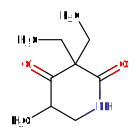
Structure for Methyprylon (DB01107)

- Weight
- Average: 183.2475
Monoisotopic: 183.125928793 - Chemical Formula
- C10H17NO2
- Synonyms
- Methyprylon
- Methyprylone
- Methyprylonum
- Metiprilon
- Metiprilona
- Metiprilone
- External IDs
- Dea No. 2575
- Ro 1-6463

Pharmacology
- Indication
For the treatment of insomnia.
 Reduce drug development failure ratesBuild, train, & validate machine-learning modelswith evidence-based and structured datasets.Build, train, & validate predictive machine-learning models with structured datasets.
- Contraindications & Blackbox Warnings
 Prevent Adverse Drug Events TodayTap into our Clinical API for life-saving information on contraindications & blackbox warnings, population restrictions, harmful risks, & more.Avoid life-threatening adverse drug events with our Clinical API
- Pharmacodynamics
Methyprylon, a piperidinedione CNS depressant, is close to barbituric acid in structure, but different enough to be called a "non-barbiturate" sedative-hynotic. Methyprylon is used for insomnia and daytime tension. Methyprylon depresses the activity of muscle tissues, the heart, and the respiratory system.
- Mechanism of action
Methyprylon binds at a distinct binding site associated with a Cl- ionopore at the GABAA receptor, increasing the duration of time for which the Cl- ionopore is open. The post-synaptic inhibitory effect of GABA in the thalamus is, therefore, prolonged.
Target Actions Organism AGABA(A) Receptor positive allosteric modulatorHumans AGamma-aminobutyric acid receptor subunit alpha-1 agonistHumans - Absorption
Not Available
- Volume of distribution
Not Available
- Protein binding
60%
- Metabolism
Hepatic. Methyprylon is almost completely metabolized.
- Route of elimination
Not Available
- Half-life
6-16 hours
- Clearance
Not Available
- Adverse Effects
 Improve decision support & research outcomesWith structured adverse effects data, including: blackbox warnings, adverse reactions, warning & precautions, & incidence rates. View sample adverse effects data in our new Data Library!Improve decision support & research outcomes with our structured adverse effects data.
- Toxicity
Symptoms of overdose include excitation and convulsions.
- Pathways
- Not Available
- Pharmacogenomic Effects/ADRs
- Not Available
Interactions
- Drug Interactions
- This information should not be interpreted without the help of a healthcare provider. If you believe you are experiencing an interaction, contact a healthcare provider immediately. The absence of an interaction does not necessarily mean no interactions exist.
Drug Interaction Integrate drug-drug
interactions in your software1,2-Benzodiazepine The risk or severity of CNS depression can be increased when Methyprylon is combined with 1,2-Benzodiazepine. Acetazolamide The risk or severity of CNS depression can be increased when Acetazolamide is combined with Methyprylon. Acetophenazine The risk or severity of CNS depression can be increased when Acetophenazine is combined with Methyprylon. Agomelatine The risk or severity of CNS depression can be increased when Methyprylon is combined with Agomelatine. Alfentanil The risk or severity of CNS depression can be increased when Alfentanil is combined with Methyprylon. - Food Interactions
- Take with or without food. The absorption is unaffected by food.
Products
 Drug product information from 10+ global regionsOur datasets provide approved product information including:dosage, form, labeller, route of administration, and marketing period.Access drug product information from over 10 global regions.
- International/Other Brands
- Dimerin / Noctan / Noludar
Categories
- ATC Codes
- N05CE02 — Methyprylon
- Drug Categories
- Chemical TaxonomyProvided by Classyfire
- Description
- This compound belongs to the class of organic compounds known as piperidinediones. These are compounds containing a piperidine ring which bears two ketones.
- Kingdom
- Organic compounds
- Super Class
- Organoheterocyclic compounds
- Class
- Piperidines
- Sub Class
- Piperidinones
- Direct Parent
- Piperidinediones
- Alternative Parents
- Delta lactams / Secondary carboxylic acid amides / Cyclic ketones / Azacyclic compounds / Organopnictogen compounds / Organonitrogen compounds / Organic oxides / Hydrocarbon derivatives
- Substituents
- Aliphatic heteromonocyclic compound / Azacycle / Carbonyl group / Carboxamide group / Carboxylic acid derivative / Cyclic ketone / Delta-lactam / Hydrocarbon derivative / Ketone / Lactam
- Molecular Framework
- Aliphatic heteromonocyclic compounds
- External Descriptors
- Not Available
- Affected organisms
- Humans and other mammals
Chemical Identifiers
- UNII
- CUT48I42ON
- CAS number
- 125-64-4
- InChI Key
- SIDLZWOQUZRBRU-UHFFFAOYSA-N
- InChI
- InChI=1S/C10H17NO2/c1-4-10(5-2)8(12)7(3)6-11-9(10)13/h7H,4-6H2,1-3H3,(H,11,13)
- IUPAC Name
- 3,3-diethyl-5-methylpiperidine-2,4-dione
- SMILES
- CCC1(CC)C(=O)NCC(C)C1=O
References
- General References
- Contos DA, Dixon KF, Guthrie RM, Gerber N, Mays DC: Nonlinear elimination of methyprylon (noludar) in an overdosed patient: correlation of clinical effects with plasma concentration. J Pharm Sci. 1991 Aug;80(8):768-71. [Article]
- Gwilt PR, Pankaskie MC, Thornburg JE, Zustiak R, Shoenthal DR: Pharmacokinetics of methyprylon following a single oral dose. J Pharm Sci. 1985 Sep;74(9):1001-3. [Article]
- Lomen P, Linet OI: Hypnotic efficacy of triazolam and methyprylon ininsomniac in-patients. J Int Med Res. 1976;4(1):55-8. [Article]
- External Links
- Human Metabolome Database
- HMDB0015239
- KEGG Drug
- D01150
- PubChem Compound
- 4162
- PubChem Substance
- 46506891
- ChemSpider
- 4018
- 6910
- ChEBI
- 31837
- ChEMBL
- CHEMBL1200790
- Therapeutic Targets Database
- DAP000683
- PharmGKB
- PA164746748
- Wikipedia
- Methyprylon
Clinical Trials
Pharmacoeconomics
- Manufacturers
- Not Available
- Packagers
- Not Available
- Dosage Forms
- Not Available
- Prices
- Not Available
- Patents
- Not Available
Properties
- State
- Solid
- Experimental Properties
Property Value Source water solubility 1.15E+004 mg/L Not Available logP 0.78 SANGSTER (1994) - Predicted Properties
Property Value Source Water Solubility 11.3 mg/mL ALOGPS logP 0.94 ALOGPS logP 1.88 Chemaxon logS -1.2 ALOGPS pKa (Strongest Acidic) 14.53 Chemaxon pKa (Strongest Basic) -3.1 Chemaxon Physiological Charge 0 Chemaxon Hydrogen Acceptor Count 2 Chemaxon Hydrogen Donor Count 1 Chemaxon Polar Surface Area 46.17 Å2 Chemaxon Rotatable Bond Count 2 Chemaxon Refractivity 50.25 m3·mol-1 Chemaxon Polarizability 19.95 Å3 Chemaxon Number of Rings 1 Chemaxon Bioavailability 1 Chemaxon Rule of Five Yes Chemaxon Ghose Filter Yes Chemaxon Veber's Rule No Chemaxon MDDR-like Rule No Chemaxon - Predicted ADMET Features
Property Value Probability Human Intestinal Absorption + 1.0 Blood Brain Barrier + 0.9958 Caco-2 permeable + 0.5745 P-glycoprotein substrate Non-substrate 0.6409 P-glycoprotein inhibitor I Inhibitor 0.5252 P-glycoprotein inhibitor II Non-inhibitor 0.8315 Renal organic cation transporter Non-inhibitor 0.8494 CYP450 2C9 substrate Non-substrate 0.8971 CYP450 2D6 substrate Non-substrate 0.8024 CYP450 3A4 substrate Non-substrate 0.5391 CYP450 1A2 substrate Non-inhibitor 0.8306 CYP450 2C9 inhibitor Non-inhibitor 0.8167 CYP450 2D6 inhibitor Non-inhibitor 0.9028 CYP450 2C19 inhibitor Non-inhibitor 0.8604 CYP450 3A4 inhibitor Non-inhibitor 0.8925 CYP450 inhibitory promiscuity Low CYP Inhibitory Promiscuity 0.922 Ames test Non AMES toxic 0.7267 Carcinogenicity Non-carcinogens 0.8355 Biodegradation Not ready biodegradable 0.866 Rat acute toxicity 2.3600 LD50, mol/kg Not applicable hERG inhibition (predictor I) Weak inhibitor 0.9762 hERG inhibition (predictor II) Non-inhibitor 0.9295
Spectra
- Mass Spec (NIST)
- Not Available
- Spectra
- Chromatographic Properties
Collision Cross Sections (CCS)
Adduct CCS Value (Å2) Source type Source [M-H]- 143.0883324 predictedDarkChem Lite v0.1.0 [M-H]- 140.99908 predictedDeepCCS 1.0 (2019) [M+H]+ 143.5626324 predictedDarkChem Lite v0.1.0 [M+H]+ 144.82643 predictedDeepCCS 1.0 (2019) [M+Na]+ 143.1923324 predictedDarkChem Lite v0.1.0 [M+Na]+ 153.7319 predictedDeepCCS 1.0 (2019)
Targets

- Kind
- Protein group
- Organism
- Humans
- Pharmacological action
- Yes
- Actions
- Positive allosteric modulator
- General Function
- Inhibitory extracellular ligand-gated ion channel activity
- Specific Function
- Component of the heteropentameric receptor for GABA, the major inhibitory neurotransmitter in the vertebrate brain. Functions also as histamine receptor and mediates cellular responses to histamine...
Components:
References
- ChEMBL Compound Report Card [Link]
- Kind
- Protein
- Organism
- Humans
- Pharmacological action
- Yes
- Actions
- Agonist
- General Function
- Inhibitory extracellular ligand-gated ion channel activity
- Specific Function
- Component of the heteropentameric receptor for GABA, the major inhibitory neurotransmitter in the vertebrate brain. Functions also as histamine receptor and mediates cellular responses to histamine...
- Gene Name
- GABRA1
- Uniprot ID
- P14867
- Uniprot Name
- Gamma-aminobutyric acid receptor subunit alpha-1
- Molecular Weight
- 51801.395 Da
References
- Overington JP, Al-Lazikani B, Hopkins AL: How many drug targets are there? Nat Rev Drug Discov. 2006 Dec;5(12):993-6. [Article]
- Imming P, Sinning C, Meyer A: Drugs, their targets and the nature and number of drug targets. Nat Rev Drug Discov. 2006 Oct;5(10):821-34. [Article]
- de Fiebre CM, Marley RJ, Miner LL, de Fiebre NE, Wehner JM, Collins AC: Classical genetic analyses of responses to sedative-hypnotic drugs in crosses derived from long-sleep and short-sleep mice. Alcohol Clin Exp Res. 1992 Jun;16(3):511-21. [Article]
- Chen X, Ji ZL, Chen YZ: TTD: Therapeutic Target Database. Nucleic Acids Res. 2002 Jan 1;30(1):412-5. [Article]

Drug created at June 13, 2005 13:24 / Updated at May 07, 2021 21:22