Identification
- Summary
Papaverine is an alkaloid used to treat many types of smooth muscle spasms such as "vascular spasms" associated with acute myocardial infarction and angina pectoris, as well as "visceral spasms".
- Generic Name
- Papaverine
- DrugBank Accession Number
- DB01113
- Background
An alkaloid found in opium but not closely related to the other opium alkaloids in its structure or pharmacological actions. It is a direct-acting smooth muscle relaxant used in the treatment of impotence and as a vasodilator, especially for cerebral vasodilation. The mechanism of its pharmacological actions is not clear, but it apparently can inhibit phosphodiesterases and it may have direct actions on calcium channels.
- Type
- Small Molecule
- Groups
- Approved, Investigational
- Structure
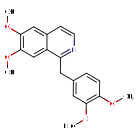
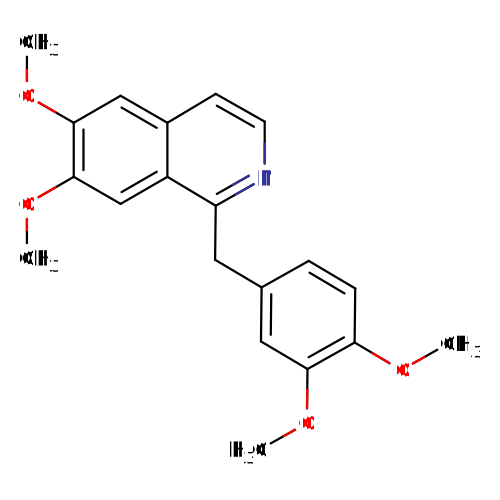
Structure for Papaverine (DB01113)
- Weight
- Average: 339.385
Monoisotopic: 339.147058165 - Chemical Formula
- C20H21NO4
- Synonyms
- Papaverina
- Papaverine

Pharmacology
- Indication
For the treatment of impotence and vasospasms.
 Reduce drug development failure ratesBuild, train, & validate machine-learning modelswith evidence-based and structured datasets.Build, train, & validate predictive machine-learning models with structured datasets.
- Associated Conditions
Indication Type Indication Combined Product Details Approval Level Age Group Patient Characteristics Dose Form Treatment of Vascular spasm ••• ••••• Treatment of Visceral spasms ••• ••••• - Contraindications & Blackbox Warnings
 Prevent Adverse Drug Events TodayTap into our Clinical API for life-saving information on contraindications & blackbox warnings, population restrictions, harmful risks, & more.Avoid life-threatening adverse drug events with our Clinical API
- Pharmacodynamics
Papaverine is a nonxanthine phosphodiesterase inhibitor for the relief of cerebral and peripheral ischemia associated with arterial spasm and myocardial ischemia complicated by arrhythmias. The main actions of Papaverine are exerted on cardiac and smooth muscle. Like qathidine, Papaverine acts directly on the heart muscle to depress conduction and prolong the refractory period. Papaverine relaxes various smooth muscles. This relaxation may be prominent if spasm exists. The muscle cell is not paralyzed by Papaverine and still responds to drugs and other stimuli causing contraction. The antispasmodic effect is a direct one, and unrelated to muscle innervation. Papaverine is practically devoid of effects on the central nervous system. Papaverine relaxes the smooth musculature of the larger blood vessels, especially coronary, systemic peripheral, and pulmonary arteries.
- Mechanism of action
Perhaps by its direct vasodilating action on cerebral blood vessels, Papaverine increases cerebral blood flow and decreases cerebral vascular resistance in normal subjects; oxygen consumption is unaltered. These effects may explain the benefit reported from the drug in cerebral vascular encephalopathy.
Target Actions Organism AcAMP-specific 3',5'-cyclic phosphodiesterase 4B inhibitorHumans UcAMP and cAMP-inhibited cGMP 3',5'-cyclic phosphodiesterase 10A inhibitorHumans UPhosphodiesterase enzymes inhibitorHumans - Absorption
Not Available
- Volume of distribution
Not Available
- Protein binding
~90%
- Metabolism
- Not Available
- Route of elimination
Not Available
- Half-life
0.5-2 hours
- Clearance
Not Available
- Adverse Effects
 Improve decision support & research outcomesWith structured adverse effects data, including: blackbox warnings, adverse reactions, warning & precautions, & incidence rates. View sample adverse effects data in our new Data Library!Improve decision support & research outcomes with our structured adverse effects data.
- Toxicity
Not Available
- Pathways
- Not Available
- Pharmacogenomic Effects/ADRs
- Not Available
Interactions
- Drug Interactions
- This information should not be interpreted without the help of a healthcare provider. If you believe you are experiencing an interaction, contact a healthcare provider immediately. The absence of an interaction does not necessarily mean no interactions exist.
Drug Interaction Integrate drug-drug
interactions in your softwareAbaloparatide The risk or severity of adverse effects can be increased when Papaverine is combined with Abaloparatide. Acebutolol The risk or severity of adverse effects can be increased when Papaverine is combined with Acebutolol. Acrivastine The risk or severity of QTc prolongation can be increased when Acrivastine is combined with Papaverine. Adenosine The risk or severity of QTc prolongation can be increased when Adenosine is combined with Papaverine. Ajmaline The risk or severity of QTc prolongation can be increased when Ajmaline is combined with Papaverine. - Food Interactions
- No interactions found.
Products
 Drug product information from 10+ global regionsOur datasets provide approved product information including:dosage, form, labeller, route of administration, and marketing period.Access drug product information from over 10 global regions.
- Product Ingredients
Ingredient UNII CAS InChI Key Papaverine codecarboxylate 3RX65N0VN7 56896-69-6 VTJFMXLVZKZSGE-UHFFFAOYSA-N Papaverine hydrochloride 23473EC6BQ 61-25-6 UOTMYNBWXDUBNX-UHFFFAOYSA-N Papaverine sulfate 7A476JZB2T 2053-26-1 KYFCEOITJFJQGT-UHFFFAOYSA-N - International/Other Brands
- Alapav / Albatran / Artegodan / Cardioverina / Cerebid / Cerespan / Delapav / Dilaves / Dispamil / Drapavel / Durapav / Dynovas / Mesotina / Myobid / Optenyl / Pameion / Pamelon / Panergon / Papacon / Papalease / Papaversan / Papital T.R. / Paptial T.R. / Pavabid / Pavacap / Pavacen / Pavadel / Pavagen / Pavakey / Pavased / Pavatest / Paverolan / Paveron / Pavnell / Qua Bid / Ro-Papav / Therapav / Vasal / Vaso-Pav
- Brand Name Prescription Products
Name Dosage Strength Route Labeller Marketing Start Marketing End Region Image Papaverine Hydrochloride Injection 30 mg/1mL Intramuscular; Intravenous Nexus Pharamaceuticals Inc. 2021-06-28 Not applicable US 
Papaverine Hydrochloride Injection, solution 30 mg/1mL Intravenous AMERICAN REGENT, INC. 1995-09-01 Not applicable US Papaverine Hydrochloride Injection, solution 30 mg/1mL Intramuscular; Intravenous Sandoz 2008-12-01 2008-12-31 US Papaverine Hydrochloride Injection, solution 30 mg/1mL Intramuscular; Intravenous Claris Lifesciences, Inc. 2009-10-07 2010-11-04 US Papaverine Hydrochloride Injection, solution 30 mg/1mL Intramuscular; Intravenous; Parenteral Bpi Labs Llc 2021-07-10 Not applicable US - Unapproved/Other Products
Name Ingredients Dosage Route Labeller Marketing Start Marketing End Region Image PAPAVERINE HCL 60 MG TABLET, 20 ADET Papaverine (60 mg) Tablet OSEL İLAÇ SAN. VE TİC. A.Ş. 2013-08-27 Not applicable Turkey 
Papaverine Hydrochloride Papaverine hydrochloride (30 mg/1mL) Injection Intramuscular; Intravenous Nexus Pharamaceuticals Inc. 2021-06-28 Not applicable US Papaverine Hydrochloride Papaverine hydrochloride (30 mg/1mL) Injection, solution Intravenous AMERICAN REGENT, INC. 1995-09-01 Not applicable US Papaverine Hydrochloride Papaverine hydrochloride (30 mg/1mL) Injection, solution Intramuscular; Intravenous Sandoz 2008-12-01 2008-12-31 US Papaverine Hydrochloride Papaverine hydrochloride (30 mg/1mL) Injection, solution Intramuscular; Intravenous Claris Lifesciences, Inc. 2009-10-07 2010-11-04 US
Categories
- ATC Codes
- G04BE02 — Papaverine
- G04BE — Drugs used in erectile dysfunction
- G04B — UROLOGICALS
- G04 — UROLOGICALS
- G — GENITO URINARY SYSTEM AND SEX HORMONES
- A03AD — Papaverine and derivatives
- A03A — DRUGS FOR FUNCTIONAL GASTROINTESTINAL DISORDERS
- A03 — DRUGS FOR FUNCTIONAL GASTROINTESTINAL DISORDERS
- A — ALIMENTARY TRACT AND METABOLISM
- Drug Categories
- Alimentary Tract and Metabolism
- Alkaloids
- Benzylisoquinolines
- Cardiovascular Agents
- Drugs for Functional Gastrointestinal Disorders
- Drugs Used in Erectile Dysfunction
- Enzyme Inhibitors
- Genito Urinary System and Sex Hormones
- Genitourinary Agents
- Heterocyclic Compounds, Fused-Ring
- Hypotensive Agents
- Isoquinolines
- Miscellaneous Vasodilatating Agents
- Moderate Risk QTc-Prolonging Agents
- Opiate Alkaloids
- Papaverine and Derivatives
- Phosphodiesterase Inhibitors
- QTc Prolonging Agents
- Urological Agents
- Urologicals
- Vasodilating Agents
- Chemical TaxonomyProvided by Classyfire
- Description
- This compound belongs to the class of organic compounds known as benzylisoquinolines. These are organic compounds containing an isoquinoline to which a benzyl group is attached.
- Kingdom
- Organic compounds
- Super Class
- Organoheterocyclic compounds
- Class
- Isoquinolines and derivatives
- Sub Class
- Benzylisoquinolines
- Direct Parent
- Benzylisoquinolines
- Alternative Parents
- Dimethoxybenzenes / Phenoxy compounds / Anisoles / Alkyl aryl ethers / Pyridines and derivatives / Heteroaromatic compounds / Azacyclic compounds / Organopnictogen compounds / Organonitrogen compounds / Hydrocarbon derivatives
- Substituents
- Alkyl aryl ether / Anisole / Aromatic heteropolycyclic compound / Azacycle / Benzenoid / Benzylisoquinoline / Dimethoxybenzene / Ether / Heteroaromatic compound / Hydrocarbon derivative
- Molecular Framework
- Aromatic heteropolycyclic compounds
- External Descriptors
- benzylisoquinoline alkaloid, dimethoxybenzene, isoquinolines (CHEBI:28241) / Isoquinoline alkaloids (C06533)
- Affected organisms
- Humans and other mammals
Chemical Identifiers
- UNII
- DAA13NKG2Q
- CAS number
- 58-74-2
- InChI Key
- XQYZDYMELSJDRZ-UHFFFAOYSA-N
- InChI
- InChI=1S/C20H21NO4/c1-22-17-6-5-13(10-18(17)23-2)9-16-15-12-20(25-4)19(24-3)11-14(15)7-8-21-16/h5-8,10-12H,9H2,1-4H3
- IUPAC Name
- 1-[(3,4-dimethoxyphenyl)methyl]-6,7-dimethoxyisoquinoline
- SMILES
- COC1=C(OC)C=C(CC2=NC=CC3=CC(OC)=C(OC)C=C23)C=C1
References
- General References
- Tang Y, Luan J, Zhang X: Accelerating tissue expansion by application of topical papaverine cream. Plast Reconstr Surg. 2004 Oct;114(5):1166-9. [Article]
- Liu JK, Couldwell WT: Intra-arterial papaverine infusions for the treatment of cerebral vasospasm induced by aneurysmal subarachnoid hemorrhage. Neurocrit Care. 2005;2(2):124-32. [Article]
- Takeuchi K, Sakamoto S, Nagayoshi Y, Nishizawa H, Matsubara J: Reactivity of the human internal thoracic artery to vasodilators in coronary artery bypass grafting. Eur J Cardiothorac Surg. 2004 Nov;26(5):956-9. [Article]
- External Links
- Human Metabolome Database
- HMDB0015245
- KEGG Drug
- D07425
- KEGG Compound
- C06533
- PubChem Compound
- 4680
- PubChem Substance
- 46508003
- ChemSpider
- 4518
- BindingDB
- 14754
- 7895
- ChEBI
- 28241
- ChEMBL
- CHEMBL19224
- ZINC
- ZINC000000056555
- Therapeutic Targets Database
- DAP000959
- PharmGKB
- PA164745550
- PDBe Ligand
- EV1
- RxList
- RxList Drug Page
- Drugs.com
- Drugs.com Drug Page
- Wikipedia
- Papaverine
- PDB Entries
- 2wey / 7dls / 7n53 / 7uqm
- MSDS
- Download (74.4 KB)
Clinical Trials
- Clinical Trials
Phase Status Purpose Conditions Count 4 Completed Other Renal Cancer 1 4 Completed Prevention Anesthesia therapy / Pediatric / Vasospasm 1 3 Terminated Treatment Gastroenteritis 1 2 Completed Supportive Care Prostate Cancer 1 2 Recruiting Prevention Radial Artery Spasm 1
Pharmacoeconomics
- Manufacturers
- Not Available
- Packagers
- Allergy Laboratories Inc.
- Amend
- American Regent
- A-S Medication Solutions LLC
- Ben Venue Laboratories Inc.
- C.O. Truxton Inc.
- Claris Lifesciences Inc.
- Dispensing Solutions
- Ebewe Pharma
- Eon Labs
- Hope Pharmaceuticals
- Kaiser Foundation Hospital
- Luitpold Pharmaceuticals Inc.
- Major Pharmaceuticals
- Meridian Medical Technologies Inc.
- Physicians Total Care Inc.
- Qualitest
- Taylor Pharmaceuticals
- Time-Cap Labs
- Dosage Forms
Form Route Strength Tablet, coated Oral Injection Intramuscular; Intravenous 40 MG/ML Injection, solution Intramuscular; Intravenous 0.04 gr Injection, solution Intramuscular; Intravenous 0.05 gr Injection, solution Intramuscular; Intravenous 0.06 gr Injection, solution Intramuscular; Intravenous 40 mg/2ml Injection, solution Intramuscular; Intravenous 50 mg/2ml Injection, solution Intramuscular; Intravenous 60 mg/2ml Injection, solution Intra-arterial; Intramuscular; Intravenous Injection, solution 30 MG/2ML Injection, solution 50 MG/3ML Granule Injection, solution Capsule Tablet Tablet 60 mg Injection Intramuscular; Intravenous 40 mg Injection Intramuscular; Intravenous 30 mg/1mL Injection, solution Intramuscular; Intravenous 30 mg/1mL Injection, solution Intramuscular; Intravenous; Parenteral 30 mg/1mL Injection, solution Intravenous 30 mg/1mL Liquid Intramuscular; Intravenous; Subcutaneous 65 mg / 2 mL - Prices
Unit description Cost Unit Papaverine 150 mg capsule sa 1.86USD capsule Papaverine 60 mg/2 ml vial 1.68USD ml Papaverine hcl powder 0.76USD g Para-time 150 mg capsule sa 0.23USD capsule DrugBank does not sell nor buy drugs. Pricing information is supplied for informational purposes only.- Patents
- Not Available
Properties
- State
- Solid
- Experimental Properties
Property Value Source melting point (°C) 226 (dec) °C PhysProp logP 3 Not Available - Predicted Properties
Property Value Source Water Solubility 0.0129 mg/mL ALOGPS logP 4.19 ALOGPS logP 3.08 Chemaxon logS -4.4 ALOGPS pKa (Strongest Basic) 6.03 Chemaxon Physiological Charge 0 Chemaxon Hydrogen Acceptor Count 5 Chemaxon Hydrogen Donor Count 0 Chemaxon Polar Surface Area 49.81 Å2 Chemaxon Rotatable Bond Count 6 Chemaxon Refractivity 95.52 m3·mol-1 Chemaxon Polarizability 36.57 Å3 Chemaxon Number of Rings 3 Chemaxon Bioavailability 1 Chemaxon Rule of Five Yes Chemaxon Ghose Filter Yes Chemaxon Veber's Rule No Chemaxon MDDR-like Rule Yes Chemaxon - Predicted ADMET Features
Property Value Probability Human Intestinal Absorption + 0.9911 Blood Brain Barrier + 0.9633 Caco-2 permeable + 0.8866 P-glycoprotein substrate Non-substrate 0.5389 P-glycoprotein inhibitor I Non-inhibitor 0.6485 P-glycoprotein inhibitor II Non-inhibitor 0.8005 Renal organic cation transporter Non-inhibitor 0.7229 CYP450 2C9 substrate Non-substrate 0.796 CYP450 2D6 substrate Substrate 0.8918 CYP450 3A4 substrate Substrate 0.6263 CYP450 1A2 substrate Inhibitor 0.9107 CYP450 2C9 inhibitor Non-inhibitor 0.9071 CYP450 2D6 inhibitor Inhibitor 0.8448 CYP450 2C19 inhibitor Inhibitor 0.778 CYP450 3A4 inhibitor Inhibitor 0.7959 CYP450 inhibitory promiscuity High CYP Inhibitory Promiscuity 0.8558 Ames test Non AMES toxic 0.689 Carcinogenicity Non-carcinogens 0.9503 Biodegradation Not ready biodegradable 0.9262 Rat acute toxicity 2.9877 LD50, mol/kg Not applicable hERG inhibition (predictor I) Weak inhibitor 0.9329 hERG inhibition (predictor II) Non-inhibitor 0.7274
Spectra
- Mass Spec (NIST)
- Not Available
- Spectra
- Chromatographic Properties
Collision Cross Sections (CCS)
Adduct CCS Value (Å2) Source type Source [M-H]- 192.1531847 predictedDarkChem Lite v0.1.0 [M-H]- 190.2511847 predictedDarkChem Lite v0.1.0 [M-H]- 184.15309 predictedDeepCCS 1.0 (2019) [M+H]+ 192.2999847 predictedDarkChem Lite v0.1.0 [M+H]+ 190.5551847 predictedDarkChem Lite v0.1.0 [M+H]+ 186.56778 predictedDeepCCS 1.0 (2019) [M+Na]+ 192.4778847 predictedDarkChem Lite v0.1.0 [M+Na]+ 190.3901847 predictedDarkChem Lite v0.1.0 [M+Na]+ 194.78093 predictedDeepCCS 1.0 (2019)
Targets

- Kind
- Protein
- Organism
- Humans
- Pharmacological action
- Yes
- Actions
- Inhibitor
- General Function
- Metal ion binding
- Specific Function
- Hydrolyzes the second messenger cAMP, which is a key regulator of many important physiological processes. May be involved in mediating central nervous system effects of therapeutic agents ranging f...
- Gene Name
- PDE4B
- Uniprot ID
- Q07343
- Uniprot Name
- cAMP-specific 3',5'-cyclic phosphodiesterase 4B
- Molecular Weight
- 83342.695 Da
References
- Overington JP, Al-Lazikani B, Hopkins AL: How many drug targets are there? Nat Rev Drug Discov. 2006 Dec;5(12):993-6. [Article]
- Imming P, Sinning C, Meyer A: Drugs, their targets and the nature and number of drug targets. Nat Rev Drug Discov. 2006 Oct;5(10):821-34. [Article]
- Xin ZC, Kim EK, Lin CS, Liu WJ, Tian L, Yuan YM, Fu J: Effects of icariin on cGMP-specific PDE5 and cAMP-specific PDE4 activities. Asian J Androl. 2003 Mar;5(1):15-8. [Article]
- Zhu S, Gan Z, Li Z, Liu Y, Yang X, Deng P, Xie Y, Yu M, Liao H, Zhao Y, Zhao L, Liao F: The measurement of cyclic nucleotide phosphodiesterase 4 activities via the quantification of inorganic phosphate with malachite green. Anal Chim Acta. 2009 Mar 16;636(1):105-10. doi: 10.1016/j.aca.2009.01.035. Epub 2009 Jan 22. [Article]
- Kind
- Protein
- Organism
- Humans
- Pharmacological action
- Unknown
- Actions
- Inhibitor
- General Function
- Metal ion binding
- Specific Function
- Plays a role in signal transduction by regulating the intracellular concentration of cyclic nucleotides. Can hydrolyze both cAMP and cGMP, but has higher affinity for cAMP and is more efficient wit...
- Gene Name
- PDE10A
- Uniprot ID
- Q9Y233
- Uniprot Name
- cAMP and cAMP-inhibited cGMP 3',5'-cyclic phosphodiesterase 10A
- Molecular Weight
- 88411.71 Da
References
- Weber M, Breier M, Ko D, Thangaraj N, Marzan DE, Swerdlow NR: Evaluating the antipsychotic profile of the preferential PDE10A inhibitor, papaverine. Psychopharmacology (Berl). 2009 May;203(4):723-35. doi: 10.1007/s00213-008-1419-x. Epub 2008 Dec 9. [Article]
- Kind
- Protein group
- Organism
- Humans
- Pharmacological action
- Unknown
- Actions
- Inhibitor
- General Function
- Metal ion binding
- Specific Function
- Cyclic nucleotide phosphodiesterase with a dual-specificity for the second messengers cAMP and cGMP, which are key regulators of many important physiological processes. Has a preference for cGMP as...
Components:
References
- Uckert S, Stief CG, Lietz B, Burmester M, Jonas U, Machtens SA: Possible role of bioactive peptides in the regulation of human detrusor smooth muscle - functional effects in vitro and immunohistochemical presence. World J Urol. 2002 Sep;20(4):244-9. doi: 10.1007/s00345-002-0287-y. Epub 2002 Jul 23. [Article]

Drug created at June 13, 2005 13:24 / Updated at April 24, 2024 14:30