Identification
- Summary
Micafungin is an antifungal agent used for the treatment of candidemia, acute disseminated candidiasis, and certain other invasive Candida infections, and for the prophylaxis of Candida infections during stem cell transplantation.
- Brand Names
- Mycamine
- Generic Name
- Micafungin
- DrugBank Accession Number
- DB01141
- Background
Micafungin is an antifungal drug. It belongs to the antifungal class of compounds known as echinocandins and exerts its effect by inhibiting the synthesis of 1,3-beta-D-glucan, an integral component of the fungal cell wall.
- Type
- Small Molecule
- Groups
- Approved, Investigational
- Structure
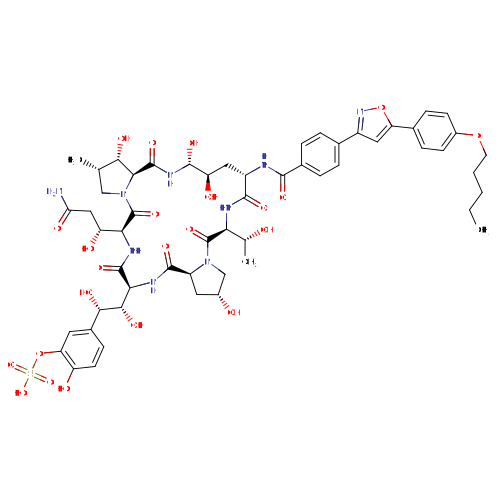
Structure for Micafungin (DB01141)
- Weight
- Average: 1270.274
Monoisotopic: 1269.438350313 - Chemical Formula
- C56H71N9O23S
- Synonyms
- Micafungin
- Micafungina
- External IDs
- FK-463

Pharmacology
- Indication
Indicated for the treatment of candidemia, acute disseminated candidiasis, and certain other invasive Candida infections, as well as esophageal candidiasis, and prophylaxis of Candida infections in patients undergoing hematopoietic stem cell transplantation. Micafungin is also used as an alternative for the treatment of oropharyngeal candidiases and has been used with some success as primary or salvage therapy, alone or in combination with other antifungals, for the treatment of invasive aspergillosis.
Indicated for the prophylaxis of Candida infections in patients undergoing hematopoietic stem cell transplantation.
 Reduce drug development failure ratesBuild, train, & validate machine-learning modelswith evidence-based and structured datasets.Build, train, & validate predictive machine-learning models with structured datasets.
- Associated Conditions
Indication Type Indication Combined Product Details Approval Level Age Group Patient Characteristics Dose Form Treatment of Abscesses •••••••••••• ••••••••• Treatment of Abscesses •••••••••••• ••••••••• Treatment of Abscesses •••••••••••• ••••••••• Treatment of Abscesses •••••••••••• Treatment of Aspergillosis ••• ••••• ••• •••••••• - Contraindications & Blackbox Warnings
 Prevent Adverse Drug Events TodayTap into our Clinical API for life-saving information on contraindications & blackbox warnings, population restrictions, harmful risks, & more.Avoid life-threatening adverse drug events with our Clinical API
- Pharmacodynamics
Formerly known as FK463, micafungin is a semisynthetic lipopeptide synthesized from a fermentation product of Coleophoma empetri that works as an antifungal agent. It is a glucan synthesis inhibitor of the echinocandin structural class. The U.S. Food and Drug Administration approved micafungin in March 2005. Micafungin inhibits an enzyme essential for fungal cell-wall synthesis. Depending on its concentration, micafungin may be fungicidal against some Candida, but is usually fungistatic against Apergillus. Micafungin can be used concomitantly with a variety of other drugs, including the HIV protease inhibitor ritonavir and the transplant medications cyclosporine and tacrolimus.
- Mechanism of action
Micafungin inhibits the synthesis of beta-1,3-D-glucan, an essential component of fungal cell walls which is not present in mammalian cells. It does this by inhibiting beta-1,3-D-glucan synthase.
Target Actions Organism A1,3-beta-glucan synthase component FKS1 inhibitorAspergillus niger (strain CBS 513.88 / FGSC A1513) - Absorption
Not absorbed orally
- Volume of distribution
- 0.39 ± 0.11 L/kg [adult patients with esophageal candidiasis]
- Protein binding
Highly (>99%) protein bound in vitro, independent of plasma concentrations over the range of 10 to 100 µg/mL. The primary binding protein is albumin; however, micafungin, at therapeutically relevant concentrations, does not competitively displace bilirubin binding to albumin. Micafungin also binds to a lesser extent to a1-acid-glycoprotein.
- Metabolism
Micafungin is metabolized to M-1 (catechol form) by arylsulfatase, with further metabolism to M-2 (methoxy form) by catechol-O-methyltransferase. M-5 is formed by hydroxylation at the side chain (w-1 position) of micafungin catalyzed by cytochrome P450 (CYP) isozymes. Even though micafungin is a substrate for and a weak inhibitor of CYP3A in vitro, hydroxylation by CYP3A is not a major pathway for micafungin metabolism in vivo.
- Route of elimination
Fecal excretion is the major route of elimination (total radioactivity at 28 days was 71% of the administered dose).
- Half-life
14-17 hours
- Clearance
- 0.359 +/- 0.179 mL/min/kg [Adult Patients with IC with 100 mg]
- 0.321 +/- 0.098 mL/min/kg [HIV- Positive Patients with EC with 50 mg]
- 0.327 +/- 0.093 mL/min/kg [HIV- Positive Patients with EC with 100 mg]
- 0.340 +/- 0.092 mL/min/kg [HIV- Positive Patients with EC with 150 mg]
- 0.214 +/- 0.031 mL/min/kg [hematopoietic stem cell transplant recipients 3 mg/kg]
- 0.204 +/- 0.036 mL/min/kg [hematopoietic stem cell transplant recipients 4 mg/kg]
- 0.224 +/- 0.064 mL/min/kg [hematopoietic stem cell transplant recipients 6 mg/kg]
- 0.223 +/- 0.081 mL/min/kg [hematopoietic stem cell transplant recipients 8 mg/kg]
- Adverse Effects
 Improve decision support & research outcomesWith structured adverse effects data, including: blackbox warnings, adverse reactions, warning & precautions, & incidence rates. View sample adverse effects data in our new Data Library!Improve decision support & research outcomes with our structured adverse effects data.
- Toxicity
Intravenous LD50 in rats is 125mg/kg. In dogs it is >200mg/kg. No cases of overdosage have been reported. Repeated daily doses up to 8 mg/kg (maximum total dose of 896 mg) in adult patients have been administered in clinical trials with no reported dose-limiting toxicity. The minimum lethal dose is 125 mg/kg in rats, equivalent to 8.1 times the recommended human clinical dose for esophageal candidiasis based on body surface area comparisons.
- Pathways
- Not Available
- Pharmacogenomic Effects/ADRs
- Not Available
Interactions
- Drug Interactions
- This information should not be interpreted without the help of a healthcare provider. If you believe you are experiencing an interaction, contact a healthcare provider immediately. The absence of an interaction does not necessarily mean no interactions exist.
Drug Interaction Integrate drug-drug
interactions in your softwareAcenocoumarol The therapeutic efficacy of Acenocoumarol can be increased when used in combination with Micafungin. Dicoumarol The therapeutic efficacy of Dicoumarol can be increased when used in combination with Micafungin. Entacapone The metabolism of Micafungin can be decreased when combined with Entacapone. Fluindione The therapeutic efficacy of Fluindione can be increased when used in combination with Micafungin. Opicapone The metabolism of Micafungin can be decreased when combined with Opicapone. - Food Interactions
- No interactions found.
Products
 Drug product information from 10+ global regionsOur datasets provide approved product information including:dosage, form, labeller, route of administration, and marketing period.Access drug product information from over 10 global regions.
- Product Ingredients
Ingredient UNII CAS InChI Key Micafungin sodium IS1UP79R56 208538-73-2 KOOAFHGJVIVFMZ-WZPXRXMFSA-M - Brand Name Prescription Products
Name Dosage Strength Route Labeller Marketing Start Marketing End Region Image Micafungin Injection, powder, lyophilized, for solution 20 mg/1mL Intravenous Par Pharmaceutical, Inc. 2021-08-01 Not applicable US 
Micafungin Injection, powder, lyophilized, for solution 10 mg/1mL Intravenous Par Pharmaceutical, Inc. 2021-08-01 Not applicable US Micafungin for Injection Powder, for solution 100 mg / vial Intravenous Accord Healthcare Inc Not applicable Not applicable Canada 
Micafungin for Injection Powder, for solution 50 mg / vial Intravenous Accord Healthcare Inc Not applicable Not applicable Canada Micafungin in Sodium Chloride Injection 100 mg/100mL Intravenous Baxter Healthcare Corporation 2023-09-29 Not applicable US - Generic Prescription Products
Name Dosage Strength Route Labeller Marketing Start Marketing End Region Image Micafungin Injection, powder, lyophilized, for solution 20 mg/1mL Intravenous Northstar Rx Llc. 2022-11-01 Not applicable US Micafungin Injection, powder, lyophilized, for solution 20 mg/1mL Intravenous Apotex Corp. 2021-02-12 2024-07-31 US Micafungin Injection, powder, lyophilized, for solution 50 mg/5mL Intravenous Meitheal Pharmaceuticals Inc. 2022-09-28 Not applicable US Micafungin Injection, powder, lyophilized, for solution 50 mg/1 Intravenous Fresenius Kabi USA, LLC 2020-05-08 Not applicable US Micafungin Injection, powder, lyophilized, for solution 10 mg/1mL Intravenous Hikma Pharmaceuticals USA Inc. 2021-07-09 Not applicable US
Categories
- ATC Codes
- J02AX05 — Micafungin
- Drug Categories
- Chemical TaxonomyProvided by Classyfire
- Description
- This compound belongs to the class of organic compounds known as oligopeptides. These are organic compounds containing a sequence of between three and ten alpha-amino acids joined by peptide bonds.
- Kingdom
- Organic compounds
- Super Class
- Organic acids and derivatives
- Class
- Carboxylic acids and derivatives
- Sub Class
- Amino acids, peptides, and analogues
- Direct Parent
- Oligopeptides
- Alternative Parents
- Cyclic peptides / Macrolactams / N-acyl-alpha amino acids and derivatives / Phenylsulfates / Benzamides / Benzoyl derivatives / Phenoxy compounds / Phenol ethers / Alkyl aryl ethers / 1-hydroxy-2-unsubstituted benzenoids show 19 more
- Substituents
- 1-hydroxy-2-unsubstituted benzenoid / Alcohol / Alkanolamine / Alkyl aryl ether / Alpha-amino acid or derivatives / Alpha-oligopeptide / Aromatic alcohol / Aromatic heteropolycyclic compound / Arylsulfate / Azacycle show 40 more
- Molecular Framework
- Aromatic heteropolycyclic compounds
- External Descriptors
- antibiotic antifungal drug, echinocandin (CHEBI:600520)
- Affected organisms
- Aspergillis, Candida and other fungi
Chemical Identifiers
- UNII
- R10H71BSWG
- CAS number
- 235114-32-6
- InChI Key
- PIEUQSKUWLMALL-YABMTYFHSA-N
- InChI
- InChI=1S/C56H71N9O23S/c1-4-5-6-17-86-32-14-11-28(12-15-32)39-21-33(63-87-39)27-7-9-29(10-8-27)49(75)58-34-20-38(70)52(78)62-54(80)45-46(72)25(2)23-65(45)56(82)43(37(69)22-41(57)71)60-53(79)44(48(74)47(73)30-13-16-36(68)40(18-30)88-89(83,84)85)61-51(77)35-19-31(67)24-64(35)55(81)42(26(3)66)59-50(34)76/h7-16,18,21,25-26,31,34-35,37-38,42-48,52,66-70,72-74,78H,4-6,17,19-20,22-24H2,1-3H3,(H2,57,71)(H,58,75)(H,59,76)(H,60,79)(H,61,77)(H,62,80)(H,83,84,85)/t25-,26+,31+,34-,35-,37+,38+,42-,43-,44-,45-,46-,47-,48-,52+/m0/s1
- IUPAC Name
- {5-[(1S,2S)-2-[(3S,6S,9S,11R,15S,18S,20R,21R,24S,25S,26S)-3-[(1R)-2-carbamoyl-1-hydroxyethyl]-11,20,21,25-tetrahydroxy-15-[(1R)-1-hydroxyethyl]-26-methyl-2,5,8,14,17,23-hexaoxo-18-(4-{5-[4-(pentyloxy)phenyl]-1,2-oxazol-3-yl}benzamido)-1,4,7,13,16,22-hexaazatricyclo[22.3.0.0^{9,13}]heptacosan-6-yl]-1,2-dihydroxyethyl]-2-hydroxyphenyl}oxidanesulfonic acid
- SMILES
- CCCCCOC1=CC=C(C=C1)C1=CC(=NO1)C1=CC=C(C=C1)C(=O)N[C@H]1C[C@@H](O)[C@@H](O)NC(=O)[C@@H]2[C@@H](O)[C@@H](C)CN2C(=O)[C@@H](NC(=O)[C@@H](NC(=O)[C@@H]2C[C@@H](O)CN2C(=O)[C@@H](NC1=O)[C@@H](C)O)[C@H](O)[C@@H](O)C1=CC(OS(O)(=O)=O)=C(O)C=C1)[C@H](O)CC(N)=O
References
- General References
- Grover ND: Echinocandins: A ray of hope in antifungal drug therapy. Indian J Pharmacol. 2010 Feb;42(1):9-11. doi: 10.4103/0253-7613.62396. [Article]
- Bormann AM, Morrison VA: Review of the pharmacology and clinical studies of micafungin. Drug Des Devel Ther. 2009 Dec 29;3:295-302. [Article]
- Vehreschild JJ, Cornely OA: Micafungin sodium, the second of the echinocandin class of antifungals: theory and practice. Future Microbiol. 2006 Aug;1(2):161-70. [Article]
- Groll AH, Stergiopoulou T, Roilides E, Walsh TJ: Micafungin: pharmacology, experimental therapeutics and clinical applications. Expert Opin Investig Drugs. 2005 Apr;14(4):489-509. [Article]
- Chandrasekar PH, Sobel JD: Micafungin: a new echinocandin. Clin Infect Dis. 2006 Apr 15;42(8):1171-8. Epub 2006 Mar 14. [Article]
- Wiederhold NP, Lewis JS 2nd: The echinocandin micafungin: a review of the pharmacology, spectrum of activity, clinical efficacy and safety. Expert Opin Pharmacother. 2007 Jun;8(8):1155-66. [Article]
- Ikeda F, Tanaka S, Ohki H, Matsumoto S, Maki K, Katashima M, Barrett D, Aoki Y: Role of micafungin in the antifungal armamentarium. Curr Med Chem. 2007;14(11):1263-75. [Article]
- Sucher AJ, Chahine EB, Balcer HE: Echinocandins: the newest class of antifungals. Ann Pharmacother. 2009 Oct;43(10):1647-57. doi: 10.1345/aph.1M237. Epub 2009 Sep 1. [Article]
- Morris MI, Villmann M: Echinocandins in the management of invasive fungal infections, part 1. Am J Health Syst Pharm. 2006 Sep 15;63(18):1693-703. [Article]
- Morris MI, Villmann M: Echinocandins in the management of invasive fungal infections, Part 2. Am J Health Syst Pharm. 2006 Oct 1;63(19):1813-20. [Article]
- External Links
- Human Metabolome Database
- HMDB0015272
- KEGG Drug
- D02465
- KEGG Compound
- C15819
- PubChem Compound
- 477468
- PubChem Substance
- 46508208
- ChemSpider
- 419105
- BindingDB
- 50478216
- 325887
- ChEBI
- 600520
- ChEMBL
- CHEMBL457547
- Therapeutic Targets Database
- DAP000548
- PharmGKB
- PA164781026
- RxList
- RxList Drug Page
- Drugs.com
- Drugs.com Drug Page
- Wikipedia
- Micafungin
- FDA label
- Download (139 KB)
- MSDS
- Download (84.3 KB)
Clinical Trials
- Clinical Trials
Phase Status Purpose Conditions Count 4 Completed Basic Science Obesity, Morbid 1 4 Completed Other Invasive Candidiasis 1 4 Completed Treatment Acute Myeloid Leukemia / Myelodysplastic Syndrome 1 4 Completed Treatment Candida Sepsis 1 4 Completed Treatment Candidemia 1
Pharmacoeconomics
- Manufacturers
- Not Available
- Packagers
- Astellas Pharma Inc.
- Dosage Forms
Form Route Strength Injection, powder, lyophilized, for solution Intravenous 100 mg/5mL Injection, powder, lyophilized, for solution Intravenous 100 mg/1 Injection, powder, lyophilized, for solution Intravenous 50 mg/1 Injection, powder, lyophilized, for solution Intravenous 50 mg/5mL Injection Intravenous 100 mg/100mL Injection Intravenous 150 mg/150mL Injection Intravenous 50 mg/50mL Injection, powder, for solution Parenteral Injection, powder, for solution 100 MG Injection, powder, for solution 50 MG Injection, powder, for solution Parenteral 100 MG Injection, powder, for solution Parenteral 50 MG Injection, solution, concentrate Intravenous 100 mg Injection, solution, concentrate Intravenous 50 mg Injection, powder, for solution Intravenous Injection, powder, for solution Intravenous 100 MG Injection, powder, for solution Intravenous 50 MG Injection, powder, lyophilized, for solution Intravenous 10 mg/1mL Injection, powder, lyophilized, for solution Intravenous 20 mg/1mL Powder, for solution Intravenous 100 mg / vial Powder, for solution Intravenous 50 mg / vial Injection Parenteral 100 mg Injection Parenteral 50 mg Powder, for solution Intravenous Powder 50 mg/1vial Injection, powder, lyophilized, for solution Intravenous 50 mg - Prices
Unit description Cost Unit Mycamine 100 mg vial 224.4USD vial Mycamine 50 mg vial 112.2USD vial DrugBank does not sell nor buy drugs. Pricing information is supplied for informational purposes only.- Patents
Patent Number Pediatric Extension Approved Expires (estimated) Region US5376634 No 1994-12-27 2011-12-27 US CA2202058 No 2007-11-06 2015-09-29 Canada CA2044746 No 2001-08-07 2011-06-17 Canada US6107458 No 2000-08-22 2019-03-16 US US6265536 No 2001-07-24 2015-09-29 US US6774104 Yes 2004-08-10 2021-07-08 US
Properties
- State
- Solid
- Experimental Properties
Property Value Source water solubility Freely soluble as sodium salt (> 200mg/mL) Not Available logP -1.5 Not Available - Predicted Properties
Property Value Source Water Solubility 0.218 mg/mL ALOGPS logP 0.67 ALOGPS logP -6.3 Chemaxon logS -3.8 ALOGPS pKa (Strongest Acidic) -2.2 Chemaxon pKa (Strongest Basic) -3.6 Chemaxon Physiological Charge -1 Chemaxon Hydrogen Acceptor Count 22 Chemaxon Hydrogen Donor Count 16 Chemaxon Polar Surface Area 510.14 Å2 Chemaxon Rotatable Bond Count 18 Chemaxon Refractivity 303.07 m3·mol-1 Chemaxon Polarizability 128.66 Å3 Chemaxon Number of Rings 7 Chemaxon Bioavailability 0 Chemaxon Rule of Five No Chemaxon Ghose Filter No Chemaxon Veber's Rule No Chemaxon MDDR-like Rule Yes Chemaxon - Predicted ADMET Features
Property Value Probability Human Intestinal Absorption + 0.8383 Blood Brain Barrier - 0.8524 Caco-2 permeable - 0.6464 P-glycoprotein substrate Substrate 0.7906 P-glycoprotein inhibitor I Non-inhibitor 0.6752 P-glycoprotein inhibitor II Non-inhibitor 0.9279 Renal organic cation transporter Non-inhibitor 0.9428 CYP450 2C9 substrate Non-substrate 0.8485 CYP450 2D6 substrate Non-substrate 0.7911 CYP450 3A4 substrate Substrate 0.5853 CYP450 1A2 substrate Non-inhibitor 0.7414 CYP450 2C9 inhibitor Non-inhibitor 0.7017 CYP450 2D6 inhibitor Non-inhibitor 0.8251 CYP450 2C19 inhibitor Non-inhibitor 0.693 CYP450 3A4 inhibitor Inhibitor 0.5393 CYP450 inhibitory promiscuity Low CYP Inhibitory Promiscuity 0.7703 Ames test Non AMES toxic 0.563 Carcinogenicity Carcinogens 0.5763 Biodegradation Not ready biodegradable 0.9916 Rat acute toxicity 2.5651 LD50, mol/kg Not applicable hERG inhibition (predictor I) Weak inhibitor 0.9686 hERG inhibition (predictor II) Inhibitor 0.716
Spectra
- Mass Spec (NIST)
- Not Available
- Spectra
- Chromatographic Properties
Collision Cross Sections (CCS)
Adduct CCS Value (Å2) Source type Source [M-H]- 313.15897 predictedDeepCCS 1.0 (2019) [M+H]+ 314.8827 predictedDeepCCS 1.0 (2019) [M+Na]+ 321.21033 predictedDeepCCS 1.0 (2019)
Targets

- Kind
- Protein
- Organism
- Aspergillus niger (strain CBS 513.88 / FGSC A1513)
- Pharmacological action
- Yes
- Actions
- Inhibitor
- General Function
- 1,3-beta-d-glucan synthase activity
- Specific Function
- Catalytic subunit of the 1,3-beta-glucan synthase. Synthesizes 1,3-beta-glucan, a major structural component of the cell wall. Involved in cell wall synthesis, maintenance and cell wall remodeling ...
- Gene Name
- fksA
- Uniprot ID
- A2QLK4
- Uniprot Name
- 1,3-beta-glucan synthase component FKS1
- Molecular Weight
- 216972.8 Da
References
- Sucher AJ, Chahine EB, Balcer HE: Echinocandins: the newest class of antifungals. Ann Pharmacother. 2009 Oct;43(10):1647-57. doi: 10.1345/aph.1M237. Epub 2009 Sep 1. [Article]
- Quindos G, Eraso E, Javier Carrillo-Munoz A, Canton E, Peman J: [In vitro antifungal activity of micafungin]. Rev Iberoam Micol. 2009 Mar 31;26(1):35-41. doi: 10.1016/S1130-1406(09)70006-3. Epub 2009 May 7. [Article]
- Morris MI, Villmann M: Echinocandins in the management of invasive fungal infections, part 1. Am J Health Syst Pharm. 2006 Sep 15;63(18):1693-703. [Article]
- Morris MI, Villmann M: Echinocandins in the management of invasive fungal infections, Part 2. Am J Health Syst Pharm. 2006 Oct 1;63(19):1813-20. [Article]
- Jarvis B, Figgitt DP, Scott LJ: Micafungin. Drugs. 2004;64(9):969-82; discussion 983-4. [Article]
Enzymes
- Kind
- Protein
- Organism
- Humans
- Pharmacological action
- Unknown
- Actions
- Substrate
- General Function
- Sulfuric ester hydrolase activity
- Specific Function
- Hydrolyzes cerebroside sulfate.
- Gene Name
- ARSA
- Uniprot ID
- P15289
- Uniprot Name
- Arylsulfatase A
- Molecular Weight
- 53587.6 Da
References
- Groll AH, Stergiopoulou T, Roilides E, Walsh TJ: Micafungin: pharmacology, experimental therapeutics and clinical applications. Expert Opin Investig Drugs. 2005 Apr;14(4):489-509. [Article]
- Wiederhold NP, Lewis JS 2nd: The echinocandin micafungin: a review of the pharmacology, spectrum of activity, clinical efficacy and safety. Expert Opin Pharmacother. 2007 Jun;8(8):1155-66. [Article]
- Kind
- Protein
- Organism
- Humans
- Pharmacological action
- Unknown
- Actions
- Substrate
- General Function
- O-methyltransferase activity
- Specific Function
- Catalyzes the O-methylation, and thereby the inactivation, of catecholamine neurotransmitters and catechol hormones. Also shortens the biological half-lives of certain neuroactive drugs, like L-DOP...
- Gene Name
- COMT
- Uniprot ID
- P21964
- Uniprot Name
- Catechol O-methyltransferase
- Molecular Weight
- 30036.77 Da
References
- Groll AH, Stergiopoulou T, Roilides E, Walsh TJ: Micafungin: pharmacology, experimental therapeutics and clinical applications. Expert Opin Investig Drugs. 2005 Apr;14(4):489-509. [Article]
- Wiederhold NP, Lewis JS 2nd: The echinocandin micafungin: a review of the pharmacology, spectrum of activity, clinical efficacy and safety. Expert Opin Pharmacother. 2007 Jun;8(8):1155-66. [Article]
- Julius JM, Gaikwad A, Lowry A, Lewis RE, Lozano RD, Dalrymple JL, Coleman RL, Smith JA: Defining the role of echinocandin catechol functional groups in the development of secondary hepatocellular carcinoma. J Antimicrob Chemother. 2012 Feb;67(2):422-9. doi: 10.1093/jac/dkr494. Epub 2011 Nov 30. [Article]

Drug created at June 13, 2005 13:24 / Updated at April 27, 2024 09:44