Identification
- Summary
Trimetrexate is a folate antagonist used for the treatment of moderate-to-severe Pneumocystis carinii pneumonia (PCP) in immunocompromised patients as an alternative therapy in combination with leucovorin.
- Brand Names
- Neutrexin
- Generic Name
- Trimetrexate
- DrugBank Accession Number
- DB01157
- Background
A nonclassical folic acid inhibitor through its inhibition of the enzyme dihydrofolate reductase. It is being tested for efficacy as an antineoplastic agent and as an antiparasitic agent against pneumocystis pneumonia in AIDS patients. Myelosuppression is its dose-limiting toxic effect.
- Type
- Small Molecule
- Groups
- Approved, Investigational
- Structure
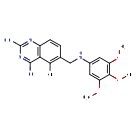
Structure for Trimetrexate (DB01157)

- Weight
- Average: 369.4176
Monoisotopic: 369.180089627 - Chemical Formula
- C19H23N5O3
- Synonyms
- Trimetrexate
- Trimetrexato
- Trimetrexatum

Pharmacology
- Indication
For use, with concurrent leucovorin administration (leucovorin protection), as an alternative therapy for the treatment of moderate-to-severe Pneumocystis carinii pneumonia (PCP) in immunocompromised patients, including patients with the acquired immunodeficiency syndrome (AIDS). Also used to treat several types of cancer including colon cancer.
 Reduce drug development failure ratesBuild, train, & validate machine-learning modelswith evidence-based and structured datasets.Build, train, & validate predictive machine-learning models with structured datasets.
- Associated Conditions
Indication Type Indication Combined Product Details Approval Level Age Group Patient Characteristics Dose Form Used in combination to treat Pneumocystis jirovecii pneumonia Regimen in combination with: Leucovorin (DB00650) •••••••••••• ••••••••• Used in combination to treat Pneumocystis jirovecii pneumonia Regimen in combination with: Leucovorin (DB00650) •••••••••••• ••••••••• - Contraindications & Blackbox Warnings
 Prevent Adverse Drug Events TodayTap into our Clinical API for life-saving information on contraindications & blackbox warnings, population restrictions, harmful risks, & more.Avoid life-threatening adverse drug events with our Clinical API
- Pharmacodynamics
Trimetrexate, a non-classical folate antagonist, is a synthetic inhibitor of the enzyme dihydrofolate reductase (DHFR). During DNA synthesis and cellular reproduction, folic acid is reduced to tetrahydrofolic acid by the enzyme folic acid reductase. By interfering with the reduction of folic acid, trimetrexate interferes with tissue cell reproduction. Generally, the most sensitive cells to the antimetabolite effect of trimetrexate are those cells which are most actively proliferating such as malignant cells, dermal epithelium, buccal and intestinal mucosa, bone marrow, fetal cells, and cells of the urinary bladder. Because the proliferation of cells in malignant tissues is greater than in most normal tissues, trimetrexate may impair the growth of the malignant tissues without causing irreversible damage to normal tissues. Due to very serious and potentially life-threatening side-effects of this drug, leucovorin must be co-administered for at least 72 hours after the last dose.
- Mechanism of action
In vitro studies have shown that trimetrexate is a competitive inhibitor of dihydrofolate reductase (DHFR) from bacterial, protozoan, and mammalian sources. DHFR catalyzes the reduction of intracellular dihydrofolate to the active coenzyme tetrahydrofolate. Inhibition of DHFR results in the depletion of this coenzyme, leading directly to interference with thymidylate biosynthesis, as well as inhibition of folate-dependent formyltransferases, and indirectly to inhibition of p.r.n. biosynthesis. The end result is disruption of DNA, RNA, and protein synthesis, with consequent cell death.
Target Actions Organism ADihydrofolate reductase inhibitorHumans - Absorption
Not Available
- Volume of distribution
- 20 ± 8 L/m2
- 36.9 ± 6 L/m2 [cancer patients]
- Protein binding
95% (over the concentration range of 18.75 to 1000 ng/mL)
- Metabolism
Hepatic. Preclinical data strongly suggest that the major metabolic pathway is oxidative O-demethylation, followed by conjugation to either glucuronide or the sulfate.
- Route of elimination
Ten to 30% of the administered dose is excreted unchanged in the urine.
- Half-life
11 to 20 hours
- Clearance
- 38 +/- 15 mL/min/m2 [patients with acquired immunodeficiency syndrome (AIDS) who had Pneumocystis carinii pneumonia (4 patients) or toxoplasmosis (2 patients). Trimetrexate was administered intravenously as a bolus injection at a dose of 30 mg/m2/day along with leucovorin 20 mg/m2 every 6 hours for 21 days]
- 53 +/- 41 mL/min/m2 [Cancer patients with advanced solid tumors using various dosage regimensreceiving a single-dose administration of 10 to 130 mg/m2]
- 30 +/- 8 mL/min/m2 [Cancer patients with advanced solid tumors using various dosage regimensafter a five-day infusion]
- Adverse Effects
 Improve decision support & research outcomesWith structured adverse effects data, including: blackbox warnings, adverse reactions, warning & precautions, & incidence rates. View sample adverse effects data in our new Data Library!Improve decision support & research outcomes with our structured adverse effects data.
- Toxicity
The LD50 of intravenous trimetrexate in mice is 62 mg/kg (186 mg/m2). Myelosuppression is a dose-limiting toxic effect.
- Pathways
- Not Available
- Pharmacogenomic Effects/ADRs
- Not Available
Interactions
- Drug Interactions
- This information should not be interpreted without the help of a healthcare provider. If you believe you are experiencing an interaction, contact a healthcare provider immediately. The absence of an interaction does not necessarily mean no interactions exist.
Drug Interaction Integrate drug-drug
interactions in your softwareAbacavir Abacavir may decrease the excretion rate of Trimetrexate which could result in a higher serum level. Aceclofenac Aceclofenac may decrease the excretion rate of Trimetrexate which could result in a higher serum level. Acemetacin Acemetacin may decrease the excretion rate of Trimetrexate which could result in a higher serum level. Acetaminophen Acetaminophen may decrease the excretion rate of Trimetrexate which could result in a higher serum level. Acetazolamide The therapeutic efficacy of Trimetrexate can be increased when used in combination with Acetazolamide. - Food Interactions
- No interactions found.
Products
 Drug product information from 10+ global regionsOur datasets provide approved product information including:dosage, form, labeller, route of administration, and marketing period.Access drug product information from over 10 global regions.
- Product Ingredients
Ingredient UNII CAS InChI Key Trimetrexate glucuronate L137U4A79K 82952-64-5 ZCJXQWYMBJYJNB-LRDBBFHQSA-N - Brand Name Prescription Products
Name Dosage Strength Route Labeller Marketing Start Marketing End Region Image Neutrexin Injection, powder, lyophilized, for solution 25 mg/2mL Intravenous Medimmune Oncology, Inc. 2006-05-11 Not applicable US 
Neutrexin Injection, powder, lyophilized, for solution 200 mg/16mL Intravenous Medimmune Oncology, Inc. 2006-05-11 Not applicable US Neutrexin Pws IV 25mg/vial Powder, for solution 25 mg / vial Intravenous Medimmune Oncology, Inc. 1994-12-31 2007-02-21 Canada 
Categories
- ATC Codes
- P01AX07 — Trimetrexate
- Drug Categories
- Acids, Acyclic
- Acids, Aldehydic
- Anti-Infective Agents
- Antimetabolites
- Antineoplastic Agents
- Antiparasitic Products, Insecticides and Repellents
- Antiprotozoals
- Carbohydrates
- Drugs that are Mainly Renally Excreted
- Enzyme Inhibitors
- Folic Acid Antagonists
- Hepatotoxic Agents
- Heterocyclic Compounds, Fused-Ring
- Hydroxy Acids
- Narrow Therapeutic Index Drugs
- Noxae
- Pharmaceutical Preparations
- Quinazolines
- Sugar Acids
- Toxic Actions
- Uronic Acids
- Chemical TaxonomyProvided by Classyfire
- Description
- This compound belongs to the class of organic compounds known as quinazolinamines. These are heterocyclic aromatic compounds containing a quianazoline moiety substituted by one or more amine groups.
- Kingdom
- Organic compounds
- Super Class
- Organoheterocyclic compounds
- Class
- Diazanaphthalenes
- Sub Class
- Benzodiazines
- Direct Parent
- Quinazolinamines
- Alternative Parents
- Methoxyanilines / Aminophenyl ethers / Phenylalkylamines / Phenoxy compounds / Methoxybenzenes / Anisoles / Secondary alkylarylamines / Aminopyrimidines and derivatives / Alkyl aryl ethers / Imidolactams show 5 more
- Substituents
- Alkyl aryl ether / Amine / Aminophenyl ether / Aminopyrimidine / Aniline or substituted anilines / Anisole / Aralkylamine / Aromatic heteropolycyclic compound / Azacycle / Benzenoid show 20 more
- Molecular Framework
- Aromatic heteropolycyclic compounds
- External Descriptors
- Not Available
- Affected organisms
- Humans and other mammals
- Pneumocystis carinii
- Bacteria and protozoa
Chemical Identifiers
- UNII
- UPN4ITI8T4
- CAS number
- 52128-35-5
- InChI Key
- NOYPYLRCIDNJJB-UHFFFAOYSA-N
- InChI
- InChI=1S/C19H23N5O3/c1-10-11(5-6-13-16(10)18(20)24-19(21)23-13)9-22-12-7-14(25-2)17(27-4)15(8-12)26-3/h5-8,22H,9H2,1-4H3,(H4,20,21,23,24)
- IUPAC Name
- 5-methyl-6-{[(3,4,5-trimethoxyphenyl)amino]methyl}quinazoline-2,4-diamine
- SMILES
- COC1=CC(NCC2=C(C)C3=C(C=C2)N=C(N)N=C3N)=CC(OC)=C1OC
References
- Synthesis Reference
Martin Stogniew, Javad M. Zadei, "Compositions comprising trimetrexate and methods of their synthesis and use." U.S. Patent US6258821, issued January, 1974.
US6258821- General References
- FDA Approved Products: Neutrexin (trimetrexate glucuronate) for injection [Link]
- External Links
- Human Metabolome Database
- HMDB0015288
- KEGG Drug
- D06238
- KEGG Compound
- C11154
- PubChem Compound
- 5583
- PubChem Substance
- 46505247
- ChemSpider
- 5381
- BindingDB
- 18268
- 42333
- ChEBI
- 9737
- ChEMBL
- CHEMBL119
- ZINC
- ZINC000000598852
- Therapeutic Targets Database
- DAP000635
- PharmGKB
- PA451790
- PDBe Ligand
- TMQ
- RxList
- RxList Drug Page
- Drugs.com
- Drugs.com Drug Page
- Wikipedia
- Trimetrexate
- FDA label
- Download (53.3 KB)
Clinical Trials
- Clinical Trials
Phase Status Purpose Conditions Count 3 Completed Treatment Human Immunodeficiency Virus (HIV) Infections / Pneumocystis Jirovecii Pneumonia 5 3 Terminated Treatment Human Immunodeficiency Virus (HIV) Infections / Pneumocystis Jirovecii Pneumonia 1 2 Completed Treatment Colorectal Cancer 1 2 Completed Treatment Leukemias / Lymphoma / Sarcomas 1 2 Completed Treatment Pancreatic Cancer 1
Pharmacoeconomics
- Manufacturers
- Not Available
- Packagers
- Ben Venue Laboratories Inc.
- Medimmune Inc.
- Dosage Forms
Form Route Strength Injection, powder, lyophilized, for solution Intravenous 200 mg/16mL Injection, powder, lyophilized, for solution Intravenous 25 mg/2mL Powder, for solution Intravenous 25 mg / vial - Prices
- Not Available
- Patents
Patent Number Pediatric Extension Approved Expires (estimated) Region US6017922 No 2000-01-25 2018-05-18 US
Properties
- State
- Solid
- Experimental Properties
Property Value Source melting point (°C) 215-217 °C PhysProp water solubility 31.4 mg/L Not Available logP 2.55 HANSCH,C ET AL. (1995) pKa 8.0 Not Available - Predicted Properties
Property Value Source Water Solubility 0.0309 mg/mL ALOGPS logP 2.36 ALOGPS logP 2.28 Chemaxon logS -4.1 ALOGPS pKa (Strongest Acidic) 17.04 Chemaxon pKa (Strongest Basic) 7.54 Chemaxon Physiological Charge 1 Chemaxon Hydrogen Acceptor Count 8 Chemaxon Hydrogen Donor Count 3 Chemaxon Polar Surface Area 117.54 Å2 Chemaxon Rotatable Bond Count 6 Chemaxon Refractivity 107.7 m3·mol-1 Chemaxon Polarizability 40.22 Å3 Chemaxon Number of Rings 3 Chemaxon Bioavailability 1 Chemaxon Rule of Five Yes Chemaxon Ghose Filter Yes Chemaxon Veber's Rule No Chemaxon MDDR-like Rule Yes Chemaxon - Predicted ADMET Features
Property Value Probability Human Intestinal Absorption + 1.0 Blood Brain Barrier + 0.9382 Caco-2 permeable + 0.6393 P-glycoprotein substrate Substrate 0.5758 P-glycoprotein inhibitor I Non-inhibitor 0.5948 P-glycoprotein inhibitor II Non-inhibitor 0.6545 Renal organic cation transporter Non-inhibitor 0.7837 CYP450 2C9 substrate Non-substrate 0.8668 CYP450 2D6 substrate Non-substrate 0.9116 CYP450 3A4 substrate Non-substrate 0.5206 CYP450 1A2 substrate Non-inhibitor 0.5 CYP450 2C9 inhibitor Non-inhibitor 0.7037 CYP450 2D6 inhibitor Non-inhibitor 0.7397 CYP450 2C19 inhibitor Non-inhibitor 0.6512 CYP450 3A4 inhibitor Non-inhibitor 0.8614 CYP450 inhibitory promiscuity Low CYP Inhibitory Promiscuity 0.6235 Ames test Non AMES toxic 0.6339 Carcinogenicity Non-carcinogens 0.9136 Biodegradation Not ready biodegradable 0.9968 Rat acute toxicity 2.3340 LD50, mol/kg Not applicable hERG inhibition (predictor I) Weak inhibitor 0.9027 hERG inhibition (predictor II) Non-inhibitor 0.6892
Spectra
- Mass Spec (NIST)
- Not Available
- Spectra
Spectrum Spectrum Type Splash Key Predicted GC-MS Spectrum - GC-MS Predicted GC-MS splash10-0ugj-0409000000-97a2080cda5a33464953 Predicted MS/MS Spectrum - 10V, Positive (Annotated) Predicted LC-MS/MS splash10-00di-0009000000-44304d384ebef5e4664d Predicted MS/MS Spectrum - 10V, Negative (Annotated) Predicted LC-MS/MS splash10-014i-0009000000-059012d3f7519ee12780 Predicted MS/MS Spectrum - 20V, Positive (Annotated) Predicted LC-MS/MS splash10-00di-0009000000-e788b5cf8c3c3f6dc8f6 Predicted MS/MS Spectrum - 20V, Negative (Annotated) Predicted LC-MS/MS splash10-0gi9-0039000000-266da0eb6eb34859ca31 Predicted MS/MS Spectrum - 40V, Positive (Annotated) Predicted LC-MS/MS splash10-00di-0901000000-3483f705b925478499d2 Predicted MS/MS Spectrum - 40V, Negative (Annotated) Predicted LC-MS/MS splash10-00vi-0392000000-d042ddaffecb9c5df560 Predicted 1H NMR Spectrum 1D NMR Not Applicable Predicted 13C NMR Spectrum 1D NMR Not Applicable - Chromatographic Properties
Collision Cross Sections (CCS)
Adduct CCS Value (Å2) Source type Source [M-H]- 209.0054296 predictedDarkChem Lite v0.1.0 [M-H]- 186.24498 predictedDeepCCS 1.0 (2019) [M+H]+ 208.5924296 predictedDarkChem Lite v0.1.0 [M+H]+ 188.603 predictedDeepCCS 1.0 (2019) [M+Na]+ 209.3178296 predictedDarkChem Lite v0.1.0 [M+Na]+ 195.57784 predictedDeepCCS 1.0 (2019)
Targets

- Kind
- Protein
- Organism
- Humans
- Pharmacological action
- Yes
- Actions
- Inhibitor
- Curator comments
- Competitive inhibitor
- General Function
- Nadph binding
- Specific Function
- Key enzyme in folate metabolism. Contributes to the de novo mitochondrial thymidylate biosynthesis pathway. Catalyzes an essential reaction for de novo glycine and purine synthesis, and for DNA pre...
- Gene Name
- DHFR
- Uniprot ID
- P00374
- Uniprot Name
- Dihydrofolate reductase
- Molecular Weight
- 21452.61 Da
References
- Bertino JR, Zhao SC, Mineishi S, Ercikan-Abali EA, Banerjee D: Use of variants of dihydrofolate reductase in gene transfer to produce resistance to methotrexate and trimetrexate. Prog Exp Tumor Res. 1999;36:82-94. [Article]
- Graffner-Nordberg M, Kolmodin K, Aqvist J, Queener SF, Hallberg A: Design, synthesis, computational prediction, and biological evaluation of ester soft drugs as inhibitors of dihydrofolate reductase from Pneumocystis carinii. J Med Chem. 2001 Jul 19;44(15):2391-402. [Article]
- Warlick CA, Diers MD, Wagner JE, McIvor RS: In vivo selection of antifolate-resistant transgenic hematopoietic stem cells in a murine bone marrow transplant model. J Pharmacol Exp Ther. 2002 Jan;300(1):50-6. [Article]
- Zhu WY, Bunni M, Priest DG, DiCapua JL, Dressler JM, Chen Z, Melera PW: Severe folate restriction results in depletion of and alteration in the composition of the intracellular folate pool, moderate sensitization to methotrexate and trimetrexate, upregulation of endogenous DHFR activity, and overexpression of metallothionein II and folate receptor alpha that, upon folate repletion, confer drug resistance to CHL cells. J Exp Ther Oncol. 2002 Sep-Oct;2(5):264-77. [Article]
- Sweeney CL, Frandsen JL, Verfaillie CM, McIvor RS: Trimetrexate inhibits progression of the murine 32Dp210 model of chronic myeloid leukemia in animals expressing drug-resistant dihydrofolate reductase. Cancer Res. 2003 Mar 15;63(6):1304-10. [Article]
- Polshakov VI, Birdsall B, Frenkiel TA, Gargaro AR, Feeney J: Structure and dynamics in solution of the complex of Lactobacillus casei dihydrofolate reductase with the new lipophilic antifolate drug trimetrexate. Protein Sci. 1999 Mar;8(3):467-81. [Article]
- Sowers R, Wenzel BD, Richardson C, Meyers PA, Healey JH, Levy AS, Gorlick R: Impairment of methotrexate transport is common in osteosarcoma tumor samples. Sarcoma. 2011;2011:834170. doi: 10.1155/2011/834170. Epub 2010 Dec 22. [Article]
Transporters
- Kind
- Protein
- Organism
- Humans
- Pharmacological action
- Unknown
- Actions
- Substrate
- General Function
- Reduced folate carrier activity
- Specific Function
- Transporter for the intake of folate. Uptake of folate in human placental choriocarcinoma cells occurs by a novel mechanism called potocytosis which functionally couples three components, namely th...
- Gene Name
- SLC19A1
- Uniprot ID
- P41440
- Uniprot Name
- Folate transporter 1
- Molecular Weight
- 64867.62 Da
References
- Wang Y, Zhao R, Goldman ID: Characterization of a folate transporter in HeLa cells with a low pH optimum and high affinity for pemetrexed distinct from the reduced folate carrier. Clin Cancer Res. 2004 Sep 15;10(18 Pt 1):6256-64. doi: 10.1158/1078-0432.CCR-04-0645. [Article]
- Sowers R, Wenzel BD, Richardson C, Meyers PA, Healey JH, Levy AS, Gorlick R: Impairment of methotrexate transport is common in osteosarcoma tumor samples. Sarcoma. 2011;2011:834170. doi: 10.1155/2011/834170. Epub 2010 Dec 22. [Article]
- Jackson RC, Fry DW, Boritzki TJ, Besserer JA, Leopold WR, Sloan BJ, Elslager EF: Biochemical pharmacology of the lipophilic antifolate, trimetrexate. Adv Enzyme Regul. 1984;22:187-206. doi: 10.1016/0065-2571(84)90014-1. [Article]

Drug created at June 13, 2005 13:24 / Updated at October 09, 2021 02:48