Identification
- Summary
Moclobemide is a monoamine oxidase inhibitor used in the treatment of major depressive disorder and bipolar disorder.
- Brand Names
- Manerix
- Generic Name
- Moclobemide
- DrugBank Accession Number
- DB01171
- Background
A reversible monoamine oxidase inhibitor (MAOI) selective for isoform A (RIMA) used to treat major depressive disorder. Most meta-analyses and most studies indicate that in the acute management of depression, moclobemide is more efficacious than placebo medication and similarly efficacious as tricyclic antidepressants (TCA) or selective serotonin reuptake inhibitors (SSRIs). Due to negligible anticholinergic and antihistaminic actions, moclobemide has been better tolerated than tri- or heterocyclic antidepressants 1.
- Type
- Small Molecule
- Groups
- Approved, Investigational
- Structure
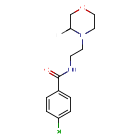
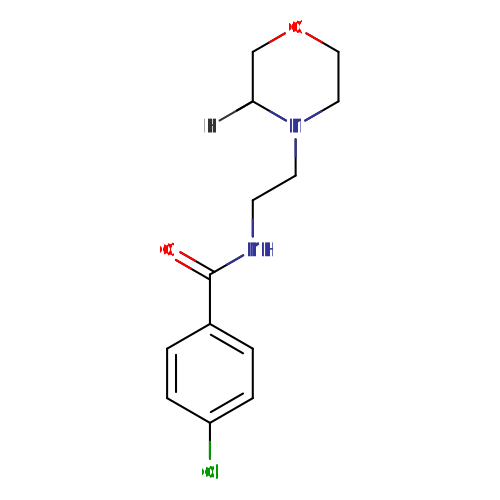
Structure for Moclobemide (DB01171)
- Weight
- Average: 268.739
Monoisotopic: 268.097855505 - Chemical Formula
- C13H17ClN2O2
- Synonyms
- 4-Chlor-N-(2-morpholinoethyl)benzamid
- Moclobemid
- Moclobemida
- Moclobemide
- Moclobemidum
- p-Chloro-N-(2-morpholinoethyl)benzamide
- External IDs
- GNF-PF-695
- RO 11-1163/000
- RO-11-1163/000
- RO-111163000

Pharmacology
- Indication
For the treatment of major depressive disorder and bipolar disorder 1.
 Reduce drug development failure ratesBuild, train, & validate machine-learning modelswith evidence-based and structured datasets.Build, train, & validate predictive machine-learning models with structured datasets.
- Associated Conditions
Indication Type Indication Combined Product Details Approval Level Age Group Patient Characteristics Dose Form Treatment of Major depressive disorder •••••••••••• - Contraindications & Blackbox Warnings
 Prevent Adverse Drug Events TodayTap into our Clinical API for life-saving information on contraindications & blackbox warnings, population restrictions, harmful risks, & more.Avoid life-threatening adverse drug events with our Clinical API
- Pharmacodynamics
A selective, reversible inhibitor of monoamine oxidase (MAO) which increases the 1. Besides its presence in sympathetic nerves, there is an abundant evidence that MAO-A is localized in noradrenergic neurons in the locus coeruleus and MAO-B is closely associated with serotonergic neurons of the raphe nucleus 1.
- Mechanism of action
The mechanism of action of moclobemide involves the selective, reversible inhibition of MAO-A. This inhibition leads to a decrease in the metabolism and destruction of monoamines in the neurotransmitters. This results in an increase in the monoamines, relieving depressive symptoms 1,2.
Target Actions Organism AAmine oxidase [flavin-containing] A antagonistinhibitorHumans UMonoamine oxidase antagonistHumans UAmine oxidase [flavin-containing] B antagonistHumans - Absorption
Well absorbed from the gastrointestinal tract (> 95%). The presence of food reduces the rate but not the extent of absorption. Hepatic first-pass metabolism reduces bioavailability to about 56% following administration of one dose, but increases to 90% with steady-state dosing as a result of saturation of the first pass effect. Peak plasma concentrations are reached within 0.3 - 1 hours following oral administration with a terminal half-life of 1.6h 4.
- Volume of distribution
1-1.5 L/Kg 4
- Protein binding
Approximately 50% (primarily to albumin) 4
- Metabolism
Moclobemide is almost completely metabolized in the liver by Cytochrome P450 2C19 and 2D6. Moclobemide is a substrate of CYP2C19. Although it acts as an inhibitor of CYP1A2, CYP2C19, and CYP2D6 1.
Hover over products below to view reaction partners
- Route of elimination
Moclobemide is almost completely renally excreted 4.
- Half-life
1-2 hours (4 hours in cirrhotic patients); metabolites are renally excreted
- Clearance
Clearance of 30-78 L/h 4, mainly excreted in urine.
- Adverse Effects
 Improve decision support & research outcomesWith structured adverse effects data, including: blackbox warnings, adverse reactions, warning & precautions, & incidence rates. View sample adverse effects data in our new Data Library!Improve decision support & research outcomes with our structured adverse effects data.
- Toxicity
LD50 (mouse) is 730mg/kg and LD50 (rat) is 1,300mg/kg. Signs of toxicity include hypertension, drowsiness, dizziness, confusion, tremors, headache, agitation, muscle rigidity and seizures 3. The effects of moclobemide alone in overdose are negligible, even with high volume ingestion. However, moclobemide overdose with a serotonergic agent (even in small, therapeutic doses) can cause severe serotonin toxicity. The elimination half-life is prolonged by two to four times in overdose, compared with that found in healthy volunteers given therapeutic doses 3.
- Pathways
- Not Available
- Pharmacogenomic Effects/ADRs
- Not Available
Interactions
- Drug Interactions
- This information should not be interpreted without the help of a healthcare provider. If you believe you are experiencing an interaction, contact a healthcare provider immediately. The absence of an interaction does not necessarily mean no interactions exist.
Drug Interaction Integrate drug-drug
interactions in your software1,2-Benzodiazepine The risk or severity of CNS depression can be increased when Moclobemide is combined with 1,2-Benzodiazepine. Abaloparatide Moclobemide may increase the orthostatic hypotensive activities of Abaloparatide. Abatacept The metabolism of Moclobemide can be increased when combined with Abatacept. Abciximab The risk or severity of bleeding and hemorrhage can be increased when Moclobemide is combined with Abciximab. Abiraterone The metabolism of Moclobemide can be decreased when combined with Abiraterone. - Food Interactions
- Avoid excessive or chronic alcohol consumption.
- Avoid tyramine-containing foods and supplements. Avoid excess consumption (<100mg) of tyramine. Food that contains tyramine includes yogurt, aged cheese, ripe bananas, wine, and sourdough bread.
- Take after a meal.
Products
 Drug product information from 10+ global regionsOur datasets provide approved product information including:dosage, form, labeller, route of administration, and marketing period.Access drug product information from over 10 global regions.
- International/Other Brands
- Aurorix
- Brand Name Prescription Products
Name Dosage Strength Route Labeller Marketing Start Marketing End Region Image Manerix Tablet 300 mg Oral Bausch Health, Canada Inc. 1995-12-31 Not applicable Canada 
Manerix Tablet 150 mg Oral Bausch Health, Canada Inc. 1992-12-31 Not applicable Canada Manerix Tab 100mg Tablet 100 mg / tab Oral Hoffmann La Roche 1992-12-31 1997-12-04 Canada Moclobemide Tablet 300 mg Oral Aa Pharma Inc 1999-07-14 Not applicable Canada Moclobemide Tablet 150 mg Oral Aa Pharma Inc 1997-09-18 Not applicable Canada - Generic Prescription Products
Name Dosage Strength Route Labeller Marketing Start Marketing End Region Image Dom-moclobemide Tablets 150mg Tablet 150 mg Oral Dominion Pharmacal 2001-02-15 2016-10-26 Canada Dom-moclobemide Tablets 300mg Tablet 300 mg Oral Dominion Pharmacal 2001-02-15 2016-10-26 Canada Nu-moclobemide Tablet 150 mg Oral Nu Pharm Inc 1998-07-28 2012-09-04 Canada Nu-moclobemide Tablet 100 mg Oral Nu Pharm Inc 1998-07-29 2012-09-04 Canada PMS-moclobemide Tablet 300 mg Oral Pharmascience Inc 2001-01-08 Not applicable Canada
Categories
- ATC Codes
- N06AG02 — Moclobemide
- Drug Categories
- Acids, Carbocyclic
- Agents that produce hypertension
- Agents that reduce seizure threshold
- Amides
- Antidepressive Agents
- Antidepressive Agents Indicated for Depression
- Benzamides and benzamide derivatives
- Benzene Derivatives
- Benzoates
- Central Nervous System Agents
- Central Nervous System Depressants
- Chlorobenzoates
- Cytochrome P-450 CYP2C19 Inhibitors
- Cytochrome P-450 CYP2C19 inhibitors (strength unknown)
- Cytochrome P-450 CYP2C19 Substrates
- Cytochrome P-450 CYP2C9 Substrates
- Cytochrome P-450 CYP2D6 Inhibitors
- Cytochrome P-450 CYP2D6 Inhibitors (strength unknown)
- Cytochrome P-450 CYP2D6 Substrates
- Cytochrome P-450 Enzyme Inhibitors
- Cytochrome P-450 Substrates
- Enzyme Inhibitors
- Monoamine Oxidase A Inhibitors
- Monoamine Oxidase A Inhibitors for interaction with Monoamine Oxidase A substrates
- Monoamine Oxidase Inhibitors
- Nervous System
- Psychoanaleptics
- Psychotropic Drugs
- Serotonergic Drugs Shown to Increase Risk of Serotonin Syndrome
- Serotonin Agents
- Serotonin Modulators
- Chemical TaxonomyProvided by Classyfire
- Description
- This compound belongs to the class of organic compounds known as 4-halobenzoic acids and derivatives. These are benzoic acids or derivatives carrying a halogen atom at the 4-position of the benzene ring.
- Kingdom
- Organic compounds
- Super Class
- Benzenoids
- Class
- Benzene and substituted derivatives
- Sub Class
- Benzoic acids and derivatives
- Direct Parent
- 4-halobenzoic acids and derivatives
- Alternative Parents
- Benzamides / Benzoyl derivatives / Chlorobenzenes / Morpholines / Aryl chlorides / Trialkylamines / Secondary carboxylic acid amides / Amino acids and derivatives / Oxacyclic compounds / Dialkyl ethers show 5 more
- Substituents
- 4-halobenzoic acid or derivatives / Amine / Amino acid or derivatives / Aromatic heteromonocyclic compound / Aryl chloride / Aryl halide / Azacycle / Benzamide / Benzoyl / Carboxamide group show 21 more
- Molecular Framework
- Aromatic heteromonocyclic compounds
- External Descriptors
- benzamides, monochlorobenzenes, morpholines (CHEBI:83531)
- Affected organisms
- Humans and other mammals
Chemical Identifiers
- UNII
- PJ0Y7AZB63
- CAS number
- 71320-77-9
- InChI Key
- YHXISWVBGDMDLQ-UHFFFAOYSA-N
- InChI
- InChI=1S/C13H17ClN2O2/c14-12-3-1-11(2-4-12)13(17)15-5-6-16-7-9-18-10-8-16/h1-4H,5-10H2,(H,15,17)
- IUPAC Name
- 4-chloro-N-[2-(morpholin-4-yl)ethyl]benzamide
- SMILES
- ClC1=CC=C(C=C1)C(=O)NCCN1CCOCC1
References
- General References
- Bonnet U: Moclobemide: therapeutic use and clinical studies. CNS Drug Rev. 2003 Spring;9(1):97-140. doi: 10.1111/j.1527-3458.2003.tb00245.x. [Article]
- Gram LF, Guentert TW, Grange S, Vistisen K, Brosen K: Moclobemide, a substrate of CYP2C19 and an inhibitor of CYP2C19, CYP2D6, and CYP1A2: a panel study. Clin Pharmacol Ther. 1995 Jun;57(6):670-7. doi: 10.1016/0009-9236(95)90230-9. [Article]
- Isbister GK, Hackett LP, Dawson AH, Whyte IM, Smith AJ: Moclobemide poisoning: toxicokinetics and occurrence of serotonin toxicity. Br J Clin Pharmacol. 2003 Oct;56(4):441-50. [Article]
- Monamine Oxidase Inhibitors [Link]
- Citalopram [Link]
- External Links
- Human Metabolome Database
- HMDB0015302
- KEGG Drug
- D02561
- PubChem Compound
- 4235
- PubChem Substance
- 46504667
- ChemSpider
- 4087
- BindingDB
- 15613
- 30121
- ChEBI
- 83531
- ChEMBL
- CHEMBL86304
- ZINC
- ZINC000019606670
- Therapeutic Targets Database
- DAP000576
- PharmGKB
- PA452615
- Wikipedia
- Moclobemide
Clinical Trials
- Clinical Trials
Phase Status Purpose Conditions Count 4 Not Yet Recruiting Treatment Panic Disorder 1 3 Completed Treatment Clozapine-induced Hypersalivation 1 3 Terminated Treatment Anxiety Disorders / Dementia / Depression / Psychosomatic Disorders / Schizophrenia 1 2 Completed Treatment Nicotine Dependence 1 2 Terminated Treatment Addiction 1
Pharmacoeconomics
- Manufacturers
- Not Available
- Packagers
- Not Available
- Dosage Forms
Form Route Strength Solution Oral 100.000 mg Tablet Oral Tablet, coated Oral 150 mg Tablet, film coated Oral Tablet Oral 100 mg / tab Tablet, film coated Oral 150 MG Tablet, film coated Oral 300 MG Tablet Oral 150 mg Tablet Oral 150 mg / tab Tablet Oral 300 mg / tab Tablet Oral 100 mg Tablet Oral 300 mg - Prices
Unit description Cost Unit Manerix 300 mg Tablet 1.34USD tablet Apo-Moclobemide 300 mg Tablet 0.75USD tablet Novo-Moclobemide 300 mg Tablet 0.75USD tablet Pms-Moclobemide 300 mg Tablet 0.75USD tablet Manerix 150 mg Tablet 0.68USD tablet Apo-Moclobemide 150 mg Tablet 0.38USD tablet Novo-Moclobemide 150 mg Tablet 0.38USD tablet Pms-Moclobemide 150 mg Tablet 0.38USD tablet Apo-Moclobemide 100 mg Tablet 0.26USD tablet Novo-Moclobemide 100 mg Tablet 0.26USD tablet Nu-Moclobemide 100 mg Tablet 0.26USD tablet DrugBank does not sell nor buy drugs. Pricing information is supplied for informational purposes only.- Patents
- Not Available
Properties
- State
- Solid
- Experimental Properties
Property Value Source melting point (°C) 132 [L1357] boiling point (°C) 377 [L1357] water solubility 3.52e-04 [L1357] logP 10.6 [L1357] pKa 10.6 (ethanol-air) [L1357] - Predicted Properties
Property Value Source Water Solubility 1.12 mg/mL ALOGPS logP 1.56 ALOGPS logP 1.45 Chemaxon logS -2.4 ALOGPS pKa (Strongest Acidic) 14.73 Chemaxon pKa (Strongest Basic) 6.02 Chemaxon Physiological Charge 0 Chemaxon Hydrogen Acceptor Count 3 Chemaxon Hydrogen Donor Count 1 Chemaxon Polar Surface Area 41.57 Å2 Chemaxon Rotatable Bond Count 4 Chemaxon Refractivity 71.93 m3·mol-1 Chemaxon Polarizability 28.21 Å3 Chemaxon Number of Rings 2 Chemaxon Bioavailability 1 Chemaxon Rule of Five Yes Chemaxon Ghose Filter Yes Chemaxon Veber's Rule No Chemaxon MDDR-like Rule No Chemaxon - Predicted ADMET Features
Property Value Probability Human Intestinal Absorption + 0.9838 Blood Brain Barrier + 0.9691 Caco-2 permeable - 0.5602 P-glycoprotein substrate Substrate 0.6652 P-glycoprotein inhibitor I Inhibitor 0.6892 P-glycoprotein inhibitor II Non-inhibitor 0.8637 Renal organic cation transporter Non-inhibitor 0.5691 CYP450 2C9 substrate Non-substrate 0.8538 CYP450 2D6 substrate Non-substrate 0.9116 CYP450 3A4 substrate Non-substrate 0.5723 CYP450 1A2 substrate Non-inhibitor 0.9138 CYP450 2C9 inhibitor Non-inhibitor 0.8989 CYP450 2D6 inhibitor Non-inhibitor 0.8081 CYP450 2C19 inhibitor Inhibitor 0.8024 CYP450 3A4 inhibitor Non-inhibitor 0.9384 CYP450 inhibitory promiscuity Low CYP Inhibitory Promiscuity 0.5956 Ames test Non AMES toxic 0.6867 Carcinogenicity Non-carcinogens 0.8727 Biodegradation Not ready biodegradable 0.9844 Rat acute toxicity 2.6098 LD50, mol/kg Not applicable hERG inhibition (predictor I) Weak inhibitor 0.7135 hERG inhibition (predictor II) Inhibitor 0.5646
Spectra
- Mass Spec (NIST)
- Not Available
- Spectra
- Chromatographic Properties
Collision Cross Sections (CCS)
Adduct CCS Value (Å2) Source type Source [M-H]- 166.3818777 predictedDarkChem Lite v0.1.0 [M-H]- 156.05547 predictedDeepCCS 1.0 (2019) [M-H]- 166.3818777 predictedDarkChem Lite v0.1.0 [M-H]- 156.05547 predictedDeepCCS 1.0 (2019) [M+H]+ 166.8811777 predictedDarkChem Lite v0.1.0 [M+H]+ 158.44276 predictedDeepCCS 1.0 (2019) [M+H]+ 166.8811777 predictedDarkChem Lite v0.1.0 [M+H]+ 158.44276 predictedDeepCCS 1.0 (2019) [M+Na]+ 166.6011777 predictedDarkChem Lite v0.1.0 [M+Na]+ 164.5066 predictedDeepCCS 1.0 (2019) [M+Na]+ 166.6011777 predictedDarkChem Lite v0.1.0 [M+Na]+ 164.5066 predictedDeepCCS 1.0 (2019)
Targets

- Kind
- Protein
- Organism
- Humans
- Pharmacological action
- Yes
- Actions
- AntagonistInhibitor
- General Function
- Serotonin binding
- Specific Function
- Catalyzes the oxidative deamination of biogenic and xenobiotic amines and has important functions in the metabolism of neuroactive and vasoactive amines in the central nervous system and peripheral...
- Gene Name
- MAOA
- Uniprot ID
- P21397
- Uniprot Name
- Amine oxidase [flavin-containing] A
- Molecular Weight
- 59681.27 Da
References
- Chen X, Ji ZL, Chen YZ: TTD: Therapeutic Target Database. Nucleic Acids Res. 2002 Jan 1;30(1):412-5. [Article]
- Berlin I, Zimmer R, Thiede HM, Payan C, Hergueta T, Robin L, Puech AJ: Comparison of the monoamine oxidase inhibiting properties of two reversible and selective monoamine oxidase-A inhibitors moclobemide and toloxatone, and assessment of their effect on psychometric performance in healthy subjects. Br J Clin Pharmacol. 1990 Dec;30(6):805-16. [Article]
- Fulton B, Benfield P: Moclobemide. An update of its pharmacological properties and therapeutic use. Drugs. 1996 Sep;52(3):450-74. [Article]
- Kind
- Protein group
- Organism
- Humans
- Pharmacological action
- Unknown
- Actions
- Antagonist
- General Function
- Serotonin binding
- Specific Function
- Catalyzes the oxidative deamination of biogenic and xenobiotic amines and has important functions in the metabolism of neuroactive and vasoactive amines in the central nervous system and peripheral...
Components:
References
- Bonnet U: Moclobemide: therapeutic use and clinical studies. CNS Drug Rev. 2003 Spring;9(1):97-140. doi: 10.1111/j.1527-3458.2003.tb00245.x. [Article]
- Kind
- Protein
- Organism
- Humans
- Pharmacological action
- Unknown
- Actions
- Antagonist
- General Function
- Primary amine oxidase activity
- Specific Function
- Catalyzes the oxidative deamination of biogenic and xenobiotic amines and has important functions in the metabolism of neuroactive and vasoactive amines in the central nervous system and peripheral...
- Gene Name
- MAOB
- Uniprot ID
- P27338
- Uniprot Name
- Amine oxidase [flavin-containing] B
- Molecular Weight
- 58762.475 Da
References
- Bonnet U: Moclobemide: therapeutic use and clinical studies. CNS Drug Rev. 2003 Spring;9(1):97-140. doi: 10.1111/j.1527-3458.2003.tb00245.x. [Article]
Enzymes
- Kind
- Protein
- Organism
- Humans
- Pharmacological action
- Unknown
- Actions
- Substrate
- General Function
- Steroid hydroxylase activity
- Specific Function
- Cytochromes P450 are a group of heme-thiolate monooxygenases. In liver microsomes, this enzyme is involved in an NADPH-dependent electron transport pathway. It oxidizes a variety of structurally un...
- Gene Name
- CYP2C9
- Uniprot ID
- P11712
- Uniprot Name
- Cytochrome P450 2C9
- Molecular Weight
- 55627.365 Da
References
- Rendic S: Summary of information on human CYP enzymes: human P450 metabolism data. Drug Metab Rev. 2002 Feb-May;34(1-2):83-448. [Article]
- Kind
- Protein
- Organism
- Humans
- Pharmacological action
- Unknown
- Actions
- SubstrateInhibitor
- General Function
- Steroid hydroxylase activity
- Specific Function
- Responsible for the metabolism of a number of therapeutic agents such as the anticonvulsant drug S-mephenytoin, omeprazole, proguanil, certain barbiturates, diazepam, propranolol, citalopram and im...
- Gene Name
- CYP2C19
- Uniprot ID
- P33261
- Uniprot Name
- Cytochrome P450 2C19
- Molecular Weight
- 55930.545 Da
References
- Gram LF, Guentert TW, Grange S, Vistisen K, Brosen K: Moclobemide, a substrate of CYP2C19 and an inhibitor of CYP2C19, CYP2D6, and CYP1A2: a panel study. Clin Pharmacol Ther. 1995 Jun;57(6):670-7. doi: 10.1016/0009-9236(95)90230-9. [Article]
- Yu KS, Yim DS, Cho JY, Park SS, Park JY, Lee KH, Jang IJ, Yi SY, Bae KS, Shin SG: Effect of omeprazole on the pharmacokinetics of moclobemide according to the genetic polymorphism of CYP2C19. Clin Pharmacol Ther. 2001 Apr;69(4):266-73. doi: 10.1067/mcp.2001.114231. [Article]
- Flockhart Table of Drug Interactions [Link]
- Kind
- Protein
- Organism
- Humans
- Pharmacological action
- Unknown
- Actions
- SubstrateInhibitor
- General Function
- Steroid hydroxylase activity
- Specific Function
- Responsible for the metabolism of many drugs and environmental chemicals that it oxidizes. It is involved in the metabolism of drugs such as antiarrhythmics, adrenoceptor antagonists, and tricyclic...
- Gene Name
- CYP2D6
- Uniprot ID
- P10635
- Uniprot Name
- Cytochrome P450 2D6
- Molecular Weight
- 55768.94 Da
References
- Hartter S, Dingemanse J, Baier D, Ziegler G, Hiemke C: The role of cytochrome P450 2D6 in the metabolism of moclobemide. Eur Neuropsychopharmacol. 1996 Aug;6(3):225-30. [Article]
- Hartter S, Dingemanse J, Baier D, Ziegler G, Hiemke C: Inhibition of dextromethorphan metabolism by moclobemide. Psychopharmacology (Berl). 1998 Jan;135(1):22-6. [Article]
- Flockhart Table of Drug Interactions [Link]
- Health Canada Approved Drug Products: Manerix (Moclobemide) tablets [Link]
- Kind
- Protein
- Organism
- Humans
- Pharmacological action
- Unknown
- Actions
- Inhibitor
- General Function
- Serotonin binding
- Specific Function
- Catalyzes the oxidative deamination of biogenic and xenobiotic amines and has important functions in the metabolism of neuroactive and vasoactive amines in the central nervous system and peripheral...
- Gene Name
- MAOA
- Uniprot ID
- P21397
- Uniprot Name
- Amine oxidase [flavin-containing] A
- Molecular Weight
- 59681.27 Da
References
- Chen X, Ji ZL, Chen YZ: TTD: Therapeutic Target Database. Nucleic Acids Res. 2002 Jan 1;30(1):412-5. [Article]
- Kind
- Protein
- Organism
- Humans
- Pharmacological action
- Unknown
- Actions
- Inhibitor
- General Function
- Primary amine oxidase activity
- Specific Function
- Catalyzes the oxidative deamination of biogenic and xenobiotic amines and has important functions in the metabolism of neuroactive and vasoactive amines in the central nervous system and peripheral...
- Gene Name
- MAOB
- Uniprot ID
- P27338
- Uniprot Name
- Amine oxidase [flavin-containing] B
- Molecular Weight
- 58762.475 Da
References
- Fisar Z, Hroudova J, Raboch J: Inhibition of monoamine oxidase activity by antidepressants and mood stabilizers. Neuro Endocrinol Lett. 2010;31(5):645-56. [Article]

Drug created at June 13, 2005 13:24 / Updated at April 26, 2024 00:45