Identification
- Summary
Estazolam is a benzodiazepine used for the short-term management of insomnia.
- Generic Name
- Estazolam
- DrugBank Accession Number
- DB01215
- Background
A benzodiazepine with anticonvulsant, hypnotic, and muscle relaxant properties. It has been shown in some cases to be more potent than diazepam or nitrazepam.
- Type
- Small Molecule
- Groups
- Approved, Illicit
- Structure
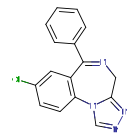
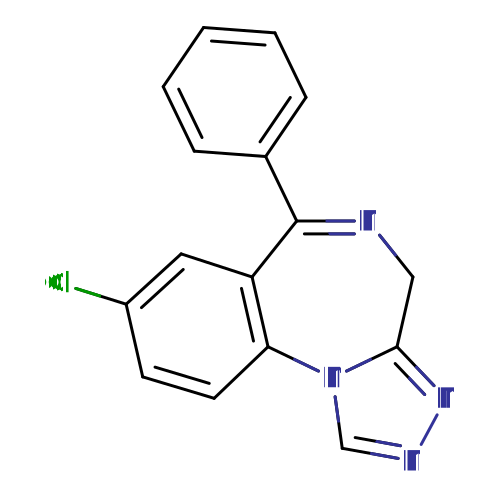
Structure for Estazolam (DB01215)
- Weight
- Average: 294.738
Monoisotopic: 294.067224079 - Chemical Formula
- C16H11ClN4
- Synonyms
- 8-chloro-6-phenyl-4H-s-triazolo(4,3-a)(1,4)benzodiazepine
- Estazolam
- Estazolamum
- External IDs
- ABBOTT-47631

Pharmacology
- Indication
For the short-term management of insomnia characterized by difficulty in falling asleep, frequent nocturnal awakenings, and/or early morning awakenings.
 Reduce drug development failure ratesBuild, train, & validate machine-learning modelswith evidence-based and structured datasets.Build, train, & validate predictive machine-learning models with structured datasets.
- Associated Conditions
Indication Type Indication Combined Product Details Approval Level Age Group Patient Characteristics Dose Form Management of Insomnia •••••••••••• - Contraindications & Blackbox Warnings
 Prevent Adverse Drug Events TodayTap into our Clinical API for life-saving information on contraindications & blackbox warnings, population restrictions, harmful risks, & more.Avoid life-threatening adverse drug events with our Clinical API
- Pharmacodynamics
Estazolam, a triazolobenzodiazepine derivative, is an oral hypnotic agent with anticonvulsant, hypnotic, and muscle relaxant properties. It has been shown in some cases to be more potent than diazepam or nitrazepam.
- Mechanism of action
Benzodiazepines bind nonspecifically to benzodiazepine receptors, which affects affects muscle relaxation, anticonvulsant activity, motor coordination, and memory. As benzodiazepine receptors are thought to be coupled to gamma-aminobutyric acid-A (GABAA) receptors, this enhances the effects GABA by increasing GABA affinity for the GABA receptor. Binding of the inhibitory neurotransmitter GABA to the site opens the chloride channel, resulting in a hyperpolarized cell membrane that prevents further excitation of the cell.
Target Actions Organism AGABA(A) Receptor positive allosteric modulatorHumans AGABA(A) Receptor Benzodiazepine Binding Site ligandHumans - Absorption
Tablets have been found to be equivalent in absorption to an orally administered solution of estazolam. In healthy subjects who received up to three times the recommended dose, peak estazolam plasma concentrations occurred within two hours after dosing (range 0.5 to 6.0 hours) and were proportional to the administered dose, suggesting linear pharmacokinetics over the dosage range tested.
- Volume of distribution
Not Available
- Protein binding
93% protein bound, independant of concentration.
- Metabolism
Extensively metabolized in the liver. In vitro studies with human liver microsomes indicate that the biotransformation of estazolam to the major circulating metabolite 4-hydroxy-estazolam is mediated by cytochrome P450 3A (CYP3A).
Hover over products below to view reaction partners
- Route of elimination
Estazolam is extensively metabolized. The elimination of the parent drug takes place via hepatic metabolism of estazolam to hydroxylated and other metabolites that are eliminated largely in the urine both free and conjugated. Less than 5% of a 2 mg dose of estazolam was excreted unchanged in the urine, with only 4% of the dose appearing in the feces. Radiolabel mass balance studies indicate that the main route of excretion is via the kidneys. After 5 days, 87% of the administered radioactivity was excreted in human urine. Less than 4% of the dose was excreted unchanged.
- Half-life
The range of estimates for the mean elimination half-life of estazolam varies from 10 to 24 hours.
- Clearance
Not Available
- Adverse Effects
 Improve decision support & research outcomesWith structured adverse effects data, including: blackbox warnings, adverse reactions, warning & precautions, & incidence rates. View sample adverse effects data in our new Data Library!Improve decision support & research outcomes with our structured adverse effects data.
- Toxicity
Symptoms of overdose include confusion, depressed breathing, drowsiness and eventually coma, lack of coordination, and slurred speech.
- Pathways
- Not Available
- Pharmacogenomic Effects/ADRs
- Not Available
Interactions
- Drug Interactions
- This information should not be interpreted without the help of a healthcare provider. If you believe you are experiencing an interaction, contact a healthcare provider immediately. The absence of an interaction does not necessarily mean no interactions exist.
Drug Interaction Integrate drug-drug
interactions in your software1,2-Benzodiazepine The risk or severity of CNS depression can be increased when Estazolam is combined with 1,2-Benzodiazepine. Abacavir Abacavir may decrease the excretion rate of Estazolam which could result in a higher serum level. Abametapir The serum concentration of Estazolam can be increased when it is combined with Abametapir. Aceclofenac Aceclofenac may decrease the excretion rate of Estazolam which could result in a higher serum level. Acemetacin Acemetacin may decrease the excretion rate of Estazolam which could result in a higher serum level. - Food Interactions
- Avoid alcohol.
- Take with or without food. The absorption is unaffected by food.
Products
 Drug product information from 10+ global regionsOur datasets provide approved product information including:dosage, form, labeller, route of administration, and marketing period.Access drug product information from over 10 global regions.
- Product Images


- International/Other Brands
- Esilgan (Takeda) / Eurodin (Takeda) / Nuctalon (Takeda)
- Brand Name Prescription Products
Name Dosage Strength Route Labeller Marketing Start Marketing End Region Image Prosom Tablet 1 mg/1 Oral Abbvie 1990-12-26 2008-03-31 US 
Prosom Tablet 2 mg/1 Oral Abbvie 1990-12-31 2008-03-31 US Prosom Tab 1mg Tablet 1 mg / tab Oral Abbott 1993-12-31 1997-08-18 Canada 
Prosom Tab 2mg Tablet 2 mg / tab Oral Abbott 1993-12-31 1997-08-18 Canada - Generic Prescription Products
Name Dosage Strength Route Labeller Marketing Start Marketing End Region Image Estazolam Tablet 1 mg/1 Oral Golden State Medical Supply 1997-08-19 2013-12-31 US Estazolam Tablet 2 mg/1 Oral Par Pharmaceutical 2009-06-30 2009-06-30 US Estazolam Tablet 2 mg/1 Oral Dr. Reddy's Labratories Inc. 2024-02-15 Not applicable US Estazolam Tablet 1 mg/1 Oral Novitium Pharma Llc 2021-04-08 Not applicable US Estazolam Tablet 2 mg/1 Oral Rebel Distributors 1997-08-19 Not applicable US


Categories
- ATC Codes
- N05CD04 — Estazolam
- Drug Categories
- Anti-Anxiety Agents
- Anticonvulsants
- Benzazepines
- Benzodiazepine hypnotics and sedatives
- Benzodiazepines and benzodiazepine derivatives
- Central Nervous System Agents
- Central Nervous System Depressants
- Cytochrome P-450 CYP3A Substrates
- Cytochrome P-450 CYP3A4 Substrates
- Cytochrome P-450 Substrates
- Drugs causing inadvertant photosensitivity
- Drugs that are Mainly Renally Excreted
- GABA Agents
- GABA Modulators
- Heterocyclic Compounds, Fused-Ring
- Hypnotics and Sedatives
- Nervous System
- Neurotransmitter Agents
- Photosensitizing Agents
- Psycholeptics
- Psychotropic Drugs
- Tranquilizing Agents
- Triazolobenzodiazepines
- Chemical TaxonomyProvided by Classyfire
- Description
- This compound belongs to the class of organic compounds known as 1,2,4-triazolo[4,3-a][1,4]benzodiazepines. These are aromatic compounds containing a 1,4-benzodiazepine fused to and sharing a nitrogen atom with a 1,2,4-triazole ring.
- Kingdom
- Organic compounds
- Super Class
- Organoheterocyclic compounds
- Class
- Benzodiazepines
- Sub Class
- 1,4-benzodiazepines
- Direct Parent
- 1,2,4-triazolo[4,3-a][1,4]benzodiazepines
- Alternative Parents
- Benzene and substituted derivatives / Aryl chlorides / Triazoles / Heteroaromatic compounds / Ketimines / Propargyl-type 1,3-dipolar organic compounds / Azacyclic compounds / Organopnictogen compounds / Organochlorides / Hydrocarbon derivatives
- Substituents
- 1,2,4-triazole / 1,2,4-triazolo[4,3-a][1,4]benzodiazepine / Aromatic heteropolycyclic compound / Aryl chloride / Aryl halide / Azacycle / Azole / Benzenoid / Heteroaromatic compound / Hydrocarbon derivative
- Molecular Framework
- Aromatic heteropolycyclic compounds
- External Descriptors
- triazoles, triazolobenzodiazepine (CHEBI:4858)
- Affected organisms
- Humans and other mammals
Chemical Identifiers
- UNII
- 36S3EQV54C
- CAS number
- 29975-16-4
- InChI Key
- CDCHDCWJMGXXRH-UHFFFAOYSA-N
- InChI
- InChI=1S/C16H11ClN4/c17-12-6-7-14-13(8-12)16(11-4-2-1-3-5-11)18-9-15-20-19-10-21(14)15/h1-8,10H,9H2
- IUPAC Name
- 12-chloro-9-phenyl-2,4,5,8-tetraazatricyclo[8.4.0.0^{2,6}]tetradeca-1(10),3,5,8,11,13-hexaene
- SMILES
- ClC1=CC2=C(C=C1)N1C=NN=C1CN=C2C1=CC=CC=C1
References
- Synthesis Reference
Hester, J.B. Jr.; U.S. Patent 3,701,782; October 31, 1972; assigned to The Upjohn Co.
- General References
- Watanabe S, Ohta H, Sakurai Y, Takao K, Ueki S: [Electroencephalographic effects of 450191-S and its metabolites in rabbits with chronic electrode implants]. Nihon Yakurigaku Zasshi. 1986 Jul;88(1):19-32. [Article]
- Oishi R, Nishibori M, Itoh Y, Saeki K: Diazepam-induced decrease in histamine turnover in mouse brain. Eur J Pharmacol. 1986 May 27;124(3):337-42. [Article]
- Usami N, Yamamoto T, Shintani S, Ishikura S, Higaki Y, Katagiri Y, Hara A: Substrate specificity of human 3(20)alpha-hydroxysteroid dehydrogenase for neurosteroids and its inhibition by benzodiazepines. Biol Pharm Bull. 2002 Apr;25(4):441-5. [Article]
- External Links
- Human Metabolome Database
- HMDB0015346
- KEGG Drug
- D00311
- KEGG Compound
- C06981
- PubChem Compound
- 3261
- PubChem Substance
- 46507430
- ChemSpider
- 3146
- BindingDB
- 50240450
- 4077
- ChEBI
- 4858
- ChEMBL
- CHEMBL285674
- ZINC
- ZINC000000001370
- Therapeutic Targets Database
- DAP000930
- PharmGKB
- PA449502
- RxList
- RxList Drug Page
- Drugs.com
- Drugs.com Drug Page
- PDRhealth
- PDRhealth Drug Page
- Wikipedia
- Estazolam
Clinical Trials
- Clinical Trials
Phase Status Purpose Conditions Count 4 Completed Treatment Primary Insomnia / Sleep Initiation and Maintenance Disorders 1 4 Unknown Status Treatment Renal Dialysis / Sleep Initiation and Maintenance Disorders 1 3 Completed Treatment Sleep Initiation and Maintenance Disorders 1 Not Available Completed Treatment Circadian Rhythms / Insomnia Chronic / Traditional Chinese Medicine 1 Not Available Not Yet Recruiting Treatment Estazolam-dependent Insomnia 1
Pharmacoeconomics
- Manufacturers
- Not Available
- Packagers
- Abbott Laboratories Ltd.
- Dispensing Solutions
- Lake Erie Medical and Surgical Supply
- Murfreesboro Pharmaceutical Nursing Supply
- Par Pharmaceuticals
- Rebel Distributors Corp.
- Southwood Pharmaceuticals
- Teva Pharmaceutical Industries Ltd.
- Watson Pharmaceuticals
- Dosage Forms
Form Route Strength Tablet Oral Solution / drops Oral 1 MG/ML Tablet Oral 1 MG Tablet Oral 2 MG Tablet Oral 1 mg/1 Tablet Oral 2 mg/1 Tablet Oral 1 mg / tab Tablet Oral 2 mg / tab Tablet Oral 2.000 mg - Prices
Unit description Cost Unit Prosom 2 mg tablet 1.71USD tablet Prosom 1 mg tablet 1.53USD tablet Estazolam 2 mg tablet 0.96USD tablet Estazolam 1 mg tablet 0.86USD tablet DrugBank does not sell nor buy drugs. Pricing information is supplied for informational purposes only.- Patents
- Not Available
Properties
- State
- Solid
- Experimental Properties
Property Value Source melting point (°C) 228-229 Hester, J.B. Jr.; U.S. Patent 3,701,782; October 31, 1972; assigned to The Upjohn Co. water solubility Practically insoluble (1.5 mg/L) Not Available logP 4.7 Not Available - Predicted Properties
Property Value Source Water Solubility 0.0423 mg/mL ALOGPS logP 1.72 ALOGPS logP 2.9 Chemaxon logS -3.8 ALOGPS pKa (Strongest Acidic) 18.3 Chemaxon pKa (Strongest Basic) 4.9 Chemaxon Physiological Charge 0 Chemaxon Hydrogen Acceptor Count 3 Chemaxon Hydrogen Donor Count 0 Chemaxon Polar Surface Area 43.07 Å2 Chemaxon Rotatable Bond Count 1 Chemaxon Refractivity 94.44 m3·mol-1 Chemaxon Polarizability 29.83 Å3 Chemaxon Number of Rings 4 Chemaxon Bioavailability 1 Chemaxon Rule of Five Yes Chemaxon Ghose Filter Yes Chemaxon Veber's Rule No Chemaxon MDDR-like Rule No Chemaxon - Predicted ADMET Features
Property Value Probability Human Intestinal Absorption + 1.0 Blood Brain Barrier + 0.9796 Caco-2 permeable + 0.8427 P-glycoprotein substrate Non-substrate 0.5939 P-glycoprotein inhibitor I Non-inhibitor 0.7883 P-glycoprotein inhibitor II Inhibitor 0.7786 Renal organic cation transporter Inhibitor 0.7784 CYP450 2C9 substrate Non-substrate 0.8367 CYP450 2D6 substrate Non-substrate 0.9081 CYP450 3A4 substrate Substrate 0.674 CYP450 1A2 substrate Inhibitor 0.8989 CYP450 2C9 inhibitor Inhibitor 0.822 CYP450 2D6 inhibitor Non-inhibitor 0.8586 CYP450 2C19 inhibitor Inhibitor 0.6571 CYP450 3A4 inhibitor Non-inhibitor 0.6818 CYP450 inhibitory promiscuity High CYP Inhibitory Promiscuity 0.8676 Ames test Non AMES toxic 0.9132 Carcinogenicity Non-carcinogens 0.7126 Biodegradation Not ready biodegradable 1.0 Rat acute toxicity 2.0584 LD50, mol/kg Not applicable hERG inhibition (predictor I) Weak inhibitor 0.9752 hERG inhibition (predictor II) Non-inhibitor 0.8944
Spectra
- Mass Spec (NIST)
- Not Available
- Spectra
- Chromatographic Properties
Collision Cross Sections (CCS)
Adduct CCS Value (Å2) Source type Source [M-H]- 168.4597181 predictedDarkChem Lite v0.1.0 [M-H]- 161.69096 predictedDeepCCS 1.0 (2019) [M-H]- 168.4597181 predictedDarkChem Lite v0.1.0 [M-H]- 161.69096 predictedDeepCCS 1.0 (2019) [M+H]+ 169.1288181 predictedDarkChem Lite v0.1.0 [M+H]+ 164.04898 predictedDeepCCS 1.0 (2019) [M+H]+ 169.1288181 predictedDarkChem Lite v0.1.0 [M+H]+ 164.04898 predictedDeepCCS 1.0 (2019) [M+Na]+ 168.9050181 predictedDarkChem Lite v0.1.0 [M+Na]+ 170.14214 predictedDeepCCS 1.0 (2019) [M+Na]+ 168.9050181 predictedDarkChem Lite v0.1.0 [M+Na]+ 170.14214 predictedDeepCCS 1.0 (2019)
Targets

- Kind
- Protein group
- Organism
- Humans
- Pharmacological action
- Yes
- Actions
- Positive allosteric modulator
- Curator comments
- The GABA(A) receptor is pentameric (i.e. comprising 5 subunit proteins) and therefore has a multitude of potential isoforms. The above target is a collection of all possible GABA(A) subunits that may participate in the formation of the pentameric receptor and is not meant to imply direct a drug-protein interaction for each individual subunit.
- General Function
- Inhibitory extracellular ligand-gated ion channel activity
- Specific Function
- Component of the heteropentameric receptor for GABA, the major inhibitory neurotransmitter in the vertebrate brain. Functions also as histamine receptor and mediates cellular responses to histamine...
Components:
References
- Sigel E, Steinmann ME: Structure, function, and modulation of GABA(A) receptors. J Biol Chem. 2012 Nov 23;287(48):40224-31. doi: 10.1074/jbc.R112.386664. Epub 2012 Oct 4. [Article]
- Zhu S, Noviello CM, Teng J, Walsh RM Jr, Kim JJ, Hibbs RE: Structure of a human synaptic GABAA receptor. Nature. 2018 Jul;559(7712):67-72. doi: 10.1038/s41586-018-0255-3. Epub 2018 Jun 27. [Article]
- Kind
- Protein group
- Organism
- Humans
- Pharmacological action
- Yes
- Actions
- Ligand
- Curator comments
- Benzodiazepines modulate GABA(A) function by binding at the interface between alpha (α) and gamma (γ) subunits. Of the 6 α-subunits, only 4 (α-1, -2, -3, and -5) participate in the formation of this binding site. The above target is a collection of all α- and γ-subunits that are known to participate in the formation of the benzodiazepine binding site.
- General Function
- Inhibitory extracellular ligand-gated ion channel activity
- Specific Function
- Component of the heteropentameric receptor for GABA, the major inhibitory neurotransmitter in the vertebrate brain. Functions also as histamine receptor and mediates cellular responses to histamine...
Components:
References
- Sigel E, Steinmann ME: Structure, function, and modulation of GABA(A) receptors. J Biol Chem. 2012 Nov 23;287(48):40224-31. doi: 10.1074/jbc.R112.386664. Epub 2012 Oct 4. [Article]
- Zhu S, Noviello CM, Teng J, Walsh RM Jr, Kim JJ, Hibbs RE: Structure of a human synaptic GABAA receptor. Nature. 2018 Jul;559(7712):67-72. doi: 10.1038/s41586-018-0255-3. Epub 2018 Jun 27. [Article]
Enzymes
- Kind
- Protein
- Organism
- Humans
- Pharmacological action
- Unknown
- Actions
- Substrate
- General Function
- Vitamin d3 25-hydroxylase activity
- Specific Function
- Cytochromes P450 are a group of heme-thiolate monooxygenases. In liver microsomes, this enzyme is involved in an NADPH-dependent electron transport pathway. It performs a variety of oxidation react...
- Gene Name
- CYP3A4
- Uniprot ID
- P08684
- Uniprot Name
- Cytochrome P450 3A4
- Molecular Weight
- 57342.67 Da
References
- Miura M, Otani K, Ohkubo T: Identification of human cytochrome P450 enzymes involved in the formation of 4-hydroxyestazolam from estazolam. Xenobiotica. 2005 May;35(5):455-65. [Article]

Drug created at June 13, 2005 13:24 / Updated at February 21, 2021 18:51