Identification
- Summary
Aminophylline is a bronchodilator consisting of theophylline that is used for the treatment of bronchospasm due to asthma, emphysema and chronic bronchitis.
- Generic Name
- Aminophylline
- DrugBank Accession Number
- DB01223
- Background
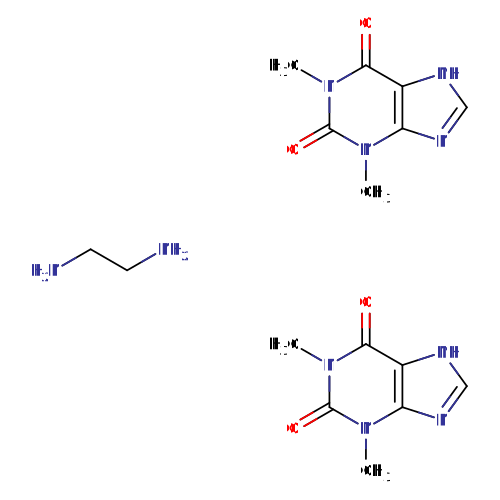
Aminophylline is a drug combination that contains theophylline and ethylenediamine in a 2:1 ratio. Once in the body, theophylline is released and acts as a phosphodiesterase inhibitor, adenosine receptor blocker, and histone deacetylase activator. Similar to other theophyllines, aminophylline is indicated for the treatment of lung diseases such as asthma, chronic bronchitis, and COPD. The majority of aminophylline medications are discontinued and the remaining medications on the market are in short supply.
- Type
- Small Molecule
- Groups
- Approved
- Structure
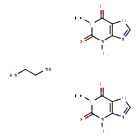
Structure for Aminophylline (DB01223)
- Weight
- Average: 420.4264
Monoisotopic: 420.198199306 - Chemical Formula
- C16H24N10O4
- Synonyms
- Aminofilina
- Aminophyllin
- Aminophylline
- Aminophyllinum
- Theophyline ethylenediamine
- Theophylline ethylenediamine

Pharmacology
- Indication
For the treatment of bronchospasm due to asthma, emphysema and chronic bronchitis.
 Reduce drug development failure ratesBuild, train, & validate machine-learning modelswith evidence-based and structured datasets.Build, train, & validate predictive machine-learning models with structured datasets.
- Associated Conditions
Indication Type Indication Combined Product Details Approval Level Age Group Patient Characteristics Dose Form Adjunct therapy in treatment of Acute exacerbation of chronic bronchitis •••••••••••• Management of Asthma •••••••••••• Management of Bronchial asthma •••••••••••• ••••••••••• Management of Bronchospasm •••••••••••• ••••••••••• Management of Chronic bronchitis •••••••••••• - Contraindications & Blackbox Warnings
 Prevent Adverse Drug Events TodayTap into our Clinical API for life-saving information on contraindications & blackbox warnings, population restrictions, harmful risks, & more.Avoid life-threatening adverse drug events with our Clinical API
- Pharmacodynamics
Aminophylline is the ethylenediamine salt of theophylline. Theophylline stimulates the CNS, skeletal muscles, and cardiac muscle. It relaxes certain smooth muscles in the bronchi, produces diuresis, and causes an increase in gastric secretion.
- Mechanism of action
Aminophylline is the ethylenediamine salt of theophylline. After ingestion, theophylline is released from aminophylline, and theophylline relaxes the smooth muscle of the bronchial airways and pulmonary blood vessels and reduces airway responsiveness to histamine, methacholine, adenosine, and allergen. Theophylline competitively inhibits type III and type IV phosphodiesterase (PDE), the enzyme responsible for breaking down cyclic AMP in smooth muscle cells, possibly resulting in bronchodilation. Theophylline also binds to the adenosine A2B receptor and blocks adenosine mediated bronchoconstriction. In inflammatory states, theophylline activates histone deacetylase to prevent transcription of inflammatory genes that require the acetylation of histones for transcription to begin.
Target Actions Organism AcGMP-inhibited 3',5'-cyclic phosphodiesterase A inhibitorHumans AAdenosine receptor A1 antagonistHumans AAdenosine receptor A3 antagonistHumans AHistone deacetylase 2 activatorHumans - Absorption
Not Available
- Volume of distribution
- 0.3 to 0.7 L/kg
- Protein binding
60%
- Metabolism
- Not Available
- Route of elimination
Not Available
- Half-life
7-9 hours
- Clearance
- 0.29 mL/kg/min [postnatal age 3-15 days]
- 0.64 mL/kg/min [postnatal age 25-57 days]
- 1.7 mL/kg/min [ 1-4 years]
- 1.6 mL/kg/min [4-12 years]
- 0.9 mL/kg/min [13-15 years]
- 1.4 mL/kg/min [16-17 years]
- 0.65 mL/kg/min [Adults (16-60 years), non-smoking asthmatics]
- 0.41 mL/kg/min [Elderly (>60 years). liver, and renal function]
- 0.33 mL/kg/min [Acute pulmonary edema]
- 0.54 mL/kg/min [COPD->60 years, stable non-smoker >1 year]
- 0.48 mL/kg/min [COPD with cor pulmonale]
- 1.25 mL/kg/min [Cystic fibrosis (14-28 years)]
- 0.31 mL/kg/min [Liver disease -cholestasis]
- 0.35 mL/kg/min [cirrhosis]
- 0.65 mL/kg/min [acute hepatitis]
- 0.47 mL/kg/min [Sepsis with multi-organ failure]
- 0.38 mL/kg/min [hypothyroid]
- 0.8 mL/kg/min [hyperthyroid]
- Adverse Effects
 Improve decision support & research outcomesWith structured adverse effects data, including: blackbox warnings, adverse reactions, warning & precautions, & incidence rates. View sample adverse effects data in our new Data Library!Improve decision support & research outcomes with our structured adverse effects data.
- Toxicity
Not Available
- Pathways
- Not Available
- Pharmacogenomic Effects/ADRs
- Not Available
Interactions
- Drug Interactions
- This information should not be interpreted without the help of a healthcare provider. If you believe you are experiencing an interaction, contact a healthcare provider immediately. The absence of an interaction does not necessarily mean no interactions exist.
Drug Interaction Integrate drug-drug
interactions in your software1,2-Benzodiazepine The therapeutic efficacy of 1,2-Benzodiazepine can be decreased when used in combination with Aminophylline. Abametapir The serum concentration of Aminophylline can be increased when it is combined with Abametapir. Abatacept The metabolism of Aminophylline can be increased when combined with Abatacept. Abiraterone The serum concentration of Aminophylline can be increased when it is combined with Abiraterone. Acalabrutinib The metabolism of Aminophylline can be decreased when combined with Acalabrutinib. - Food Interactions
- Administer vitamin supplements. Aminophylline may reduce Vitamin B6 levels as an adverse effect. Consider supplementation.
- Avoid excessive or chronic alcohol consumption. Ingesting a large amount of alcohol may reduce aminophylline clearance, therefore increasing its serum concentration.
- Exercise caution with grapefruit products. Grapefruit inhibits CYP3A4 metabolism, which may increase the serum concentration of aminophylline.
- Exercise caution with St. John's Wort. This herb induces the CYP3A4 metabolism of aminophylline. Therefore it may reduce the serum concentration and effectiveness of aminophylline.
- Limit caffeine intake. Excessive caffeine intake with aminophylline may exacerbate caffiene-like side effects such as nausea, nervousness, irritability, insomnia and tremors.
- Take with food. This may reduce gastric irritation. Aminophylline absorption is slower when taken with food.
Products
 Drug product information from 10+ global regionsOur datasets provide approved product information including:dosage, form, labeller, route of administration, and marketing period.Access drug product information from over 10 global regions.
- Product Ingredients
Ingredient UNII CAS InChI Key Aminophylline dihydrate C229N9DX94 5897-66-5 FXNJPZOEDHBGEY-UHFFFAOYSA-N - Active Moieties
Name Kind UNII CAS InChI Key Theophylline unknown 0I55128JYK 58-55-9 ZFXYFBGIUFBOJW-UHFFFAOYSA-N - International/Other Brands
- Minomal / Somophyllin
- Brand Name Prescription Products
Name Dosage Strength Route Labeller Marketing Start Marketing End Region Image Aminophylline Injection, solution 25 mg/1mL Intravenous Hospira, Inc. 2006-11-07 2006-11-07 US 
Aminophylline Injection, solution 25 mg/1mL Intravenous Hospira, Inc. 2006-11-07 2006-11-07 US Aminophylline Inj 25mg/ml Solution 25 mg / mL Intravenous Omega Laboratories Ltd 1984-12-31 Not applicable Canada 
Aminophylline Inj 50mg/ml Solution 50 mg / mL Intravenous Omega Laboratories Ltd 1984-12-31 Not applicable Canada Aminophylline Injection 50mg/ml Solution 50 mg / mL Intravenous Hospira Healthcare Ulc 1981-12-31 2012-08-03 Canada - Generic Prescription Products
Name Dosage Strength Route Labeller Marketing Start Marketing End Region Image Aminophylline Injection, solution 25 mg/1mL Intravenous Hospira, Inc. 2005-05-10 Not applicable US Aminophylline Injection, solution 25 mg/1mL Intravenous Medical Purchasing Solutions, Llc 2005-02-28 Not applicable US Aminophylline Injection, solution 25 mg/1mL Intravenous General Injectables & Vaccines, Inc 2010-07-01 2023-08-01 US Aminophylline Injection 25 mg/1mL Intravenous American Regent 1982-06-15 2008-10-09 US Aminophylline Injection, solution 25 mg/1mL Intravenous Cardinal Health 2011-02-11 2018-09-30 US - Unapproved/Other Products
Name Ingredients Dosage Route Labeller Marketing Start Marketing End Region Image AMINOCARDOL 10 ML 240 MG 100 AMPUL Aminophylline (240 mg/10ml) Injection, solution Intravenous NOVARTİS ÜRÜNLERİ 2018-07-31 2022-04-11 Turkey 
AMINOCARDOL 240MG/10 ML 3 AMPUL Aminophylline (240 mg/10ml) Injection, solution Intravenous NOVARTİS ÜRÜNLERİ 2018-07-31 2022-04-11 Turkey
Categories
- ATC Codes
- R03DA55 — Aminophylline, combinations
- R03DA — Xanthines
- R03D — OTHER SYSTEMIC DRUGS FOR OBSTRUCTIVE AIRWAY DISEASES
- R03 — DRUGS FOR OBSTRUCTIVE AIRWAY DISEASES
- R — RESPIRATORY SYSTEM
- R03DA — Xanthines
- R03D — OTHER SYSTEMIC DRUGS FOR OBSTRUCTIVE AIRWAY DISEASES
- R03 — DRUGS FOR OBSTRUCTIVE AIRWAY DISEASES
- R — RESPIRATORY SYSTEM
- R03DA — Xanthines
- R03D — OTHER SYSTEMIC DRUGS FOR OBSTRUCTIVE AIRWAY DISEASES
- R03 — DRUGS FOR OBSTRUCTIVE AIRWAY DISEASES
- R — RESPIRATORY SYSTEM
- Drug Categories
- Agents that reduce seizure threshold
- Amines
- Anti-Asthmatic Agents
- Autonomic Agents
- Bronchodilator Agents
- Cardiotonic Agents
- Cardiovascular Agents
- Compounds used in a research, industrial, or household setting
- Cytochrome P-450 CYP1A2 Substrates
- Cytochrome P-450 CYP1A2 Substrates with a Narrow Therapeutic Index
- Cytochrome P-450 CYP2E1 Substrates
- Cytochrome P-450 CYP2E1 Substrates with a Narrow Therapeutic Index
- Cytochrome P-450 CYP3A Substrates
- Cytochrome P-450 CYP3A4 Substrates
- Cytochrome P-450 CYP3A4 Substrates with a Narrow Therapeutic Index
- Cytochrome P-450 Substrates
- Diamines
- Drugs for Obstructive Airway Diseases
- Enzyme Inhibitors
- Ethylenediamines
- Heterocyclic Compounds, Fused-Ring
- Narrow Therapeutic Index Drugs
- Neurotransmitter Agents
- Peripheral Nervous System Agents
- Pharmaceutical Preparations
- Phosphodiesterase Inhibitors
- Polyamines
- Protective Agents
- Purinergic Agents
- Purinergic Antagonists
- Purinergic P1 Receptor Antagonists
- Purines
- Purinones
- Respiratory Smooth Muscle Relaxants
- Respiratory System Agents
- Xanthine derivatives
- Xanthines and Adrenergics
- Chemical TaxonomyProvided by Classyfire
- Description
- This compound belongs to the class of organic compounds known as monoalkylamines. These are organic compounds containing an primary aliphatic amine group.
- Kingdom
- Organic compounds
- Super Class
- Organic nitrogen compounds
- Class
- Organonitrogen compounds
- Sub Class
- Amines
- Direct Parent
- Monoalkylamines
- Alternative Parents
- Organopnictogen compounds / Hydrocarbon derivatives
- Substituents
- Aromatic heteropolycyclic compound / Hydrocarbon derivative / Organopnictogen compound / Primary aliphatic amine
- Molecular Framework
- Not Available
- External Descriptors
- Not Available
- Affected organisms
- Humans and other mammals
Chemical Identifiers
- UNII
- 27Y3KJK423
- CAS number
- 317-34-0
- InChI Key
- FQPFAHBPWDRTLU-UHFFFAOYSA-N
- InChI
- InChI=1S/2C7H8N4O2.C2H8N2/c2*1-10-5-4(8-3-9-5)6(12)11(2)7(10)13;3-1-2-4/h2*3H,1-2H3,(H,8,9);1-4H2
- IUPAC Name
- bis(1,3-dimethyl-2,3,6,7-tetrahydro-1H-purine-2,6-dione); ethane-1,2-diamine
- SMILES
- NCCN.CN1C2=C(NC=N2)C(=O)N(C)C1=O.CN1C2=C(NC=N2)C(=O)N(C)C1=O
References
- General References
- AIFA Product Information: Aminomal (aminophylline) for injection or rectal administration [Link]
- External Links
- Human Metabolome Database
- HMDB0015354
- KEGG Drug
- D00227
- PubChem Compound
- 9433
- PubChem Substance
- 46508784
- ChemSpider
- 9062
- 689
- ChEBI
- 2659
- ChEMBL
- CHEMBL1370561
- Therapeutic Targets Database
- DAP000613
- PharmGKB
- PA164781029
- Drugs.com
- Drugs.com Drug Page
- Wikipedia
- Aminophylline
- MSDS
- Download (72.7 KB)
Clinical Trials
- Clinical Trials
Phase Status Purpose Conditions Count 4 Completed Prevention Acute Kidney Injury (AKI) 1 4 Completed Prevention Patients With Severe Chronic Kidney Disease Being Evaluated With Nuclear Stress Testing of the Heart Using the Stress Agent Regadenoson 1 4 Completed Treatment Anesthesia therapy 1 4 Completed Treatment Postdural Puncture Headache 1 4 Not Yet Recruiting Treatment Complete Heart Block / Inferior Wall Myocardial Infarction 1
Pharmacoeconomics
- Manufacturers
- Not Available
- Packagers
- Amend
- C.O. Truxton Inc.
- Cardinal Health
- Carlisle Laboratories Inc.
- Dispensing Solutions
- G & W Labs
- General Injectables and Vaccines Inc.
- Hospira Inc.
- Kaiser Foundation Hospital
- Lake Erie Medical and Surgical Supply
- Major Pharmaceuticals
- Murfreesboro Pharmaceutical Nursing Supply
- PCA LLC
- Pharmedix
- Prescript Pharmaceuticals
- West-Ward Pharmaceuticals
- Dosage Forms
Form Route Strength Solution Intravenous 240 mg Solution Intravenous 250 mg Suppository Rectal Tablet, chewable Oral Injection, solution Intravenous 240 MG/10ML Injection, solution Intravenous; Parenteral 240 MG/10ML Injection, solution Intravenous Tablet, coated Oral Injection, solution 240 MG/10ML Injection, solution Intramuscular 350 mg/2ml Pill 200 MG Solution Intramuscular 350 mg/2ml Suppository Rectal 350 MG Tablet Oral 600 mg Tablet, extended release Oral 600 MG Injection Intravenous Injection Intravenous 25 mg/1mL Injection, solution Intravenous 25 mg/1mL Solution Oral 105 mg/5mL Tablet Oral Tablet Oral 100 mg/1 Tablet Oral 200 mg/1 Tablet, film coated Oral Solution Intravenous 50 mg / mL Injection Intravenous 0.25 g/10ml Solution Intravenous 25 mg / mL Tablet Oral 100 mg / tab Tablet Oral 97.5 mg Injection Intravenous 250 mg/10mL Solution Parenteral 250.000 mg Capsule Oral 200 mg Tablet, extended release Oral 225 mg Tablet, extended release Oral 350 mg Injection, solution Intramuscular Suppository Rectal 250 mg/1 Suppository Rectal 500 mg/1 Solution Intravenous 250.000 mg Solution 25 mg/1ml Tablet Oral 100 mg Tablet, coated Oral 100 mg - Prices
Unit description Cost Unit Aminophylline 250 mg/10 ml vial 0.48USD ml Aminophylline 25 mg/ml 0.41USD ml Phyllocontin-350 350 mg Sustained-Release Tablet 0.31USD tablet Aminophylline 100 mg tablet 0.26USD tablet Phyllocontin 225 mg Sustained-Release Tablet 0.24USD tablet Aminophylline powder 0.17USD g Aminophylline 200 mg tablet 0.15USD tablet DrugBank does not sell nor buy drugs. Pricing information is supplied for informational purposes only.- Patents
- Not Available
Properties
- State
- Solid
- Experimental Properties
Property Value Source water solubility 2E+005 mg/L MERCK INDEX (1996) logP -3.03 Not Available - Predicted Properties
Property Value Source Water Solubility 22.9 mg/mL ALOGPS logP -0.26 ALOGPS logP -0.77 Chemaxon logS -0.9 ALOGPS pKa (Strongest Acidic) 7.82 Chemaxon pKa (Strongest Basic) -0.78 Chemaxon Physiological Charge 0 Chemaxon Hydrogen Acceptor Count 3 Chemaxon Hydrogen Donor Count 1 Chemaxon Polar Surface Area 69.3 Å2 Chemaxon Rotatable Bond Count 1 Chemaxon Refractivity 44.93 m3·mol-1 Chemaxon Polarizability 16.86 Å3 Chemaxon Number of Rings 4 Chemaxon Bioavailability 1 Chemaxon Rule of Five Yes Chemaxon Ghose Filter No Chemaxon Veber's Rule No Chemaxon MDDR-like Rule No Chemaxon - Predicted ADMET Features
Property Value Probability Human Intestinal Absorption + 0.9778 Blood Brain Barrier + 0.5908 Caco-2 permeable - 0.6802 P-glycoprotein substrate Substrate 0.7341 P-glycoprotein inhibitor I Non-inhibitor 0.9164 P-glycoprotein inhibitor II Non-inhibitor 0.9673 Renal organic cation transporter Non-inhibitor 0.7935 CYP450 2C9 substrate Non-substrate 0.8073 CYP450 2D6 substrate Non-substrate 0.8093 CYP450 3A4 substrate Substrate 0.5482 CYP450 1A2 substrate Non-inhibitor 0.8726 CYP450 2C9 inhibitor Non-inhibitor 0.9332 CYP450 2D6 inhibitor Non-inhibitor 0.9633 CYP450 2C19 inhibitor Non-inhibitor 0.9184 CYP450 3A4 inhibitor Non-inhibitor 0.8031 CYP450 inhibitory promiscuity Low CYP Inhibitory Promiscuity 0.8858 Ames test Non AMES toxic 0.6724 Carcinogenicity Non-carcinogens 0.8696 Biodegradation Not ready biodegradable 0.9149 Rat acute toxicity 2.4979 LD50, mol/kg Not applicable hERG inhibition (predictor I) Weak inhibitor 0.7876 hERG inhibition (predictor II) Inhibitor 0.6143
Spectra
- Mass Spec (NIST)
- Not Available
- Spectra
Spectrum Spectrum Type Splash Key LC-MS/MS Spectrum - LC-ESI-qTof , Positive LC-MS/MS splash10-001i-1900000000-f6d60952fa154f363515 MS/MS Spectrum - , positive LC-MS/MS splash10-001i-1900000000-f6d60952fa154f363515 Predicted 1H NMR Spectrum 1D NMR Not Applicable Predicted 13C NMR Spectrum 1D NMR Not Applicable - Chromatographic Properties
Collision Cross Sections (CCS)
Adduct CCS Value (Å2) Source type Source [M-H]- 182.76608 predictedDeepCCS 1.0 (2019) [M+H]+ 185.14821 predictedDeepCCS 1.0 (2019) [M+Na]+ 191.54904 predictedDeepCCS 1.0 (2019)
Targets

- Kind
- Protein
- Organism
- Humans
- Pharmacological action
- Yes
- Actions
- Inhibitor
- General Function
- Metal ion binding
- Specific Function
- Cyclic nucleotide phosphodiesterase with a dual-specificity for the second messengers cAMP and cGMP, which are key regulators of many important physiological processes.
- Gene Name
- PDE3A
- Uniprot ID
- Q14432
- Uniprot Name
- cGMP-inhibited 3',5'-cyclic phosphodiesterase A
- Molecular Weight
- 124978.06 Da
References
- Hirota K, Yoshioka H, Kabara S, Koizumi Y, Abe H, Sato T, Matsuki A: Spasmolytic effects of colforsin daropate on serotonin-induced pulmonary hypertension and bronchoconstriction in dogs. Acta Anaesthesiol Scand. 2002 Mar;46(3):297-302. [Article]
- Chen X, Ji ZL, Chen YZ: TTD: Therapeutic Target Database. Nucleic Acids Res. 2002 Jan 1;30(1):412-5. [Article]
- Kind
- Protein
- Organism
- Humans
- Pharmacological action
- Yes
- Actions
- Antagonist
- General Function
- Purine nucleoside binding
- Specific Function
- Receptor for adenosine. The activity of this receptor is mediated by G proteins which inhibit adenylyl cyclase.
- Gene Name
- ADORA1
- Uniprot ID
- P30542
- Uniprot Name
- Adenosine receptor A1
- Molecular Weight
- 36511.325 Da
References
- Yamamoto S, Nakanishi O, Matsui T, Shinohara N, Kinoshita H, Lambert C, Ishikawa T: Intrathecal adenosine A1 receptor agonist attenuates hyperalgesia without inhibiting spinal glutamate release in the rat. Cell Mol Neurobiol. 2003 Apr;23(2):175-85. [Article]
- Lerman BB: Response of nonreentrant catecholamine-mediated ventricular tachycardia to endogenous adenosine and acetylcholine. Evidence for myocardial receptor-mediated effects. Circulation. 1993 Feb;87(2):382-90. [Article]
- Kind
- Protein
- Organism
- Humans
- Pharmacological action
- Yes
- Actions
- Antagonist
- General Function
- G-protein coupled adenosine receptor activity
- Specific Function
- Receptor for adenosine. The activity of this receptor is mediated by G proteins which inhibits adenylyl cyclase. Possible role in reproduction.
- Gene Name
- ADORA3
- Uniprot ID
- P0DMS8
- Uniprot Name
- Adenosine receptor A3
- Molecular Weight
- 36184.175 Da
References
- Stella L, de Novellis V, Marabese I, Berrino L, Maione S, Filippelli A, Rossi F: The role of A3 adenosine receptors in central regulation of arterial blood pressure. Br J Pharmacol. 1998 Oct;125(3):437-40. [Article]
- Kind
- Protein
- Organism
- Humans
- Pharmacological action
- Yes
- Actions
- Activator
- General Function
- Transcription factor binding
- Specific Function
- Responsible for the deacetylation of lysine residues on the N-terminal part of the core histones (H2A, H2B, H3 and H4). Histone deacetylation gives a tag for epigenetic repression and plays an impo...
- Gene Name
- HDAC2
- Uniprot ID
- Q92769
- Uniprot Name
- Histone deacetylase 2
- Molecular Weight
- 55363.855 Da
References
- Ito K, Lim S, Caramori G, Cosio B, Chung KF, Adcock IM, Barnes PJ: A molecular mechanism of action of theophylline: Induction of histone deacetylase activity to decrease inflammatory gene expression. Proc Natl Acad Sci U S A. 2002 Jun 25;99(13):8921-6. Epub 2002 Jun 17. [Article]
Enzymes
- Kind
- Protein
- Organism
- Humans
- Pharmacological action
- Unknown
- Actions
- Substrate
- General Function
- Steroid hydroxylase activity
- Specific Function
- Metabolizes several precarcinogens, drugs, and solvents to reactive metabolites. Inactivates a number of drugs and xenobiotics and also bioactivates many xenobiotic substrates to their hepatotoxic ...
- Gene Name
- CYP2E1
- Uniprot ID
- P05181
- Uniprot Name
- Cytochrome P450 2E1
- Molecular Weight
- 56848.42 Da
References
- Tjia JF, Colbert J, Back DJ: Theophylline metabolism in human liver microsomes: inhibition studies. J Pharmacol Exp Ther. 1996 Mar;276(3):912-7. [Article]
- Kind
- Protein
- Organism
- Humans
- Pharmacological action
- Unknown
- Actions
- Substrate
- General Function
- Vitamin d3 25-hydroxylase activity
- Specific Function
- Cytochromes P450 are a group of heme-thiolate monooxygenases. In liver microsomes, this enzyme is involved in an NADPH-dependent electron transport pathway. It performs a variety of oxidation react...
- Gene Name
- CYP3A4
- Uniprot ID
- P08684
- Uniprot Name
- Cytochrome P450 3A4
- Molecular Weight
- 57342.67 Da
References
- Tjia JF, Colbert J, Back DJ: Theophylline metabolism in human liver microsomes: inhibition studies. J Pharmacol Exp Ther. 1996 Mar;276(3):912-7. [Article]
- Kind
- Protein
- Organism
- Humans
- Pharmacological action
- Unknown
- Actions
- Substrate
- General Function
- Oxidoreductase activity, acting on paired donors, with incorporation or reduction of molecular oxygen, reduced flavin or flavoprotein as one donor, and incorporation of one atom of oxygen
- Specific Function
- Cytochromes P450 are a group of heme-thiolate monooxygenases. In liver microsomes, this enzyme is involved in an NADPH-dependent electron transport pathway. It oxidizes a variety of structurally un...
- Gene Name
- CYP1A2
- Uniprot ID
- P05177
- Uniprot Name
- Cytochrome P450 1A2
- Molecular Weight
- 58293.76 Da
References
- Macias WL, Bergstrom RF, Cerimele BJ, Kassahun K, Tatum DE, Callaghan JT: Lack of effect of olanzapine on the pharmacokinetics of a single aminophylline dose in healthy men. Pharmacotherapy. 1998 Nov-Dec;18(6):1237-48. [Article]
- CYP1A2, CTEP document, NIH [File]
- Cytochrome P450 Drug Interactions [File]

Drug created at June 13, 2005 13:24 / Updated at April 27, 2024 09:44