Identification
- Summary
Alimemazine is an antihistamine agent used to prevent and relieve allergic conditions which cause pruritus and other allergic skin conditions, including urticaria.
- Brand Names
- Panectyl
- Generic Name
- Alimemazine
- DrugBank Accession Number
- DB01246
- Background
A phenothiazine derivative that is used as an antipruritic.
- Type
- Small Molecule
- Groups
- Approved, Vet approved
- Structure
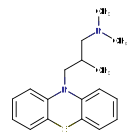
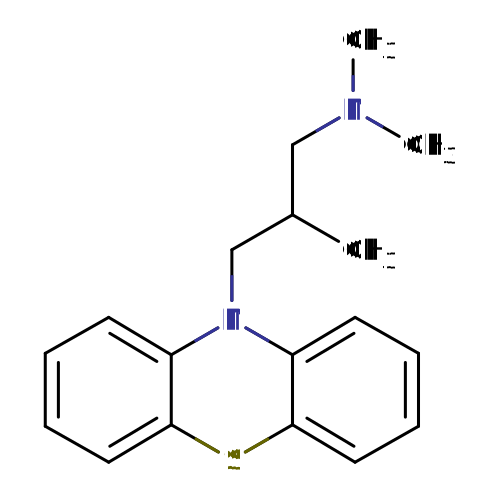
Structure for Alimemazine (DB01246)
- Weight
- Average: 298.446
Monoisotopic: 298.150369404 - Chemical Formula
- C18H22N2S
- Synonyms
- Alimemazina
- Alimemazine
- Alimemazinum
- Methylpromazine
- Trimeprazine
- External IDs
- Bayer 1219
- BAYER-1219
- RP 6549
- RP-6549

Pharmacology
- Indication
Used to prevent and relieve allergic conditions which cause pruritus (itching) and urticaria (some allergic skin reactions).
 Reduce drug development failure ratesBuild, train, & validate machine-learning modelswith evidence-based and structured datasets.Build, train, & validate predictive machine-learning models with structured datasets.
- Associated Conditions
- Contraindications & Blackbox Warnings
 Prevent Adverse Drug Events TodayTap into our Clinical API for life-saving information on contraindications & blackbox warnings, population restrictions, harmful risks, & more.Avoid life-threatening adverse drug events with our Clinical API
- Pharmacodynamics
Trimeprazine (also known as Alimemazine) is a tricyclic antihistamine, similar in structure to the phenothiazine antipsychotics, but differing in the ring-substitution and chain characteristics. Trimeprazine is in the same class of drugs as chlorpromazine (Thorazine) and trifluoperazine (Stelazine); however, unlike the other drugs in this class, trimeprazine is not used clinically as an anti-psychotic. It acts as an anti-histamine, a sedative, and an anti-emetic (anti-nausea). Trimeprazine is used principally as an anti-emetic, to prevent motion sickness or as an anti-histamine in combination with other medications in cough and cold preparations. Tricyclic antihistamines are also structurally-related to the tricyclic antidepressants, explaining the antihistaminergic adverse effects of these two drug classes and also the poor tolerability profile of tricyclic H1-antihistamines.
- Mechanism of action
Trimeprazine competes with free histamine for binding at HA-receptor sites. This antagonizes the effects of histamine on HA-receptors, leading to a reduction of the negative symptoms brought on by histamine HA-receptor binding.
Target Actions Organism AHistamine H1 receptor antagonistHumans - Absorption
Well absorbed in the digestive tract.
- Volume of distribution
Not Available
- Protein binding
Not Available
- Metabolism
Hepatic
- Route of elimination
Not Available
- Half-life
Not Available
- Clearance
Not Available
- Adverse Effects
 Improve decision support & research outcomesWith structured adverse effects data, including: blackbox warnings, adverse reactions, warning & precautions, & incidence rates. View sample adverse effects data in our new Data Library!Improve decision support & research outcomes with our structured adverse effects data.
- Toxicity
Symptoms of overdose clumsiness or unsteadiness, seizures, severe drowsiness, flushing or redness of face, hallucinations, muscle spasms (especially of neck and back), restlessness, shortness of breath, shuffling walk, tic-like (jerky) movements of head and face, trembling and shaking of hands, and insomnia.
- Pathways
Pathway Category Alimemazine H1-Antihistamine Action Drug action - Pharmacogenomic Effects/ADRs
- Not Available
Interactions
- Drug Interactions
- This information should not be interpreted without the help of a healthcare provider. If you believe you are experiencing an interaction, contact a healthcare provider immediately. The absence of an interaction does not necessarily mean no interactions exist.
Drug Interaction Integrate drug-drug
interactions in your software1,2-Benzodiazepine The risk or severity of CNS depression can be increased when Alimemazine is combined with 1,2-Benzodiazepine. Acebutolol The serum concentration of Acebutolol can be increased when it is combined with Alimemazine. Acetazolamide The risk or severity of CNS depression can be increased when Acetazolamide is combined with Alimemazine. Acetohexamide The therapeutic efficacy of Acetohexamide can be decreased when used in combination with Alimemazine. Acetophenazine The risk or severity of CNS depression can be increased when Acetophenazine is combined with Alimemazine. - Food Interactions
- Avoid alcohol. Ingesting alcohol may potentiate the CNS depressant effects of alimemazine/trimeprazine.
- Take after a meal. Taking alimemazine/trimeprazine after eating may reduce drowsiness by allowing for more gradual absorption.
Products
 Drug product information from 10+ global regionsOur datasets provide approved product information including:dosage, form, labeller, route of administration, and marketing period.Access drug product information from over 10 global regions.
- Product Ingredients
Ingredient UNII CAS InChI Key Alimemazine tartrate 362NW1LD6Z 4330-99-8 AJZJIYUOOJLBAU-RNKHSWPKSA-N - International/Other Brands
- Alimezine / Nedeltran / Repeltin / Theralen / Theralene / Vallergan
- Brand Name Prescription Products
Name Dosage Strength Route Labeller Marketing Start Marketing End Region Image Panectyl Tablet 5 mg Oral Searchlight Pharma Inc 1959-12-31 Not applicable Canada 
Panectyl Tablet 2.5 mg Oral Searchlight Pharma Inc 1959-12-31 Not applicable Canada Panectyl 2.5 Liq 2.5mg/5ml Liquid 2.5 mg / 5 mL Oral Aventis Pharma Ltd. 1960-12-31 2003-07-22 Canada
Categories
- ATC Codes
- R06AD01 — Alimemazine
- Drug Categories
- Antihistamines for Systemic Use
- Antipruritics
- Antipsychotic Agents
- Central Nervous System Depressants
- Dermatologicals
- Heterocyclic Compounds, Fused-Ring
- Histamine Agents
- Histamine Antagonists
- Histamine H1 Antagonists
- Neurotoxic agents
- Neurotransmitter Agents
- Phenothiazine Derivatives
- Phenothiazines
- Potential QTc-Prolonging Agents
- QTc Prolonging Agents
- Sulfur Compounds
- Chemical TaxonomyProvided by Classyfire
- Description
- This compound belongs to the class of organic compounds known as phenothiazines. These are polycyclic aromatic compounds containing a phenothiazine moiety, which is a linear tricyclic system that consists of a two benzene rings joined by a para-thiazine ring.
- Kingdom
- Organic compounds
- Super Class
- Organoheterocyclic compounds
- Class
- Benzothiazines
- Sub Class
- Phenothiazines
- Direct Parent
- Phenothiazines
- Alternative Parents
- Alkyldiarylamines / Diarylthioethers / Benzenoids / 1,4-thiazines / Trialkylamines / Azacyclic compounds / Organopnictogen compounds / Hydrocarbon derivatives
- Substituents
- Alkyldiarylamine / Amine / Aromatic heteropolycyclic compound / Aryl thioether / Azacycle / Benzenoid / Diarylthioether / Hydrocarbon derivative / Organic nitrogen compound / Organonitrogen compound
- Molecular Framework
- Aromatic heteropolycyclic compounds
- External Descriptors
- phenothiazines (CHEBI:9725)
- Affected organisms
- Humans and other mammals
Chemical Identifiers
- UNII
- 76H78MJJ52
- CAS number
- 84-96-8
- InChI Key
- ZZHLYYDVIOPZBE-UHFFFAOYSA-N
- InChI
- InChI=1S/C18H22N2S/c1-14(12-19(2)3)13-20-15-8-4-6-10-17(15)21-18-11-7-5-9-16(18)20/h4-11,14H,12-13H2,1-3H3
- IUPAC Name
- dimethyl[2-methyl-3-(10H-phenothiazin-10-yl)propyl]amine
- SMILES
- CC(CN(C)C)CN1C2=CC=CC=C2SC2=CC=CC=C12
References
- General References
- Not Available
- External Links
- Human Metabolome Database
- HMDB0015376
- KEGG Drug
- D07125
- KEGG Compound
- C07172
- PubChem Compound
- 5574
- PubChem Substance
- 46508449
- ChemSpider
- 5373
- BindingDB
- 50062261
- 10825
- ChEBI
- 9725
- ChEMBL
- CHEMBL829
- Therapeutic Targets Database
- DAP001077
- PharmGKB
- PA164744009
- Wikipedia
- Alimemazine
Clinical Trials
Pharmacoeconomics
- Manufacturers
- Not Available
- Packagers
- Emcure Pharmaceuticals Ltd.
- Dosage Forms
Form Route Strength Tablet Oral 2.5 mg Tablet Oral 5 mg Liquid Oral 2.5 mg / 5 mL - Prices
Unit description Cost Unit Panectyl 5 mg Tablet 0.37USD tablet Panectyl 2.5 mg Tablet 0.3USD tablet DrugBank does not sell nor buy drugs. Pricing information is supplied for informational purposes only.- Patents
- Not Available
Properties
- State
- Solid
- Experimental Properties
Property Value Source melting point (°C) 68 °C PhysProp boiling point (°C) 150-175 °C at 3.00E-01 mm Hg PhysProp water solubility 0.942 mg/L Not Available logP 4.71 HANSCH,C ET AL. (1995) pKa 9.05 SANGSTER (1994) - Predicted Properties
Property Value Source Water Solubility 0.00835 mg/mL ALOGPS logP 4.82 ALOGPS logP 4.41 Chemaxon logS -4.6 ALOGPS pKa (Strongest Basic) 9.42 Chemaxon Physiological Charge 1 Chemaxon Hydrogen Acceptor Count 2 Chemaxon Hydrogen Donor Count 0 Chemaxon Polar Surface Area 6.48 Å2 Chemaxon Rotatable Bond Count 4 Chemaxon Refractivity 93.37 m3·mol-1 Chemaxon Polarizability 34.83 Å3 Chemaxon Number of Rings 3 Chemaxon Bioavailability 1 Chemaxon Rule of Five Yes Chemaxon Ghose Filter Yes Chemaxon Veber's Rule Yes Chemaxon MDDR-like Rule No Chemaxon - Predicted ADMET Features
Property Value Probability Human Intestinal Absorption + 0.9738 Blood Brain Barrier + 0.9886 Caco-2 permeable + 0.7965 P-glycoprotein substrate Substrate 0.6637 P-glycoprotein inhibitor I Inhibitor 0.6501 P-glycoprotein inhibitor II Inhibitor 0.7613 Renal organic cation transporter Non-inhibitor 0.5286 CYP450 2C9 substrate Non-substrate 0.7739 CYP450 2D6 substrate Substrate 0.748 CYP450 3A4 substrate Substrate 0.5224 CYP450 1A2 substrate Non-inhibitor 0.804 CYP450 2C9 inhibitor Non-inhibitor 0.9195 CYP450 2D6 inhibitor Inhibitor 0.9381 CYP450 2C19 inhibitor Non-inhibitor 0.8436 CYP450 3A4 inhibitor Non-inhibitor 0.6702 CYP450 inhibitory promiscuity High CYP Inhibitory Promiscuity 0.6487 Ames test Non AMES toxic 0.7784 Carcinogenicity Non-carcinogens 0.9034 Biodegradation Not ready biodegradable 0.9968 Rat acute toxicity 3.1217 LD50, mol/kg Not applicable hERG inhibition (predictor I) Weak inhibitor 0.9819 hERG inhibition (predictor II) Inhibitor 0.818
Spectra
- Mass Spec (NIST)
- Download (7.83 KB)
- Spectra
- Chromatographic Properties
Collision Cross Sections (CCS)
Adduct CCS Value (Å2) Source type Source [M-H]- 181.1774952 predictedDarkChem Lite v0.1.0 [M-H]- 160.59222 predictedDeepCCS 1.0 (2019) [M+H]+ 182.1885952 predictedDarkChem Lite v0.1.0 [M+H]+ 162.95021 predictedDeepCCS 1.0 (2019) [M+Na]+ 181.9923952 predictedDarkChem Lite v0.1.0 [M+Na]+ 169.04338 predictedDeepCCS 1.0 (2019)
Targets

- Kind
- Protein
- Organism
- Humans
- Pharmacological action
- Yes
- Actions
- Antagonist
- General Function
- Histamine receptor activity
- Specific Function
- In peripheral tissues, the H1 subclass of histamine receptors mediates the contraction of smooth muscles, increase in capillary permeability due to contraction of terminal venules, and catecholamin...
- Gene Name
- HRH1
- Uniprot ID
- P35367
- Uniprot Name
- Histamine H1 receptor
- Molecular Weight
- 55783.61 Da
References
- Santos DE, Liu GJ, Takeuchi H: Blockers for excitatory effects of achatin-I, a tetrapeptide having a D-phenylalanine residue, on a snail neurone. Eur J Pharmacol. 1995 Jan 16;272(2-3):231-9. [Article]
- Chen X, Ji ZL, Chen YZ: TTD: Therapeutic Target Database. Nucleic Acids Res. 2002 Jan 1;30(1):412-5. [Article]


Drug created at June 13, 2005 13:24 / Updated at April 26, 2024 00:45