Identification
- Summary
Posaconazole is a triazole antifungal drug that is used to treat invasive infections by Candida species and Aspergillus species in severely immunocompromised patients.
- Brand Names
- Noxafil, Posanol
- Generic Name
- Posaconazole
- DrugBank Accession Number
- DB01263
- Background
Posaconazole is a triazole antifungal drug that is used to treat invasive infections by Candida species and Aspergillus species in severely immunocompromised patients.
- Type
- Small Molecule
- Groups
- Approved, Investigational, Vet approved
- Structure
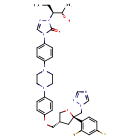
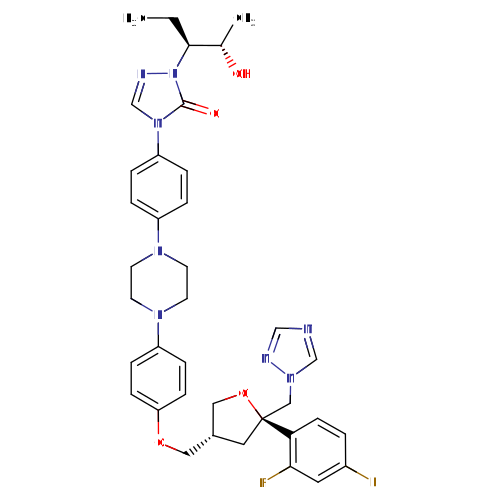
Structure for Posaconazole (DB01263)
- Weight
- Average: 700.7774
Monoisotopic: 700.329708282 - Chemical Formula
- C37H42F2N8O4
- Synonyms
- Posaconazole
- External IDs
- Sch 56592
- SCH-56592
- SCH56592
- Schering 56592

Pharmacology
- Indication
For prophylaxis of invasive Aspergillus and Candida infections in patients, 13 years of age and older, who are at high risk of developing these infections due to being severely immunocompromised as a result of procedures such as hematopoietic stem cell transplant (HSCT) recipients with graft-versus-host disease (GVHD), or due to hematologic malignancies with prolonged neutropenia from chemotherapy. Also for the treatment of oropharyngeal candidiasis, including oropharyngeal candidiasis refractory to itraconazole and/or fluconazole. Posaconazole is used as an alternative treatment for invasive aspergillosis, Fusarium infections, and zygomycosis in patients who are intolerant of, or whose disease is refractory to, other antifungals.
 Reduce drug development failure ratesBuild, train, & validate machine-learning modelswith evidence-based and structured datasets.Build, train, & validate predictive machine-learning models with structured datasets.
- Associated Conditions
Indication Type Indication Combined Product Details Approval Level Age Group Patient Characteristics Dose Form Prophylaxis of Aspergillus infection •••••••••••• ••••••• ••••••• •••••••• •••••••••• ••••••••• •••••••••••• •••••••••• Prophylaxis of Aspergillus infection •••••••••••• ••••••• ••••••• •••••••• •••••••••• ••••••••• •••••••••••• •••••••••• Prophylaxis of Aspergillus infection •••••••••••• ••••••••••••••••• ••••••• ••••••• •••••••• •••••••••• ••••••••• •••••••••••• •••••••••• Prophylaxis of Candida infections •••••••••••• ••••••• ••••••• •••••••• •••••••••• ••••••••• •••••••••••• •••••••••• Prophylaxis of Candida infections •••••••••••• ••••••• ••••••• •••••••• •••••••••• ••••••••• •••••••••••• •••••••••• - Contraindications & Blackbox Warnings
 Prevent Adverse Drug Events TodayTap into our Clinical API for life-saving information on contraindications & blackbox warnings, population restrictions, harmful risks, & more.Avoid life-threatening adverse drug events with our Clinical API
- Pharmacodynamics
Posaconazole is an antifungal agent structurally related to itraconazole. It is a drug derived from itraconzaole through the replacement of the chlorine substituents with flourine in the phenyl ring, as well as hydroxylation of the triazolone side chain. These modifications enhance the potency and spectrum of activity of the drug. Posaconazole can be either fungicial or fungistatic in action.
- Mechanism of action
As a triazole antifungal agent, posaconazole exerts its antifungal activity through blockage of the cytochrome P-450 dependent enzyme, sterol 14α-demethylase, in fungi by binding to the heme cofactor located on the enzyme. This leads to the inhibition of the synthesis of ergosterol, a key component of the fungal cell membrane, and accumulation of methylated sterol precursors. This results in inhibition of fungal cell growth and ultimately, cell death.
Target Actions Organism ACytochrome P450 51 antagonistYeast - Absorption
Posaconazole is absorbed with a median Tmax of approximately 3 to 5 hours.
- Volume of distribution
- 1774 L
- Protein binding
Posaconazole is highly protein bound (>98%), predominantly to albumin.
- Metabolism
Posaconazole primarily circulates as the parent compound in plasma. Of the circulating metabolites, the majority are glucuronide conjugates formed via UDP glucuronidation (phase 2 enzymes). Posaconazole does not have any major circulating oxidative (CYP450 mediated) metabolites. The excreted metabolites in urine and feces account for ~17% of the administered radiolabeled dose.
- Route of elimination
The excreted metabolites in urine and feces account for ~17% of the administered radiolabeled dose.
- Half-life
Posaconazole is eliminated with a mean half-life (t½) of 35 hours (range 20 to 66 hours).
- Clearance
- 32 L/hr
- 51 L/hr [Single-Dose Suspension Administration of 200 mg, fasted]
- 21 L/hr [Single-Dose Suspension Administration of 200 mg, nonfat meal]
- 14 L/hr [Single-Dose Suspension Administration of 200 mg, high fat meal]
- 91 L/hr [Single-Dose Suspension Administration of 400 mg, fasted]
- 43 L/hr [Single-Dose Suspension Administration of 400 mg with liquid nutritional supplement (14 g fat)]
- Adverse Effects
 Improve decision support & research outcomesWith structured adverse effects data, including: blackbox warnings, adverse reactions, warning & precautions, & incidence rates. View sample adverse effects data in our new Data Library!Improve decision support & research outcomes with our structured adverse effects data.
- Toxicity
During the clinical trials, some patients received posaconazole up to 1600 mg/day with no adverse events noted that were different from the lower doses. In addition, accidental overdose was noted in one patient who took 1200 mg BID for 3 days. No related adverse events were noted by the investigator.
- Pathways
- Not Available
- Pharmacogenomic Effects/ADRs
- Not Available
Interactions
- Drug Interactions
- This information should not be interpreted without the help of a healthcare provider. If you believe you are experiencing an interaction, contact a healthcare provider immediately. The absence of an interaction does not necessarily mean no interactions exist.
Drug Interaction Integrate drug-drug
interactions in your software1,2-Benzodiazepine The metabolism of 1,2-Benzodiazepine can be decreased when combined with Posaconazole. Abametapir The serum concentration of Posaconazole can be increased when it is combined with Abametapir. Abemaciclib The metabolism of Abemaciclib can be decreased when combined with Posaconazole. Abiraterone The metabolism of Abiraterone can be decreased when combined with Posaconazole. Abrocitinib The serum concentration of Posaconazole can be increased when it is combined with Abrocitinib. - Food Interactions
- Take with food. Posaconazole suspension can also be taken with a nutritional supplement drink or carbonated beverage if a full meal cannot be consumed.
Products
 Drug product information from 10+ global regionsOur datasets provide approved product information including:dosage, form, labeller, route of administration, and marketing period.Access drug product information from over 10 global regions.
- Product Images

- International/Other Brands
- Noxafil
- Brand Name Prescription Products
Name Dosage Strength Route Labeller Marketing Start Marketing End Region Image Gln-posaconazole Tablet, delayed release 100 mg Oral Glenmark Pharmaceuticals, Inc 2023-10-04 Not applicable Canada 
Noxafil Solution 18 mg/1mL Intravenous Merck Sharp & Dohme Llc 2014-03-13 Not applicable US 
Noxafil Tablet, delayed release 100 mg Oral Merck Sharp And Dohme B.V 2016-09-08 Not applicable EU 
Noxafil Tablet, coated 100 mg/1 Oral Merck Sharp & Dohme Llc 2013-11-25 Not applicable US 
Noxafil Suspension 300 mg Oral Merck Sharp And Dohme B.V 2022-05-04 Not applicable EU - Generic Prescription Products
Name Dosage Strength Route Labeller Marketing Start Marketing End Region Image Apo-posaconazole Tablet, delayed release 100 mg Oral Apotex Corporation Not applicable Not applicable Canada Jamp Posaconazole Suspension 40 mg / mL Oral Jamp Pharma Corporation 2023-05-24 Not applicable Canada Mint-posaconazole Tablet, delayed release 100 mg Oral Mint Pharmaceuticals Inc Not applicable Not applicable Canada Posaconazole Suspension 40 mg/1mL Oral Hikma Pharmaceuticals USA Inc. 2023-03-29 Not applicable US Posaconazole Tablet, delayed release 100 mg/1 Oral bryant ranch prepack 2023-09-15 Not applicable US


Categories
- ATC Codes
- J02AC04 — Posaconazole
- Drug Categories
- 14-alpha Demethylase Inhibitors
- Anti-Infective Agents
- Antifungal Agents
- Antiinfectives for Systemic Use
- Antimycotics for Systemic Use
- Antiparasitic Agents
- Antiprotozoals
- Azole Antifungals
- Cytochrome P-450 CYP3A Inhibitors
- Cytochrome P-450 CYP3A Substrates
- Cytochrome P-450 CYP3A4 Inhibitors
- Cytochrome P-450 CYP3A4 Inhibitors (strong)
- Cytochrome P-450 CYP3A4 Substrates
- Cytochrome P-450 Enzyme Inhibitors
- Cytochrome P-450 Substrates
- Enzyme Inhibitors
- Hormone Antagonists
- Hormones, Hormone Substitutes, and Hormone Antagonists
- P-glycoprotein inhibitors
- P-glycoprotein substrates
- Potential QTc-Prolonging Agents
- QTc Prolonging Agents
- Steroid Synthesis Inhibitors
- Triazole and tetrazole derivatives
- Triazole Derivatives
- Trypanocidal Agents
- Chemical TaxonomyProvided by Classyfire
- Description
- This compound belongs to the class of organic compounds known as phenylpiperazines. These are compounds containing a phenylpiperazine skeleton, which consists of a piperazine bound to a phenyl group.
- Kingdom
- Organic compounds
- Super Class
- Organoheterocyclic compounds
- Class
- Diazinanes
- Sub Class
- Piperazines
- Direct Parent
- Phenylpiperazines
- Alternative Parents
- N-arylpiperazines / Phenyl-1,2,4-triazoles / Aminophenyl ethers / Phenoxy compounds / Aniline and substituted anilines / Dialkylarylamines / Alkyl aryl ethers / Fluorobenzenes / Aryl fluorides / Tetrahydrofurans show 9 more
- Substituents
- 1,2,4-triazole / Alcohol / Alkyl aryl ether / Amine / Aminophenyl ether / Aniline or substituted anilines / Aromatic heteromonocyclic compound / Aryl fluoride / Aryl halide / Azacycle show 30 more
- Molecular Framework
- Aromatic heteromonocyclic compounds
- External Descriptors
- organofluorine compound, aromatic ether, N-arylpiperazine, triazole antifungal drug, conazole antifungal drug, triazoles, oxolanes (CHEBI:64355)
- Affected organisms
- Aspergillis, Candida and other fungi
Chemical Identifiers
- UNII
- 6TK1G07BHZ
- CAS number
- 171228-49-2
- InChI Key
- RAGOYPUPXAKGKH-XAKZXMRKSA-N
- InChI
- InChI=1S/C37H42F2N8O4/c1-3-35(26(2)48)47-36(49)46(25-42-47)31-7-5-29(6-8-31)43-14-16-44(17-15-43)30-9-11-32(12-10-30)50-20-27-19-37(51-21-27,22-45-24-40-23-41-45)33-13-4-28(38)18-34(33)39/h4-13,18,23-27,35,48H,3,14-17,19-22H2,1-2H3/t26-,27+,35-,37-/m0/s1
- IUPAC Name
- 4-{4-[4-(4-{[(3R,5R)-5-(2,4-difluorophenyl)-5-[(1H-1,2,4-triazol-1-yl)methyl]oxolan-3-yl]methoxy}phenyl)piperazin-1-yl]phenyl}-1-[(2S,3S)-2-hydroxypentan-3-yl]-4,5-dihydro-1H-1,2,4-triazol-5-one
- SMILES
- CC[C@@H]([C@H](C)O)N1N=CN(C1=O)C1=CC=C(C=C1)N1CCN(CC1)C1=CC=C(OC[C@@H]2CO[C@](CN3C=NC=N3)(C2)C2=C(F)C=C(F)C=C2)C=C1
References
- Synthesis Reference
Dominic De Souza, "PREPARATION OF POSACONAZOLE INTERMEDIATES." U.S. Patent US20130203994, issued August 08, 2013.
US20130203994- General References
- Cornely OA, Maertens J, Winston DJ, Perfect J, Ullmann AJ, Walsh TJ, Helfgott D, Holowiecki J, Stockelberg D, Goh YT, Petrini M, Hardalo C, Suresh R, Angulo-Gonzalez D: Posaconazole vs. fluconazole or itraconazole prophylaxis in patients with neutropenia. N Engl J Med. 2007 Jan 25;356(4):348-59. [Article]
- Ullmann AJ, Lipton JH, Vesole DH, Chandrasekar P, Langston A, Tarantolo SR, Greinix H, Morais de Azevedo W, Reddy V, Boparai N, Pedicone L, Patino H, Durrant S: Posaconazole or fluconazole for prophylaxis in severe graft-versus-host disease. N Engl J Med. 2007 Jan 25;356(4):335-47. [Article]
- Bhattacharya M, Rajeshwari K, Dhingra B: Posaconazole. J Postgrad Med. 2010 Apr-Jun;56(2):163-7. doi: 10.4103/0022-3859.65281. [Article]
- Frampton JE, Scott LJ: Posaconazole : a review of its use in the prophylaxis of invasive fungal infections. Drugs. 2008;68(7):993-1016. [Article]
- Schiller DS, Fung HB: Posaconazole: an extended-spectrum triazole antifungal agent. Clin Ther. 2007 Sep;29(9):1862-86. [Article]
- Kwon DS, Mylonakis E: Posaconazole: a new broad-spectrum antifungal agent. Expert Opin Pharmacother. 2007 Jun;8(8):1167-78. [Article]
- Groll AH, Walsh TJ: Posaconazole: clinical pharmacology and potential for management of fungal infections. Expert Rev Anti Infect Ther. 2005 Aug;3(4):467-87. [Article]
- Rachwalski EJ, Wieczorkiewicz JT, Scheetz MH: Posaconazole: an oral triazole with an extended spectrum of activity. Ann Pharmacother. 2008 Oct;42(10):1429-38. doi: 10.1345/aph.1L005. Epub 2008 Aug 19. [Article]
- Li Y, Theuretzbacher U, Clancy CJ, Nguyen MH, Derendorf H: Pharmacokinetic/pharmacodynamic profile of posaconazole. Clin Pharmacokinet. 2010 Jun;49(6):379-96. doi: 10.2165/11319340-000000000-00000. [Article]
- FDA Approved Drug Products: NOXAFIL (posaconazole) injection, suspension, and tablets [Link]
- External Links
- KEGG Drug
- D02555
- PubChem Compound
- 468595
- PubChem Substance
- 46508639
- ChemSpider
- 411709
- BindingDB
- 50181473
- 282446
- ChEBI
- 64355
- ChEMBL
- CHEMBL1397
- ZINC
- ZINC000003938482
- Therapeutic Targets Database
- DAP001101
- PharmGKB
- PA151958574
- PDBe Ligand
- X2N
- RxList
- RxList Drug Page
- Drugs.com
- Drugs.com Drug Page
- Wikipedia
- Posaconazole
- PDB Entries
- 2x2n / 4j14 / 4ze1 / 5fsa / 5tl8 / 6e8q / 7niw
- FDA label
- Download (183 KB)
Clinical Trials
- Clinical Trials
Phase Status Purpose Conditions Count 4 Completed Basic Science Obesity, Morbid 1 4 Completed Basic Science Systemic Fungal Infections 1 4 Completed Prevention Acute Graft-Versus-Host Disease (GVHD) / Acute Myeloid Leukemia / Allogeneic Stem Cell Transplant / Myelodysplastic Syndrome 1 4 Completed Prevention Acute Myeloid Leukemia / Aplastic Anemia / Bone Marrow Transplant (BMT) / Myelodysplastic Syndrome 1 4 Completed Prevention Acute Myeloid Leukemia / Fungal Infections / Neutropenia 1
Pharmacoeconomics
- Manufacturers
- Not Available
- Packagers
- Patheon Inc.
- Schering Corp.
- Schering-Plough Inc.
- Dosage Forms
Form Route Strength Suspension Oral 40 mg / mL Injection, solution Intravenous 300 mg/16.7ml Powder Oral 300 mg Powder, for suspension Oral 300 mg/1 Solution Intravenous 18 mg/1mL Suspension Oral 300 mg Suspension Oral 40 mg/ml Suspension Oral 40 mg/1mL Tablet, coated Oral 100 mg/1 Tablet, delayed release Oral 100 mg Tablet, film coated Oral 100 mg Tablet Oral 100 mg Suspension Oral 4 g Tablet, delayed release Oral Injection, solution, concentrate Intravenous 300 mg Suspension Oral Injection Intravenous 18 mg/1mL Injection, solution Intravenous 18 mg/1mL Tablet Oral 100 mg/1 Tablet, delayed release Oral 100 mg/1 Tablet, delayed release Oral 100.00 mg Solution Intravenous 300 mg / 16.7 mL Suspension Oral 200 mg / 5 mL Injection, solution Intravenous 300 mg Solution Intravenous 300 mg Suspension Oral 4000.000 mg Tablet Oral 100.000 mg - Prices
Unit description Cost Unit Noxafil 40 mg/ml suspension 7.08USD ml DrugBank does not sell nor buy drugs. Pricing information is supplied for informational purposes only.- Patents
Patent Number Pediatric Extension Approved Expires (estimated) Region US5703079 No 1997-12-30 2014-08-26 US CA2305803 No 2009-12-22 2018-10-05 Canada CA2179396 No 2001-04-17 2014-12-20 Canada US5661151 No 1997-08-26 2019-07-19 US US6958337 No 2005-10-25 2018-10-05 US US8263600 No 2012-09-11 2022-04-01 US US9023790 No 2015-05-05 2031-07-04 US US8410077 No 2013-04-02 2029-03-13 US US9493582 No 2016-11-15 2033-02-27 US US9358297 No 2016-06-07 2031-06-24 US US9750822 No 2017-09-05 2029-03-13 US US10117951 No 2018-11-06 2029-03-13 US
Properties
- State
- Solid
- Experimental Properties
Property Value Source water solubility Insoluble Not Available logP 5.5 Not Available - Predicted Properties
Property Value Source logP 5.41 Chemaxon pKa (Strongest Acidic) 14.83 Chemaxon pKa (Strongest Basic) 3.93 Chemaxon Physiological Charge 0 Chemaxon Hydrogen Acceptor Count 9 Chemaxon Hydrogen Donor Count 1 Chemaxon Polar Surface Area 111.79 Å2 Chemaxon Rotatable Bond Count 12 Chemaxon Refractivity 200.71 m3·mol-1 Chemaxon Polarizability 74.27 Å3 Chemaxon Number of Rings 7 Chemaxon Bioavailability 0 Chemaxon Rule of Five No Chemaxon Ghose Filter No Chemaxon Veber's Rule No Chemaxon MDDR-like Rule Yes Chemaxon - Predicted ADMET Features
Property Value Probability Human Intestinal Absorption + 1.0 Blood Brain Barrier - 0.5499 Caco-2 permeable + 0.5332 P-glycoprotein substrate Substrate 0.7822 P-glycoprotein inhibitor I Inhibitor 0.7338 P-glycoprotein inhibitor II Non-inhibitor 0.8895 Renal organic cation transporter Non-inhibitor 0.7323 CYP450 2C9 substrate Non-substrate 0.8131 CYP450 2D6 substrate Non-substrate 0.8354 CYP450 3A4 substrate Substrate 0.6683 CYP450 1A2 substrate Non-inhibitor 0.8484 CYP450 2C9 inhibitor Inhibitor 0.5281 CYP450 2D6 inhibitor Non-inhibitor 0.8667 CYP450 2C19 inhibitor Non-inhibitor 0.6409 CYP450 3A4 inhibitor Non-inhibitor 0.5532 CYP450 inhibitory promiscuity Low CYP Inhibitory Promiscuity 0.5074 Ames test AMES toxic 0.5235 Carcinogenicity Non-carcinogens 0.7341 Biodegradation Not ready biodegradable 1.0 Rat acute toxicity 2.8919 LD50, mol/kg Not applicable hERG inhibition (predictor I) Weak inhibitor 0.5306 hERG inhibition (predictor II) Inhibitor 0.6661
Spectra
- Mass Spec (NIST)
- Not Available
- Spectra
- Chromatographic Properties
Collision Cross Sections (CCS)
Adduct CCS Value (Å2) Source type Source [M-H]- 240.03249 predictedDeepCCS 1.0 (2019) [M+H]+ 242.42809 predictedDeepCCS 1.0 (2019) [M+Na]+ 248.34059 predictedDeepCCS 1.0 (2019)
Targets

- Kind
- Protein
- Organism
- Yeast
- Pharmacological action
- Yes
- Actions
- Antagonist
- General Function
- Sterol 14-demethylase activity
- Specific Function
- Catalyzes C14-demethylation of lanosterol which is critical for ergosterol biosynthesis. It transforms lanosterol into 4,4'-dimethyl cholesta-8,14,24-triene-3-beta-ol.
- Gene Name
- ERG11
- Uniprot ID
- P10613
- Uniprot Name
- Lanosterol 14-alpha demethylase
- Molecular Weight
- 60674.965 Da
References
- Overington JP, Al-Lazikani B, Hopkins AL: How many drug targets are there? Nat Rev Drug Discov. 2006 Dec;5(12):993-6. [Article]
- Imming P, Sinning C, Meyer A: Drugs, their targets and the nature and number of drug targets. Nat Rev Drug Discov. 2006 Oct;5(10):821-34. [Article]
- Chau AS, Mendrick CA, Sabatelli FJ, Loebenberg D, McNicholas PM: Application of real-time quantitative PCR to molecular analysis of Candida albicans strains exhibiting reduced susceptibility to azoles. Antimicrob Agents Chemother. 2004 Jun;48(6):2124-31. [Article]
- Li X, Brown N, Chau AS, Lopez-Ribot JL, Ruesga MT, Quindos G, Mendrick CA, Hare RS, Loebenberg D, DiDomenico B, McNicholas PM: Changes in susceptibility to posaconazole in clinical isolates of Candida albicans. J Antimicrob Chemother. 2004 Jan;53(1):74-80. Epub 2003 Dec 4. [Article]
- Bhattacharya M, Rajeshwari K, Dhingra B: Posaconazole. J Postgrad Med. 2010 Apr-Jun;56(2):163-7. doi: 10.4103/0022-3859.65281. [Article]
- Schiller DS, Fung HB: Posaconazole: an extended-spectrum triazole antifungal agent. Clin Ther. 2007 Sep;29(9):1862-86. [Article]
- Kwon DS, Mylonakis E: Posaconazole: a new broad-spectrum antifungal agent. Expert Opin Pharmacother. 2007 Jun;8(8):1167-78. [Article]
- Groll AH, Walsh TJ: Posaconazole: clinical pharmacology and potential for management of fungal infections. Expert Rev Anti Infect Ther. 2005 Aug;3(4):467-87. [Article]
- Berman HM, Westbrook J, Feng Z, Gilliland G, Bhat TN, Weissig H, Shindyalov IN, Bourne PE: The Protein Data Bank. Nucleic Acids Res. 2000 Jan 1;28(1):235-42. [Article]
- Warrilow AG, Melo N, Martel CM, Parker JE, Nes WD, Kelly SL, Kelly DE: Expression, purification, and characterization of Aspergillus fumigatus sterol 14-alpha demethylase (CYP51) isoenzymes A and B. Antimicrob Agents Chemother. 2010 Oct;54(10):4225-34. doi: 10.1128/AAC.00316-10. Epub 2010 Jul 26. [Article]
Enzymes
- Kind
- Protein
- Organism
- Humans
- Pharmacological action
- Unknown
- Actions
- SubstrateInhibitor
- General Function
- Vitamin d3 25-hydroxylase activity
- Specific Function
- Cytochromes P450 are a group of heme-thiolate monooxygenases. In liver microsomes, this enzyme is involved in an NADPH-dependent electron transport pathway. It performs a variety of oxidation react...
- Gene Name
- CYP3A4
- Uniprot ID
- P08684
- Uniprot Name
- Cytochrome P450 3A4
- Molecular Weight
- 57342.67 Da
References
- Nagappan V, Deresinski S: Reviews of anti-infective agents: posaconazole: a broad-spectrum triazole antifungal agent. Clin Infect Dis. 2007 Dec 15;45(12):1610-7. doi: 10.1086/523576. [Article]
- Kharuzhyk SA, Matskevich SA, Filjustin AE, Bogushevich EV, Ugolkova SA: Survey of computed tomography doses and establishment of national diagnostic reference levels in the Republic of Belarus. Radiat Prot Dosimetry. 2010 Apr-May;139(1-3):367-70. doi: 10.1093/rpd/ncq070. Epub 2010 Feb 24. [Article]
- Kwon DS, Mylonakis E: Posaconazole: a new broad-spectrum antifungal agent. Expert Opin Pharmacother. 2007 Jun;8(8):1167-78. [Article]
- Drug Interactions & Labeling - FDA [Link]
- FDA Drug Development and Drug Interactions: Table of Substrates, Inhibitors and Inducers [Link]
Transporters
- Kind
- Protein
- Organism
- Humans
- Pharmacological action
- Unknown
- Actions
- SubstrateInhibitor
- General Function
- Xenobiotic-transporting atpase activity
- Specific Function
- Energy-dependent efflux pump responsible for decreased drug accumulation in multidrug-resistant cells.
- Gene Name
- ABCB1
- Uniprot ID
- P08183
- Uniprot Name
- Multidrug resistance protein 1
- Molecular Weight
- 141477.255 Da
References
- Nagappan V, Deresinski S: Reviews of anti-infective agents: posaconazole: a broad-spectrum triazole antifungal agent. Clin Infect Dis. 2007 Dec 15;45(12):1610-7. doi: 10.1086/523576. [Article]
- Shumaker AC, Bullard HM, Churpek J, Knoebel RW: Posaconazole-digoxin drug-drug interaction mediated by inhibition of P-glycoprotein. J Oncol Pharm Pract. 2019 Oct;25(7):1758-1761. doi: 10.1177/1078155218801055. Epub 2018 Sep 27. [Article]

Drug created at May 16, 2007 17:41 / Updated at April 27, 2024 09:44