Identification
- Generic Name
- Lumiracoxib
- DrugBank Accession Number
- DB01283
- Background
Lumiracoxib is a COX-2 selective non-steroidal anti-inflammatory drug (NSAID). On August 11, 2007, Australia's Therapeutic Goods Administration (TGA, the Australian equivalent of the FDA) cancelled the registration of lumiracoxib in Australia due to concerns that it may cause liver failure. New Zealand and Canada have also followed suit in recalling the drug.
- Type
- Small Molecule
- Groups
- Approved, Investigational
- Structure
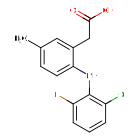
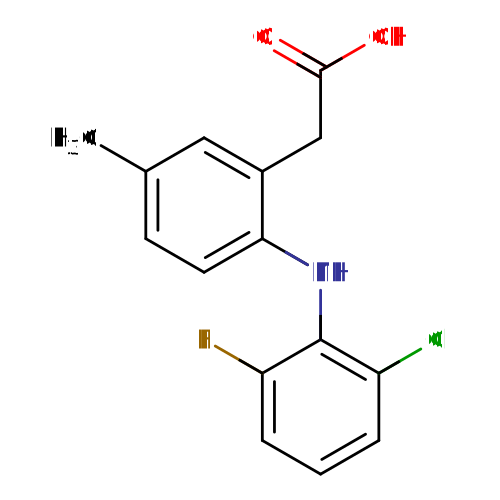
Structure for Lumiracoxib (DB01283)
- Weight
- Average: 293.721
Monoisotopic: 293.061884577 - Chemical Formula
- C15H13ClFNO2
- Synonyms
- 2-((2-chloro-6-fluorophenyl)amino)-5-methylbenzeneacetic acid
- Lumiracoxib
- Lumiracoxibum
- External IDs
- COX 189
- COX-189
- COX189

Pharmacology
- Indication
For the acute and chronic treatment of the signs and symptoms of osteoarthritis of the knee in adults.
 Reduce drug development failure ratesBuild, train, & validate machine-learning modelswith evidence-based and structured datasets.Build, train, & validate predictive machine-learning models with structured datasets.
- Contraindications & Blackbox Warnings
 Prevent Adverse Drug Events TodayTap into our Clinical API for life-saving information on contraindications & blackbox warnings, population restrictions, harmful risks, & more.Avoid life-threatening adverse drug events with our Clinical API
- Pharmacodynamics
Lumiracoxib has a different structure from the standard COX-2 inhibitors (e.g. celecoxib). It more closely resembles the structure of diclofenac (one chlorine substituted by fluorine, the phenylacetic acid has another methyl group in meta position), making it a member of the arylalkanoic acid family of NSAIDs. It binds to a different site on the COX-2 receptor than the standard COX-2 inhibitors. It displays extremely high COX-2 selectivity.
- Mechanism of action
The mechanism of action of lumiracoxib is due to inhibition of prostaglandin synthesis via inhibition of cyclooygenase-2 (COX-2). Lumiracoxib does not inhibit COX-1 at therapeutic concentrations.
Target Actions Organism AProstaglandin G/H synthase 2 inhibitorHumans AProstaglandin G/H synthase 1 inhibitorHumans - Absorption
Rapidly absorbed following oral administration, with an absolute oral bioavailablity of 74%.
- Volume of distribution
Not Available
- Protein binding
Highly bound to plasma proteins (>= 98%).
- Metabolism
Hepatic oxidation and hydroxylation via CYP2C9. Three major metabolites have been identified in plasma: 4'-hydroxy-lumiracoxib, 5-carboxy-lumiracoxib, and 4'-hydroxy-5-carboxy-lumiracoxib.
Hover over products below to view reaction partners
- Route of elimination
Not Available
- Half-life
Terminal half-life is approximately 4 hours.
- Clearance
Not Available
- Adverse Effects
 Improve decision support & research outcomesWith structured adverse effects data, including: blackbox warnings, adverse reactions, warning & precautions, & incidence rates. View sample adverse effects data in our new Data Library!Improve decision support & research outcomes with our structured adverse effects data.
- Toxicity
Single oral doses in mice and rats resulted in mortality and/or moribundity at doses of 600 mg/kg and 500 mg/kg, respectively. Single intraperitoneal doses in mice and rats results in mortality/moribundity at 750 mg/kg and 1000 mg/kg, respectively. The maximum non-lethal single oral and intraperitoneal dose in mouse was 300 mg/kg and 250 mg/kg, respectively. In the rat it was 150 mg/kg and 250 mg/kg, respectively.
- Pathways
Pathway Category Lumiracoxib Action Pathway Drug action - Pharmacogenomic Effects/ADRs
- Not Available
Interactions
- Drug Interactions
- This information should not be interpreted without the help of a healthcare provider. If you believe you are experiencing an interaction, contact a healthcare provider immediately. The absence of an interaction does not necessarily mean no interactions exist.
Drug Interaction Integrate drug-drug
interactions in your softwareAbacavir Lumiracoxib may decrease the excretion rate of Abacavir which could result in a higher serum level. Abatacept The metabolism of Lumiracoxib can be increased when combined with Abatacept. Abciximab The risk or severity of bleeding and hemorrhage can be increased when Lumiracoxib is combined with Abciximab. Abrocitinib The metabolism of Abrocitinib can be decreased when combined with Lumiracoxib. Acebutolol Lumiracoxib may decrease the antihypertensive activities of Acebutolol. - Food Interactions
- Take with or without food. The absorption is unaffected by food.
Products
 Drug product information from 10+ global regionsOur datasets provide approved product information including:dosage, form, labeller, route of administration, and marketing period.Access drug product information from over 10 global regions.
- International/Other Brands
- Prexige (Novartis)
Categories
- ATC Codes
- M01AH06 — Lumiracoxib
- Drug Categories
- Acids, Carbocyclic
- Agents causing hyperkalemia
- Agents that produce hypertension
- Analgesics
- Analgesics, Non-Narcotic
- Anti-Inflammatory Agents
- Anti-Inflammatory Agents, Non-Steroidal
- Antiinflammatory and Antirheumatic Products
- Antiinflammatory and Antirheumatic Products, Non-Steroids
- Antirheumatic Agents
- COX-2 Inhibitors
- Cyclooxygenase Inhibitors
- Cytochrome P-450 CYP1A2 Substrates
- Cytochrome P-450 CYP2C19 Substrates
- Cytochrome P-450 CYP2C9 Substrates
- Cytochrome P-450 Substrates
- Enzyme Inhibitors
- Musculo-Skeletal System
- Nephrotoxic agents
- Peripheral Nervous System Agents
- Phenylacetates
- Selective Cyclooxygenase 2 Inhibitors (NSAIDs)
- Sensory System Agents
- UGT1A9 Substrates
- Chemical TaxonomyProvided by Classyfire
- Description
- This compound belongs to the class of organic compounds known as aminotoluenes. These are organic aromatic compounds containing a benzene that carries a single methyl group and one amino group.
- Kingdom
- Organic compounds
- Super Class
- Benzenoids
- Class
- Benzene and substituted derivatives
- Sub Class
- Toluenes
- Direct Parent
- Aminotoluenes
- Alternative Parents
- Aniline and substituted anilines / Fluorobenzenes / Chlorobenzenes / Aryl fluorides / Aryl chlorides / Amino acids / Secondary amines / Monocarboxylic acids and derivatives / Carboxylic acids / Organopnictogen compounds show 5 more
- Substituents
- Amine / Amino acid / Amino acid or derivatives / Aminotoluene / Aniline or substituted anilines / Aromatic homomonocyclic compound / Aryl chloride / Aryl fluoride / Aryl halide / Carbonyl group show 17 more
- Molecular Framework
- Aromatic homomonocyclic compounds
- External Descriptors
- organofluorine compound, monocarboxylic acid, organochlorine compound, secondary amino compound, amino acid (CHEBI:73044)
- Affected organisms
- Humans and other mammals
Chemical Identifiers
- UNII
- V91T9204HU
- CAS number
- 220991-20-8
- InChI Key
- KHPKQFYUPIUARC-UHFFFAOYSA-N
- InChI
- InChI=1S/C15H13ClFNO2/c1-9-5-6-13(10(7-9)8-14(19)20)18-15-11(16)3-2-4-12(15)17/h2-7,18H,8H2,1H3,(H,19,20)
- IUPAC Name
- 2-{2-[(2-chloro-6-fluorophenyl)amino]-5-methylphenyl}acetic acid
- SMILES
- CC1=CC=C(NC2=C(Cl)C=CC=C2F)C(CC(O)=O)=C1
References
- General References
- Not Available
- External Links
- Human Metabolome Database
- HMDB0015403
- KEGG Drug
- D03714
- PubChem Compound
- 151166
- PubChem Substance
- 46506378
- ChemSpider
- 133236
- BindingDB
- 50207446
- ChEBI
- 73044
- ChEMBL
- CHEMBL404108
- ZINC
- ZINC000000007563
- Therapeutic Targets Database
- DAP000970
- PharmGKB
- PA164769031
- PDBe Ligand
- LUR
- Wikipedia
- Lumiracoxib
- PDB Entries
- 4iiz / 4ik6 / 4oty / 4rrw / 4rrx / 4rrz
Clinical Trials
- Clinical Trials
Phase Status Purpose Conditions Count 4 Completed Treatment Controlled Hypertension / Osteoarthritis (OA) 1 4 Completed Treatment Gout Flares 1 4 Completed Treatment Healthy Volunteers (HV) 1 4 Completed Treatment Musculoskeletal Pain 1 4 Completed Treatment Osteoarthritis With Controlled Hypertension 1
Pharmacoeconomics
- Manufacturers
- Not Available
- Packagers
- Not Available
- Dosage Forms
Form Route Strength Tablet, film coated Oral 200 mg Tablet, film coated Oral 400 mg Tablet, film coated Oral 100 mg - Prices
- Not Available
- Patents
- Not Available
Properties
- State
- Solid
- Experimental Properties
Property Value Source logP 3.9 Not Available - Predicted Properties
Property Value Source Water Solubility 0.00549 mg/mL ALOGPS logP 4.56 ALOGPS logP 4.31 Chemaxon logS -4.7 ALOGPS pKa (Strongest Acidic) 4.11 Chemaxon pKa (Strongest Basic) -1.3 Chemaxon Physiological Charge -1 Chemaxon Hydrogen Acceptor Count 3 Chemaxon Hydrogen Donor Count 2 Chemaxon Polar Surface Area 49.33 Å2 Chemaxon Rotatable Bond Count 4 Chemaxon Refractivity 75.91 m3·mol-1 Chemaxon Polarizability 28.54 Å3 Chemaxon Number of Rings 2 Chemaxon Bioavailability 1 Chemaxon Rule of Five Yes Chemaxon Ghose Filter Yes Chemaxon Veber's Rule No Chemaxon MDDR-like Rule No Chemaxon - Predicted ADMET Features
Property Value Probability Human Intestinal Absorption + 0.9825 Blood Brain Barrier + 0.9715 Caco-2 permeable + 0.818 P-glycoprotein substrate Non-substrate 0.7336 P-glycoprotein inhibitor I Non-inhibitor 0.7134 P-glycoprotein inhibitor II Non-inhibitor 0.9389 Renal organic cation transporter Non-inhibitor 0.916 CYP450 2C9 substrate Non-substrate 0.7247 CYP450 2D6 substrate Non-substrate 0.8639 CYP450 3A4 substrate Non-substrate 0.5964 CYP450 1A2 substrate Inhibitor 0.5208 CYP450 2C9 inhibitor Inhibitor 0.6844 CYP450 2D6 inhibitor Non-inhibitor 0.8163 CYP450 2C19 inhibitor Non-inhibitor 0.8576 CYP450 3A4 inhibitor Non-inhibitor 0.8063 CYP450 inhibitory promiscuity Low CYP Inhibitory Promiscuity 0.6222 Ames test Non AMES toxic 0.8453 Carcinogenicity Non-carcinogens 0.6326 Biodegradation Not ready biodegradable 0.9954 Rat acute toxicity 3.5160 LD50, mol/kg Not applicable hERG inhibition (predictor I) Weak inhibitor 0.9512 hERG inhibition (predictor II) Non-inhibitor 0.7169
Spectra
- Mass Spec (NIST)
- Not Available
- Spectra
Spectrum Spectrum Type Splash Key Predicted GC-MS Spectrum - GC-MS Predicted GC-MS splash10-0002-2290000000-3dc98edbc540838a7548 Predicted MS/MS Spectrum - 10V, Positive (Annotated) Predicted LC-MS/MS splash10-004l-0090000000-5085ee66094b4f002cf7 Predicted MS/MS Spectrum - 10V, Negative (Annotated) Predicted LC-MS/MS splash10-0006-0090000000-e8b6733f03a88fcff16f Predicted MS/MS Spectrum - 20V, Positive (Annotated) Predicted LC-MS/MS splash10-002e-0090000000-58840747e86af48a14ad Predicted MS/MS Spectrum - 20V, Negative (Annotated) Predicted LC-MS/MS splash10-001l-5090000000-107f858c1fd356762ef2 Predicted MS/MS Spectrum - 40V, Positive (Annotated) Predicted LC-MS/MS splash10-05fs-0960000000-bddf16ec1a5bccb6282b Predicted MS/MS Spectrum - 40V, Negative (Annotated) Predicted LC-MS/MS splash10-001i-9260000000-c62003ad672fe4575993 Predicted 1H NMR Spectrum 1D NMR Not Applicable Predicted 13C NMR Spectrum 1D NMR Not Applicable - Chromatographic Properties
Collision Cross Sections (CCS)
Adduct CCS Value (Å2) Source type Source [M-H]- 170.8362821 predictedDarkChem Lite v0.1.0 [M-H]- 165.29262 predictedDeepCCS 1.0 (2019) [M+H]+ 171.4655821 predictedDarkChem Lite v0.1.0 [M+H]+ 167.65062 predictedDeepCCS 1.0 (2019) [M+Na]+ 171.1742821 predictedDarkChem Lite v0.1.0 [M+Na]+ 173.74388 predictedDeepCCS 1.0 (2019)
Targets

- Kind
- Protein
- Organism
- Humans
- Pharmacological action
- Yes
- Actions
- Inhibitor
- General Function
- Prostaglandin-endoperoxide synthase activity
- Specific Function
- Converts arachidonate to prostaglandin H2 (PGH2), a committed step in prostanoid synthesis. Constitutively expressed in some tissues in physiological conditions, such as the endothelium, kidney and...
- Gene Name
- PTGS2
- Uniprot ID
- P35354
- Uniprot Name
- Prostaglandin G/H synthase 2
- Molecular Weight
- 68995.625 Da
References
- Capone ML, Tacconelli S, Sciulli MG, Patrignani P: Clinical pharmacology of selective COX-2 inhibitors. Int J Immunopathol Pharmacol. 2003 May-Aug;16(2 Suppl):49-58. [Article]
- Tacconelli S, Capone ML, Patrignani P: Clinical pharmacology of novel selective COX-2 inhibitors. Curr Pharm Des. 2004;10(6):589-601. [Article]
- Atherton C, Jones J, McKaig B, Bebb J, Cunliffe R, Burdsall J, Brough J, Stevenson D, Bonner J, Rordorf C, Scott G, Branson J, Hawkey CJ: Pharmacology and gastrointestinal safety of lumiracoxib, a novel cyclooxygenase-2 selective inhibitor: An integrated study. Clin Gastroenterol Hepatol. 2004 Feb;2(2):113-20. [Article]
- Kalbag J, Yeh CM, Milosavljev S, Lasseter K, Oberstein S, Rordorf C: No influence of moderate hepatic impairment on the pharmacokinetics of lumiracoxib, an oral COX-2 selective inhibitor. Pharmacol Res. 2004 Aug;50(2):181-6. [Article]
- Esser R, Berry C, Du Z, Dawson J, Fox A, Fujimoto RA, Haston W, Kimble EF, Koehler J, Peppard J, Quadros E, Quintavalla J, Toscano K, Urban L, van Duzer J, Zhang X, Zhou S, Marshall PJ: Preclinical pharmacology of lumiracoxib: a novel selective inhibitor of cyclooxygenase-2. Br J Pharmacol. 2005 Feb;144(4):538-50. [Article]
- Chen X, Ji ZL, Chen YZ: TTD: Therapeutic Target Database. Nucleic Acids Res. 2002 Jan 1;30(1):412-5. [Article]
- Kind
- Protein
- Organism
- Humans
- Pharmacological action
- Yes
- Actions
- Inhibitor
- General Function
- Prostaglandin-endoperoxide synthase activity
- Specific Function
- Converts arachidonate to prostaglandin H2 (PGH2), a committed step in prostanoid synthesis. Involved in the constitutive production of prostanoids in particular in the stomach and platelets. In gas...
- Gene Name
- PTGS1
- Uniprot ID
- P23219
- Uniprot Name
- Prostaglandin G/H synthase 1
- Molecular Weight
- 68685.82 Da
References
- Capone ML, Tacconelli S, Sciulli MG, Patrignani P: Clinical pharmacology of selective COX-2 inhibitors. Int J Immunopathol Pharmacol. 2003 May-Aug;16(2 Suppl):49-58. [Article]
- Esser R, Berry C, Du Z, Dawson J, Fox A, Fujimoto RA, Haston W, Kimble EF, Koehler J, Peppard J, Quadros E, Quintavalla J, Toscano K, Urban L, van Duzer J, Zhang X, Zhou S, Marshall PJ: Preclinical pharmacology of lumiracoxib: a novel selective inhibitor of cyclooxygenase-2. Br J Pharmacol. 2005 Feb;144(4):538-50. [Article]
- Jermany J, Branson J, Schmouder R, Guillaume M, Rordorf C: Lumiracoxib does not affect the ex vivo antiplatelet aggregation activity of low-dose aspirin in healthy subjects. J Clin Pharmacol. 2005 Oct;45(10):1172-8. [Article]
- Warner TD, Vojnovic I, Bishop-Bailey D, Mitchell JA: Influence of plasma protein on the potencies of inhibitors of cyclooxygenase-1 and -2. FASEB J. 2006 Mar;20(3):542-4. Epub 2006 Jan 10. [Article]
- Blobaum AL, Marnett LJ: Molecular determinants for the selective inhibition of cyclooxygenase-2 by lumiracoxib. J Biol Chem. 2007 Jun 1;282(22):16379-90. Epub 2007 Apr 12. [Article]
Enzymes
- Kind
- Protein
- Organism
- Humans
- Pharmacological action
- Unknown
- Actions
- Substrate
- General Function
- Steroid hydroxylase activity
- Specific Function
- Responsible for the metabolism of a number of therapeutic agents such as the anticonvulsant drug S-mephenytoin, omeprazole, proguanil, certain barbiturates, diazepam, propranolol, citalopram and im...
- Gene Name
- CYP2C19
- Uniprot ID
- P33261
- Uniprot Name
- Cytochrome P450 2C19
- Molecular Weight
- 55930.545 Da
References
- Zhou SF, Zhou ZW, Yang LP, Cai JP: Substrates, inducers, inhibitors and structure-activity relationships of human Cytochrome P450 2C9 and implications in drug development. Curr Med Chem. 2009;16(27):3480-675. Epub 2009 Sep 1. [Article]
- Rordorf CM, Choi L, Marshall P, Mangold JB: Clinical pharmacology of lumiracoxib: a selective cyclo-oxygenase-2 inhibitor. Clin Pharmacokinet. 2005;44(12):1247-66. doi: 10.2165/00003088-200544120-00004. [Article]
- Kind
- Protein
- Organism
- Humans
- Pharmacological action
- Unknown
- Actions
- Substrate
- General Function
- Retinoic acid binding
- Specific Function
- UDPGT is of major importance in the conjugation and subsequent elimination of potentially toxic xenobiotics and endogenous compounds. This isoform has specificity for phenols. Isoform 2 lacks trans...
- Gene Name
- UGT1A9
- Uniprot ID
- O60656
- Uniprot Name
- UDP-glucuronosyltransferase 1-9
- Molecular Weight
- 59940.495 Da
References
- Zhou SF, Zhou ZW, Yang LP, Cai JP: Substrates, inducers, inhibitors and structure-activity relationships of human Cytochrome P450 2C9 and implications in drug development. Curr Med Chem. 2009;16(27):3480-675. Epub 2009 Sep 1. [Article]
- Kind
- Protein
- Organism
- Humans
- Pharmacological action
- Unknown
- Actions
- Substrate
- General Function
- Oxidoreductase activity, acting on paired donors, with incorporation or reduction of molecular oxygen, reduced flavin or flavoprotein as one donor, and incorporation of one atom of oxygen
- Specific Function
- Cytochromes P450 are a group of heme-thiolate monooxygenases. In liver microsomes, this enzyme is involved in an NADPH-dependent electron transport pathway. It oxidizes a variety of structurally un...
- Gene Name
- CYP1A2
- Uniprot ID
- P05177
- Uniprot Name
- Cytochrome P450 1A2
- Molecular Weight
- 58293.76 Da
References
- Rordorf CM, Choi L, Marshall P, Mangold JB: Clinical pharmacology of lumiracoxib: a selective cyclo-oxygenase-2 inhibitor. Clin Pharmacokinet. 2005;44(12):1247-66. doi: 10.2165/00003088-200544120-00004. [Article]
- Kind
- Protein
- Organism
- Humans
- Pharmacological action
- Unknown
- Actions
- Substrate
- General Function
- Steroid hydroxylase activity
- Specific Function
- Cytochromes P450 are a group of heme-thiolate monooxygenases. In liver microsomes, this enzyme is involved in an NADPH-dependent electron transport pathway. It oxidizes a variety of structurally un...
- Gene Name
- CYP2C9
- Uniprot ID
- P11712
- Uniprot Name
- Cytochrome P450 2C9
- Molecular Weight
- 55627.365 Da
References
- Zhou SF, Zhou ZW, Yang LP, Cai JP: Substrates, inducers, inhibitors and structure-activity relationships of human Cytochrome P450 2C9 and implications in drug development. Curr Med Chem. 2009;16(27):3480-675. Epub 2009 Sep 1. [Article]
- Rordorf CM, Choi L, Marshall P, Mangold JB: Clinical pharmacology of lumiracoxib: a selective cyclo-oxygenase-2 inhibitor. Clin Pharmacokinet. 2005;44(12):1247-66. doi: 10.2165/00003088-200544120-00004. [Article]

Drug created at May 17, 2007 16:57 / Updated at February 21, 2021 18:51