Identification
- Summary
Fenoterol is a beta-2 adrenergic agonist and bronchodilator used for the symptomatic treatment of asthma.
- Generic Name
- Fenoterol
- DrugBank Accession Number
- DB01288
- Background
Fenoterol is an adrenergic beta-2 agonist that is used as a bronchodilator and tocolytic.
- Type
- Small Molecule
- Groups
- Approved, Investigational
- Structure
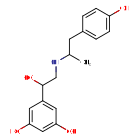
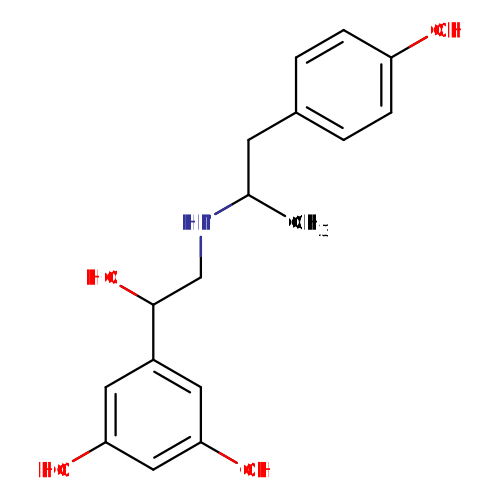
Structure for Fenoterol (DB01288)
- Weight
- Average: 303.3529
Monoisotopic: 303.147058165 - Chemical Formula
- C17H21NO4
- Synonyms
- 1-(3,5-dihydroxyphenyl)-1-hydroxy-2-((4-hydroxyphenyl)isopropylamino)ethane
- 1-(p-hydroxyphenyl)-2-((β-hydroxy-β-(3',5'-dihydroxyphenyl))ethyl)aminopropane
- 3,5-dihydroxy-α-(((p-hydroxy-α-methylphenethyl)amino)methyl)benzyl alcohol
- 5-{1-Hydroxy-2-[2-(4-hydroxy-phenyl)-1-methyl-ethylamino]-ethyl}-benzene-1,3-diol
- Fenoterol
- Fenoterolum
- Phenoterol
- External IDs
- TH-1165

Pharmacology
- Indication
Fenoterol is used for the treatment of asthma.
 Reduce drug development failure ratesBuild, train, & validate machine-learning modelswith evidence-based and structured datasets.Build, train, & validate predictive machine-learning models with structured datasets.
- Associated Conditions
Indication Type Indication Combined Product Details Approval Level Age Group Patient Characteristics Dose Form Prophylaxis of Asthma, exercise-induced •••••••••••• Symptomatic treatment of Asthmatic attack •••••••••••• Adjunct therapy in treatment of Bronchial asthma •••••••••••• Used in combination to manage Severe copd exacerbation Combination Product in combination with: Ipratropium (DB00332) •••••••••••• - Contraindications & Blackbox Warnings
 Prevent Adverse Drug Events TodayTap into our Clinical API for life-saving information on contraindications & blackbox warnings, population restrictions, harmful risks, & more.Avoid life-threatening adverse drug events with our Clinical API
- Pharmacodynamics
Fenoterol is a beta agonist designed to open up the airways to the lungs by decreasing bronchconstriction.
- Mechanism of action
Beta(2)-receptor stimulation in the lung causes relaxation of bronchial smooth muscle, bronchodilation, and increased bronchial airflow.
Target Actions Organism ABeta-2 adrenergic receptor agonistHumans UBeta-1 adrenergic receptor agonistHumans UBeta-3 adrenergic receptor agonistHumans - Absorption
Not Available
- Volume of distribution
Not Available
- Protein binding
Not Available
- Metabolism
Hepatic.
- Route of elimination
Not Available
- Half-life
Not Available
- Clearance
Not Available
- Adverse Effects
 Improve decision support & research outcomesWith structured adverse effects data, including: blackbox warnings, adverse reactions, warning & precautions, & incidence rates. View sample adverse effects data in our new Data Library!Improve decision support & research outcomes with our structured adverse effects data.
- Toxicity
Symptoms of overdose include angina (chest pain), dizziness, dry mouth, fatigue, flu-like symptoms, headache, heart irregularities, high or low blood pressure, high blood sugar, insomnia, muscle cramps, nausea, nervousness, rapid heartbeat, seizures, and tremor.
- Pathways
- Not Available
- Pharmacogenomic Effects/ADRs
- Not Available
Interactions
- Drug Interactions
- This information should not be interpreted without the help of a healthcare provider. If you believe you are experiencing an interaction, contact a healthcare provider immediately. The absence of an interaction does not necessarily mean no interactions exist.
Drug Interaction Integrate drug-drug
interactions in your softwareAcebutolol The therapeutic efficacy of Fenoterol can be decreased when used in combination with Acebutolol. Aceclofenac The risk or severity of hypertension can be increased when Fenoterol is combined with Aceclofenac. Acemetacin The risk or severity of hypertension can be increased when Fenoterol is combined with Acemetacin. Acetylsalicylic acid The risk or severity of hypertension can be increased when Acetylsalicylic acid is combined with Fenoterol. Aclidinium The risk or severity of adverse effects can be increased when Fenoterol is combined with Aclidinium. - Food Interactions
- Take with or without food. The absorption is unaffected by food.
Products
 Drug product information from 10+ global regionsOur datasets provide approved product information including:dosage, form, labeller, route of administration, and marketing period.Access drug product information from over 10 global regions.
- Product Ingredients
Ingredient UNII CAS InChI Key Fenoterol hydrobromide RLI45Z99RB 1944-12-3 SGZRQMALQBXAIQ-NRNQBQMASA-N - International/Other Brands
- Alveofen (Prieto) / Berotec (Boehringer Ingelheim) / Berotec N (Boehringer Ingelheim) / Cenfenol (Center) / Partusisten (Boehringer Ingelheim)
- Brand Name Prescription Products
Name Dosage Strength Route Labeller Marketing Start Marketing End Region Image Berotec 1mg/ml Solution 1 mg / mL Respiratory (inhalation) Boehringer Ingelheim (Canada) Ltd Ltee 1982-12-31 2008-12-16 Canada 
Berotec Aem 100mcg/dose Aerosol, metered 100 mcg / act Respiratory (inhalation) Boehringer Ingelheim (Canada) Ltd Ltee 1992-12-31 2007-11-02 Canada Berotec Forte Metered Aer Aerosol, metered 0.2 mg / ns Respiratory (inhalation) Boehringer Ingelheim (Canada) Ltd Ltee 1977-12-31 1997-08-14 Canada Berotec Tab 2.5mg Tablet 2.5 mg Oral Boehringer Ingelheim (Canada) Ltd Ltee 1979-12-31 2000-07-31 Canada Berotec Udv Inhalation Solution 0.25mg/ml Solution 0.25 mg / mL Respiratory (inhalation) Boehringer Ingelheim (Canada) Ltd Ltee 1994-12-31 2005-02-10 Canada - Mixture Products
Name Ingredients Dosage Route Labeller Marketing Start Marketing End Region Image Berodual - Dosieraerosol Fenoterol hydrobromide (0.05 mg) + Ipratropium bromide monohydrate (0.02 mg) Aerosol, metered Respiratory (inhalation) Boehringer Ingelheim Rcv Gmb H & Co Kg 1981-09-15 Not applicable Austria 
BERODUAL N METERED DOSE INHALER Fenoterol hydrobromide (50 mcg/dose) + Ipratropium bromide anhydrous (20 mcg/dose) Aerosol, spray Respiratory (inhalation) BOEHRINGER INGELHEIM SINGAPORE PTE. LTD. 2001-11-30 Not applicable Singapore 
BERODUAL SOLUTION Fenoterol hydrobromide (0.5 mg/ml) + Ipratropium bromide monohydrate (0.25 mg/ml) Solution Respiratory (inhalation) BOEHRINGER INGELHEIM SINGAPORE PTE. LTD. 1989-04-28 Not applicable Singapore BERODUAL® HFA Fenoterol hydrobromide (0.05 mg) + Ipratropium (0.02 mg) Solution Respiratory (inhalation) BOEHRINGER INGELHEIM PHARMA GMBH & CO. KG. 2006-11-10 Not applicable Colombia 
BERODUAL® SOLUCION. Fenoterol hydrobromide (0.5 mg) + Ipratropium bromide anhydrous (0.25 mg) Solution Respiratory (inhalation) PHARMETIQUE S.A. 2006-11-10 Not applicable Colombia
Categories
- ATC Codes
- R03CC04 — Fenoterol
- R03CC — Selective beta-2-adrenoreceptor agonists
- R03C — ADRENERGICS FOR SYSTEMIC USE
- R03 — DRUGS FOR OBSTRUCTIVE AIRWAY DISEASES
- R — RESPIRATORY SYSTEM
- R03AL — Adrenergics in combination with anticholinergics incl. triple combinations with corticosteroids
- R03A — ADRENERGICS, INHALANTS
- R03 — DRUGS FOR OBSTRUCTIVE AIRWAY DISEASES
- R — RESPIRATORY SYSTEM
- G02CA — Sympathomimetics, labour repressants
- G02C — OTHER GYNECOLOGICALS
- G02 — OTHER GYNECOLOGICALS
- G — GENITO URINARY SYSTEM AND SEX HORMONES
- Drug Categories
- Adrenergic Agents
- Adrenergic Agonists
- Adrenergic beta-2 Receptor Agonists
- Adrenergic beta-Agonists
- Adrenergics for Systemic Use
- Adrenergics, Inhalants
- Agents producing tachycardia
- Agents that produce hypertension
- Agents to Treat Airway Disease
- Alcohols
- Amines
- Amino Alcohols
- Anti-Asthmatic Agents
- Anticholinergic Agents
- Autonomic Agents
- Benzene Derivatives
- Bronchodilator Agents
- Catechols
- Drugs for Obstructive Airway Diseases
- Ethanolamines
- Genito Urinary System and Sex Hormones
- Metaproterenol
- Neurotransmitter Agents
- Peripheral Nervous System Agents
- Phenols
- Reproductive Control Agents
- Respiratory System Agents
- Selective Beta 2-adrenergic Agonists
- Sympathomimetics
- Sympathomimetics, Labour Repressants
- Tocolytic Agents
- Chemical TaxonomyProvided by Classyfire
- Description
- This compound belongs to the class of organic compounds known as amphetamines and derivatives. These are organic compounds containing or derived from 1-phenylpropan-2-amine.
- Kingdom
- Organic compounds
- Super Class
- Benzenoids
- Class
- Benzene and substituted derivatives
- Sub Class
- Phenethylamines
- Direct Parent
- Amphetamines and derivatives
- Alternative Parents
- Phenylpropanes / Resorcinols / Aralkylamines / 1-hydroxy-4-unsubstituted benzenoids / 1-hydroxy-2-unsubstituted benzenoids / Secondary alcohols / 1,2-aminoalcohols / Dialkylamines / Organopnictogen compounds / Hydrocarbon derivatives show 1 more
- Substituents
- 1,2-aminoalcohol / 1-hydroxy-2-unsubstituted benzenoid / 1-hydroxy-4-unsubstituted benzenoid / Alcohol / Amine / Amphetamine or derivatives / Aralkylamine / Aromatic alcohol / Aromatic homomonocyclic compound / Hydrocarbon derivative show 11 more
- Molecular Framework
- Aromatic homomonocyclic compounds
- External Descriptors
- secondary alcohol, secondary amino compound, resorcinols (CHEBI:149226)
- Affected organisms
- Humans and other mammals
Chemical Identifiers
- UNII
- 22M9P70OQ9
- CAS number
- 13392-18-2
- InChI Key
- LSLYOANBFKQKPT-UHFFFAOYSA-N
- InChI
- InChI=1S/C17H21NO4/c1-11(6-12-2-4-14(19)5-3-12)18-10-17(22)13-7-15(20)9-16(21)8-13/h2-5,7-9,11,17-22H,6,10H2,1H3
- IUPAC Name
- 5-(1-hydroxy-2-{[1-(4-hydroxyphenyl)propan-2-yl]amino}ethyl)benzene-1,3-diol
- SMILES
- CC(CC1=CC=C(O)C=C1)NCC(O)C1=CC(O)=CC(O)=C1
References
- Synthesis Reference
Zeile, K., Thoma, O. and Mentrup, A,; U.S. Patent 3,341,593; September 12, 1967; assigned to Boehringer lngelheim GmbH, Germany.
- General References
- AIFA Product Information: Dosberotec (fenoterol hydrobromide) for inhalation [Link]
- External Links
- Human Metabolome Database
- HMDB0015405
- KEGG Drug
- D04157
- PubChem Compound
- 3343
- PubChem Substance
- 46509099
- ChemSpider
- 3226
- BindingDB
- 50131281
- 4333
- ChEBI
- 149226
- ChEMBL
- CHEMBL32800
- Therapeutic Targets Database
- DAP000946
- PharmGKB
- PA10079
- Guide to Pharmacology
- GtP Drug Page
- Wikipedia
- Fenoterol
Clinical Trials
- Clinical Trials
Phase Status Purpose Conditions Count 4 Completed Treatment Acute Bronchial Obstruction, Asthma 1 4 Unknown Status Treatment Chronic Obstructive Pulmonary Disease (COPD) 1 3 Completed Treatment Asthma 3 3 Completed Treatment Asthma / Chronic Obstructive Pulmonary Disease (COPD) 1 3 Completed Treatment Chronic Obstructive Pulmonary Disease (COPD) 2
Pharmacoeconomics
- Manufacturers
- Not Available
- Packagers
- Not Available
- Dosage Forms
Form Route Strength Aerosol Buccal Aerosol Respiratory (inhalation) Solution Respiratory (inhalation) Aerosol, metered Respiratory (inhalation) Aerosol, spray Respiratory (inhalation) 50 mcg/dose Solution Respiratory (inhalation) 0.5 mg/ml Aerosol Respiratory (inhalation) Aerosol, metered Respiratory (inhalation) 100 µg Solution Respiratory (inhalation) 1 mg / mL Aerosol, metered Respiratory (inhalation) 100 mcg / act Aerosol, metered Respiratory (inhalation) 0.2 mg / ns Aerosol, metered Respiratory (inhalation) Gas Respiratory (inhalation) 100 UG Tablet Oral 2.5 mg Solution Respiratory (inhalation) 0.25 mg / mL Solution Respiratory (inhalation) 0.625 mg / mL Aerosol Respiratory (inhalation) 15 ML Aerosol, metered Respiratory (inhalation) 100 MCG Aerosol, metered Respiratory (inhalation) 200 MCG Powder, metered Respiratory (inhalation) 0.2 MG Solution Oral 1 MG/ML Solution Respiratory (inhalation) 200 MCG Spray Respiratory (inhalation) 0.5 MG/2ML Spray Respiratory (inhalation) 1.25 MG/2ML Spray Respiratory (inhalation) 5 MG/ML Syrup 0.5 MG/ML Solution Nasal 1.25 mg/4ml Aerosol Respiratory (inhalation) 100000 Mcg Syrup Oral - Prices
- Not Available
- Patents
- Not Available
Properties
- State
- Solid
- Experimental Properties
Property Value Source melting point (°C) 222-223 Zeile, K., Thoma, O. and Mentrup, A,; U.S. Patent 3,341,593; September 12, 1967; assigned to Boehringer lngelheim GmbH, Germany. - Predicted Properties
Property Value Source Water Solubility 0.162 mg/mL ALOGPS logP 1.36 ALOGPS logP 1.47 Chemaxon logS -3.3 ALOGPS pKa (Strongest Acidic) 8.85 Chemaxon pKa (Strongest Basic) 9.63 Chemaxon Physiological Charge 1 Chemaxon Hydrogen Acceptor Count 5 Chemaxon Hydrogen Donor Count 5 Chemaxon Polar Surface Area 92.95 Å2 Chemaxon Rotatable Bond Count 6 Chemaxon Refractivity 85 m3·mol-1 Chemaxon Polarizability 31.75 Å3 Chemaxon Number of Rings 2 Chemaxon Bioavailability 1 Chemaxon Rule of Five Yes Chemaxon Ghose Filter Yes Chemaxon Veber's Rule No Chemaxon MDDR-like Rule No Chemaxon - Predicted ADMET Features
Property Value Probability Human Intestinal Absorption + 0.987 Blood Brain Barrier - 0.9294 Caco-2 permeable - 0.8957 P-glycoprotein substrate Substrate 0.7292 P-glycoprotein inhibitor I Non-inhibitor 0.9064 P-glycoprotein inhibitor II Non-inhibitor 0.946 Renal organic cation transporter Non-inhibitor 0.7992 CYP450 2C9 substrate Non-substrate 0.7004 CYP450 2D6 substrate Non-substrate 0.7055 CYP450 3A4 substrate Non-substrate 0.625 CYP450 1A2 substrate Non-inhibitor 0.9045 CYP450 2C9 inhibitor Non-inhibitor 0.9071 CYP450 2D6 inhibitor Inhibitor 0.8932 CYP450 2C19 inhibitor Non-inhibitor 0.9026 CYP450 3A4 inhibitor Non-inhibitor 0.8308 CYP450 inhibitory promiscuity Low CYP Inhibitory Promiscuity 0.8681 Ames test Non AMES toxic 0.8609 Carcinogenicity Non-carcinogens 0.9011 Biodegradation Not ready biodegradable 0.9174 Rat acute toxicity 2.1550 LD50, mol/kg Not applicable hERG inhibition (predictor I) Weak inhibitor 0.813 hERG inhibition (predictor II) Non-inhibitor 0.7963
Spectra
- Mass Spec (NIST)
- Not Available
- Spectra
- Chromatographic Properties
Collision Cross Sections (CCS)
Adduct CCS Value (Å2) Source type Source [M-H]- 175.5997035 predictedDarkChem Lite v0.1.0 [M-H]- 171.78706 predictedDeepCCS 1.0 (2019) [M+H]+ 176.5030035 predictedDarkChem Lite v0.1.0 [M+H]+ 174.14507 predictedDeepCCS 1.0 (2019) [M+Na]+ 176.1321035 predictedDarkChem Lite v0.1.0 [M+Na]+ 180.2382 predictedDeepCCS 1.0 (2019)
Targets

- Kind
- Protein
- Organism
- Humans
- Pharmacological action
- Yes
- Actions
- Agonist
- General Function
- Protein homodimerization activity
- Specific Function
- Beta-adrenergic receptors mediate the catecholamine-induced activation of adenylate cyclase through the action of G proteins. The beta-2-adrenergic receptor binds epinephrine with an approximately ...
- Gene Name
- ADRB2
- Uniprot ID
- P07550
- Uniprot Name
- Beta-2 adrenergic receptor
- Molecular Weight
- 46458.32 Da
References
- de Vries B, Roffel AF, Zaagsma J, Meurs H: Effect of fenoterol-induced constitutive beta(2)-adrenoceptor activity on contractile receptor function in airway smooth muscle. Eur J Pharmacol. 2001 Nov 23;431(3):353-9. [Article]
- Boterman M, Smits SR, Meurs H, Zaagsma J: Protein kinase C potentiates homologous desensitization of the beta2-adrenoceptor in bovine tracheal smooth muscle. Eur J Pharmacol. 2006 Jan 4;529(1-3):151-6. Epub 2005 Dec 1. [Article]
- Marone G, Ambrosio G, Bonaduce D, Genovese A, Triggiani M, Condorelli M: Inhibition of IgE-mediated histamine release from human basophils and mast cells by fenoterol. Int Arch Allergy Appl Immunol. 1984;74(4):356-61. [Article]
- Coqueret O, Demarquay D, Lagente V: Role of cyclic AMP in the modulation of IgE production by the beta 2-adrenoceptor agonist, fenoterol. Eur Respir J. 1996 Feb;9(2):220-5. [Article]
- Bouillon T, Meineke I, Port R, Hildebrandt R, Gunther K, Gundert-Remy U: Concentration-effect relationship of the positive chronotropic and hypokalaemic effects of fenoterol in healthy women of childbearing age. Eur J Clin Pharmacol. 1996;51(2):153-60. [Article]
- Chen X, Ji ZL, Chen YZ: TTD: Therapeutic Target Database. Nucleic Acids Res. 2002 Jan 1;30(1):412-5. [Article]
- Kind
- Protein
- Organism
- Humans
- Pharmacological action
- Unknown
- Actions
- Agonist
- General Function
- Receptor signaling protein activity
- Specific Function
- Beta-adrenergic receptors mediate the catecholamine-induced activation of adenylate cyclase through the action of G proteins. This receptor binds epinephrine and norepinephrine with approximately e...
- Gene Name
- ADRB1
- Uniprot ID
- P08588
- Uniprot Name
- Beta-1 adrenergic receptor
- Molecular Weight
- 51322.1 Da
References
- Hoffmann C, Leitz MR, Oberdorf-Maass S, Lohse MJ, Klotz KN: Comparative pharmacology of human beta-adrenergic receptor subtypes--characterization of stably transfected receptors in CHO cells. Naunyn Schmiedebergs Arch Pharmacol. 2004 Feb;369(2):151-9. Epub 2004 Jan 17. [Article]
- Kind
- Protein
- Organism
- Humans
- Pharmacological action
- Unknown
- Actions
- Agonist
- General Function
- Protein homodimerization activity
- Specific Function
- Beta-adrenergic receptors mediate the catecholamine-induced activation of adenylate cyclase through the action of G proteins. Beta-3 is involved in the regulation of lipolysis and thermogenesis.
- Gene Name
- ADRB3
- Uniprot ID
- P13945
- Uniprot Name
- Beta-3 adrenergic receptor
- Molecular Weight
- 43518.615 Da
References
- Hoffmann C, Leitz MR, Oberdorf-Maass S, Lohse MJ, Klotz KN: Comparative pharmacology of human beta-adrenergic receptor subtypes--characterization of stably transfected receptors in CHO cells. Naunyn Schmiedebergs Arch Pharmacol. 2004 Feb;369(2):151-9. Epub 2004 Jan 17. [Article]

Drug created at June 28, 2007 15:56 / Updated at December 02, 2023 07:02