Identification
- Generic Name
- Practolol
- DrugBank Accession Number
- DB01297
- Background
A beta-adrenergic antagonist that has been used in the emergency treatment of cardiac arrhythmias.
- Type
- Small Molecule
- Groups
- Approved
- Structure
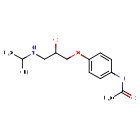
Structure for Practolol (DB01297)

- Weight
- Average: 266.3361
Monoisotopic: 266.16304258 - Chemical Formula
- C14H22N2O3
- Synonyms
- (±)-practolol
- 1-(4-acetamidophenoxy)-3-isopropylamino-2-propanol
- 4'-(2-hydroxy-3-(isopropylamino)propoxy)acetanilide
- N-(4-(2-hydroxy-3-((1-methylethyl)amino)propoxy)phenyl)acetamide
- Practolol
- Practololo
- Practololum
- Praktololu
- External IDs
- AY-21,011
- AY-21011
- I.C.I. 50,172
- I.C.I.-50,172
- ICI-50172
- Tocris-0831

Pharmacology
- Indication
Used in the emergency treatment of cardiac arrhythmias.
 Reduce drug development failure ratesBuild, train, & validate machine-learning modelswith evidence-based and structured datasets.Build, train, & validate predictive machine-learning models with structured datasets.
- Contraindications & Blackbox Warnings
 Prevent Adverse Drug Events TodayTap into our Clinical API for life-saving information on contraindications & blackbox warnings, population restrictions, harmful risks, & more.Avoid life-threatening adverse drug events with our Clinical API
- Pharmacodynamics
Practolol is a beta-adrenergic receptor antagonist that has been used in the emergency treatment of cardiac arrhythmias. Beta blockers inhibit normal epinephrine-mediated sympathetic actions, but have minimal effect on resting subjects. That is, they reduce the effect of excitement/physical exertion on heart rate and force of contraction and dilation of blood vessels.
- Mechanism of action
Like other beta-adrenergic antagonists, practolol competes with adrenergic neurotransmitters such as catecholamines for binding at sympathetic receptor sites. Like propranolol and timolol, practolol binds at beta(1)-adrenergic receptors in the heart and vascular smooth muscle, inhibiting the effects of the catecholamines epinephrine and norepinephrine and decreasing heart rate, cardiac output, and systolic and diastolic blood pressure.
Target Actions Organism ABeta-1 adrenergic receptor antagonistHumans - Absorption
Not Available
- Volume of distribution
Not Available
- Protein binding
Not Available
- Metabolism
- Not Available
- Route of elimination
Not Available
- Half-life
Not Available
- Clearance
Not Available
- Adverse Effects
 Improve decision support & research outcomesWith structured adverse effects data, including: blackbox warnings, adverse reactions, warning & precautions, & incidence rates. View sample adverse effects data in our new Data Library!Improve decision support & research outcomes with our structured adverse effects data.
- Toxicity
Symptoms of overdose include abdominal irritation, central nervous system depression, coma, extremely slow heartbeat, heart failure, lethargy, low blood pressure, and wheezing.
- Pathways
Pathway Category Practolol Action Pathway Drug action - Pharmacogenomic Effects/ADRs
- Not Available
Interactions
- Drug Interactions
- This information should not be interpreted without the help of a healthcare provider. If you believe you are experiencing an interaction, contact a healthcare provider immediately. The absence of an interaction does not necessarily mean no interactions exist.
Drug Interaction Integrate drug-drug
interactions in your softwareAbaloparatide Abaloparatide may increase the hypotensive activities of Practolol. Abatacept The metabolism of Practolol can be increased when combined with Abatacept. Abiraterone The metabolism of Practolol can be decreased when combined with Abiraterone. Acarbose The therapeutic efficacy of Acarbose can be increased when used in combination with Practolol. Acebutolol Acebutolol may increase the arrhythmogenic activities of Practolol. - Food Interactions
- Avoid alcohol.
- Avoid natural licorice.
Products
 Drug product information from 10+ global regionsOur datasets provide approved product information including:dosage, form, labeller, route of administration, and marketing period.Access drug product information from over 10 global regions.
- Product Ingredients
Ingredient UNII CAS InChI Key Practolol hydrochloride AT88RXS5AE 6996-43-6 UEWORNJBQXFYSM-UHFFFAOYSA-N
Categories
- ATC Codes
- C07AB01 — Practolol
- Drug Categories
- Acetanilides
- Adrenergic Agents
- Adrenergic Antagonists
- Adrenergic beta-1 Receptor Antagonists
- Adrenergic beta-Antagonists
- Agents causing hyperkalemia
- Alcohols
- Amides
- Amines
- Amino Alcohols
- Anilides
- Aniline Compounds
- Antiarrhythmic agents
- Antihypertensive Agents
- Beta Blocking Agents, Selective
- Bradycardia-Causing Agents
- Cardiovascular Agents
- Cytochrome P-450 CYP2D6 Substrates
- Cytochrome P-450 Substrates
- Neurotransmitter Agents
- Phenoxypropanolamines
- Propanolamines
- Propanols
- Chemical TaxonomyProvided by Classyfire
- Description
- This compound belongs to the class of organic compounds known as acetanilides. These are organic compounds containing an acetamide group conjugated to a phenyl group.
- Kingdom
- Organic compounds
- Super Class
- Benzenoids
- Class
- Benzene and substituted derivatives
- Sub Class
- Anilides
- Direct Parent
- Acetanilides
- Alternative Parents
- N-acetylarylamines / Phenoxy compounds / Phenol ethers / Alkyl aryl ethers / Acetamides / Secondary carboxylic acid amides / Secondary alcohols / Amino acids and derivatives / 1,2-aminoalcohols / Dialkylamines show 4 more
- Substituents
- 1,2-aminoalcohol / Acetamide / Acetanilide / Alcohol / Alkyl aryl ether / Amine / Amino acid or derivatives / Aromatic homomonocyclic compound / Carbonyl group / Carboxamide group show 17 more
- Molecular Framework
- Aromatic homomonocyclic compounds
- External Descriptors
- secondary alcohol, secondary amino compound, acetamides, ethanolamines, propanolamine (CHEBI:258351)
- Affected organisms
- Not Available
Chemical Identifiers
- UNII
- SUG9176GRW
- CAS number
- 6673-35-4
- InChI Key
- DURULFYMVIFBIR-UHFFFAOYSA-N
- InChI
- InChI=1S/C14H22N2O3/c1-10(2)15-8-13(18)9-19-14-6-4-12(5-7-14)16-11(3)17/h4-7,10,13,15,18H,8-9H2,1-3H3,(H,16,17)
- IUPAC Name
- N-(4-{2-hydroxy-3-[(propan-2-yl)amino]propoxy}phenyl)acetamide
- SMILES
- CC(C)NCC(O)COC1=CC=C(NC(C)=O)C=C1
References
- General References
- Not Available
- External Links
- Human Metabolome Database
- HMDB0015411
- KEGG Drug
- D05587
- KEGG Compound
- C11696
- PubChem Compound
- 4883
- PubChem Substance
- 46507496
- ChemSpider
- 4715
- BindingDB
- 25749
- 8620
- ChEBI
- 258351
- ChEMBL
- CHEMBL6995
- Therapeutic Targets Database
- DAP000940
- PharmGKB
- PA164752820
- Wikipedia
- Practolol
Clinical Trials
Pharmacoeconomics
- Manufacturers
- Not Available
- Packagers
- Not Available
- Dosage Forms
- Not Available
- Prices
- Not Available
- Patents
- Not Available
Properties
- State
- Solid
- Experimental Properties
Property Value Source melting point (°C) 134-136 °C PhysProp logP 0.79 HANSCH,C ET AL. (1995) Caco2 permeability -6.05 ADME Research, USCD - Predicted Properties
Property Value Source Water Solubility 0.49 mg/mL ALOGPS logP 0.53 ALOGPS logP 0.83 Chemaxon logS -2.7 ALOGPS pKa (Strongest Acidic) 14.03 Chemaxon pKa (Strongest Basic) 9.67 Chemaxon Physiological Charge 1 Chemaxon Hydrogen Acceptor Count 4 Chemaxon Hydrogen Donor Count 3 Chemaxon Polar Surface Area 70.59 Å2 Chemaxon Rotatable Bond Count 7 Chemaxon Refractivity 75.24 m3·mol-1 Chemaxon Polarizability 30.39 Å3 Chemaxon Number of Rings 1 Chemaxon Bioavailability 1 Chemaxon Rule of Five Yes Chemaxon Ghose Filter Yes Chemaxon Veber's Rule No Chemaxon MDDR-like Rule No Chemaxon - Predicted ADMET Features
Property Value Probability Human Intestinal Absorption + 0.9472 Blood Brain Barrier - 0.8609 Caco-2 permeable - 0.8957 P-glycoprotein substrate Substrate 0.589 P-glycoprotein inhibitor I Non-inhibitor 0.8705 P-glycoprotein inhibitor II Non-inhibitor 0.9147 Renal organic cation transporter Non-inhibitor 0.9484 CYP450 2C9 substrate Non-substrate 0.781 CYP450 2D6 substrate Non-substrate 0.5082 CYP450 3A4 substrate Non-substrate 0.6487 CYP450 1A2 substrate Non-inhibitor 0.9046 CYP450 2C9 inhibitor Non-inhibitor 0.907 CYP450 2D6 inhibitor Inhibitor 0.6103 CYP450 2C19 inhibitor Non-inhibitor 0.9025 CYP450 3A4 inhibitor Non-inhibitor 0.9289 CYP450 inhibitory promiscuity Low CYP Inhibitory Promiscuity 0.9268 Ames test Non AMES toxic 0.9153 Carcinogenicity Non-carcinogens 0.8402 Biodegradation Not ready biodegradable 0.9564 Rat acute toxicity 1.9187 LD50, mol/kg Not applicable hERG inhibition (predictor I) Weak inhibitor 0.9917 hERG inhibition (predictor II) Non-inhibitor 0.898
Spectra
- Mass Spec (NIST)
- Not Available
- Spectra
- Chromatographic Properties
Collision Cross Sections (CCS)
Adduct CCS Value (Å2) Source type Source [M-H]- 177.5412205 predictedDarkChem Lite v0.1.0 [M-H]- 164.61516 predictedDeepCCS 1.0 (2019) [M+H]+ 178.3210205 predictedDarkChem Lite v0.1.0 [M+H]+ 166.97316 predictedDeepCCS 1.0 (2019) [M+Na]+ 177.6259205 predictedDarkChem Lite v0.1.0 [M+Na]+ 173.06631 predictedDeepCCS 1.0 (2019)
Targets

- Kind
- Protein
- Organism
- Humans
- Pharmacological action
- Yes
- Actions
- Antagonist
- General Function
- Receptor signaling protein activity
- Specific Function
- Beta-adrenergic receptors mediate the catecholamine-induced activation of adenylate cyclase through the action of G proteins. This receptor binds epinephrine and norepinephrine with approximately e...
- Gene Name
- ADRB1
- Uniprot ID
- P08588
- Uniprot Name
- Beta-1 adrenergic receptor
- Molecular Weight
- 51322.1 Da
References
- Abrahamsson T: The beta 1- and beta 2-adrenoceptor stimulatory effects of alprenolol, oxprenolol and pindolol: a study in the isolated right atrium and uterus of the rat. Br J Pharmacol. 1986 Apr;87(4):657-64. [Article]
- Keyrilainen O, Uusitalo A: A comparative study of three beta 1-adrenoreceptor blocking drugs with different degree of intrinsic stimulating activity (metoprolol, practolol and H 87/07) in patients with angina pectoris. Ann Clin Res. 1978 Aug;10(4):185-90. [Article]
- Saarnivaara L, Lindgren L, Hynynen M: Effects of practolol and metoprolol on QT interval, heart rate and arterial pressure during induction of anaesthesia. Acta Anaesthesiol Scand. 1984 Dec;28(6):644-8. [Article]
- Chen X, Ji ZL, Chen YZ: TTD: Therapeutic Target Database. Nucleic Acids Res. 2002 Jan 1;30(1):412-5. [Article]
- Buxton IL, Brunton LL: Direct analysis of beta-adrenergic receptor subtypes on intact adult ventricular myocytes of the rat. Circ Res. 1985 Jan;56(1):126-32. [Article]
Enzymes
- Kind
- Protein
- Organism
- Humans
- Pharmacological action
- No
- Actions
- Substrate
- General Function
- Steroid hydroxylase activity
- Specific Function
- Responsible for the metabolism of many drugs and environmental chemicals that it oxidizes. It is involved in the metabolism of drugs such as antiarrhythmics, adrenoceptor antagonists, and tricyclic...
- Gene Name
- CYP2D6
- Uniprot ID
- P10635
- Uniprot Name
- Cytochrome P450 2D6
- Molecular Weight
- 55768.94 Da
References
- Sternieri E, Coccia CP, Pinetti D, Guerzoni S, Ferrari A: Pharmacokinetics and interactions of headache medications, part II: prophylactic treatments. Expert Opin Drug Metab Toxicol. 2006 Dec;2(6):981-1007. doi: 10.1517/17425255.2.6.981 . [Article]
- Brodde OE, Kroemer HK: Drug-drug interactions of beta-adrenoceptor blockers. Arzneimittelforschung. 2003;53(12):814-22. [Article]
- Iwaki M, Niwa T, Bandoh S, Itoh M, Hirose H, Kawase A, Komura H: Application of substrate depletion assay to evaluation of CYP isoforms responsible for stereoselective metabolism of carvedilol. Drug Metab Pharmacokinet. 2016 Dec;31(6):425-432. doi: 10.1016/j.dmpk.2016.08.007. Epub 2016 Sep 2. [Article]

Drug created at June 30, 2007 14:19 / Updated at February 21, 2021 18:51