Identification
- Generic Name
- Quinethazone
- DrugBank Accession Number
- DB01325
- Background
Quinethazone, marketed as Hydromox, is a thiazide diuretic indicated for hypertension. Patients may experience adverse reactions such as dizziness, dry mouth, nausea, and hypokalemia.
- Type
- Small Molecule
- Groups
- Approved
- Structure

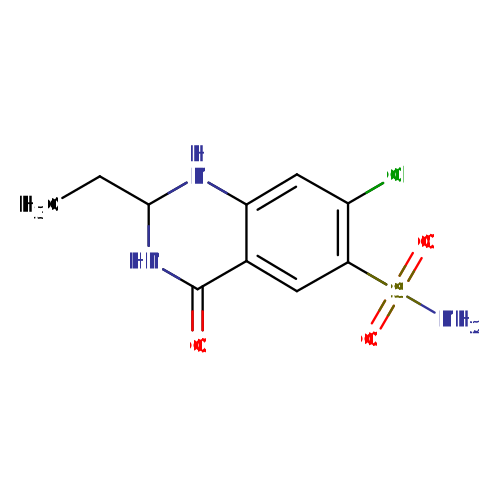
Structure for Quinethazone (DB01325)
- Weight
- Average: 289.739
Monoisotopic: 289.028789662 - Chemical Formula
- C10H12ClN3O3S
- Synonyms
- Chinetazone
- Quinetazona
- Quinethazon
- Quinethazone
- Quinethazonum
- External IDs
- CL 36010

Pharmacology
- Indication
Used to treat hypertension.
 Reduce drug development failure ratesBuild, train, & validate machine-learning modelswith evidence-based and structured datasets.Build, train, & validate predictive machine-learning models with structured datasets.
- Contraindications & Blackbox Warnings
 Prevent Adverse Drug Events TodayTap into our Clinical API for life-saving information on contraindications & blackbox warnings, population restrictions, harmful risks, & more.Avoid life-threatening adverse drug events with our Clinical API
- Pharmacodynamics
Quinethazone is a thiazide diuretic used to treat hypertension. It inhibits Na+/Cl- reabsorption from the distal convoluted tubules in the kidneys. Thiazides also cause loss of potassium and an increase in serum uric acid. Thiazides are often used to treat hypertension, but their hypotensive effects are not necessarily due to their diuretic activity. Thiazides have been shown to prevent hypertension-related morbidity and mortality although the mechanism is not fully understood. Thiazides cause vasodilation by activating calcium-activated potassium channels (large conductance) in vascular smooth muscles and inhibiting various carbonic anhydrases in vascular tissue.
- Mechanism of action
As a diuretic, quinethazone inhibits active chloride reabsorption at the early distal tubule via the Na-Cl cotransporter, resulting in an increase in the excretion of sodium, chloride, and water. Thiazides like quinethazone also inhibit sodium ion transport across the renal tubular epithelium through binding to the thiazide sensitive sodium-chloride transporter. This results in an increase in potassium excretion via the sodium-potassium exchange mechanism. The antihypertensive mechanism of quinethazone is less well understood although it may be mediated through its action on carbonic anhydrases in the smooth muscle or through its action on the large-conductance calcium-activated potassium (KCa) channel, also found in the smooth muscle.
Target Actions Organism ASolute carrier family 12 member 1 inhibitorHumans ASolute carrier family 12 member 2 inhibitorHumans ASolute carrier family 12 member 3 inhibitorHumans ACarbonic anhydrase 1 inhibitorHumans ACarbonic anhydrase 2 inhibitorHumans - Absorption
Not Available
- Volume of distribution
Not Available
- Protein binding
Not Available
- Metabolism
- Not Available
- Route of elimination
Not Available
- Half-life
Not Available
- Clearance
Not Available
- Adverse Effects
 Improve decision support & research outcomesWith structured adverse effects data, including: blackbox warnings, adverse reactions, warning & precautions, & incidence rates. View sample adverse effects data in our new Data Library!Improve decision support & research outcomes with our structured adverse effects data.
- Toxicity
Not Available
- Pathways
Pathway Category Quinethazone Action Pathway Drug action - Pharmacogenomic Effects/ADRs
- Not Available
Interactions
- Drug Interactions
- This information should not be interpreted without the help of a healthcare provider. If you believe you are experiencing an interaction, contact a healthcare provider immediately. The absence of an interaction does not necessarily mean no interactions exist.
Drug Interaction Integrate drug-drug
interactions in your softwareAbacavir Quinethazone may increase the excretion rate of Abacavir which could result in a lower serum level and potentially a reduction in efficacy. Acarbose The therapeutic efficacy of Acarbose can be decreased when used in combination with Quinethazone. Aceclofenac The therapeutic efficacy of Quinethazone can be decreased when used in combination with Aceclofenac. Acemetacin The therapeutic efficacy of Quinethazone can be decreased when used in combination with Acemetacin. Acetaminophen Quinethazone may increase the excretion rate of Acetaminophen which could result in a lower serum level and potentially a reduction in efficacy. - Food Interactions
- Take with food. Food increases bioavailability.
Products
 Drug product information from 10+ global regionsOur datasets provide approved product information including:dosage, form, labeller, route of administration, and marketing period.Access drug product information from over 10 global regions.
- International/Other Brands
- Aquamox / Hydromox / Idrokin
Categories
- ATC Codes
- G01AE10 — Combinations of sulfonamides
- G01AE — Sulfonamides
- G01A — ANTIINFECTIVES AND ANTISEPTICS, EXCL. COMBINATIONS WITH CORTICOSTEROIDS
- G01 — GYNECOLOGICAL ANTIINFECTIVES AND ANTISEPTICS
- G — GENITO URINARY SYSTEM AND SEX HORMONES
- C03BA — Sulfonamides, plain
- C03B — LOW-CEILING DIURETICS, EXCL. THIAZIDES
- C03 — DIURETICS
- C — CARDIOVASCULAR SYSTEM
- Drug Categories
- Amides
- Cardiovascular Agents
- Diuretics
- Genito Urinary System and Sex Hormones
- Gynecological Antiinfectives and Antiseptics
- Heterocyclic Compounds, Fused-Ring
- Low-Ceiling Diuretics, Excl. Thiazides
- Membrane Transport Modulators
- Natriuretic Agents
- Sodium Chloride Symporter Inhibitors
- Sulfonamides
- Sulfones
- Sulfur Compounds
- Chemical TaxonomyProvided by Classyfire
- Description
- This compound belongs to the class of organic compounds known as quinazolines. These are compounds containing a quinazoline moiety, which is made up of two fused six-member aromatic rings, a benzene ring and a pyrimidine ring.
- Kingdom
- Organic compounds
- Super Class
- Organoheterocyclic compounds
- Class
- Diazanaphthalenes
- Sub Class
- Benzodiazines
- Direct Parent
- Quinazolines
- Alternative Parents
- Secondary alkylarylamines / Organosulfonamides / Benzenoids / Aryl chlorides / Vinylogous amides / Aminosulfonyl compounds / Secondary carboxylic acid amides / Lactams / Amino acids and derivatives / Azacyclic compounds show 5 more
- Substituents
- Amine / Amino acid or derivatives / Aminosulfonyl compound / Aromatic heteropolycyclic compound / Aryl chloride / Aryl halide / Azacycle / Benzenoid / Carboxamide group / Carboxylic acid derivative show 20 more
- Molecular Framework
- Aromatic heteropolycyclic compounds
- External Descriptors
- quinazolines (CHEBI:8717)
- Affected organisms
- Humans and other mammals
Chemical Identifiers
- UNII
- 455E0S048W
- CAS number
- 73-49-4
- InChI Key
- AGMMTXLNIQSRCG-UHFFFAOYSA-N
- InChI
- InChI=1S/C10H12ClN3O3S/c1-2-9-13-7-4-6(11)8(18(12,16)17)3-5(7)10(15)14-9/h3-4,9,13H,2H2,1H3,(H,14,15)(H2,12,16,17)
- IUPAC Name
- 7-chloro-2-ethyl-4-oxo-1,2,3,4-tetrahydroquinazoline-6-sulfonamide
- SMILES
- CCC1NC(=O)C2=CC(=C(Cl)C=C2N1)S(N)(=O)=O
References
- General References
- Not Available
- External Links
- Human Metabolome Database
- HMDB0015420
- KEGG Drug
- D00461
- KEGG Compound
- C07342
- PubChem Compound
- 6307
- PubChem Substance
- 46507280
- ChemSpider
- 6068
- BindingDB
- 25898
- 59743
- ChEBI
- 8717
- ChEMBL
- CHEMBL1532
- Therapeutic Targets Database
- DAP000955
- PharmGKB
- PA164760863
- Wikipedia
- Quinethazone
Clinical Trials
Pharmacoeconomics
- Manufacturers
- Not Available
- Packagers
- Not Available
- Dosage Forms
Form Route Strength Tablet - Prices
- Not Available
- Patents
- Not Available
Properties
- State
- Solid
- Experimental Properties
Property Value Source melting point (°C) 251 °C PhysProp water solubility 150 mg/L (at 25 °C) YALKOWSKY,SH & DANNENFELSER,RM (1992) - Predicted Properties
Property Value Source Water Solubility 2.51 mg/mL ALOGPS logP 1.6 ALOGPS logP 1.19 Chemaxon logS -2.1 ALOGPS pKa (Strongest Acidic) 9.56 Chemaxon pKa (Strongest Basic) -0.97 Chemaxon Physiological Charge 0 Chemaxon Hydrogen Acceptor Count 4 Chemaxon Hydrogen Donor Count 3 Chemaxon Polar Surface Area 101.29 Å2 Chemaxon Rotatable Bond Count 2 Chemaxon Refractivity 69.34 m3·mol-1 Chemaxon Polarizability 27.3 Å3 Chemaxon Number of Rings 2 Chemaxon Bioavailability 1 Chemaxon Rule of Five Yes Chemaxon Ghose Filter Yes Chemaxon Veber's Rule No Chemaxon MDDR-like Rule No Chemaxon - Predicted ADMET Features
Property Value Probability Human Intestinal Absorption + 0.9952 Blood Brain Barrier - 0.7026 Caco-2 permeable - 0.7327 P-glycoprotein substrate Non-substrate 0.5421 P-glycoprotein inhibitor I Non-inhibitor 0.847 P-glycoprotein inhibitor II Non-inhibitor 0.9619 Renal organic cation transporter Non-inhibitor 0.8991 CYP450 2C9 substrate Non-substrate 0.5767 CYP450 2D6 substrate Non-substrate 0.8418 CYP450 3A4 substrate Non-substrate 0.6226 CYP450 1A2 substrate Non-inhibitor 0.9045 CYP450 2C9 inhibitor Non-inhibitor 0.9071 CYP450 2D6 inhibitor Non-inhibitor 0.9231 CYP450 2C19 inhibitor Non-inhibitor 0.9025 CYP450 3A4 inhibitor Non-inhibitor 0.9011 CYP450 inhibitory promiscuity Low CYP Inhibitory Promiscuity 0.6867 Ames test Non AMES toxic 0.9133 Carcinogenicity Non-carcinogens 0.7634 Biodegradation Not ready biodegradable 1.0 Rat acute toxicity 1.8960 LD50, mol/kg Not applicable hERG inhibition (predictor I) Weak inhibitor 0.9882 hERG inhibition (predictor II) Non-inhibitor 0.9334
Spectra
- Mass Spec (NIST)
- Not Available
- Spectra
- Chromatographic Properties
Collision Cross Sections (CCS)
Adduct CCS Value (Å2) Source type Source [M-H]- 167.889006 predictedDarkChem Lite v0.1.0 [M-H]- 160.95576 predictedDeepCCS 1.0 (2019) [M+H]+ 168.487106 predictedDarkChem Lite v0.1.0 [M+H]+ 163.31377 predictedDeepCCS 1.0 (2019) [M+Na]+ 168.004006 predictedDarkChem Lite v0.1.0 [M+Na]+ 169.40692 predictedDeepCCS 1.0 (2019)
Targets

- Kind
- Protein
- Organism
- Humans
- Pharmacological action
- Yes
- Actions
- Inhibitor
- General Function
- Sodium:potassium:chloride symporter activity
- Specific Function
- Electrically silent transporter system. Mediates sodium and chloride reabsorption. Plays a vital role in the regulation of ionic balance and cell volume.
- Gene Name
- SLC12A1
- Uniprot ID
- Q13621
- Uniprot Name
- Solute carrier family 12 member 1
- Molecular Weight
- 121449.13 Da
References
- Duarte JD, Cooper-DeHoff RM: Mechanisms for blood pressure lowering and metabolic effects of thiazide and thiazide-like diuretics. Expert Rev Cardiovasc Ther. 2010 Jun;8(6):793-802. doi: 10.1586/erc.10.27. [Article]
- Gamba G: The thiazide-sensitive Na+-Cl- cotransporter: molecular biology, functional properties, and regulation by WNKs. Am J Physiol Renal Physiol. 2009 Oct;297(4):F838-48. doi: 10.1152/ajprenal.00159.2009. Epub 2009 May 27. [Article]
- Ellison DH: The thiazide-sensitive na-cl cotransporter and human disease: reemergence of an old player. J Am Soc Nephrol. 2003 Feb;14(2):538-40. [Article]
- Ko B, Hoover RS: Molecular physiology of the thiazide-sensitive sodium-chloride cotransporter. Curr Opin Nephrol Hypertens. 2009 Sep;18(5):421-7. doi: 10.1097/MNH.0b013e32832f2fcb. [Article]
- Kind
- Protein
- Organism
- Humans
- Pharmacological action
- Yes
- Actions
- Inhibitor
- General Function
- Sodium:potassium:chloride symporter activity
- Specific Function
- Electrically silent transporter system. Mediates sodium and chloride reabsorption. Plays a vital role in the regulation of ionic balance and cell volume.
- Gene Name
- SLC12A2
- Uniprot ID
- P55011
- Uniprot Name
- Solute carrier family 12 member 2
- Molecular Weight
- 131445.825 Da
References
- Duarte JD, Cooper-DeHoff RM: Mechanisms for blood pressure lowering and metabolic effects of thiazide and thiazide-like diuretics. Expert Rev Cardiovasc Ther. 2010 Jun;8(6):793-802. doi: 10.1586/erc.10.27. [Article]
- Gamba G: The thiazide-sensitive Na+-Cl- cotransporter: molecular biology, functional properties, and regulation by WNKs. Am J Physiol Renal Physiol. 2009 Oct;297(4):F838-48. doi: 10.1152/ajprenal.00159.2009. Epub 2009 May 27. [Article]
- Ellison DH: The thiazide-sensitive na-cl cotransporter and human disease: reemergence of an old player. J Am Soc Nephrol. 2003 Feb;14(2):538-40. [Article]
- Ko B, Hoover RS: Molecular physiology of the thiazide-sensitive sodium-chloride cotransporter. Curr Opin Nephrol Hypertens. 2009 Sep;18(5):421-7. doi: 10.1097/MNH.0b013e32832f2fcb. [Article]
- Kind
- Protein
- Organism
- Humans
- Pharmacological action
- Yes
- Actions
- Inhibitor
- General Function
- Transporter activity
- Specific Function
- Key mediator of sodium and chloride reabsorption in this nephron segment, accounting for a significant fraction of renal sodium reabsorption.
- Gene Name
- SLC12A3
- Uniprot ID
- P55017
- Uniprot Name
- Solute carrier family 12 member 3
- Molecular Weight
- 113138.04 Da
References
- Duarte JD, Cooper-DeHoff RM: Mechanisms for blood pressure lowering and metabolic effects of thiazide and thiazide-like diuretics. Expert Rev Cardiovasc Ther. 2010 Jun;8(6):793-802. doi: 10.1586/erc.10.27. [Article]
- Gamba G: The thiazide-sensitive Na+-Cl- cotransporter: molecular biology, functional properties, and regulation by WNKs. Am J Physiol Renal Physiol. 2009 Oct;297(4):F838-48. doi: 10.1152/ajprenal.00159.2009. Epub 2009 May 27. [Article]
- Ellison DH: The thiazide-sensitive na-cl cotransporter and human disease: reemergence of an old player. J Am Soc Nephrol. 2003 Feb;14(2):538-40. [Article]
- Ko B, Hoover RS: Molecular physiology of the thiazide-sensitive sodium-chloride cotransporter. Curr Opin Nephrol Hypertens. 2009 Sep;18(5):421-7. doi: 10.1097/MNH.0b013e32832f2fcb. [Article]
- Kind
- Protein
- Organism
- Humans
- Pharmacological action
- Yes
- Actions
- Inhibitor
- General Function
- Zinc ion binding
- Specific Function
- Reversible hydration of carbon dioxide. Can hydrates cyanamide to urea.
- Gene Name
- CA1
- Uniprot ID
- P00915
- Uniprot Name
- Carbonic anhydrase 1
- Molecular Weight
- 28870.0 Da
References
- Temperini C, Cecchi A, Scozzafava A, Supuran CT: Carbonic anhydrase inhibitors. Sulfonamide diuretics revisited--old leads for new applications? Org Biomol Chem. 2008 Jul 21;6(14):2499-506. doi: 10.1039/b800767e. Epub 2008 May 29. [Article]
- Temperini C, Cecchi A, Scozzafava A, Supuran CT: Carbonic anhydrase inhibitors. Interaction of indapamide and related diuretics with 12 mammalian isozymes and X-ray crystallographic studies for the indapamide-isozyme II adduct. Bioorg Med Chem Lett. 2008 Apr 15;18(8):2567-73. doi: 10.1016/j.bmcl.2008.03.051. Epub 2008 Mar 20. [Article]
- Supuran CT: Diuretics: from classical carbonic anhydrase inhibitors to novel applications of the sulfonamides. Curr Pharm Des. 2008;14(7):641-8. [Article]
- Kind
- Protein
- Organism
- Humans
- Pharmacological action
- Yes
- Actions
- Inhibitor
- General Function
- Zinc ion binding
- Specific Function
- Essential for bone resorption and osteoclast differentiation (By similarity). Reversible hydration of carbon dioxide. Can hydrate cyanamide to urea. Involved in the regulation of fluid secretion in...
- Gene Name
- CA2
- Uniprot ID
- P00918
- Uniprot Name
- Carbonic anhydrase 2
- Molecular Weight
- 29245.895 Da
References
- Temperini C, Cecchi A, Scozzafava A, Supuran CT: Carbonic anhydrase inhibitors. Sulfonamide diuretics revisited--old leads for new applications? Org Biomol Chem. 2008 Jul 21;6(14):2499-506. doi: 10.1039/b800767e. Epub 2008 May 29. [Article]
- Temperini C, Cecchi A, Scozzafava A, Supuran CT: Carbonic anhydrase inhibitors. Interaction of indapamide and related diuretics with 12 mammalian isozymes and X-ray crystallographic studies for the indapamide-isozyme II adduct. Bioorg Med Chem Lett. 2008 Apr 15;18(8):2567-73. doi: 10.1016/j.bmcl.2008.03.051. Epub 2008 Mar 20. [Article]
- Supuran CT: Diuretics: from classical carbonic anhydrase inhibitors to novel applications of the sulfonamides. Curr Pharm Des. 2008;14(7):641-8. [Article]

Drug created at June 30, 2007 17:21 / Updated at February 21, 2021 18:51