Identification
- Summary
Mestranol is a synthetic estradiol found in oral contraceptive pills for contraception and the treatment of other conditions in the female reproductive system, such as dysmenorrhea and dysfunctional uterine bleeding.
- Generic Name
- Mestranol
- DrugBank Accession Number
- DB01357
- Background
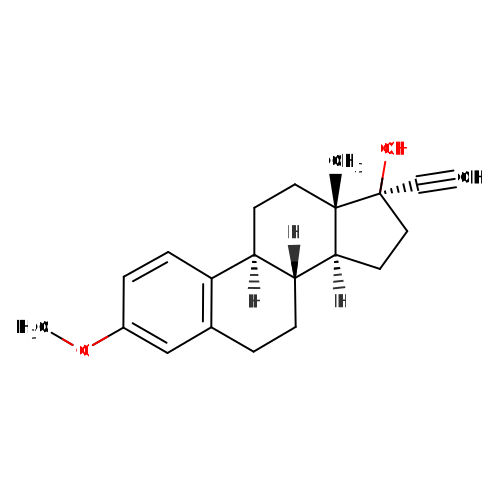
The 3-methyl ether of ethinyl estradiol. It must be demethylated to be biologically active. It is used as the estrogen component of many combination ORAL contraceptives.
- Type
- Small Molecule
- Groups
- Approved
- Structure
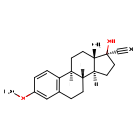
Structure for Mestranol (DB01357)
- Weight
- Average: 310.4299
Monoisotopic: 310.193280076 - Chemical Formula
- C21H26O2
- Synonyms
- Mestranol
- External IDs
- 33355

Pharmacology
- Indication
Mestranol was used as one of the first oral contraceptives.
 Reduce drug development failure ratesBuild, train, & validate machine-learning modelswith evidence-based and structured datasets.Build, train, & validate predictive machine-learning models with structured datasets.
- Associated Conditions
Indication Type Indication Combined Product Details Approval Level Age Group Patient Characteristics Dose Form Used in combination to treat Abnormal uterine bleeding Combination Product in combination with: Norethisterone (DB00717) ••• ••••• Used in combination to treat Dysmenorrhea Combination Product in combination with: Norethisterone (DB00717) ••• ••••• Used in combination to manage Endometriosis Combination Product in combination with: Norethisterone (DB00717) ••• ••••• Used in combination to treat Menorrhagia Combination Product in combination with: Norethisterone (DB00717) ••• ••••• Used in combination to manage Polycystic ovarian syndrome Combination Product in combination with: Norethisterone (DB00717) ••• ••••• - Associated Therapies
- Contraindications & Blackbox Warnings
 Prevent Adverse Drug Events TodayTap into our Clinical API for life-saving information on contraindications & blackbox warnings, population restrictions, harmful risks, & more.Avoid life-threatening adverse drug events with our Clinical API
- Pharmacodynamics
Not Available
- Mechanism of action
Mestranol is the 3-methyl ether of ethinylestradiol. Ethinylestradiol, is a synthetic derivative of estradiol. Ethinylestradiol is orally bio-active and the estrogen used in almost all modern formulations of combined oral contraceptive pills. It binds to (and activates) the estrogen receptor. Mestranol is a biologically inactive prodrug of ethinylestradiol to which it is demethylated in the liver with a conversion efficiency of 70%.
Estrogens diffuse into their target cells and interact with a protein receptor. Target cells include the female reproductive tract, the mammary gland, the hypothalamus, and the pituitary. Estrogens increase the hepatic synthesis of sex hormone binding globulin (SHBG), thyroid-binding globulin (TBG), and other serum proteins and suppress follicle-stimulating hormone (FSH) from the anterior pituitary. The combination of an estrogen with a progestin suppresses the hypothalamic-pituitary system, decreasing the secretion of gonadotropin-releasing hormone (GnRH).
Target Actions Organism AEstrogen receptor alpha agonistHumans - Absorption
Not Available
- Volume of distribution
Not Available
- Protein binding
Not Available
- Metabolism
Hover over products below to view reaction partners
- Route of elimination
Not Available
- Half-life
Not Available
- Clearance
Not Available
- Adverse Effects
 Improve decision support & research outcomesWith structured adverse effects data, including: blackbox warnings, adverse reactions, warning & precautions, & incidence rates. View sample adverse effects data in our new Data Library!Improve decision support & research outcomes with our structured adverse effects data.
- Toxicity
Not Available
- Pathways
- Not Available
- Pharmacogenomic Effects/ADRs
- Not Available
Interactions
- Drug Interactions
- This information should not be interpreted without the help of a healthcare provider. If you believe you are experiencing an interaction, contact a healthcare provider immediately. The absence of an interaction does not necessarily mean no interactions exist.
Drug Interaction Integrate drug-drug
interactions in your softwareAbametapir The serum concentration of Mestranol can be increased when it is combined with Abametapir. Abatacept The metabolism of Mestranol can be increased when combined with Abatacept. Abciximab The risk or severity of adverse effects can be increased when Mestranol is combined with Abciximab. Abiraterone The metabolism of Mestranol can be decreased when combined with Abiraterone. Abrocitinib The metabolism of Abrocitinib can be decreased when combined with Mestranol. - Food Interactions
- No interactions found.
Products
 Drug product information from 10+ global regionsOur datasets provide approved product information including:dosage, form, labeller, route of administration, and marketing period.Access drug product information from over 10 global regions.
- Mixture Products
Name Ingredients Dosage Route Labeller Marketing Start Marketing End Region Image Necon Mestranol (0.05 mg/1) + Norethisterone (1 mg/1) Kit Oral Actavis Pharma Company 1967-11-17 2019-02-28 US 
Norinyl Mestranol (0.05 mg/1) + Norethisterone (1 mg/1) Kit; Tablet Oral Actavis Pharma, Inc. 1967-11-17 2017-11-30 US Norinyl 1/50 -(21-day Regimen) Mestranol (.05 mg) + Norethisterone (1 mg) Tablet Oral Pfizer Canada Ulc 1996-11-04 2006-08-02 Canada 
Norinyl 1/50 -(28-day Regimen) Mestranol (0.05 mg) + Norethisterone (1 mg) Tablet Oral Pfizer Canada Ulc 1998-05-20 2006-08-02 Canada Norinyl 1/50 21 Tab Mestranol (.05 mg / tab) + Norethisterone (1 mg / tab) Tablet Oral Syntex Inc. 1965-12-31 1996-09-30 Canada
Categories
- Drug Categories
- Adrenal Cortex Hormones
- Contraceptive Agents, Female
- Contraceptive Agents, Hormonal
- Contraceptives, Oral
- Contraceptives, Oral, Hormonal
- Cytochrome P-450 CYP2C8 Substrates
- Cytochrome P-450 CYP2C9 Substrates
- Cytochrome P-450 CYP3A Substrates
- Cytochrome P-450 CYP3A4 Substrates
- Cytochrome P-450 Substrates
- Estradiol Congeners
- Estrogen Contraceptives
- Estrogenic Steroids, Alkylated
- Estrogens
- Ethinyl Estradiol
- Fused-Ring Compounds
- Gonadal Hormones
- Gonadal Steroid Hormones
- Hormonal Contraceptives for Systemic Use
- Hormones
- Hormones, Hormone Substitutes, and Hormone Antagonists
- Hyperglycemia-Associated Agents
- Norpregnanes
- Norpregnatrienes
- Norsteroids
- Reproductive Control Agents
- Steroids
- Thyroxine-binding globulin inducers
- Chemical TaxonomyProvided by Classyfire
- Description
- This compound belongs to the class of organic compounds known as estrane steroids. These are steroids with a structure based on the estrane skeleton.
- Kingdom
- Organic compounds
- Super Class
- Lipids and lipid-like molecules
- Class
- Steroids and steroid derivatives
- Sub Class
- Estrane steroids
- Direct Parent
- Estrane steroids
- Alternative Parents
- 17-hydroxysteroids / Phenanthrenes and derivatives / Tetralins / Anisoles / Alkyl aryl ethers / Ynones / Tertiary alcohols / Cyclic alcohols and derivatives / Acetylides / Hydrocarbon derivatives
- Substituents
- 17-hydroxysteroid / Acetylide / Alcohol / Alkyl aryl ether / Anisole / Aromatic homopolycyclic compound / Benzenoid / Cyclic alcohol / Estrane-skeleton / Ether
- Molecular Framework
- Aromatic homopolycyclic compounds
- External Descriptors
- terminal acetylenic compound, aromatic ether, 17beta-hydroxy steroid (CHEBI:6784)
- Affected organisms
- Not Available
Chemical Identifiers
- UNII
- B2V233XGE7
- CAS number
- 72-33-3
- InChI Key
- IMSSROKUHAOUJS-MJCUULBUSA-N
- InChI
- InChI=1S/C21H26O2/c1-4-21(22)12-10-19-18-7-5-14-13-15(23-3)6-8-16(14)17(18)9-11-20(19,21)2/h1,6,8,13,17-19,22H,5,7,9-12H2,2-3H3/t17-,18-,19+,20+,21+/m1/s1
- IUPAC Name
- (1R,3aS,3bR,9bS,11aS)-1-ethynyl-7-methoxy-11a-methyl-1H,2H,3H,3aH,3bH,4H,5H,9bH,10H,11H,11aH-cyclopenta[a]phenanthren-1-ol
- SMILES
- [H][C@@]12CC[C@@](O)(C#C)[C@@]1(C)CC[C@]1([H])C3=C(CC[C@@]21[H])C=C(OC)C=C3
References
- General References
- Not Available
- External Links
- Human Metabolome Database
- HMDB0015446
- KEGG Drug
- D00575
- KEGG Compound
- C07618
- PubChem Compound
- 6291
- PubChem Substance
- 46507679
- ChemSpider
- 6054
- 6782
- ChEBI
- 6784
- ChEMBL
- CHEMBL1201151
- ZINC
- ZINC000003815424
- Therapeutic Targets Database
- DAP001014
- PharmGKB
- PA450388
- Wikipedia
- Mestranol
Clinical Trials
- Clinical Trials
Phase Status Purpose Conditions Count 3 Completed Treatment Rheumatoid Arthritis 1 1 Completed Not Available Healthy Volunteers (HV) / Pharmacokinetics of Ethinyl Estradiol and Norethindrone / Pharmacokinetics of Isavuconazole 1 1 Completed Basic Science Healthy Volunteers (HV) 1 1 Completed Treatment Healthy Volunteers (HV) 1 1 Withdrawn Treatment Cancer 1
Pharmacoeconomics
- Manufacturers
- Not Available
- Packagers
- Not Available
- Dosage Forms
Form Route Strength Kit Oral Kit; tablet Oral Tablet Oral Tablet Oral 80.000 mcg Tablet Tablet, film coated Tablet, sugar coated Oral - Prices
- Not Available
- Patents
- Not Available
Properties
- State
- Solid
- Experimental Properties
Property Value Source melting point (°C) 150.5 °C PhysProp - Predicted Properties
Property Value Source Water Solubility 0.00377 mg/mL ALOGPS logP 3.89 ALOGPS logP 4.04 Chemaxon logS -4.9 ALOGPS pKa (Strongest Acidic) 17.59 Chemaxon pKa (Strongest Basic) -1.7 Chemaxon Physiological Charge 0 Chemaxon Hydrogen Acceptor Count 2 Chemaxon Hydrogen Donor Count 1 Chemaxon Polar Surface Area 29.46 Å2 Chemaxon Rotatable Bond Count 1 Chemaxon Refractivity 91.86 m3·mol-1 Chemaxon Polarizability 36.7 Å3 Chemaxon Number of Rings 4 Chemaxon Bioavailability 1 Chemaxon Rule of Five Yes Chemaxon Ghose Filter Yes Chemaxon Veber's Rule Yes Chemaxon MDDR-like Rule No Chemaxon - Predicted ADMET Features
Property Value Probability Human Intestinal Absorption + 0.9929 Blood Brain Barrier + 0.9465 Caco-2 permeable + 0.8463 P-glycoprotein substrate Substrate 0.656 P-glycoprotein inhibitor I Non-inhibitor 0.6099 P-glycoprotein inhibitor II Non-inhibitor 0.8382 Renal organic cation transporter Non-inhibitor 0.8148 CYP450 2C9 substrate Non-substrate 0.7521 CYP450 2D6 substrate Non-substrate 0.9116 CYP450 3A4 substrate Substrate 0.7656 CYP450 1A2 substrate Inhibitor 0.9107 CYP450 2C9 inhibitor Non-inhibitor 0.9071 CYP450 2D6 inhibitor Non-inhibitor 0.9334 CYP450 2C19 inhibitor Inhibitor 0.7721 CYP450 3A4 inhibitor Inhibitor 0.5232 CYP450 inhibitory promiscuity Low CYP Inhibitory Promiscuity 0.7758 Ames test Non AMES toxic 0.9132 Carcinogenicity Non-carcinogens 0.8714 Biodegradation Not ready biodegradable 0.9829 Rat acute toxicity 1.5234 LD50, mol/kg Not applicable hERG inhibition (predictor I) Weak inhibitor 0.8958 hERG inhibition (predictor II) Inhibitor 0.5679
Spectra
- Mass Spec (NIST)
- Download (9.65 KB)
- Spectra
- Chromatographic Properties
Collision Cross Sections (CCS)
Adduct CCS Value (Å2) Source type Source [M-H]- 188.1597663 predictedDarkChem Lite v0.1.0 [M-H]- 187.2990663 predictedDarkChem Lite v0.1.0 [M-H]- 189.0517663 predictedDarkChem Lite v0.1.0 [M-H]- 184.7427 predictedDeepCCS 1.0 (2019) [M+H]+ 188.5858663 predictedDarkChem Lite v0.1.0 [M+H]+ 187.6303663 predictedDarkChem Lite v0.1.0 [M+H]+ 189.6215663 predictedDarkChem Lite v0.1.0 [M+H]+ 186.73766 predictedDeepCCS 1.0 (2019) [M+Na]+ 188.0713663 predictedDarkChem Lite v0.1.0 [M+Na]+ 187.3363663 predictedDarkChem Lite v0.1.0 [M+Na]+ 189.7333663 predictedDarkChem Lite v0.1.0 [M+Na]+ 192.65016 predictedDeepCCS 1.0 (2019)
Targets

- Kind
- Protein
- Organism
- Humans
- Pharmacological action
- Yes
- Actions
- Agonist
- General Function
- Zinc ion binding
- Specific Function
- Nuclear hormone receptor. The steroid hormones and their receptors are involved in the regulation of eukaryotic gene expression and affect cellular proliferation and differentiation in target tissu...
- Gene Name
- ESR1
- Uniprot ID
- P03372
- Uniprot Name
- Estrogen receptor
- Molecular Weight
- 66215.45 Da
References
- Dulos J, Vijn P, van Doorn C, Hofstra CL, Veening-Griffioen D, de Graaf J, Dijcks FA, Boots AM: Suppression of the inflammatory response in experimental arthritis is mediated via estrogen receptor alpha but not estrogen receptor beta. Arthritis Res Ther. 2010;12(3):R101. doi: 10.1186/ar3032. Epub 2010 May 24. [Article]
- Cleuren AC, Van der Linden IK, De Visser YP, Wagenaar GT, Reitsma PH, Van Vlijmen BJ: 17alpha-Ethinylestradiol rapidly alters transcript levels of murine coagulation genes via estrogen receptor alpha. J Thromb Haemost. 2010 Aug;8(8):1838-46. doi: 10.1111/j.1538-7836.2010.03930.x. Epub 2010 May 27. [Article]
- Chen X, Ji ZL, Chen YZ: TTD: Therapeutic Target Database. Nucleic Acids Res. 2002 Jan 1;30(1):412-5. [Article]
Enzymes
- Kind
- Protein
- Organism
- Humans
- Pharmacological action
- No
- Actions
- Substrate
- General Function
- Vitamin d3 25-hydroxylase activity
- Specific Function
- Cytochromes P450 are a group of heme-thiolate monooxygenases. In liver microsomes, this enzyme is involved in an NADPH-dependent electron transport pathway. It performs a variety of oxidation react...
- Gene Name
- CYP3A4
- Uniprot ID
- P08684
- Uniprot Name
- Cytochrome P450 3A4
- Molecular Weight
- 57342.67 Da
References
- PDR [Link]
- Kind
- Protein
- Organism
- Humans
- Pharmacological action
- No
- Actions
- Substrate
- General Function
- Steroid hydroxylase activity
- Specific Function
- Cytochromes P450 are a group of heme-thiolate monooxygenases. In liver microsomes, this enzyme is involved in an NADPH-dependent electron transport pathway. It oxidizes a variety of structurally un...
- Gene Name
- CYP2C8
- Uniprot ID
- P10632
- Uniprot Name
- Cytochrome P450 2C8
- Molecular Weight
- 55824.275 Da
References
- Gavhane YN, Yadav AV: Loss of orally administered drugs in GI tract. Saudi Pharm J. 2012 Oct;20(4):331-44. doi: 10.1016/j.jsps.2012.03.005. Epub 2012 Apr 20. [Article]
- Kind
- Protein
- Organism
- Humans
- Pharmacological action
- Unknown
- Actions
- Substrate
- General Function
- Steroid hydroxylase activity
- Specific Function
- Cytochromes P450 are a group of heme-thiolate monooxygenases. In liver microsomes, this enzyme is involved in an NADPH-dependent electron transport pathway. It oxidizes a variety of structurally un...
- Gene Name
- CYP2C9
- Uniprot ID
- P11712
- Uniprot Name
- Cytochrome P450 2C9
- Molecular Weight
- 55627.365 Da
References
- Zhou SF, Zhou ZW, Yang LP, Cai JP: Substrates, inducers, inhibitors and structure-activity relationships of human Cytochrome P450 2C9 and implications in drug development. Curr Med Chem. 2009;16(27):3480-675. Epub 2009 Sep 1. [Article]
- Schmider J, Greenblatt DJ, von Moltke LL, Karsov D, Vena R, Friedman HL, Shader RI: Biotransformation of mestranol to ethinyl estradiol in vitro: the role of cytochrome P-450 2C9 and metabolic inhibitors. J Clin Pharmacol. 1997 Mar;37(3):193-200. [Article]


Drug created at July 06, 2007 19:51 / Updated at June 19, 2021 00:26