Identification
- Summary
Iohexol is a contrast agent for intrathecal administration used in myelography and contrast enhancement for computerized tomography.
- Brand Names
- Omnipaque, Oraltag
- Generic Name
- Iohexol
- DrugBank Accession Number
- DB01362
- Background
Iohexol is an effective non-ionic, water-soluble contrast agent which is used in myelography, arthrography, nephroangiography, arteriography, and other radiographic procedures. Its low systemic toxicity is the combined result of low chemotoxicity and low osmolality.
- Type
- Small Molecule
- Groups
- Approved
- Structure

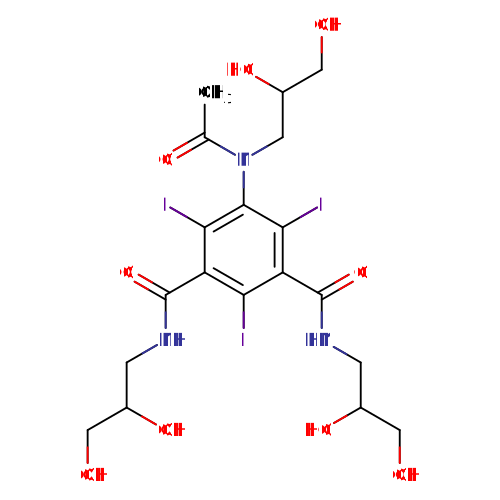
Structure for Iohexol (DB01362)
- Weight
- Average: 821.1379
Monoisotopic: 820.880309705 - Chemical Formula
- C19H26I3N3O9
- Synonyms
- Iohexol
- Iohexolum
- N,N'-Bis(2,3-dihydroxypropyl)-5-(N-(2,3-dihydroxypropyl)acetamido)-2,4,6-triiodoisophthalamide
- External IDs
- WIN 39424
- WIN-39424

Pharmacology
- Indication
Iohexol ia used in myelography, arthrography, nephroangiography, arteriography, and other radiographic procedures.
 Reduce drug development failure ratesBuild, train, & validate machine-learning modelswith evidence-based and structured datasets.Build, train, & validate predictive machine-learning models with structured datasets.
- Contraindications & Blackbox Warnings
 Prevent Adverse Drug Events TodayTap into our Clinical API for life-saving information on contraindications & blackbox warnings, population restrictions, harmful risks, & more.Avoid life-threatening adverse drug events with our Clinical API
- Pharmacodynamics
Iohexol is an effective non-ionic, water-soluble contrast agent which is used in myelography, arthrography, nephroangiography, arteriography, and other radiographic procedures. Its low systemic toxicity is the combined result of low chemotoxicity and low osmolality.
- Mechanism of action
Organic iodine compounds block x-rays as they pass through the body, thereby allowing body structures containing iodine to be delineated in contrast to those structures that do not contain iodine. The degree of opacity produced by these compounds is directly proportional to the total amount (concentration and volume) of the iodinated contrast agent in the path of the x-rays. After intrathecal administration into the subarachnoid space, diffusion of iohexol in the CSF allows the visualization of the subarachnoid spaces of the head and spinal canal. After intravascular administration, iohexol makes opaque those vessels in its path of flow, allowing visualization of the internal structures until significant hemodilution occurs.
- Absorption
Small amounts are absorbed through the bladder via intravesical instillation. Following intrauterine instillation, the majority of the medium within the uterine cavity is discharged into the vagina immediately upon termination of procedure. However, any medium retained in the uterine or peritoneal cavity is absorbed systemically within 60 minutes. May not be absorbed for up to 24 hours if tubes are obstructed and dilated.
- Volume of distribution
- 350-849 mL/kg
- Protein binding
Not Available
- Metabolism
- Not Available
- Route of elimination
Iohexol is absorbed from cerebrospinal fluid (CSF) into the bloodstream and is eliminated by renal excretion. No significant metabolism, deiodination, or biotransformation occurs.
- Half-life
Intrathecal half-life is 3.4 hours (mean). Intravascular is approximately 2 hours (with normal renal function).
- Clearance
- 109 mL/min [Adult patients receiving 16-18 ml of iohexol (180 mgI/mL) by lumbar intrathecal injection]
- Adverse Effects
 Improve decision support & research outcomesWith structured adverse effects data, including: blackbox warnings, adverse reactions, warning & precautions, & incidence rates. View sample adverse effects data in our new Data Library!Improve decision support & research outcomes with our structured adverse effects data.
- Toxicity
Non-ionic radiocontrast agents like iohexol are cytotoxic to renal cells. The toxic effects include apoptosis, cellular energy failure, disruption of calcium homeostasis, and disturbance of tubular cell polarity, and are thought to be linked to oxidative stress.
- Pathways
- Not Available
- Pharmacogenomic Effects/ADRs
- Not Available
Interactions
- Drug Interactions
- This information should not be interpreted without the help of a healthcare provider. If you believe you are experiencing an interaction, contact a healthcare provider immediately. The absence of an interaction does not necessarily mean no interactions exist.
Drug Interaction Integrate drug-drug
interactions in your softwareAcetazolamide The therapeutic efficacy of Acetazolamide can be decreased when used in combination with Iohexol. Aldesleukin The risk of a hypersensitivity reaction to Iohexol is increased when it is combined with Aldesleukin. Amifampridine The risk or severity of seizure can be increased when Iohexol is combined with Amifampridine. Amobarbital The therapeutic efficacy of Amobarbital can be decreased when used in combination with Iohexol. Brexanolone The therapeutic efficacy of Brexanolone can be decreased when used in combination with Iohexol. - Food Interactions
- No interactions found.
Products
 Drug product information from 10+ global regionsOur datasets provide approved product information including:dosage, form, labeller, route of administration, and marketing period.Access drug product information from over 10 global regions.
- International/Other Brands
- Histodenz (Sigma) / Nycodenz
- Brand Name Prescription Products
Name Dosage Strength Route Labeller Marketing Start Marketing End Region Image Omnipaque Injection, solution 350 mg/1mL Intravascular; Intravenous; Oral GE Healthcare Inc. 2006-07-21 Not applicable US 
Omnipaque Solution 12 mg/1mL Oral GE Healthcare Inc. 2018-04-27 Not applicable US Omnipaque Injection, solution 180 mg/1mL Intrathecal; Oral; Rectal GE Healthcare Inc. 2004-07-15 Not applicable US Omnipaque Solution 518 mg/1mL Intravenous Apothecary Shop Wholesale Inc. 2011-06-01 2011-08-31 US Omnipaque Injection, solution 300 mg/1mL Intrathecal; Intravascular; Intravenous; Oral GE Healthcare Inc. 2006-09-21 Not applicable US - Unapproved/Other Products
Name Ingredients Dosage Route Labeller Marketing Start Marketing End Region Image BL-Contrast Iohexol (240 mg/1mL) + Betamethasone sodium phosphate (3 mg/1mL) + Betamethasone acetate (3 mg/1mL) + Isopropyl alcohol (70 mL/100mL) + Lidocaine hydrochloride (10 mg/1mL) + Povidone-iodine (10 mg/1mL) Kit Infiltration; Intra-articular; Intralesional; Intramuscular; Intrathecal; Intravascular; Intravenous; Perineural; Topical Asclemed Usa, Inc. 2024-03-04 Not applicable US
Categories
- ATC Codes
- V08AB02 — Iohexol
- Drug Categories
- Acids, Carbocyclic
- Agents that reduce seizure threshold
- Benzene Derivatives
- Benzoates
- Compounds used in a research, industrial, or household setting
- Contrast Media
- Diagnostic Uses of Chemicals
- Iodinated Contrast Agents
- Iodobenzoates
- Radiographic Contrast Agent
- Roentgenography
- Triiodobenzoic Acids
- Watersoluble, Nephrotropic, Low Osmolar X-Ray Contrast Media
- X-Ray Contrast Activity
- X-Ray Contrast Media, Iodinated
- Chemical TaxonomyProvided by Classyfire
- Description
- This compound belongs to the class of organic compounds known as o-haloacetanilides. These are organic compounds containing an acetamide group conjugated to a phenyl group, which is in turn ortho-substituted with a halogen atom.
- Kingdom
- Organic compounds
- Super Class
- Benzenoids
- Class
- Benzene and substituted derivatives
- Sub Class
- Anilides
- Direct Parent
- O-haloacetanilides
- Alternative Parents
- P-haloacetanilides / Iodobenzenes / Aryl iodides / Tertiary carboxylic acid amides / Acetamides / Secondary alcohols / Propargyl-type 1,3-dipolar organic compounds / Carboximidic acids / Primary alcohols / Organopnictogen compounds show 5 more
- Substituents
- Acetamide / Alcohol / Aromatic homomonocyclic compound / Aryl halide / Aryl iodide / Carbonyl group / Carboxamide group / Carboximidic acid / Carboximidic acid derivative / Carboxylic acid derivative show 18 more
- Molecular Framework
- Aromatic homomonocyclic compounds
- External Descriptors
- organoiodine compound, benzenedicarboxamide (CHEBI:31709)
- Affected organisms
- Humans and other mammals
Chemical Identifiers
- UNII
- 4419T9MX03
- CAS number
- 66108-95-0
- InChI Key
- NTHXOOBQLCIOLC-UHFFFAOYSA-N
- InChI
- InChI=1S/C19H26I3N3O9/c1-8(29)25(4-11(32)7-28)17-15(21)12(18(33)23-2-9(30)5-26)14(20)13(16(17)22)19(34)24-3-10(31)6-27/h9-11,26-28,30-32H,2-7H2,1H3,(H,23,33)(H,24,34)
- IUPAC Name
- N1,N3-bis(2,3-dihydroxypropyl)-5-[N-(2,3-dihydroxypropyl)acetamido]-2,4,6-triiodobenzene-1,3-dicarboxamide
- SMILES
- CC(=O)N(CC(O)CO)C1=C(I)C(C(=O)NCC(O)CO)=C(I)C(C(=O)NCC(O)CO)=C1I
References
- Synthesis Reference
Xiu C. Wang, Steve A. Chamberlin, Ashok V. Bhatia, Gregg E. Robinson, John Hufnagel, "Process for the preparation of iohexol." U.S. Patent US5705692, issued December, 1985.
US5705692- General References
- Kawada TK: Iohexol and iopamidol: second-generation nonionic radiographic contrast media. Drug Intell Clin Pharm. 1985 Jul-Aug;19(7-8):525-9. [Article]
- Shaw DD, Potts DG: Toxicology of iohexol. Invest Radiol. 1985 Jan-Feb;20(1 Suppl):S10-3. [Article]
- FDA Approved Drug Products: OMNIPAQUE (iohexol) injection and oral solution. [Link]
- External Links
- Human Metabolome Database
- HMDB0015449
- KEGG Drug
- D01817
- PubChem Compound
- 3730
- PubChem Substance
- 46506178
- ChemSpider
- 3599
- 5956
- ChEBI
- 31709
- ChEMBL
- CHEMBL1200455
- PharmGKB
- PA450061
- Wikipedia
- Iohexol
Clinical Trials
- Clinical Trials
Phase Status Purpose Conditions Count 4 Completed Not Available Human Immunodeficiency Virus (HIV) Infections 1 4 Completed Diagnostic Contrast Media Dosing 1 4 Completed Diagnostic Healthy Volunteers (HV) 1 4 Completed Diagnostic Hormone Replacement Therapy / Renal Function / Transgender 1 4 Completed Treatment Human Immunodeficiency Virus Type 1 (HIV-1) Infection 1
Pharmacoeconomics
- Manufacturers
- Not Available
- Packagers
- GE Healthcare Inc.
- Hospira Inc.
- Nycomed Inc.
- Dosage Forms
Form Route Strength Injection, solution Parenteral Injection Intra-arterial; Intrathecal; Intravenous 647 mg/ml Injection, solution Intra-arterial; Intravenous 755 mg/ml Kit Infiltration; Intra-articular; Intralesional; Intramuscular; Intrathecal; Intravascular; Intravenous; Perineural; Topical Solution 300 mg Solution 350 mg Solution Intra-arterial; Intrathecal; Intravenous 300 mg/ml Solution Intra-arterial; Intrathecal; Intravenous 350 mg/ml Injection, solution Injection Solution Intra-articular; Intrathecal; Intravenous 647 mg Injection, solution Intravenous 647 mg Solution Intra-arterial; Intrathecal; Intravenous 300 mg Injection Intra-articular; Intrathecal; Intravascular; Intravenous; Oral; Rectal Injection Intra-articular; Intravascular; Intravenous; Oral Injection, solution Intrathecal; Intravascular; Intravenous; Oral 240 mg/1mL Injection, solution Intrathecal; Intravascular; Intravenous; Oral 300 mg/1mL Injection, solution Intrathecal; Oral; Rectal 180 mg/1mL Injection, solution Intravascular; Intravenous 140 mg/1mL Injection, solution Intravascular; Intravenous; Oral 350 mg/1mL Injection, solution Parenteral 300 MG Injection, solution Parenteral 350 MG Injection, solution Parenteral 518 mg/ml Injection, solution Parenteral 647 mg/ml Injection, solution Parenteral 755 mg/ml Solution Intravenous 388.3 mg/1mL Solution Intravenous 518 mg/1mL Solution Intravenous 647.1 mg/1mL Solution Oral 12 mg/1mL Solution Oral 9 mg/1mL Solution 350 mg/1ml Solution Subarachnoid 388 mg / mL Liquid Subarachnoid 180 mg / mL Solution Intra-articular; Intravascular; Oral; Rectal; Subarachnoid 518 mg / mL Liquid Intravenous; Subarachnoid 240 mg / mL Solution Intra-articular; Intravascular; Oral; Rectal; Subarachnoid 647 mg / mL Liquid Intravenous; Subarachnoid 300 mg / mL Injection, solution Intrathecal 647 mg Injection Intrathecal 647 mg/ml Solution Intravascular; Oral 755 mg / mL Liquid Intravenous 350 mg / mL Injection Intrathecal 755 mg/ml Injection Intra-arterial; Intrathecal; Intravenous Injection Intra-arterial; Intracavitary; Intrathecal; Intravascular; Intravenous 300 mg/ml Injection Intravascular 350 mg/ml Solution Intra-arterial; Intra-articular; Intrathecal; Intrauterine; Intravenous; Oral; Rectal 300 mg Solution Intra-arterial; Intra-articular; Intrathecal; Intrauterine; Intravenous; Oral; Rectal 30000000 mg Solution Intra-arterial; Intravenous 350 mg Injection, solution Intravenous 755 mg/ml Injection, solution Intravenous Injection Intrathecal 300 mg/mL Injection, solution Intravenous 350 mg/mL For solution Oral 4.5 g/1 Injection, solution 300 mg/1ml Injection, solution 350 mg/1ml Solution 300 mg/1ml - Prices
Unit description Cost Unit Myelo-kit 180 mg/ml 62.19USD each Omnipaque 240 mg/ml vial 5.34USD ml Omnipaque 180 mg/ml vial 4.92USD ml Omnipaque 300 mg/ml vial 4.82USD ml Omnipaque 210 mg/ml vial 3.53USD ml Omnipaque 350 mg/ml cartridge 2.29USD ml Omnipaque 300 mg/ml cartridge 2.17USD ml Omnipaque 240 mg/ml cartridge 1.77USD ml Omnipaque 300 mg/ml syringe 1.08USD ml Omnipaque 350 mg/ml infu btl 1.08USD ml Omnipaque 140 mg/ml vial 0.78USD ml DrugBank does not sell nor buy drugs. Pricing information is supplied for informational purposes only.- Patents
- Not Available
Properties
- State
- Solid
- Experimental Properties
Property Value Source melting point (°C) 174-180 °C PhysProp logP -3.05 HANSCH,C & LEO,AJ (1985) - Predicted Properties
Property Value Source Water Solubility 0.796 mg/mL ALOGPS logP -2.8 ALOGPS logP -2 Chemaxon logS -3 ALOGPS pKa (Strongest Acidic) 11.73 Chemaxon pKa (Strongest Basic) -3 Chemaxon Physiological Charge 0 Chemaxon Hydrogen Acceptor Count 9 Chemaxon Hydrogen Donor Count 8 Chemaxon Polar Surface Area 199.89 Å2 Chemaxon Rotatable Bond Count 12 Chemaxon Refractivity 148.84 m3·mol-1 Chemaxon Polarizability 60.37 Å3 Chemaxon Number of Rings 1 Chemaxon Bioavailability 0 Chemaxon Rule of Five No Chemaxon Ghose Filter No Chemaxon Veber's Rule No Chemaxon MDDR-like Rule No Chemaxon - Predicted ADMET Features
Property Value Probability Human Intestinal Absorption - 0.8406 Blood Brain Barrier - 0.5082 Caco-2 permeable - 0.6474 P-glycoprotein substrate Substrate 0.5 P-glycoprotein inhibitor I Non-inhibitor 0.8375 P-glycoprotein inhibitor II Non-inhibitor 0.8629 Renal organic cation transporter Non-inhibitor 0.9534 CYP450 2C9 substrate Non-substrate 0.7747 CYP450 2D6 substrate Non-substrate 0.8175 CYP450 3A4 substrate Non-substrate 0.6895 CYP450 1A2 substrate Non-inhibitor 0.919 CYP450 2C9 inhibitor Non-inhibitor 0.9071 CYP450 2D6 inhibitor Non-inhibitor 0.9303 CYP450 2C19 inhibitor Non-inhibitor 0.9025 CYP450 3A4 inhibitor Non-inhibitor 0.971 CYP450 inhibitory promiscuity Low CYP Inhibitory Promiscuity 0.7514 Ames test Non AMES toxic 0.9035 Carcinogenicity Non-carcinogens 0.8016 Biodegradation Not ready biodegradable 0.9937 Rat acute toxicity 1.6446 LD50, mol/kg Not applicable hERG inhibition (predictor I) Weak inhibitor 0.9895 hERG inhibition (predictor II) Non-inhibitor 0.7193
Spectra
- Mass Spec (NIST)
- Not Available
- Spectra
- Chromatographic Properties
Collision Cross Sections (CCS)
Adduct CCS Value (Å2) Source type Source [M-H]- 210.765411 predictedDarkChem Lite v0.1.0 [M-H]- 220.62375 predictedDeepCCS 1.0 (2019) [M+H]+ 210.763611 predictedDarkChem Lite v0.1.0 [M+H]+ 222.98175 predictedDeepCCS 1.0 (2019) [M+Na]+ 210.460011 predictedDarkChem Lite v0.1.0 [M+Na]+ 229.07489 predictedDeepCCS 1.0 (2019)

Drug created at July 06, 2007 19:54 / Updated at April 26, 2024 00:45