Identification
- Summary
Salsalate is a nonsteroidal anti-inflammatory agent used in the symptomatic relief of rheumatoid arthritis, osteoarthritis and related rheumatic disorders.
- Generic Name
- Salsalate
- DrugBank Accession Number
- DB01399
- Background
Salsalate is a nonsteroidal anti-inflammatory agent for oral administration. Salsalate's mode of action as an anti-inflammatory and antirheumatic agent may be due to inhibition of synthesis and release of prostaglandins. The usefulness of salicylic acid, the active in vivo product of salsalate, in the treatment of arthritic disorders has been established. In contrast to aspirin, salsalate causes no greater fecal gastrointestinal blood loss than placebo. Salsalate is readily soluble in the small intestine where it is partially hydrolyzed to two molecules of salicylic acid. A significant portion of the parent compound is absorbed unchanged and undergoes rapid esterase hydrolysis in the body. The parent compound has an elimination half-life of about 1 hour. Salicylic acid (the active metabolite) biotransformation is saturated at anti-inflammatory doses of salsalate. Such capacity limited biotransformation results in an increase in the half-life of salicylic acid from 3.5 to 16 or more hours.
- Type
- Small Molecule
- Groups
- Approved
- Structure
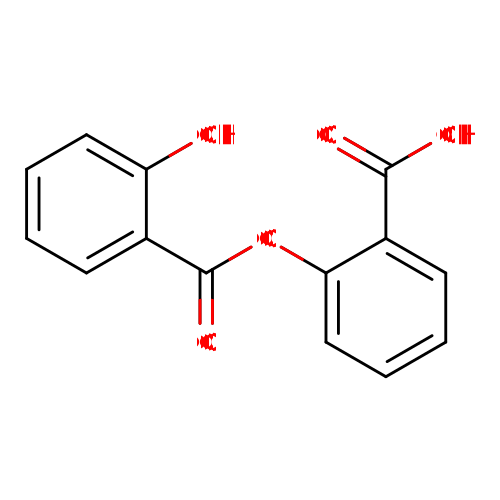
Structure for Salsalate (DB01399)
- Weight
- Average: 258.2262
Monoisotopic: 258.05282343 - Chemical Formula
- C14H10O5
- Synonyms
- 2-Carboxyphenyl salicylate
- Disalicylic acid
- Disalicylsäure
- O-Salicylcylsalicylsäure
- o-Salicylsalicylic acid
- Salicylic acid bimolecular ester
- Salicyloxysalicylic acid
- Salicyloylsalicylic acid
- Salicylsalicylic acid
- Salsalate
- Salsalato
- Salsalatum
- Sasapyrin
- Sasapyrine
- Sasapyrinum
- External IDs
- NSC-49171

Pharmacology
- Indication
For relief of the signs and symptoms of rheumatoid arthritis, osteoarthritis and related rheumatic disorders.
 Reduce drug development failure ratesBuild, train, & validate machine-learning modelswith evidence-based and structured datasets.Build, train, & validate predictive machine-learning models with structured datasets.
- Contraindications & Blackbox Warnings
 Prevent Adverse Drug Events TodayTap into our Clinical API for life-saving information on contraindications & blackbox warnings, population restrictions, harmful risks, & more.Avoid life-threatening adverse drug events with our Clinical API
- Pharmacodynamics
Salsalate is a nonsteroidal anti-inflammatory agent for oral administration. Salsalate's mode of action as an anti-inflammatory and antirheumatic agent may be due to inhibition of synthesis and release of prostaglandins. The usefulness of salicylic acid, the active in vivo product of salsalate, in the treatment of arthritic disorders has been established. In contrast to aspirin, salsalate causes no greater fecal gastrointestinal blood loss than placebo.
- Mechanism of action
The mode of anti-inflammatory action of salsalate and other nonsteroidal anti-inflammatory drugs is not fully defined, but appears to be primarily associated with inhibition of prostaglandin synthesis. This inhibition of prostaglandin synthesis is done through the inactivation of cyclooxygenase-1 (COX-1) and COX-2, which are reponsible for catalyzing the formation of prostaglandins in the arachidonic acid pathway. Although salicylic acid (the primary metabolite of salsalate) is a weak inhibitor of prostaglandin synthesis in vitro, salsalate appears to selectively inhibit prostaglandin synthesis in vivo, providing anti-inflammatory activity equivalent to aspirin and indomethacin. Unlike aspirin, salsalate does not inhibit platelet aggregation.
Target Actions Organism AProstaglandin G/H synthase 2 inhibitorHumans AProstaglandin G/H synthase 1 inhibitorHumans - Absorption
Salsalate is insoluble in acid gastric fluids (< 0.1 mg/ml at pH 1.0), but readily soluble in the small intestine where it is partially hydrolyzed to two molecules of salicylic acid. A significant portion of the parent compound is absorbed unchanged. The amount of salicylic acid available from salsalate is about 15% less than from aspirin, when the two drugs are administered on a salicylic acid molar equivalent basis (3.6 g salsalate/5 g aspirin). Food slows the absorption of all salicylates including salsalate.
- Volume of distribution
Not Available
- Protein binding
Salicylate: 90-95% bound at plasma salicylate concentrations <100 mcg/mL; 70-85% bound at concentrations of 100-400 mcg/mL; 25-60% bound at concentrations >400 mcg/mL.
- Metabolism
Salsalate is readily soluble in the small intestine where it is partially hydrolyzed to two molecules of salicylic acid. A significant portion of the parent compound is absorbed unchanged and undergoes rapid esterase hydrolysis in the body.
- Route of elimination
Not Available
- Half-life
The parent compound has an elimination half-life of about 1 hour. Salicylic acid (the active metabolite) biotransformation is saturated at anti-inflammatory doses of salsalate. Such capacity limited biotransformation results in an increase in the half-life of salicylic acid from 3.5 to 16 or more hours.
- Clearance
Not Available
- Adverse Effects
 Improve decision support & research outcomesWith structured adverse effects data, including: blackbox warnings, adverse reactions, warning & precautions, & incidence rates. View sample adverse effects data in our new Data Library!Improve decision support & research outcomes with our structured adverse effects data.
- Toxicity
Death has followed ingestion of 10 to 30 g of salicylates in adults, but much larger amounts have been ingested without fatal outcome.
- Pathways
Pathway Category Salsalate Action Pathway Drug action - Pharmacogenomic Effects/ADRs
- Not Available
Interactions
- Drug Interactions
- This information should not be interpreted without the help of a healthcare provider. If you believe you are experiencing an interaction, contact a healthcare provider immediately. The absence of an interaction does not necessarily mean no interactions exist.
Drug Interaction Integrate drug-drug
interactions in your softwareAbacavir Salsalate may decrease the excretion rate of Abacavir which could result in a higher serum level. Abciximab The risk or severity of bleeding and hemorrhage can be increased when Salsalate is combined with Abciximab. Acebutolol Salsalate may decrease the antihypertensive activities of Acebutolol. Aceclofenac The risk or severity of adverse effects can be increased when Salsalate is combined with Aceclofenac. Acemetacin The risk or severity of adverse effects can be increased when Salsalate is combined with Acemetacin. - Food Interactions
- Avoid excessive or chronic alcohol consumption. Ingesting alcohol may increase the risk of developing a gastrointestinal bleed.
- Take with or without food. Taking salsalate with food may slow the absorption of salsalate but does not significantly impact the Cmax or AUC.
Products
 Drug product information from 10+ global regionsOur datasets provide approved product information including:dosage, form, labeller, route of administration, and marketing period.Access drug product information from over 10 global regions.
- Product Images
- Brand Name Prescription Products
Name Dosage Strength Route Labeller Marketing Start Marketing End Region Image Disalcid Tablet 750 mg/1 Oral Avion Pharmaceuticals, Llc 2014-09-18 2016-05-31 US 
Disalcid Tablet 500 mg/1 Oral Avion Pharmaceuticals, Llc 2014-09-18 2016-05-31 US Disalcid - Tab 500mg Tablet 500 mg Oral 3 M Pharmaceuticals, A Division Of 3 M Canada Company 1996-10-01 2002-07-09 Canada 
Disalcid - Tab 750mg Tablet 750 mg Oral 3 M Pharmaceuticals, A Division Of 3 M Canada Company 1996-06-01 2002-07-09 Canada Disalcid Tab 500mg Tablet 500 mg / tab Oral 3 M Pharmaceuticals, A Division Of 3 M Canada Company 1993-12-31 1999-10-27 Canada - Unapproved/Other Products
Name Ingredients Dosage Route Labeller Marketing Start Marketing End Region Image Disalcid Salsalate (750 mg/1) Tablet Oral Avion Pharmaceuticals, Llc 2014-09-18 2016-05-31 US Disalcid Salsalate (500 mg/1) Tablet Oral Avion Pharmaceuticals, Llc 2014-09-18 2016-05-31 US Salsalate Salsalate (750 mg/1) Tablet Oral Av Pak 2015-02-18 2017-05-01 US Salsalate Salsalate (500 mg/1) Tablet, film coated Oral NATIONWIDE LABORATORIES, LLC 2011-08-19 Not applicable US Salsalate Salsalate (500 mg/1) Tablet, film coated Oral Westminster Pharmaceuticals, LLC 2017-08-24 2024-04-30 US


Categories
- ATC Codes
- N02BA06 — Salsalate
- Drug Categories
- Acids, Carbocyclic
- Agents causing hyperkalemia
- Agents that produce hypertension
- Analgesics
- Analgesics, Non-Narcotic
- Anti-Inflammatory Agents
- Anti-Inflammatory Agents, Non-Steroidal
- Anti-Inflammatory Agents, Non-Steroidal (Non-Selective)
- Antirheumatic Agents
- Benzene Derivatives
- Benzoates
- Hydroxy Acids
- Hydroxybenzoates
- Nephrotoxic agents
- Nervous System
- Non COX-2 selective NSAIDS
- Peripheral Nervous System Agents
- Phenols
- Salicylic Acid and Derivatives
- Sensory System Agents
- Chemical TaxonomyProvided by Classyfire
- Description
- This compound belongs to the class of organic compounds known as depsides and depsidones. These are polycyclic compounds that is either a polyphenolic compound composed of two or more monocyclic aromatic units linked by an ester bond (depside), or a compound containing the depsidone structure (depsidone).
- Kingdom
- Organic compounds
- Super Class
- Phenylpropanoids and polyketides
- Class
- Depsides and depsidones
- Sub Class
- Not Available
- Direct Parent
- Depsides and depsidones
- Alternative Parents
- o-Hydroxybenzoic acid esters / Salicylic acid and derivatives / Phenol esters / Benzoic acids / Phenoxy compounds / Benzoyl derivatives / 1-hydroxy-4-unsubstituted benzenoids / 1-hydroxy-2-unsubstituted benzenoids / Dicarboxylic acids and derivatives / Vinylogous acids show 5 more
- Substituents
- 1-hydroxy-2-unsubstituted benzenoid / 1-hydroxy-4-unsubstituted benzenoid / Aromatic homomonocyclic compound / Benzenoid / Benzoate ester / Benzoic acid / Benzoic acid or derivatives / Benzoyl / Carboxylic acid / Carboxylic acid derivative show 14 more
- Molecular Framework
- Aromatic homomonocyclic compounds
- External Descriptors
- phenols, salicylates, benzoate ester, benzoic acids (CHEBI:9014)
- Affected organisms
- Humans and other mammals
Chemical Identifiers
- UNII
- V9MO595C9I
- CAS number
- 552-94-3
- InChI Key
- WVYADZUPLLSGPU-UHFFFAOYSA-N
- InChI
- InChI=1S/C14H10O5/c15-11-7-3-1-5-9(11)14(18)19-12-8-4-2-6-10(12)13(16)17/h1-8,15H,(H,16,17)
- IUPAC Name
- 2-(2-hydroxybenzoyloxy)benzoic acid
- SMILES
- OC(=O)C1=CC=CC=C1OC(=O)C1=CC=CC=C1O
References
- General References
- Not Available
- External Links
- Human Metabolome Database
- HMDB0015471
- KEGG Drug
- D00428
- PubChem Compound
- 5161
- PubChem Substance
- 46506882
- ChemSpider
- 4977
- BindingDB
- 85244
- 36108
- ChEBI
- 9014
- ChEMBL
- CHEMBL154111
- ZINC
- ZINC000000002062
- Therapeutic Targets Database
- DAP000734
- PharmGKB
- PA164745462
- RxList
- RxList Drug Page
- Drugs.com
- Drugs.com Drug Page
- PDRhealth
- PDRhealth Drug Page
- Wikipedia
- Salsalate
Clinical Trials
- Clinical Trials
Phase Status Purpose Conditions Count 4 Completed Treatment Diabetes / Type 2 Diabetes Mellitus 1 4 Completed Treatment Nonalcoholic Fatty Liver / Osteoarthritis (OA) 1 4 Completed Treatment Schizoaffective Disorders / Schizophrenia 1 2 Completed Prevention Obesity 1 2 Completed Treatment Acute Myeloid Leukemia / Chronic Myelomonocytic Leukemia / Myeloblasts 10 Percent or More of Bone Marrow Nucleated Cells / Myelodysplastic Syndrome / Myeloproliferative Neoplasms (MPNs) / Recurrent Acute Myeloid Leukemia / Refractory Acute Myeloid Leukemia (AML) / Secondary Acute Myeloid Leukemia (Secondary AML, sAML) 1
Pharmacoeconomics
- Manufacturers
- Not Available
- Packagers
- 3M Health Care
- Advanced Pharmaceutical Services Inc.
- Amarin Pharmaceuticals
- Amerisource Health Services Corp.
- Amneal Pharmaceuticals
- Apotheca Inc.
- AQ Pharmaceuticals Inc.
- A-S Medication Solutions LLC
- Boca Pharmacal
- Caraco Pharmaceutical Labs
- Comprehensive Consultant Services Inc.
- DHHS Program Support Center Supply Service Center
- Direct Dispensing Inc.
- Dispensing Solutions
- Diversified Healthcare Services Inc.
- Golden State Medical Supply Inc.
- H.J. Harkins Co. Inc.
- Heartland Repack Services LLC
- Innoviant Pharmacy Inc.
- Ivax Pharmaceuticals
- Kaiser Foundation Hospital
- Lake Erie Medical and Surgical Supply
- Liberty Pharmaceuticals
- Major Pharmaceuticals
- Murfreesboro Pharmaceutical Nursing Supply
- Nucare Pharmaceuticals Inc.
- PD-Rx Pharmaceuticals Inc.
- Pharmedix
- Physicians Total Care Inc.
- Pliva Inc.
- Prepackage Specialists
- Prepak Systems Inc.
- Professional Co.
- Ranbaxy Laboratories
- Rebel Distributors Corp.
- Remedy Repack
- Resource Optimization and Innovation LLC
- Sandhills Packaging Inc.
- Schwarz Pharma Inc.
- Southwood Pharmaceuticals
- Sunrise Pharmaceutical Inc.
- Superior Pharmeceuticals
- United Research Laboratories Inc.
- Va Cmop Dallas
- Dosage Forms
Form Route Strength Tablet Oral 500 mg Tablet Oral 750 mg Tablet Oral 500 mg / tab Tablet Oral 750 mg / tab Tablet Oral 500 mg/1 Tablet Oral 750 mg/1 Tablet, film coated Oral 500 mg/1 Tablet, film coated Oral 750 mg/1 - Prices
Unit description Cost Unit Salsalate powder 16.8USD g Salsalate 750 mg tablet 0.55USD tablet Salflex-750 tablet 0.5USD tablet Salflex-500 tablet 0.37USD tablet Salsalate 500 mg tablet 0.26USD tablet DrugBank does not sell nor buy drugs. Pricing information is supplied for informational purposes only.- Patents
- Not Available
Properties
- State
- Solid
- Experimental Properties
Property Value Source melting point (°C) 147 °C PhysProp - Predicted Properties
Property Value Source Water Solubility 0.246 mg/mL ALOGPS logP 3.44 ALOGPS logP 3.64 Chemaxon logS -3 ALOGPS pKa (Strongest Acidic) 3.4 Chemaxon pKa (Strongest Basic) -4.3 Chemaxon Physiological Charge -1 Chemaxon Hydrogen Acceptor Count 4 Chemaxon Hydrogen Donor Count 2 Chemaxon Polar Surface Area 83.83 Å2 Chemaxon Rotatable Bond Count 4 Chemaxon Refractivity 67.1 m3·mol-1 Chemaxon Polarizability 24.93 Å3 Chemaxon Number of Rings 2 Chemaxon Bioavailability 1 Chemaxon Rule of Five Yes Chemaxon Ghose Filter Yes Chemaxon Veber's Rule No Chemaxon MDDR-like Rule No Chemaxon - Predicted ADMET Features
Property Value Probability Human Intestinal Absorption + 0.9161 Blood Brain Barrier + 0.8946 Caco-2 permeable + 0.5186 P-glycoprotein substrate Non-substrate 0.6391 P-glycoprotein inhibitor I Non-inhibitor 0.8819 P-glycoprotein inhibitor II Non-inhibitor 0.9074 Renal organic cation transporter Non-inhibitor 0.8788 CYP450 2C9 substrate Non-substrate 0.7946 CYP450 2D6 substrate Non-substrate 0.9353 CYP450 3A4 substrate Non-substrate 0.7281 CYP450 1A2 substrate Non-inhibitor 0.7887 CYP450 2C9 inhibitor Non-inhibitor 0.5411 CYP450 2D6 inhibitor Non-inhibitor 0.9409 CYP450 2C19 inhibitor Non-inhibitor 0.8028 CYP450 3A4 inhibitor Non-inhibitor 0.9568 CYP450 inhibitory promiscuity Low CYP Inhibitory Promiscuity 0.8116 Ames test Non AMES toxic 0.9731 Carcinogenicity Non-carcinogens 0.8579 Biodegradation Ready biodegradable 0.5723 Rat acute toxicity 2.4607 LD50, mol/kg Not applicable hERG inhibition (predictor I) Weak inhibitor 0.9607 hERG inhibition (predictor II) Non-inhibitor 0.9403
Spectra
- Mass Spec (NIST)
- Download (7.76 KB)
- Spectra
Spectrum Spectrum Type Splash Key Predicted GC-MS Spectrum - GC-MS Predicted GC-MS splash10-00di-0900000000-08ef63493442bd429803 Predicted MS/MS Spectrum - 10V, Positive (Annotated) Predicted LC-MS/MS splash10-00di-2900000000-877d855eb0e31561d592 Predicted MS/MS Spectrum - 10V, Negative (Annotated) Predicted LC-MS/MS splash10-0006-9020000000-5cb0d31a1e70ce62b40f Predicted MS/MS Spectrum - 20V, Positive (Annotated) Predicted LC-MS/MS splash10-006x-4960000000-f6312de41eaf6f2deb52 Predicted MS/MS Spectrum - 40V, Positive (Annotated) Predicted LC-MS/MS splash10-0fdo-9320000000-e5afcab66661807b7555 Predicted MS/MS Spectrum - 20V, Negative (Annotated) Predicted LC-MS/MS splash10-0006-9200000000-9b5e5e6ab11accce2457 Predicted MS/MS Spectrum - 40V, Negative (Annotated) Predicted LC-MS/MS splash10-00kf-9310000000-dd434d8bc7654fb69ec1 Predicted 1H NMR Spectrum 1D NMR Not Applicable Predicted 13C NMR Spectrum 1D NMR Not Applicable - Chromatographic Properties
Collision Cross Sections (CCS)
Adduct CCS Value (Å2) Source type Source [M-H]- 167.6327483 predictedDarkChem Lite v0.1.0 [M-H]- 167.1765483 predictedDarkChem Lite v0.1.0 [M-H]- 152.32887 predictedDeepCCS 1.0 (2019) [M+H]+ 165.4325483 predictedDarkChem Lite v0.1.0 [M+H]+ 164.2925483 predictedDarkChem Lite v0.1.0 [M+H]+ 154.72444 predictedDeepCCS 1.0 (2019) [M+Na]+ 165.7800483 predictedDarkChem Lite v0.1.0 [M+Na]+ 165.5864483 predictedDarkChem Lite v0.1.0 [M+Na]+ 160.76604 predictedDeepCCS 1.0 (2019)
Targets

- Kind
- Protein
- Organism
- Humans
- Pharmacological action
- Yes
- Actions
- Inhibitor
- General Function
- Prostaglandin-endoperoxide synthase activity
- Specific Function
- Converts arachidonate to prostaglandin H2 (PGH2), a committed step in prostanoid synthesis. Constitutively expressed in some tissues in physiological conditions, such as the endothelium, kidney and...
- Gene Name
- PTGS2
- Uniprot ID
- P35354
- Uniprot Name
- Prostaglandin G/H synthase 2
- Molecular Weight
- 68995.625 Da
References
- Stichtenoth DO, Zeidler H, Frolich JC: [New non-steroidal anti-rheumatic drugs: selective inhibitors of inducible cyclooxygenase]. Med Klin (Munich). 1998 Jul 15;93(7):407-15. [Article]
- Schaefer MG, Plowman BK, Morreale AP, Egan M: Interaction of rofecoxib and celecoxib with warfarin. Am J Health Syst Pharm. 2003 Jul 1;60(13):1319-23. [Article]
- Motsko SP, Rascati KL, Busti AJ, Wilson JP, Barner JC, Lawson KA, Worchel J: Temporal relationship between use of NSAIDs, including selective COX-2 inhibitors, and cardiovascular risk. Drug Saf. 2006;29(7):621-32. [Article]
- Josephs MD, Cheng G, Ksontini R, Moldawer LL, Hocking MP: Products of cyclooxygenase-2 catalysis regulate postoperative bowel motility. J Surg Res. 1999 Sep;86(1):50-4. [Article]
- Kind
- Protein
- Organism
- Humans
- Pharmacological action
- Yes
- Actions
- Inhibitor
- General Function
- Prostaglandin-endoperoxide synthase activity
- Specific Function
- Converts arachidonate to prostaglandin H2 (PGH2), a committed step in prostanoid synthesis. Involved in the constitutive production of prostanoids in particular in the stomach and platelets. In gas...
- Gene Name
- PTGS1
- Uniprot ID
- P23219
- Uniprot Name
- Prostaglandin G/H synthase 1
- Molecular Weight
- 68685.82 Da
References
- Stevenson DD: Aspirin and NSAID sensitivity. Immunol Allergy Clin North Am. 2004 Aug;24(3):491-505, vii. [Article]
- Schmidt A, Hescheler J, Offermanns S, Spicher K, Hinsch KD, Klinz FJ, Codina J, Birnbaumer L, Gausepohl H, Frank R, et al.: Involvement of pertussis toxin-sensitive G-proteins in the hormonal inhibition of dihydropyridine-sensitive Ca2+ currents in an insulin-secreting cell line (RINm5F). J Biol Chem. 1991 Sep 25;266(27):18025-33. [Article]
- Josephs MD, Cheng G, Ksontini R, Moldawer LL, Hocking MP: Products of cyclooxygenase-2 catalysis regulate postoperative bowel motility. J Surg Res. 1999 Sep;86(1):50-4. [Article]
- Chen X, Ji ZL, Chen YZ: TTD: Therapeutic Target Database. Nucleic Acids Res. 2002 Jan 1;30(1):412-5. [Article]


Drug created at July 08, 2007 17:05 / Updated at September 28, 2021 21:54