Identification
- Summary
Neostigmine is a cholinesterase inhibitor used in the symptomatic treatment of myasthenia gravis by improving muscle tone.
- Brand Names
- Bloxiverz, Prevduo, Prostigmin
- Generic Name
- Neostigmine
- DrugBank Accession Number
- DB01400
- Background
A cholinesterase inhibitor used in the treatment of myasthenia gravis and to reverse the effects of muscle relaxants such as gallamine and tubocurarine. Neostigmine, unlike physostigmine, does not cross the blood-brain barrier.
- Type
- Small Molecule
- Groups
- Approved, Vet approved
- Structure
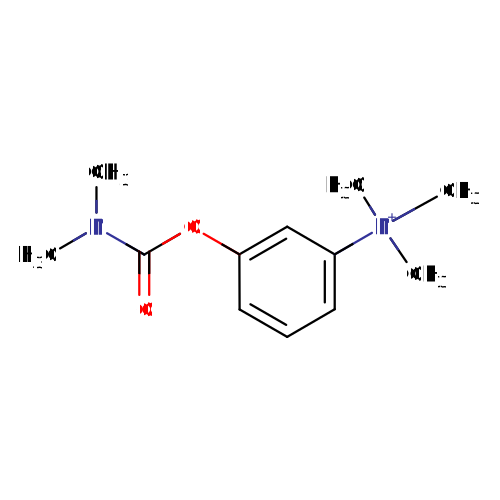
Structure for Neostigmine (DB01400)
- Weight
- Average: 223.2915
Monoisotopic: 223.144652862 - Chemical Formula
- C12H19N2O2
- Synonyms
- (m-Hydroxyphenyl)trimethylammonium dimethylcarbamate
- 3-Trimethylammoniumphenyl N,N-dimethylcarbamate
- Eustigmin
- Eustigmine
- m-Trimethylammoniumphenyldimethylcarbamate
- Neostigmina

Pharmacology
- Indication
Neostigmine is used for the symptomatic treatment of myasthenia gravis by improving muscle tone.
 Reduce drug development failure ratesBuild, train, & validate machine-learning modelswith evidence-based and structured datasets.Build, train, & validate predictive machine-learning models with structured datasets.
- Associated Conditions
Indication Type Indication Combined Product Details Approval Level Age Group Patient Characteristics Dose Form Management of Curarization •••••••••••• Symptomatic treatment of Myasthenia gravis •••••••••••• Reversal of Neuromuscular blockade •••••••••••• Treatment of Ogilvie's syndrome ••• ••••• Treatment of Post-operative urinary retention •••••••••••• - Contraindications & Blackbox Warnings
 Prevent Adverse Drug Events TodayTap into our Clinical API for life-saving information on contraindications & blackbox warnings, population restrictions, harmful risks, & more.Avoid life-threatening adverse drug events with our Clinical API
- Pharmacodynamics
Neostigmine is a cholinesterase inhibitor used in the treatment of myasthenia gravis and to reverse the effects of muscle relaxants such as gallamine and tubocurarine. Neostigmine, unlike physostigmine, does not cross the blood-brain barrier. By inhibiting acetylcholinesterase, more acetylcholine is available in the synapse, therefore, more of it can bind to the fewer receptors present in myasthenia gravis and can better trigger muscular contraction.
- Mechanism of action
Neostigmine is a parasympathomimetic, specifically, a reversible cholinesterase inhibitor. The drug inhibits acetylcholinesterase which is responsible for the degredation of acetylcholine. So, with acetylcholinesterase inhibited, more acetylcholine is present By interfering with the breakdown of acetylcholine, neostigmine indirectly stimulates both nicotinic and muscarinic receptors which are involved in muscle contraction.. It does not cross the blood-brain barrier.
Target Actions Organism AAcetylcholinesterase inhibitorHumans - Absorption
Neostigmine bromide is poorly absorbed from the gastrointestinal tract following oral administration
- Volume of distribution
Not Available
- Protein binding
Protein binding to human serum albumin ranges from 15 to 25 percent.
- Metabolism
Neostigmine undergoes hydrolysis by cholinesterase and is also metabolized by microsomal enzymes in the liver.
- Route of elimination
Not Available
- Half-life
The half-life ranged from 42 to 60 minutes with a mean half-life of 52 minutes.
- Clearance
Not Available
- Adverse Effects
 Improve decision support & research outcomesWith structured adverse effects data, including: blackbox warnings, adverse reactions, warning & precautions, & incidence rates. View sample adverse effects data in our new Data Library!Improve decision support & research outcomes with our structured adverse effects data.
- Toxicity
Overdosage of Neostigmine can cause cholinergic crisis, which is characterized by increasing muscle weakness, and through involvement of the muscles of respiration, may result in death. The LD 50 of neostigmine methylsulfate in mice is 0.3 ± 0.02 mg/kg intravenously, 0.54 ± 0.03 mg/kg subcutaneously, and 0.395 ± 0.025 mg/kg intramuscularly; in rats the LD 50 is 0.315 ± 0.019 mg/kg intravenously, 0.445 ± 0.032 mg/kg subcutaneously, and 0.423 ± 0.032 mg/kg intramuscularly.
- Pathways
- Not Available
- Pharmacogenomic Effects/ADRs
- Not Available
Interactions
- Drug Interactions
- This information should not be interpreted without the help of a healthcare provider. If you believe you are experiencing an interaction, contact a healthcare provider immediately. The absence of an interaction does not necessarily mean no interactions exist.
Drug Interaction Integrate drug-drug
interactions in your softwareAcebutolol Neostigmine may increase the bradycardic activities of Acebutolol. Acetylcholine The risk or severity of adverse effects can be increased when Neostigmine is combined with Acetylcholine. Aclidinium Neostigmine may increase the neuromuscular blocking activities of Aclidinium. Amantadine The therapeutic efficacy of Amantadine can be decreased when used in combination with Neostigmine. Amifampridine The risk or severity of adverse effects can be increased when Neostigmine is combined with Amifampridine. - Food Interactions
- No interactions found.
Products
 Drug product information from 10+ global regionsOur datasets provide approved product information including:dosage, form, labeller, route of administration, and marketing period.Access drug product information from over 10 global regions.
- Product Ingredients
Ingredient UNII CAS InChI Key Neostigmine bromide 005SYP50G5 114-80-7 LULNWZDBKTWDGK-UHFFFAOYSA-M Neostigmine methylsulfate 98IMH7M386 51-60-5 OSZNNLWOYWAHSS-UHFFFAOYSA-M - International/Other Brands
- Vagostigmin
- Brand Name Prescription Products
Name Dosage Strength Route Labeller Marketing Start Marketing End Region Image Bloxiverz Injection 0.5 mg/1mL Intravenous Exela Pharma Sciences, LLC 2013-07-24 Not applicable US 
Bloxiverz Injection 1 mg/1mL Intravenous Avadel Legacy Pharmaceuticals, Llc 2013-07-24 2022-11-30 US Bloxiverz Injection 0.5 mg/1mL Intravenous Avadel Legacy Pharmaceuticals, Llc 2013-07-24 2022-08-31 US Bloxiverz Injection 1 mg/1mL Intravenous Exela Pharma Sciences, LLC 2021-03-03 Not applicable US Bloxiverz Injection 0.5 mg/1mL Intravenous Avadel Legacy Pharmaceuticals, Llc 2013-07-24 2018-12-31 US - Generic Prescription Products
Name Dosage Strength Route Labeller Marketing Start Marketing End Region Image Neostigmine Injection 0.5 mg/1mL Intravenous Dr.Reddy's Laboratories Inc 2018-09-04 Not applicable US Neostigmine Injection 1 mg/1mL Intravenous Dr.Reddy's Laboratories Inc 2018-09-04 Not applicable US Neostigmine Injection 1 mg/1mL Intravenous Medical Purchasing Solutions, Llc 2018-09-04 Not applicable US Neostigmine Methylsulfate Injection 0.5 mg/1mL Intravenous Caplin Steriles Limited 2021-04-30 Not applicable US Neostigmine Methylsulfate Injection 1 mg/1mL Intravenous Hikma Pharmaceuticals USA Inc. 2022-07-13 Not applicable US - Mixture Products
Name Ingredients Dosage Route Labeller Marketing Start Marketing End Region Image Prevduo Neostigmine methylsulfate (1 mg/1mL) + Glycopyrronium bromide (0.2 mg/1mL) Injection Intravenous Par Pharmaceutical, Inc. 2023-05-15 Not applicable US - Unapproved/Other Products
Name Ingredients Dosage Route Labeller Marketing Start Marketing End Region Image Neostigmine Methylsuflate Neostigmine methylsulfate (1 mg/1mL) Injection, solution Intramuscular; Intravenous; Subcutaneous General Injectables & Vaccines 2010-08-01 2014-08-31 US Neostigmine Methylsulfate Neostigmine methylsulfate (0.5 mg/1mL) Injection, solution Intramuscular; Intravenous; Subcutaneous Claris Lifesciences, Inc. 2009-10-07 2010-11-04 US Neostigmine Methylsulfate Neostigmine methylsulfate (1 mg/1mL) Injection, solution Intramuscular; Intravenous; Subcutaneous American Regent 2003-01-16 2016-10-17 US Neostigmine Methylsulfate Neostigmine methylsulfate (1 mg/1mL) Injection Intramuscular; Intravenous; Subcutaneous Cardinal Health 1973-01-01 2014-09-30 US Neostigmine Methylsulfate Neostigmine methylsulfate (0.5 mg/1mL) Injection, solution Intramuscular; Intravenous; Subcutaneous Claris Lifesciences Limited 2009-10-07 2010-11-04 US
Categories
- ATC Codes
- N07AA01 — Neostigmine
- N07AA — Anticholinesterases
- N07A — PARASYMPATHOMIMETICS
- N07 — OTHER NERVOUS SYSTEM DRUGS
- N — NERVOUS SYSTEM
- S01EB — Parasympathomimetics
- S01E — ANTIGLAUCOMA PREPARATIONS AND MIOTICS
- S01 — OPHTHALMOLOGICALS
- S — SENSORY ORGANS
- Drug Categories
- Amines
- Antiglaucoma Preparations and Miotics
- Autonomic Agents
- Cholinergic Agents
- Cholinesterase Inhibitors
- Enzyme Inhibitors
- Nervous System
- Neurotransmitter Agents
- Onium Compounds
- Ophthalmologicals
- Parasympathomemetic (Cholinergic) Agents
- Parasympathomimetics
- Peripheral Nervous System Agents
- Phenylammonium Compounds
- Quaternary Ammonium Compounds
- Sensory Organs
- Chemical TaxonomyProvided by Classyfire
- Description
- This compound belongs to the class of organic compounds known as phenoxy compounds. These are aromatic compounds contaning a phenoxy group.
- Kingdom
- Organic compounds
- Super Class
- Benzenoids
- Class
- Benzene and substituted derivatives
- Sub Class
- Phenoxy compounds
- Direct Parent
- Phenoxy compounds
- Alternative Parents
- Aniline and substituted anilines / Quaternary ammonium salts / Carbamate esters / Organic carbonic acids and derivatives / Organopnictogen compounds / Organic salts / Organic oxides / Hydrocarbon derivatives / Carbonyl compounds / Amines show 1 more
- Substituents
- Amine / Aniline or substituted anilines / Aromatic homomonocyclic compound / Carbamic acid ester / Carbonic acid derivative / Carbonyl group / Hydrocarbon derivative / Organic cation / Organic nitrogen compound / Organic oxide show 7 more
- Molecular Framework
- Aromatic homomonocyclic compounds
- External Descriptors
- quaternary ammonium ion (CHEBI:7514)
- Affected organisms
- Humans and other mammals
Chemical Identifiers
- UNII
- 3982TWQ96G
- CAS number
- 59-99-4
- InChI Key
- ALWKGYPQUAPLQC-UHFFFAOYSA-N
- InChI
- InChI=1S/C12H19N2O2/c1-13(2)12(15)16-11-8-6-7-10(9-11)14(3,4)5/h6-9H,1-5H3/q+1
- IUPAC Name
- 3-[(dimethylcarbamoyl)oxy]-N,N,N-trimethylanilinium
- SMILES
- CN(C)C(=O)OC1=CC(=CC=C1)[N+](C)(C)C
References
- General References
- Not Available
- External Links
- Human Metabolome Database
- HMDB0015472
- KEGG Drug
- D08261
- KEGG Compound
- C07258
- PubChem Compound
- 4456
- PubChem Substance
- 46509161
- ChemSpider
- 4301
- BindingDB
- 50022775
- 7315
- ChEBI
- 7514
- ChEMBL
- CHEMBL278020
- ZINC
- ZINC000000001792
- Therapeutic Targets Database
- DAP000563
- PharmGKB
- PA450611
- RxList
- RxList Drug Page
- Drugs.com
- Drugs.com Drug Page
- Wikipedia
- Neostigmine
- MSDS
- Download (74.7 KB)
Clinical Trials
- Clinical Trials
Phase Status Purpose Conditions Count 4 Active Not Recruiting Diagnostic Neostigmine / Sugammadex 1 4 Active Not Recruiting Prevention Bowel Dysfunction / Neuromuscular Blockade / Postoperative Complications 1 4 Completed Basic Science Electromyography / Respiratory Muscles 1 4 Completed Diagnostic Intraocular Pressure Changes During Tracheal Extubation 1 4 Completed Diagnostic Residual Neuromuscular Block 1
Pharmacoeconomics
- Manufacturers
- Not Available
- Packagers
- American Regent
- Pharmedium
- Spectrum Pharmaceuticals
- Valeant Ltd.
- Dosage Forms
Form Route Strength Injection Intravenous 0.5 mg/1mL Injection Intravenous 1 mg/1mL Injection, solution Intramuscular; Intravenous; Subcutaneous Solution Intravenous 0.500 mg Injection, solution Parenteral 0.5 MG/ML Injection, solution Intramuscular; Intravenous; Subcutaneous 0.5 mg/ml Injection, solution Parenteral 0.5 mg Injection, solution 0.5 mg/ml Solution Intramuscular; Intravenous 0.5 mg Solution Parenteral 0.5 mg Solution Intramuscular; Intravenous; Parenteral 0.5 mg Solution Intramuscular; Intravenous; Subcutaneous 0.5 mg Injection 0.5 mg Injection Intramuscular; Intravenous; Subcutaneous 0.5 mg/1mL Injection Intramuscular; Intravenous; Subcutaneous 1 mg/1mL Injection Intravenous 0.51 mg/1mL Injection Intravenous 1.02 mg/1mL Injection, solution Intramuscular; Intravenous; Subcutaneous 0.5 mg/1mL Injection, solution Intramuscular; Intravenous; Subcutaneous 1 mg/1mL Injection, solution Intramuscular; Intravenous; Subcutaneous 5 mg/1mL Injection, solution Intravenous 0.5 mg/1mL Injection, solution Intravenous 1 mg/1mL Solution Intramuscular; Intravenous; Subcutaneous 0.5 mg / mL Solution Intramuscular; Intravenous; Subcutaneous 1 mg / mL Solution Intramuscular; Intravenous; Subcutaneous 2.5 mg / mL Liquid Intramuscular; Intravenous; Subcutaneous 0.5 mg / mL Liquid Intramuscular; Intravenous; Subcutaneous 1 mg / mL Injection, solution Intramuscular; Intravenous; Subcutaneous 2.5 mg/ml Injection Intravenous Injection Tablet Oral 15 mg/1 Tablet Oral 15 mg Injection Intramuscular; Intravenous; Subcutaneous 0.5 mg/ml Liquid Intramuscular; Intravenous; Subcutaneous .5 mg / mL Injection, solution Tablet Oral Injection Intramuscular; Intravenous; Subcutaneous Injection Intramuscular; Intravenous; Subcutaneous 2.5 mg/ml Injection, solution 0.5 mg/1ml Solution 0.5 mg/1ml Solution Parenteral 0.500 mg Solution 2.5 mg/1ml - Prices
Unit description Cost Unit Neostigmine bromide powder 96.57USD g Neostigmine ms 5 mg/5 ml syr 1.99USD ml Prostigmin 1:4000 ampul 1.42USD ml Prostigmin 15 mg tablet 1.04USD tablet Neostigmine 1:1000 vial 0.48USD ml Neostigmine 1:2000 vial 0.48USD ml DrugBank does not sell nor buy drugs. Pricing information is supplied for informational purposes only.- Patents
Patent Number Pediatric Extension Approved Expires (estimated) Region US10456354 No 2019-10-29 2038-10-25 US US11110054 No 2021-09-07 2038-10-25 US
Properties
- State
- Solid
- Experimental Properties
- Not Available
- Predicted Properties
Property Value Source Water Solubility 0.0677 mg/mL ALOGPS logP -1.6 ALOGPS logP -2.2 Chemaxon logS -3.6 ALOGPS Physiological Charge 1 Chemaxon Hydrogen Acceptor Count 1 Chemaxon Hydrogen Donor Count 0 Chemaxon Polar Surface Area 29.54 Å2 Chemaxon Rotatable Bond Count 3 Chemaxon Refractivity 75.28 m3·mol-1 Chemaxon Polarizability 25.08 Å3 Chemaxon Number of Rings 1 Chemaxon Bioavailability 1 Chemaxon Rule of Five Yes Chemaxon Ghose Filter No Chemaxon Veber's Rule Yes Chemaxon MDDR-like Rule No Chemaxon - Predicted ADMET Features
Property Value Probability Human Intestinal Absorption - 0.8576 Blood Brain Barrier + 0.9583 Caco-2 permeable + 0.608 P-glycoprotein substrate Non-substrate 0.8263 P-glycoprotein inhibitor I Non-inhibitor 0.9598 P-glycoprotein inhibitor II Non-inhibitor 0.9279 Renal organic cation transporter Non-inhibitor 0.9181 CYP450 2C9 substrate Non-substrate 0.7197 CYP450 2D6 substrate Non-substrate 0.6869 CYP450 3A4 substrate Substrate 0.622 CYP450 1A2 substrate Non-inhibitor 0.9045 CYP450 2C9 inhibitor Non-inhibitor 0.907 CYP450 2D6 inhibitor Non-inhibitor 0.9367 CYP450 2C19 inhibitor Non-inhibitor 0.9025 CYP450 3A4 inhibitor Non-inhibitor 0.9424 CYP450 inhibitory promiscuity Low CYP Inhibitory Promiscuity 0.8362 Ames test AMES toxic 0.5146 Carcinogenicity Non-carcinogens 0.5931 Biodegradation Not ready biodegradable 0.7893 Rat acute toxicity 2.9481 LD50, mol/kg Not applicable hERG inhibition (predictor I) Weak inhibitor 0.952 hERG inhibition (predictor II) Non-inhibitor 0.8738
Spectra
- Mass Spec (NIST)
- Not Available
- Spectra
- Chromatographic Properties
Collision Cross Sections (CCS)
Adduct CCS Value (Å2) Source type Source [M-H]- 152.71416 predictedDeepCCS 1.0 (2019) [M+H]+ 155.11018 predictedDeepCCS 1.0 (2019) [M+Na]+ 161.02272 predictedDeepCCS 1.0 (2019)
Targets

- Kind
- Protein
- Organism
- Humans
- Pharmacological action
- Yes
- Actions
- Inhibitor
- General Function
- Serine hydrolase activity
- Specific Function
- Terminates signal transduction at the neuromuscular junction by rapid hydrolysis of the acetylcholine released into the synaptic cleft. Role in neuronal apoptosis.
- Gene Name
- ACHE
- Uniprot ID
- P22303
- Uniprot Name
- Acetylcholinesterase
- Molecular Weight
- 67795.525 Da
References
- Trevisani GT, Hyman NH, Church JM: Neostigmine: safe and effective treatment for acute colonic pseudo-obstruction. Dis Colon Rectum. 2000 May;43(5):599-603. [Article]
- Naves LA, Van der Kloot W: Repetitive nerve stimulation decreases the acetylcholine content of quanta at the frog neuromuscular junction. J Physiol. 2001 May 1;532(Pt 3):637-47. [Article]
- Takeuchi K, Kawauchi S, Araki H, Ueki S, Furukawa O: Stimulation by nizatidine, a histamine H(2)-receptor antagonist, of duodenal HCO(3)(-)secretion in rats:relation to anti-cholinesterase activity. World J Gastroenterol. 2000 Oct;6(5):651-658. [Article]
- Minic J, Chatonnet A, Krejci E, Molgo J: Butyrylcholinesterase and acetylcholinesterase activity and quantal transmitter release at normal and acetylcholinesterase knockout mouse neuromuscular junctions. Br J Pharmacol. 2003 Jan;138(1):177-87. [Article]
- Beck KD, Brennan FX, Moldow RL, Ottenweller JE, Zhu G, Servatius RJ: Stress interacts with peripheral cholinesterase inhibitors to cause central nervous system effects. Life Sci. 2003 May 23;73(1):41-51. [Article]
- Zhang B, Hepner DL, Tran MH, Friedman M, Korn JR, Menzin J: Neuromuscular blockade, reversal agent use, and operating room time: retrospective analysis of US inpatient surgeries. Curr Med Res Opin. 2009 Apr;25(4):943-50. doi: 10.1185/03007990902769054 . [Article]
- Chen X, Ji ZL, Chen YZ: TTD: Therapeutic Target Database. Nucleic Acids Res. 2002 Jan 1;30(1):412-5. [Article]
Enzymes
- Kind
- Protein
- Organism
- Humans
- Pharmacological action
- Unknown
- Actions
- Inhibitor
- General Function
- Identical protein binding
- Specific Function
- Esterase with broad substrate specificity. Contributes to the inactivation of the neurotransmitter acetylcholine. Can degrade neurotoxic organophosphate esters.
- Gene Name
- BCHE
- Uniprot ID
- P06276
- Uniprot Name
- Cholinesterase
- Molecular Weight
- 68417.575 Da
References
- Saito S: Cholinesterase inhibitors induce growth cone collapse and inhibit neurite extension in primary cultured chick neurons. Neurotoxicol Teratol. 1998 Jul-Aug;20(4):411-9. [Article]

Drug created at July 08, 2007 17:06 / Updated at April 27, 2024 09:44