Identification
- Generic Name
- Choline magnesium trisalicylate
- DrugBank Accession Number
- DB01401
- Background
Choline magnesium trisalicylate is a non-acetylated salicylate used widely as a nonsteroidal anti-inflammatory drug. Trisalicylate significantly reduces methotrexate renal clearance, displacing methotrexate from protein, increasing the fraction unbound by 28% 1,2.
- Type
- Small Molecule
- Groups
- Approved
- Structure
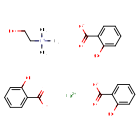
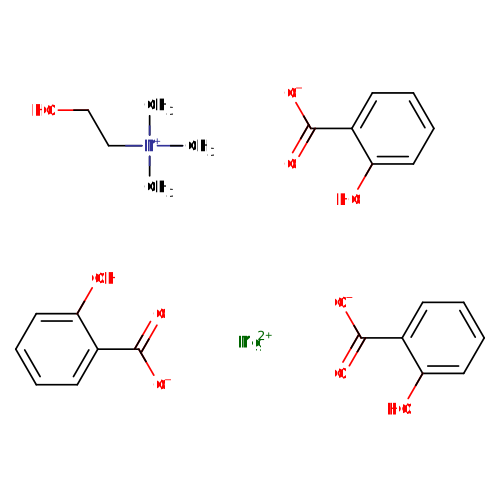
Structure for Choline magnesium trisalicylate (DB01401)
- Weight
- Average: 539.814
Monoisotopic: 539.164188051 - Chemical Formula
- C26H29MgNO10
- Synonyms
- Not Available

Pharmacology
- Indication
Choline magnesium trisalicylate is used to reduce pain and inflammation caused by conditions such as arthritis. This medication is also used to treat fever in adults.
 Reduce drug development failure ratesBuild, train, & validate machine-learning modelswith evidence-based and structured datasets.Build, train, & validate predictive machine-learning models with structured datasets.
- Associated Conditions
Indication Type Indication Combined Product Details Approval Level Age Group Patient Characteristics Dose Form Symptomatic treatment of Arthritis •••••••••••• ••••• Symptomatic treatment of Juvenile idiopathic arthritis •••••••••••• ••••••••• Symptomatic treatment of Osteoarthritis •••••••••••• ••••• Management of Pyrexia •••••••••••• ••••• Symptomatic treatment of Rheumatoid arthritis •••••••••••• ••••• - Contraindications & Blackbox Warnings
 Prevent Adverse Drug Events TodayTap into our Clinical API for life-saving information on contraindications & blackbox warnings, population restrictions, harmful risks, & more.Avoid life-threatening adverse drug events with our Clinical API
- Pharmacodynamics
Trisalicylate-choline is a non-steroidal anti-inflammatory drug (NSAID) that contains a combination of choline salicylate and magnesium salicylate. Does not affect platelet aggregation.
- Mechanism of action
Inhibits prostaglandin synthesis; acts on the hypothalamus heat-regulating center to reduce fever; blocks the generation of pain impulses
Target Actions Organism UProstaglandin G/H synthase 1 inhibitorHumans UProstaglandin G/H synthase 2 inhibitorHumans - Absorption
Not Available
- Volume of distribution
Not Available
- Protein binding
Not Available
- Metabolism
- Not Available
- Route of elimination
renal
- Half-life
Not Available
- Clearance
Not Available
- Adverse Effects
 Improve decision support & research outcomesWith structured adverse effects data, including: blackbox warnings, adverse reactions, warning & precautions, & incidence rates. View sample adverse effects data in our new Data Library!Improve decision support & research outcomes with our structured adverse effects data.
- Toxicity
Salicylate intoxication, known as salicylism, may occur with large doses or extended therapy. Common symptoms of salicylism include headache, dizziness, tinnitus, hearing impairment, confusion, drowsiness, sweating, vomiting, diarrhea, and hyperventilation. A more severe degree of salicylate intoxication can lead to CNS disturbances, alteration in electrolyte balance, respiratory and metabolic acidosis, hyperthermia, and dehydration.
- Pathways
Pathway Category Trisalicylate-Choline Action Pathway Drug action - Pharmacogenomic Effects/ADRs
- Not Available
Interactions
- Drug Interactions
- This information should not be interpreted without the help of a healthcare provider. If you believe you are experiencing an interaction, contact a healthcare provider immediately. The absence of an interaction does not necessarily mean no interactions exist.
Drug Interaction Integrate drug-drug
interactions in your softwareAbacavir Choline magnesium trisalicylate may decrease the excretion rate of Abacavir which could result in a higher serum level. Abciximab The risk or severity of bleeding and hemorrhage can be increased when Choline magnesium trisalicylate is combined with Abciximab. Acebutolol Choline magnesium trisalicylate may decrease the antihypertensive activities of Acebutolol. Aceclofenac The risk or severity of adverse effects can be increased when Choline magnesium trisalicylate is combined with Aceclofenac. Acemetacin The risk or severity of adverse effects can be increased when Choline magnesium trisalicylate is combined with Acemetacin. - Food Interactions
- Not Available
Products
 Drug product information from 10+ global regionsOur datasets provide approved product information including:dosage, form, labeller, route of administration, and marketing period.Access drug product information from over 10 global regions.
- International/Other Brands
- Tricosal / Trilisate
Categories
- Drug Categories
- Acids, Carbocyclic
- Agents causing hyperkalemia
- Agents that produce hypertension
- Alcohols
- Amines
- Amino Alcohols
- Analgesics
- Analgesics, Non-Narcotic
- Anti-Inflammatory Agents
- Anti-Inflammatory Agents, Non-Steroidal
- Anti-Inflammatory Agents, Non-Steroidal (Non-Selective)
- Antirheumatic Agents
- Benzene Derivatives
- Benzoates
- Central Nervous System Agents
- Ethanolamines
- Hydroxy Acids
- Hydroxybenzoates
- Nephrotoxic agents
- Non COX-2 selective NSAIDS
- Onium Compounds
- Peripheral Nervous System Agents
- Phenols
- Quaternary Ammonium Compounds
- Sensory System Agents
- Trimethyl Ammonium Compounds
- Chemical TaxonomyProvided by Classyfire
- Description
- This compound belongs to the class of organic compounds known as salicylic acids. These are ortho-hydroxylated benzoic acids.
- Kingdom
- Organic compounds
- Super Class
- Benzenoids
- Class
- Benzene and substituted derivatives
- Sub Class
- Benzoic acids and derivatives
- Direct Parent
- Salicylic acids
- Alternative Parents
- Benzoic acids / Benzoyl derivatives / Phenoxides / 1-hydroxy-2-unsubstituted benzenoids / 1-hydroxy-4-unsubstituted benzenoids / Cholines / Vinylogous acids / Tetraalkylammonium salts / 1,2-aminoalcohols / Carboxylic acid salts show 7 more
- Substituents
- 1,2-aminoalcohol / 1-hydroxy-2-unsubstituted benzenoid / 1-hydroxy-4-unsubstituted benzenoid / Alcohol / Alkanolamine / Amine / Aromatic homomonocyclic compound / Benzoic acid / Benzoyl / Carboxylic acid show 19 more
- Molecular Framework
- Not Available
- External Descriptors
- Not Available
- Affected organisms
- Not Available
Chemical Identifiers
- UNII
- Not Available
- CAS number
- 64425-90-7
- InChI Key
- FQCQGOZEWWPOKI-UHFFFAOYSA-K
- InChI
- InChI=1S/3C7H6O3.C5H14NO.Mg/c3*8-6-4-2-1-3-5(6)7(9)10;1-6(2,3)4-5-7;/h3*1-4,8H,(H,9,10);7H,4-5H2,1-3H3;/q;;;+1;+2/p-3
- IUPAC Name
- magnesium(2+) (2-hydroxyethyl)trimethylazanium tris(2-hydroxybenzoate)
- SMILES
- [Mg++].C[N+](C)(C)CCO.OC1=CC=CC=C1C([O-])=O.OC1=CC=CC=C1C([O-])=O.OC1=CC=CC=C1C([O-])=O
References
- General References
- Nadkarni MM, Peller CA, Retig J: Eosinophilic hepatitis after ingestion of choline magnesium trisalicylate. Am J Gastroenterol. 1992 Jan;87(1):151-3. [Article]
- Tracy TS, Krohn K, Jones DR, Bradley JD, Hall SD, Brater DC: The effects of a salicylate, ibuprofen, and naproxen on the disposition of methotrexate in patients with rheumatoid arthritis. Eur J Clin Pharmacol. 1992;42(2):121-5. [Article]
- External Links
- Human Metabolome Database
- HMDB0015473
- PubChem Compound
- 54682045
- PubChem Substance
- 46505243
- ChemSpider
- 10642393
- 215799
- PharmGKB
- PA164749164
Clinical Trials
- Clinical Trials
Pharmacoeconomics
- Manufacturers
- Not Available
- Packagers
- Ivax Pharmaceuticals
- Pliva Inc.
- Dosage Forms
- Not Available
- Prices
Unit description Cost Unit Choline mag trisal 1 gm tablet 1.23USD tablet Choline mag trisal 750 mg tablet 0.81USD tablet Choline mag trisal 500 mg tablet 0.57USD tablet DrugBank does not sell nor buy drugs. Pricing information is supplied for informational purposes only.- Patents
- Not Available
Properties
- State
- Solid
- Experimental Properties
- Not Available
- Predicted Properties
Property Value Source Water Solubility 0.0686 mg/mL ALOGPS logP 2.86 ALOGPS logP 1.98 Chemaxon logS -3.6 ALOGPS pKa (Strongest Acidic) 2.79 Chemaxon pKa (Strongest Basic) -6.3 Chemaxon Physiological Charge -1 Chemaxon Hydrogen Acceptor Count 3 Chemaxon Hydrogen Donor Count 1 Chemaxon Polar Surface Area 60.36 Å2 Chemaxon Rotatable Bond Count 5 Chemaxon Refractivity 46.13 m3·mol-1 Chemaxon Polarizability 12.38 Å3 Chemaxon Number of Rings 3 Chemaxon Bioavailability 1 Chemaxon Rule of Five No Chemaxon Ghose Filter No Chemaxon Veber's Rule No Chemaxon MDDR-like Rule No Chemaxon - Predicted ADMET Features
Property Value Probability Human Intestinal Absorption - 0.9852 Blood Brain Barrier - 0.8993 Caco-2 permeable + 0.5436 P-glycoprotein substrate Substrate 0.7681 P-glycoprotein inhibitor I Non-inhibitor 0.9522 P-glycoprotein inhibitor II Non-inhibitor 0.6479 Renal organic cation transporter Non-inhibitor 0.7147 CYP450 2C9 substrate Non-substrate 0.7398 CYP450 2D6 substrate Non-substrate 0.7764 CYP450 3A4 substrate Substrate 0.588 CYP450 1A2 substrate Non-inhibitor 0.7658 CYP450 2C9 inhibitor Non-inhibitor 0.8703 CYP450 2D6 inhibitor Non-inhibitor 0.7642 CYP450 2C19 inhibitor Non-inhibitor 0.8941 CYP450 3A4 inhibitor Non-inhibitor 0.9072 CYP450 inhibitory promiscuity Low CYP Inhibitory Promiscuity 0.9752 Ames test Non AMES toxic 0.7389 Carcinogenicity Non-carcinogens 0.729 Biodegradation Ready biodegradable 0.5807 Rat acute toxicity 2.3576 LD50, mol/kg Not applicable hERG inhibition (predictor I) Weak inhibitor 0.8568 hERG inhibition (predictor II) Non-inhibitor 0.7428
Spectra
- Mass Spec (NIST)
- Not Available
- Spectra
- Not Available
- Chromatographic Properties
Collision Cross Sections (CCS)
Adduct CCS Value (Å2) Source type Source [M-H]- 125.5821905 predictedDarkChem Lite v0.1.0 [M+H]+ 126.6207905 predictedDarkChem Lite v0.1.0 [M+Na]+ 125.9818905 predictedDarkChem Lite v0.1.0
Targets

- Kind
- Protein
- Organism
- Humans
- Pharmacological action
- Unknown
- Actions
- Inhibitor
- General Function
- Prostaglandin-endoperoxide synthase activity
- Specific Function
- Converts arachidonate to prostaglandin H2 (PGH2), a committed step in prostanoid synthesis. Involved in the constitutive production of prostanoids in particular in the stomach and platelets. In gas...
- Gene Name
- PTGS1
- Uniprot ID
- P23219
- Uniprot Name
- Prostaglandin G/H synthase 1
- Molecular Weight
- 68685.82 Da
References
- Nizankowska E, Dworski R, Soja J, Szczeklik A: Salicylate pre-treatment attenuates intensity of bronchial and nasal symptoms precipitated by aspirin in aspirin-intolerant patients. Clin Exp Allergy. 1990 Nov;20(6):647-52. [Article]
- Simon RA: Adverse respiratory reactions to aspirin and nonsteroidal anti-inflammatory drugs. Curr Allergy Asthma Rep. 2004 Jan;4(1):17-24. [Article]
- Schwartz KA: Aspirin resistance: a review of diagnostic methodology, mechanisms, and clinical utility. Adv Clin Chem. 2006;42:81-110. [Article]
- Kind
- Protein
- Organism
- Humans
- Pharmacological action
- Unknown
- Actions
- Inhibitor
- General Function
- Prostaglandin-endoperoxide synthase activity
- Specific Function
- Converts arachidonate to prostaglandin H2 (PGH2), a committed step in prostanoid synthesis. Constitutively expressed in some tissues in physiological conditions, such as the endothelium, kidney and...
- Gene Name
- PTGS2
- Uniprot ID
- P35354
- Uniprot Name
- Prostaglandin G/H synthase 2
- Molecular Weight
- 68995.625 Da
References
- Simon RA: Adverse respiratory reactions to aspirin and nonsteroidal anti-inflammatory drugs. Curr Allergy Asthma Rep. 2004 Jan;4(1):17-24. [Article]
- Brzozowski T, Konturek PC, Sliwowski Z, Kwiecien S, Drozdowicz D, Pawlik M, Mach K, Konturek SJ, Pawlik WW: Interaction of nonsteroidal anti-inflammatory drugs (NSAID) with Helicobacter pylori in the stomach of humans and experimental animals. J Physiol Pharmacol. 2006 Sep;57 Suppl 3:67-79. [Article]
- Wang HJ, Liu XJ, Yang KX, Luo FM, Lou JY, Peng ZL: [Effects of nonsteroidal anti-inflammatory drug celecoxib on expression of cyclooxygenase-2 (COX-2) in ovarian carcinoma cell]. Sichuan Da Xue Xue Bao Yi Xue Ban. 2006 Sep;37(5):757-60. [Article]
- Shen J, Gammon MD, Terry MB, Teitelbaum SL, Neugut AI, Santella RM: Genetic polymorphisms in the cyclooxygenase-2 gene, use of nonsteroidal anti-inflammatory drugs, and breast cancer risk. Breast Cancer Res. 2006;8(6):R71. [Article]
- Nakano M, Denda N, Matsumoto M, Kawamura M, Kawakubo Y, Hatanaka K, Hiramoto Y, Sato Y, Noshiro M, Harada Y: Interaction between cyclooxygenase (COX)-1- and COX-2-products modulates COX-2 expression in the late phase of acute inflammation. Eur J Pharmacol. 2007 Mar 22;559(2-3):210-8. Epub 2006 Dec 16. [Article]

Drug created at July 08, 2007 17:07 / Updated at June 12, 2020 17:41