Identification
- Summary
Danazol is a synthetic steroid and pituitary gonadotropin inhibitor used in the treatment of endometriosis and symptomatic treatment of severe pain and tenderness associated with benign fibrocystic breasts.
- Brand Names
- Cyclomen
- Generic Name
- Danazol
- DrugBank Accession Number
- DB01406
- Background
A synthetic steroid with antigonadotropic and anti-estrogenic activities that acts as an anterior pituitary suppressant by inhibiting the pituitary output of gonadotropins. It possesses some androgenic properties. Danazol has been used in the treatment of endometriosis and some benign breast disorders.
- Type
- Small Molecule
- Groups
- Approved
- Structure
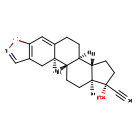
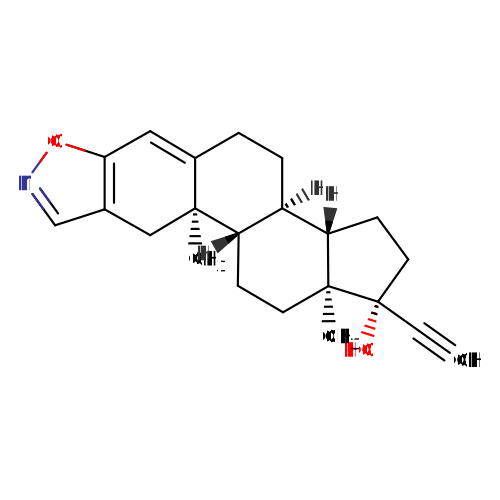
Structure for Danazol (DB01406)
- Weight
- Average: 337.4553
Monoisotopic: 337.204179113 - Chemical Formula
- C22H27NO2
- Synonyms
- Danazol
- Danazolum
- External IDs
- WIN 17,757
- WIN-17757

Pharmacology
- Indication
For the treatment of endometriosis and fibrocystic breast disease (in patients unresponsive to simple measures). Also used for the prophylactic treatment of all types of hereditary angioedema in males and females.
 Reduce drug development failure ratesBuild, train, & validate machine-learning modelswith evidence-based and structured datasets.Build, train, & validate predictive machine-learning models with structured datasets.
- Associated Conditions
Indication Type Indication Combined Product Details Approval Level Age Group Patient Characteristics Dose Form Treatment of Endometriosis •••••••••••• Symptomatic treatment of Fibrocystic breast disease •••••••••••• Management of Hereditary angioedema •••••••••••• Management of Refractory immune thrombocytopenia ••• ••••• - Contraindications & Blackbox Warnings
 Prevent Adverse Drug Events TodayTap into our Clinical API for life-saving information on contraindications & blackbox warnings, population restrictions, harmful risks, & more.Avoid life-threatening adverse drug events with our Clinical API
- Pharmacodynamics
Danazol is a derivative of the synthetic steroid ethisterone, a modified testosterone. It was approved by the U.S. Food and Drug Administration (FDA) as the first drug to specifically treat endometriosis, but its role as a treatment for endometriosis has been largely replaced by the gonadotropin-releasing hormone (GnRH) agonists. Danazol has antigonadotropic and anti-estrogenic activities. Danazol acts as an anterior pituitary suppressant by inhibiting the pituitary output of gonadotropins. It possesses some androgenic properties.
- Mechanism of action
As a gonadotropin inhibitor, danazol suppresses the pituitary-ovarian axis possibly by inhibiting the output of pituitary gonadotropins. Danazol also depresses the preovulatory surge in output of follicle-stimulating hormone (FSH) and luteinizing hormone (LH), thereby reducing ovarian estrogen production. Danazol may also directly inhibits ovarian steroidogenesis; bind to androgen, progesterone, and glucocorticoid receptors; bind to sex-hormone-binding globulin and corticosteroid-binding globulin; and increases the metabolic clearance rate of progesterone. Another mechanism of action by which danazol may use to facilitate regression of endometriosis is by decreasing IgG, IgM, and IgA concentrations, as well as phospholipid and IgG isotope autoantibodies. In the treatment of endometriosis, as a consequence of suppression of ovarian function, danazol causes both normal and ectopic endometrial tissues to become inactive and atrophic. This leads to anovulation and associated amenorrhea. In fibrocystic breast disease, the exact mechanism of action of danazol is unknown, but may be related to suppressed estrogenic stimulation as a result of decreased ovarian production of estrogen. A direct effect on steroid receptor sites in breast tissue is also possible. This leads to a disappearance of nodularity, relief of pain and tenderness, and possibly changes in the menstrual pattern. In terms of hereditary angioedema, danazol corrects the underlying biochemical deficiency by increasing serum concentrations of the deficient C1 esterase inhibitor, resulting in increased serum concentrations of the C4 component of the complement system. (Source: PharmGKB)
Target Actions Organism AEstrogen receptor alpha agonistHumans AAndrogen receptor agonistHumans AProgesterone receptor agonistHumans AGonadotropin-releasing hormone receptor negative modulatorHumans APutative gonadotropin-releasing hormone II receptor negative modulatorHumans UC-C motif chemokine 2 inhibitorHumans - Absorption
Not Available
- Volume of distribution
Not Available
- Protein binding
Not Available
- Metabolism
Hepatic, to principal metabolites, ethisterone and 17-hydroxymethylethisterone.
Hover over products below to view reaction partners
- Route of elimination
Not Available
- Half-life
Approximately 24 hours.
- Clearance
Not Available
- Adverse Effects
 Improve decision support & research outcomesWith structured adverse effects data, including: blackbox warnings, adverse reactions, warning & precautions, & incidence rates. View sample adverse effects data in our new Data Library!Improve decision support & research outcomes with our structured adverse effects data.
- Toxicity
Not Available
- Pathways
- Not Available
- Pharmacogenomic Effects/ADRs
- Not Available
Interactions
- Drug Interactions
- This information should not be interpreted without the help of a healthcare provider. If you believe you are experiencing an interaction, contact a healthcare provider immediately. The absence of an interaction does not necessarily mean no interactions exist.
Drug Interaction Integrate drug-drug
interactions in your software1,2-Benzodiazepine The metabolism of 1,2-Benzodiazepine can be decreased when combined with Danazol. Abemaciclib The metabolism of Abemaciclib can be decreased when combined with Danazol. Abiraterone The metabolism of Abiraterone can be decreased when combined with Danazol. Acalabrutinib The metabolism of Acalabrutinib can be decreased when combined with Danazol. Acarbose The therapeutic efficacy of Acarbose can be decreased when used in combination with Danazol. - Food Interactions
- Take with or without food. The absorption is unaffected by food.
Products
 Drug product information from 10+ global regionsOur datasets provide approved product information including:dosage, form, labeller, route of administration, and marketing period.Access drug product information from over 10 global regions.
- Product Images


- International/Other Brands
- Danol (Sanofi)
- Brand Name Prescription Products
Name Dosage Strength Route Labeller Marketing Start Marketing End Region Image Cyclomen Capsule 50 mg Oral Sanofi Aventis 1980-12-31 Not applicable Canada 
Cyclomen Capsule 100 mg Oral Sanofi Aventis 1976-12-31 Not applicable Canada Cyclomen Capsule 200 mg Oral Sanofi Aventis 1972-12-31 Not applicable Canada Danocrine Capsule 200 mg/1 Oral Sanofi Aventis 1976-06-21 2004-12-14 US 
Danocrine Capsule 200 mg/1 Oral Physicians Total Care, Inc. 1976-06-21 2005-03-18 US - Generic Prescription Products
Name Dosage Strength Route Labeller Marketing Start Marketing End Region Image Danazol Capsule 200 mg/1 Oral AvKARE 2016-02-23 Not applicable US Danazol Capsule 200 mg/1 Oral Lannett Company, Inc. 2005-09-28 Not applicable US Danazol Capsule 50 mg/1 Oral Av Kare, Inc. 2012-07-03 2015-09-03 US Danazol Capsule 200 mg/1 Oral Physicians Total Care, Inc. 2005-11-21 2011-06-30 US Danazol Capsule 100 mg/1 Oral Lannett Company, Inc. 2007-04-19 Not applicable US


Categories
- ATC Codes
- G03XA01 — Danazol
- Drug Categories
- Androgens
- Antigonadotropins and Similar Agents
- Cytochrome P-450 CYP3A Inhibitors
- Cytochrome P-450 CYP3A4 Inhibitors
- Cytochrome P-450 CYP3A4 Inhibitors (moderate)
- Cytochrome P-450 CYP3A4 Inhibitors (strong)
- Cytochrome P-450 Enzyme Inhibitors
- Estrogen Antagonists
- Fused-Ring Compounds
- Genito Urinary System and Sex Hormones
- Hormone Antagonists
- Hormones, Hormone Substitutes, and Hormone Antagonists
- Hyperglycemia-Associated Agents
- Pregnadienes
- Pregnanes
- Sex Hormones and Modulators of the Genital System
- Steroids
- Thyroxine-binding globulin inhibitors
- Chemical TaxonomyProvided by Classyfire
- Description
- This compound belongs to the class of organic compounds known as estrane steroids. These are steroids with a structure based on the estrane skeleton.
- Kingdom
- Organic compounds
- Super Class
- Lipids and lipid-like molecules
- Class
- Steroids and steroid derivatives
- Sub Class
- Estrane steroids
- Direct Parent
- Estrane steroids
- Alternative Parents
- 17-hydroxysteroids / Ynones / Tertiary alcohols / Isoxazoles / Heteroaromatic compounds / Cyclic alcohols and derivatives / Oxacyclic compounds / Azacyclic compounds / Acetylides / Organopnictogen compounds show 2 more
- Substituents
- 17-hydroxysteroid / Acetylide / Alcohol / Aromatic heteropolycyclic compound / Azacycle / Azole / Cyclic alcohol / Estrane-skeleton / Heteroaromatic compound / Hydrocarbon derivative show 11 more
- Molecular Framework
- Aromatic heteropolycyclic compounds
- External Descriptors
- terminal acetylenic compound, 17beta-hydroxy steroid (CHEBI:4315)
- Affected organisms
- Humans and other mammals
Chemical Identifiers
- UNII
- N29QWW3BUO
- CAS number
- 17230-88-5
- InChI Key
- POZRVZJJTULAOH-LHZXLZLDSA-N
- InChI
- InChI=1S/C22H27NO2/c1-4-22(24)10-8-18-16-6-5-15-11-19-14(13-23-25-19)12-20(15,2)17(16)7-9-21(18,22)3/h1,11,13,16-18,24H,5-10,12H2,2-3H3/t16-,17+,18+,20+,21+,22+/m1/s1
- IUPAC Name
- (1S,2R,13R,14S,17R,18S)-17-ethynyl-2,18-dimethyl-7-oxa-6-azapentacyclo[11.7.0.0^{2,10}.0^{4,8}.0^{14,18}]icosa-4(8),5,9-trien-17-ol
- SMILES
- [H][C@@]12CC[C@@](O)(C#C)[C@@]1(C)CC[C@@]1([H])[C@@]2([H])CCC2=CC3=C(C[C@]12C)C=NO3
References
- Synthesis Reference
Clinton, R. and Hanson, A.; US. Patent 3,135,743; June 2, 1964; assigned to Sterling Drug.
- General References
- Dmowski WP: Danazol. A synthetic steroid with diverse biologic effects. J Reprod Med. 1990 Jan;35(1 Suppl):69-74; discussion 74-5. [Article]
- Donaldson VH: Danazol. Am J Med. 1989 Sep;87(3N):49N-55N. [Article]
- Jenkin G: Review: The mechanism of action of danazol, a novel steroid derivative. Aust N Z J Obstet Gynaecol. 1980 May;20(2):113-8. [Article]
- External Links
- Human Metabolome Database
- HMDB0002835
- KEGG Drug
- D00289
- PubChem Compound
- 28417
- PubChem Substance
- 46506475
- ChemSpider
- 26436
- BindingDB
- 50423541
- 3102
- ChEBI
- 4315
- ChEMBL
- CHEMBL1479
- ZINC
- ZINC000003881958
- Therapeutic Targets Database
- DAP001017
- PharmGKB
- PA164749056
- PDBe Ligand
- QA1
- RxList
- RxList Drug Page
- Drugs.com
- Drugs.com Drug Page
- Wikipedia
- Danazol
- PDB Entries
- 6ulb
- MSDS
- Download (75 KB)
Clinical Trials
- Clinical Trials
Phase Status Purpose Conditions Count 4 Completed Treatment Endometriosis / Infertility / Ovarian Cysts 1 3 Completed Treatment Post Polycythemia Vera Myelofibrosis / Post-essential Thrombocythemia Myelofibrosis (Post-ET MF) / Primary Myelofibrosis (PMF) 1 3 Completed Treatment Unexplained Infertility 1 3 Recruiting Treatment Endometriosis 1 3 Recruiting Treatment Post Polycythemia Vera Myelofibrosis / Post-essential Thrombocythemia Myelofibrosis (Post-ET MF) / Primary Myelofibrosis (PMF) 1
Pharmacoeconomics
- Manufacturers
- Not Available
- Packagers
- Amerisource Health Services Corp.
- Barr Pharmaceuticals
- Kaiser Foundation Hospital
- Lannett Co. Inc.
- Medisca Inc.
- Murfreesboro Pharmaceutical Nursing Supply
- Physicians Total Care Inc.
- Sanofi-Aventis Inc.
- Dosage Forms
Form Route Strength Capsule Oral Capsule Oral 50 mg Powder 1 kg/1kg Capsule, coated Oral 100 mg Capsule, coated Oral 200 mg Capsule Oral 100 mg/1 Capsule Oral 200 mg/1 Capsule Oral 50 mg/1 Capsule Oral 100.000 mg Tablet Oral 100.000 mg Capsule Oral 200 mg Capsule Oral 100 mg - Prices
Unit description Cost Unit Danazol powder 21.42USD g Danazol 200 mg capsule 5.2USD capsule Danocrine 200 mg capsule 4.53USD capsule Danazol 100 mg capsule 2.92USD capsule Cyclomen 200 mg Capsule 2.31USD capsule Danazol 50 mg capsule 1.95USD capsule Cyclomen 100 mg Capsule 1.45USD capsule Cyclomen 50 mg Capsule 0.98USD capsule DrugBank does not sell nor buy drugs. Pricing information is supplied for informational purposes only.- Patents
- Not Available
Properties
- State
- Solid
- Experimental Properties
Property Value Source melting point (°C) 224.2-226.8 Clinton, R. and Hanson, A.; US. Patent 3,135,743; June 2, 1964; assigned to Sterling Drug. logP 0.51 PERRISSOUD,D & TESTA,B (1986) - Predicted Properties
Property Value Source Water Solubility 0.0176 mg/mL ALOGPS logP 3.62 ALOGPS logP 3.46 Chemaxon logS -4.3 ALOGPS pKa (Strongest Acidic) 17.59 Chemaxon pKa (Strongest Basic) 0.25 Chemaxon Physiological Charge 0 Chemaxon Hydrogen Acceptor Count 2 Chemaxon Hydrogen Donor Count 1 Chemaxon Polar Surface Area 46.26 Å2 Chemaxon Rotatable Bond Count 0 Chemaxon Refractivity 98.54 m3·mol-1 Chemaxon Polarizability 38.44 Å3 Chemaxon Number of Rings 5 Chemaxon Bioavailability 1 Chemaxon Rule of Five Yes Chemaxon Ghose Filter Yes Chemaxon Veber's Rule No Chemaxon MDDR-like Rule No Chemaxon - Predicted ADMET Features
Property Value Probability Human Intestinal Absorption + 1.0 Blood Brain Barrier + 0.9781 Caco-2 permeable + 0.8866 P-glycoprotein substrate Substrate 0.5938 P-glycoprotein inhibitor I Non-inhibitor 0.5194 P-glycoprotein inhibitor II Non-inhibitor 0.8893 Renal organic cation transporter Non-inhibitor 0.8178 CYP450 2C9 substrate Non-substrate 0.8487 CYP450 2D6 substrate Non-substrate 0.9116 CYP450 3A4 substrate Substrate 0.67 CYP450 1A2 substrate Inhibitor 0.9107 CYP450 2C9 inhibitor Non-inhibitor 0.7407 CYP450 2D6 inhibitor Non-inhibitor 0.8731 CYP450 2C19 inhibitor Inhibitor 0.5962 CYP450 3A4 inhibitor Inhibitor 0.796 CYP450 inhibitory promiscuity High CYP Inhibitory Promiscuity 0.7692 Ames test Non AMES toxic 0.6885 Carcinogenicity Non-carcinogens 0.9083 Biodegradation Not ready biodegradable 0.9562 Rat acute toxicity 1.3291 LD50, mol/kg Not applicable hERG inhibition (predictor I) Weak inhibitor 0.6896 hERG inhibition (predictor II) Non-inhibitor 0.8734
Spectra
- Mass Spec (NIST)
- Not Available
- Spectra
- Chromatographic Properties
Collision Cross Sections (CCS)
Adduct CCS Value (Å2) Source type Source [M-H]- 187.390272 predictedDarkChem Lite v0.1.0 [M-H]- 187.042872 predictedDarkChem Lite v0.1.0 [M-H]- 191.179472 predictedDarkChem Lite v0.1.0 [M-H]- 176.58781 predictedDeepCCS 1.0 (2019) [M+H]+ 188.441372 predictedDarkChem Lite v0.1.0 [M+H]+ 189.141172 predictedDarkChem Lite v0.1.0 [M+H]+ 191.793272 predictedDarkChem Lite v0.1.0 [M+H]+ 178.48323 predictedDeepCCS 1.0 (2019) [M+Na]+ 186.566972 predictedDarkChem Lite v0.1.0 [M+Na]+ 187.191972 predictedDarkChem Lite v0.1.0 [M+Na]+ 191.591772 predictedDarkChem Lite v0.1.0 [M+Na]+ 184.26115 predictedDeepCCS 1.0 (2019)
Targets

- Kind
- Protein
- Organism
- Humans
- Pharmacological action
- Yes
- Actions
- Agonist
- General Function
- Zinc ion binding
- Specific Function
- Nuclear hormone receptor. The steroid hormones and their receptors are involved in the regulation of eukaryotic gene expression and affect cellular proliferation and differentiation in target tissu...
- Gene Name
- ESR1
- Uniprot ID
- P03372
- Uniprot Name
- Estrogen receptor
- Molecular Weight
- 66215.45 Da
References
- Fujimoto J, Hori M, Itoh T, Ichigo S, Nishigaki M, Tamaya T: Danazol decreases transcription of estrogen receptor gene in human monocytes. Gen Pharmacol. 1995 May;26(3):507-16. [Article]
- Snyder BW, Beecham GD, Winneker RC: Danazol suppression of luteinizing hormone in the rat: evidence for mediation by both androgen and estrogen receptors. Proc Soc Exp Biol Med. 1990 May;194(1):54-7. [Article]
- Sanfilippo JS, Barrows GH, Apkarian RP, Wittliff JL: Evaluation of danazol influence upon the uterus using scanning electron microscopic morphometric and biochemical analyses. Surg Gynecol Obstet. 1985 May;160(5):421-8. [Article]
- Chen X, Ji ZL, Chen YZ: TTD: Therapeutic Target Database. Nucleic Acids Res. 2002 Jan 1;30(1):412-5. [Article]
- Kind
- Protein
- Organism
- Humans
- Pharmacological action
- Yes
- Actions
- Agonist
- General Function
- Zinc ion binding
- Specific Function
- Steroid hormone receptors are ligand-activated transcription factors that regulate eukaryotic gene expression and affect cellular proliferation and differentiation in target tissues. Transcription ...
- Gene Name
- AR
- Uniprot ID
- P10275
- Uniprot Name
- Androgen receptor
- Molecular Weight
- 98987.9 Da
References
- Donaldson VH: Danazol. Am J Med. 1989 Sep;87(3N):49N-55N. [Article]
- Sasagawa S, Shimizu Y, Kami H, Takeuchi T, Mita S, Imada K, Kato S, Mizuguchi K: Dienogest is a selective progesterone receptor agonist in transactivation analysis with potent oral endometrial activity due to its efficient pharmacokinetic profile. Steroids. 2008 Feb;73(2):222-31. Epub 2007 Oct 22. [Article]
- Gomez F, Ruiz P, Lopez R, Rivera C, Romero S, Bernal JA: Effects of androgen treatment on expression of macrophage Fcgamma receptors. Clin Diagn Lab Immunol. 2000 Jul;7(4):682-6. [Article]
- Roselli CE: The effect of anabolic-androgenic steroids on aromatase activity and androgen receptor binding in the rat preoptic area. Brain Res. 1998 May 11;792(2):271-6. [Article]
- Dmowski WP: Danazol. A synthetic steroid with diverse biologic effects. J Reprod Med. 1990 Jan;35(1 Suppl):69-74; discussion 74-5. [Article]
- Kind
- Protein
- Organism
- Humans
- Pharmacological action
- Yes
- Actions
- Agonist
- General Function
- Zinc ion binding
- Specific Function
- The steroid hormones and their receptors are involved in the regulation of eukaryotic gene expression and affect cellular proliferation and differentiation in target tissues. Progesterone receptor ...
- Gene Name
- PGR
- Uniprot ID
- P06401
- Uniprot Name
- Progesterone receptor
- Molecular Weight
- 98979.96 Da
References
- Beaumont H, Augood C, Duckitt K, Lethaby A: Danazol for heavy menstrual bleeding. Cochrane Database Syst Rev. 2007 Jul 18;(3):CD001017. [Article]
- Sasagawa S, Shimizu Y, Kami H, Takeuchi T, Mita S, Imada K, Kato S, Mizuguchi K: Dienogest is a selective progesterone receptor agonist in transactivation analysis with potent oral endometrial activity due to its efficient pharmacokinetic profile. Steroids. 2008 Feb;73(2):222-31. Epub 2007 Oct 22. [Article]
- Huang HF, Wang M: [Effects of gossypol acetate, danazol, progesterone and GnRH-A on estrogen and progesterone receptors of human endometrial cells]. Zhongguo Zhong Xi Yi Jie He Za Zhi. 1994 Jun;14(6):352-3, 325. [Article]
- Dmowski WP: Danazol. A synthetic steroid with diverse biologic effects. J Reprod Med. 1990 Jan;35(1 Suppl):69-74; discussion 74-5. [Article]
- Kind
- Protein
- Organism
- Humans
- Pharmacological action
- Yes
- Actions
- Negative modulator
- General Function
- Peptide binding
- Specific Function
- Receptor for gonadotropin releasing hormone (GnRH) that mediates the action of GnRH to stimulate the secretion of the gonadotropic hormones luteinizing hormone (LH) and follicle-stimulating hormone...
- Gene Name
- GNRHR
- Uniprot ID
- P30968
- Uniprot Name
- Gonadotropin-releasing hormone receptor
- Molecular Weight
- 37730.355 Da
References
- Tian ZZ, Zhao H, Chen BY: [Effect of Chinese herbal medicine for nourishing yin and purging fire on mRNA expressions of gonadotropin-releasing hormone and its receptor in precocious puberty model rats]. Zhongguo Zhong Xi Yi Jie He Za Zhi. 2003 Sep;23(9):695-8. [Article]
- Menon M, Peegel H, Katta V: Inhibition of gonadotropin-releasing hormone receptors in rat anterior pituitary monolayer cell cultures by danazol. Am J Obstet Gynecol. 1986 Feb;154(2):367-72. [Article]
- Roth C, Hegemann F, Hildebrandt J, Balzer I, Witt A, Wuttke W, Jarry H: Pituitary and gonadal effects of GnRH (gonadotropin releasing hormone) analogues in two peripubertal female rat models. Pediatr Res. 2004 Jan;55(1):126-33. Epub 2003 Nov 6. [Article]
- Dmowski WP: Danazol. A synthetic steroid with diverse biologic effects. J Reprod Med. 1990 Jan;35(1 Suppl):69-74; discussion 74-5. [Article]
- Kind
- Protein
- Organism
- Humans
- Pharmacological action
- Yes
- Actions
- Negative modulator
- General Function
- Gonadotropin-releasing hormone receptor activity
- Specific Function
- Putative receptor for gonadotropin releasing hormone II (GnRH II) which is most probably non-functional.
- Gene Name
- GNRHR2
- Uniprot ID
- Q96P88
- Uniprot Name
- Putative gonadotropin-releasing hormone II receptor
- Molecular Weight
- 32536.935 Da
References
- Overington JP, Al-Lazikani B, Hopkins AL: How many drug targets are there? Nat Rev Drug Discov. 2006 Dec;5(12):993-6. [Article]
- Imming P, Sinning C, Meyer A: Drugs, their targets and the nature and number of drug targets. Nat Rev Drug Discov. 2006 Oct;5(10):821-34. [Article]
- Dmowski WP: Danazol. A synthetic steroid with diverse biologic effects. J Reprod Med. 1990 Jan;35(1 Suppl):69-74; discussion 74-5. [Article]
- Menon M, Peegel H, Katta V: Inhibition of gonadotropin-releasing hormone receptors in rat anterior pituitary monolayer cell cultures by danazol. Am J Obstet Gynecol. 1986 Feb;154(2):367-72. [Article]
- Kind
- Protein
- Organism
- Humans
- Pharmacological action
- Unknown
- Actions
- Inhibitor
- General Function
- Not Available
- Specific Function
- Not Available
- Gene Name
- CCL2
- Uniprot ID
- P13500
- Uniprot Name
- C-C motif chemokine 2
- Molecular Weight
- 11024.87 Da
References
- Boucher A, Lemay A, Akoum A: Effect of hormonal agents on monocyte chemotactic protein-1 expression by endometrial epithelial cells of women with endometriosis. Fertil Steril. 2000 Nov;74(5):969-75. [Article]
- Jolicoeur C, Lemay A, Akoum A: Comparative effect of danazol and a GnRH agonist on monocyte chemotactic protein-1 expression by endometriotic cells. Am J Reprod Immunol. 2001 Feb;45(2):86-93. [Article]
Enzymes
- Kind
- Protein
- Organism
- Humans
- Pharmacological action
- Unknown
- Actions
- Inhibitor
- General Function
- Vitamin d3 25-hydroxylase activity
- Specific Function
- Cytochromes P450 are a group of heme-thiolate monooxygenases. In liver microsomes, this enzyme is involved in an NADPH-dependent electron transport pathway. It performs a variety of oxidation react...
- Gene Name
- CYP3A4
- Uniprot ID
- P08684
- Uniprot Name
- Cytochrome P450 3A4
- Molecular Weight
- 57342.67 Da
References
- Kind
- Protein
- Organism
- Humans
- Pharmacological action
- Unknown
- Actions
- Inhibitor
- General Function
- Oxygen binding
- Specific Function
- Catalyzes the formation of aromatic C18 estrogens from C19 androgens.
- Gene Name
- CYP19A1
- Uniprot ID
- P11511
- Uniprot Name
- Aromatase
- Molecular Weight
- 57882.48 Da
References
- Murakami K, Nomura K, Shinohara K, Kasai T, Shozu M, Inoue M: Danazol inhibits aromatase activity of endometriosis-derived stromal cells by a competitive mechanism. Fertil Steril. 2006 Aug;86(2):291-7. doi: 10.1016/j.fertnstert.2005.12.074. Epub 2006 Jun 27. [Article]
Carriers
- Kind
- Protein
- Organism
- Humans
- Pharmacological action
- No
- Actions
- Antagonist
- General Function
- Androgen binding
- Specific Function
- Functions as an androgen transport protein, but may also be involved in receptor mediated processes. Each dimer binds one molecule of steroid. Specific for 5-alpha-dihydrotestosterone, testosterone...
- Gene Name
- SHBG
- Uniprot ID
- P04278
- Uniprot Name
- Sex hormone-binding globulin
- Molecular Weight
- 43778.755 Da
References
- De Leo V, Morgante G, La Marca A, Musacchio MC, Sorace M, Cavicchioli C, Petraglia F: A benefit-risk assessment of medical treatment for uterine leiomyomas. Drug Saf. 2002;25(11):759-79. [Article]
- Telimaa S, Apter D, Reinila M, Ronnberg L, Kauppila A: Placebo-controlled comparison of hormonal and biochemical effects of danazol and high-dose medroxyprogesterone acetate. Eur J Obstet Gynecol Reprod Biol. 1990 Jul-Aug;36(1-2):97-105. [Article]
- Donaldson VH: Danazol. Am J Med. 1989 Sep;87(3N):49N-55N. [Article]
- Valimaki M, Nilsson CG, Roine R, Ylikorkala O: Comparison between the effects of nafarelin and danazol on serum lipids and lipoproteins in patients with endometriosis. J Clin Endocrinol Metab. 1989 Dec;69(6):1097-103. [Article]
- Forbes KL, Dowsett M, Rose GL, Mudge JE, Jeffcoate SL: Dosage-related effects of danazol on sex hormone binding globulin and free and total androgen levels. Clin Endocrinol (Oxf). 1986 Nov;25(5):597-605. [Article]

Drug created at July 13, 2007 20:36 / Updated at April 27, 2024 09:44