Identification
- Summary
Flunitrazepam is a benzodiazepine used to manage anxiety disorders and insomnia.
- Generic Name
- Flunitrazepam
- DrugBank Accession Number
- DB01544
- Background
Flunitrazepam is a benzodiazepine with pharmacologic actions similar to those of diazepam that can cause anterograde amnesia. Some reports indicate that it is used as a date rape drug and suggest that it may precipitate violent behavior. The United States Government has banned the importation of this drug.
- Type
- Small Molecule
- Groups
- Approved, Illicit
- Structure
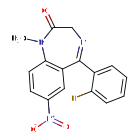
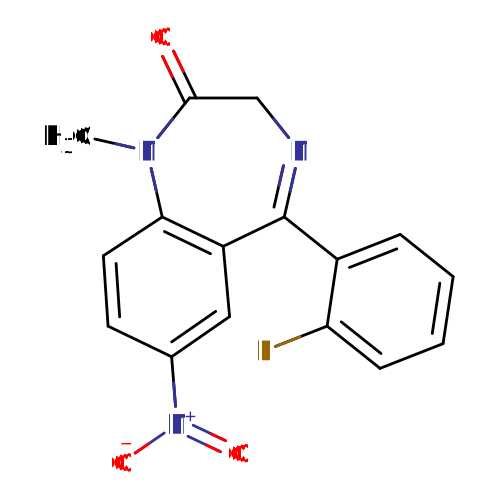
Structure for Flunitrazepam (DB01544)
- Weight
- Average: 313.2832
Monoisotopic: 313.08626947 - Chemical Formula
- C16H12FN3O3
- Synonyms
- Flunitrazepam
- Flunitrazepamum
- External IDs
- RO 5-4200
- RO-5-4200
- RO-54200

Pharmacology
- Indication
For short-term treatment of severe insomnias, that are not responsive to other hypnotics.
 Reduce drug development failure ratesBuild, train, & validate machine-learning modelswith evidence-based and structured datasets.Build, train, & validate predictive machine-learning models with structured datasets.
- Associated Conditions
- Contraindications & Blackbox Warnings
 Prevent Adverse Drug Events TodayTap into our Clinical API for life-saving information on contraindications & blackbox warnings, population restrictions, harmful risks, & more.Avoid life-threatening adverse drug events with our Clinical API
- Pharmacodynamics
Flunitrazepam is a powerful hypnotic drug that is a benzodiazepine derivative. It has powerful hypnotic, sedative, anxiolytic, and skeletal muscle relaxant properties. The drug is sometimes used as a date rape drug. In the United States, the drug has not been approved by the Food and Drug Administration for medical use, and is considered to be an illegal drug. It has however been approved in the United Kingdom and other countries.
- Mechanism of action
Benzodiazepines bind nonspecifically to benzodiazepine receptors BNZ1, which mediates sleep, and BNZ2, which affects affects muscle relaxation, anticonvulsant activity, motor coordination, and memory. As benzodiazepine receptors are thought to be coupled to gamma-aminobutyric acid-A (GABAA) receptors, this enhances the effects of GABA by increasing GABA affinity for the GABA receptor. Binding of the inhibitory neurotransmitter GABA to the site opens the chloride channel, resulting in a hyperpolarized cell membrane that prevents further excitation of the cell.
Target Actions Organism AGABA(A) Receptor positive allosteric modulatorHumans AGABA(A) Receptor Benzodiazepine Binding Site ligandHumans - Absorption
50% (suppository) and 64-77% (oral)
- Volume of distribution
Not Available
- Protein binding
Not Available
- Metabolism
Hepatic.
- Route of elimination
Not Available
- Half-life
18-26 hours
- Clearance
Not Available
- Adverse Effects
 Improve decision support & research outcomesWith structured adverse effects data, including: blackbox warnings, adverse reactions, warning & precautions, & incidence rates. View sample adverse effects data in our new Data Library!Improve decision support & research outcomes with our structured adverse effects data.
- Toxicity
Symptoms of overdose include confusion, coma, impaired coordination, sleepiness, and slowed reaction time.
- Pathways
- Not Available
- Pharmacogenomic Effects/ADRs
- Not Available
Interactions
- Drug Interactions
- This information should not be interpreted without the help of a healthcare provider. If you believe you are experiencing an interaction, contact a healthcare provider immediately. The absence of an interaction does not necessarily mean no interactions exist.
Drug Interaction Integrate drug-drug
interactions in your software1,2-Benzodiazepine The risk or severity of CNS depression can be increased when Flunitrazepam is combined with 1,2-Benzodiazepine. Abacavir The metabolism of Abacavir can be decreased when combined with Flunitrazepam. Abametapir The serum concentration of Flunitrazepam can be increased when it is combined with Abametapir. Abatacept The metabolism of Flunitrazepam can be increased when combined with Abatacept. Abrocitinib The metabolism of Abrocitinib can be decreased when combined with Flunitrazepam. - Food Interactions
- Avoid alcohol.
- Avoid grapefruit products.
- Limit caffeine intake.
- Take with food.
Products
 Drug product information from 10+ global regionsOur datasets provide approved product information including:dosage, form, labeller, route of administration, and marketing period.Access drug product information from over 10 global regions.
- International/Other Brands
- Hipnosedon (Roche) / Hypnodorm (Alphapharm) / Narcozep (Roche) / Rohypnol (Roche) / Roipnol (Roche)
Categories
- ATC Codes
- N05CD03 — Flunitrazepam
- Drug Categories
- Anti-Anxiety Agents
- Benzazepines
- Benzodiazepine hypnotics and sedatives
- Benzodiazepines and benzodiazepine derivatives
- Benzodiazepinones
- Central Nervous System Agents
- Central Nervous System Depressants
- Cytochrome P-450 CYP2A6 Substrates
- Cytochrome P-450 CYP2B6 Substrates
- Cytochrome P-450 CYP2C19 Substrates
- Cytochrome P-450 CYP2C9 Substrates
- Cytochrome P-450 CYP2E1 Inhibitors
- Cytochrome P-450 CYP2E1 Inhibitors (strength unknown)
- Cytochrome P-450 CYP3A Substrates
- Cytochrome P-450 CYP3A4 Substrates
- Cytochrome P-450 Enzyme Inhibitors
- Cytochrome P-450 Substrates
- GABA Agents
- GABA Modulators
- Heterocyclic Compounds, Fused-Ring
- Hypnotics and Sedatives
- Muscle Relaxants
- Muscle Relaxants, Centrally Acting Agents
- Nervous System
- Neurotransmitter Agents
- Psycholeptics
- Psychotropic Drugs
- Tranquilizing Agents
- UGT1A1 Inhibitors
- UGT1A3 Inhibitors
- UGT2B7 Inhibitors
- Chemical TaxonomyProvided by Classyfire
- Description
- This compound belongs to the class of organic compounds known as 1,4-benzodiazepines. These are organic compounds containing a benzene ring fused to a 1,4-azepine.
- Kingdom
- Organic compounds
- Super Class
- Organoheterocyclic compounds
- Class
- Benzodiazepines
- Sub Class
- 1,4-benzodiazepines
- Direct Parent
- 1,4-benzodiazepines
- Alternative Parents
- Alpha amino acids and derivatives / Nitroaromatic compounds / Fluorobenzenes / Aryl fluorides / Tertiary carboxylic acid amides / Lactams / Ketimines / Propargyl-type 1,3-dipolar organic compounds / Organic oxoazanium compounds / Azacyclic compounds show 5 more
- Substituents
- 1,4-benzodiazepine / Allyl-type 1,3-dipolar organic compound / Alpha-amino acid or derivatives / Aromatic heteropolycyclic compound / Aryl fluoride / Aryl halide / Azacycle / Benzenoid / C-nitro compound / Carbonyl group show 23 more
- Molecular Framework
- Aromatic heteropolycyclic compounds
- External Descriptors
- Not Available
- Affected organisms
- Humans and other mammals
Chemical Identifiers
- UNII
- 620X0222FQ
- CAS number
- 1622-62-4
- InChI Key
- PPTYJKAXVCCBDU-UHFFFAOYSA-N
- InChI
- InChI=1S/C16H12FN3O3/c1-19-14-7-6-10(20(22)23)8-12(14)16(18-9-15(19)21)11-4-2-3-5-13(11)17/h2-8H,9H2,1H3
- IUPAC Name
- 5-(2-fluorophenyl)-1-methyl-7-nitro-2,3-dihydro-1H-1,4-benzodiazepin-2-one
- SMILES
- CN1C2=C(C=C(C=C2)[N+]([O-])=O)C(=NCC1=O)C1=CC=CC=C1F
References
- Synthesis Reference
Kariss, J. and Newmark, H.L.; U.S. Patent 3,116,203; December 31, 1963; assigned to Hoffmann-la Roche Inc. Kariss, J. and Newmark, H.L.; US. Patent 3,123,529; March 3,1964; assigned to Hoffmann-La Roche Inc. Keiler, O., Steiger, N. and Sternbach, L.H.; U.S. Patent 3,203,990; August 31, 1965; assigned to Hoffmann-La Roche Inc.
- General References
- Rickels K: The clinical use of hypnotics: indications for use and the need for a variety of hypnotics. Acta Psychiatr Scand Suppl. 1986;332:132-41. [Article]
- Robertson MD, Drummer OH: Postmortem drug metabolism by bacteria. J Forensic Sci. 1995 May;40(3):382-6. [Article]
- Oelschlager H: [Chemical and pharmacologic aspects of benzodiazepines]. Schweiz Rundsch Med Prax. 1989 Jul 4;78(27-28):766-72. [Article]
- Usami N, Yamamoto T, Shintani S, Ishikura S, Higaki Y, Katagiri Y, Hara A: Substrate specificity of human 3(20)alpha-hydroxysteroid dehydrogenase for neurosteroids and its inhibition by benzodiazepines. Biol Pharm Bull. 2002 Apr;25(4):441-5. [Article]
- Tokunaga S, Takeda Y, Shinomiya K, Hirase M, Kamei C: Effects of some H1-antagonists on the sleep-wake cycle in sleep-disturbed rats. J Pharmacol Sci. 2007 Feb;103(2):201-6. Epub 2007 Feb 8. [Article]
- External Links
- Human Metabolome Database
- HMDB0015510
- KEGG Drug
- D01230
- PubChem Compound
- 3380
- PubChem Substance
- 46504553
- ChemSpider
- 3263
- BindingDB
- 25878
- 4460
- ChEBI
- 31622
- ChEMBL
- CHEMBL13280
- ZINC
- ZINC000003812994
- Therapeutic Targets Database
- DAP000931
- PharmGKB
- PA164781320
- Wikipedia
- Flunitrazepam
Clinical Trials
Pharmacoeconomics
- Manufacturers
- Not Available
- Packagers
- Not Available
- Dosage Forms
Form Route Strength Capsule Solution / drops Tablet, film coated Oral 1 mg Tablet, film coated Oral Tablet Tablet 1 MG - Prices
- Not Available
- Patents
- Not Available
Properties
- State
- Solid
- Experimental Properties
Property Value Source melting point (°C) 166-167 °C Kariss, J. and Newmark, H.L.; U.S. Patent 3,116,203; December 31, 1963; assigned to Hoffmann-la Roche Inc. Kariss, J. and Newmark, H.L.; US. Patent 3,123,529; March 3,1964; assigned to Hoffmann-La Roche Inc. Keiler, O., Steiger, N. and Sternbach, L.H.; U.S. Patent 3,203,990; August 31, 1965; assigned to Hoffmann-La Roche Inc. logP 2.06 HANSCH,C ET AL. (1995) - Predicted Properties
Property Value Source Water Solubility 0.00858 mg/mL ALOGPS logP 2.2 ALOGPS logP 2.55 Chemaxon logS -4.6 ALOGPS pKa (Strongest Basic) 1.72 Chemaxon Physiological Charge 0 Chemaxon Hydrogen Acceptor Count 4 Chemaxon Hydrogen Donor Count 0 Chemaxon Polar Surface Area 75.81 Å2 Chemaxon Rotatable Bond Count 2 Chemaxon Refractivity 81.54 m3·mol-1 Chemaxon Polarizability 29.67 Å3 Chemaxon Number of Rings 3 Chemaxon Bioavailability 1 Chemaxon Rule of Five Yes Chemaxon Ghose Filter Yes Chemaxon Veber's Rule No Chemaxon MDDR-like Rule No Chemaxon - Predicted ADMET Features
Property Value Probability Human Intestinal Absorption + 0.9922 Blood Brain Barrier + 0.973 Caco-2 permeable + 0.5257 P-glycoprotein substrate Substrate 0.6717 P-glycoprotein inhibitor I Non-inhibitor 0.6428 P-glycoprotein inhibitor II Non-inhibitor 0.9094 Renal organic cation transporter Non-inhibitor 0.713 CYP450 2C9 substrate Non-substrate 0.7621 CYP450 2D6 substrate Non-substrate 0.8932 CYP450 3A4 substrate Substrate 0.725 CYP450 1A2 substrate Non-inhibitor 0.5691 CYP450 2C9 inhibitor Non-inhibitor 0.5163 CYP450 2D6 inhibitor Non-inhibitor 0.8776 CYP450 2C19 inhibitor Inhibitor 0.5957 CYP450 3A4 inhibitor Inhibitor 0.5626 CYP450 inhibitory promiscuity High CYP Inhibitory Promiscuity 0.5555 Ames test AMES toxic 0.9108 Carcinogenicity Non-carcinogens 0.7209 Biodegradation Not ready biodegradable 1.0 Rat acute toxicity 2.8125 LD50, mol/kg Not applicable hERG inhibition (predictor I) Weak inhibitor 0.9869 hERG inhibition (predictor II) Non-inhibitor 0.8074
Spectra
- Mass Spec (NIST)
- Not Available
- Spectra
- Chromatographic Properties
Collision Cross Sections (CCS)
Adduct CCS Value (Å2) Source type Source [M-H]- 181.1967766 predictedDarkChem Lite v0.1.0 [M-H]- 164.86116 predictedDeepCCS 1.0 (2019) [M+H]+ 181.6544766 predictedDarkChem Lite v0.1.0 [M+H]+ 167.2192 predictedDeepCCS 1.0 (2019) [M+Na]+ 181.3780766 predictedDarkChem Lite v0.1.0 [M+Na]+ 173.90341 predictedDeepCCS 1.0 (2019)
Targets

- Kind
- Protein group
- Organism
- Humans
- Pharmacological action
- Yes
- Actions
- Positive allosteric modulator
- Curator comments
- The GABA(A) receptor is pentameric (i.e. comprising 5 subunit proteins) and therefore has a multitude of potential isoforms. The above target is a collection of all possible GABA(A) subunits that may participate in the formation of the pentameric receptor and is not meant to imply direct a drug-protein interaction for each individual subunit.
- General Function
- Inhibitory extracellular ligand-gated ion channel activity
- Specific Function
- Component of the heteropentameric receptor for GABA, the major inhibitory neurotransmitter in the vertebrate brain. Functions also as histamine receptor and mediates cellular responses to histamine...
Components:
References
- Sigel E, Steinmann ME: Structure, function, and modulation of GABA(A) receptors. J Biol Chem. 2012 Nov 23;287(48):40224-31. doi: 10.1074/jbc.R112.386664. Epub 2012 Oct 4. [Article]
- Zhu S, Noviello CM, Teng J, Walsh RM Jr, Kim JJ, Hibbs RE: Structure of a human synaptic GABAA receptor. Nature. 2018 Jul;559(7712):67-72. doi: 10.1038/s41586-018-0255-3. Epub 2018 Jun 27. [Article]
- Kind
- Protein group
- Organism
- Humans
- Pharmacological action
- Yes
- Actions
- Ligand
- Curator comments
- Benzodiazepines modulate GABA(A) function by binding at the interface between alpha (α) and gamma (γ) subunits. Of the 6 α-subunits, only 4 (α-1, -2, -3, and -5) participate in the formation of this binding site. The above target is a collection of all α- and γ-subunits that are known to participate in the formation of the benzodiazepine binding site.
- General Function
- Inhibitory extracellular ligand-gated ion channel activity
- Specific Function
- Component of the heteropentameric receptor for GABA, the major inhibitory neurotransmitter in the vertebrate brain. Functions also as histamine receptor and mediates cellular responses to histamine...
Components:
References
- Sigel E, Steinmann ME: Structure, function, and modulation of GABA(A) receptors. J Biol Chem. 2012 Nov 23;287(48):40224-31. doi: 10.1074/jbc.R112.386664. Epub 2012 Oct 4. [Article]
- Zhu S, Noviello CM, Teng J, Walsh RM Jr, Kim JJ, Hibbs RE: Structure of a human synaptic GABAA receptor. Nature. 2018 Jul;559(7712):67-72. doi: 10.1038/s41586-018-0255-3. Epub 2018 Jun 27. [Article]
Enzymes
- Kind
- Protein
- Organism
- Humans
- Pharmacological action
- Unknown
- Actions
- Substrate
- General Function
- Steroid hydroxylase activity
- Specific Function
- Exhibits a high coumarin 7-hydroxylase activity. Can act in the hydroxylation of the anti-cancer drugs cyclophosphamide and ifosphamide. Competent in the metabolic activation of aflatoxin B1. Const...
- Gene Name
- CYP2A6
- Uniprot ID
- P11509
- Uniprot Name
- Cytochrome P450 2A6
- Molecular Weight
- 56501.005 Da
References
- Rendic S: Summary of information on human CYP enzymes: human P450 metabolism data. Drug Metab Rev. 2002 Feb-May;34(1-2):83-448. [Article]
- Kind
- Protein
- Organism
- Humans
- Pharmacological action
- Unknown
- Actions
- Inhibitor
- General Function
- Glucuronosyltransferase activity
- Specific Function
- UDPGT is of major importance in the conjugation and subsequent elimination of potentially toxic xenobiotics and endogenous compounds.Its unique specificity for 3,4-catechol estrogens and estriol su...
- Gene Name
- UGT2B7
- Uniprot ID
- P16662
- Uniprot Name
- UDP-glucuronosyltransferase 2B7
- Molecular Weight
- 60694.12 Da
References
- Thomassin J, Tephly TR: Photoaffinity labeling of rat liver microsomal morphine UDP-glucuronosyltransferase by [3H]flunitrazepam. Mol Pharmacol. 1990 Sep;38(3):294-8. [Article]
- Cheng Z, Rios GR, King CD, Coffman BL, Green MD, Mojarrabi B, Mackenzie PI, Tephly TR: Glucuronidation of catechol estrogens by expressed human UDP-glucuronosyltransferases (UGTs) 1A1, 1A3, and 2B7. Toxicol Sci. 1998 Sep;45(1):52-7. [Article]
- Kind
- Protein
- Organism
- Humans
- Pharmacological action
- Unknown
- Actions
- Substrate
- General Function
- Steroid hydroxylase activity
- Specific Function
- Cytochromes P450 are a group of heme-thiolate monooxygenases. In liver microsomes, this enzyme is involved in an NADPH-dependent electron transport pathway. It oxidizes a variety of structurally un...
- Gene Name
- CYP2B6
- Uniprot ID
- P20813
- Uniprot Name
- Cytochrome P450 2B6
- Molecular Weight
- 56277.81 Da
References
- Rendic S: Summary of information on human CYP enzymes: human P450 metabolism data. Drug Metab Rev. 2002 Feb-May;34(1-2):83-448. [Article]
- Kind
- Protein
- Organism
- Humans
- Pharmacological action
- Unknown
- Actions
- Substrate
- General Function
- Steroid hydroxylase activity
- Specific Function
- Cytochromes P450 are a group of heme-thiolate monooxygenases. In liver microsomes, this enzyme is involved in an NADPH-dependent electron transport pathway. It oxidizes a variety of structurally un...
- Gene Name
- CYP2C9
- Uniprot ID
- P11712
- Uniprot Name
- Cytochrome P450 2C9
- Molecular Weight
- 55627.365 Da
References
- Rendic S: Summary of information on human CYP enzymes: human P450 metabolism data. Drug Metab Rev. 2002 Feb-May;34(1-2):83-448. [Article]
- Kind
- Protein
- Organism
- Humans
- Pharmacological action
- Unknown
- Actions
- Substrate
- General Function
- Vitamin d3 25-hydroxylase activity
- Specific Function
- Cytochromes P450 are a group of heme-thiolate monooxygenases. In liver microsomes, this enzyme is involved in an NADPH-dependent electron transport pathway. It performs a variety of oxidation react...
- Gene Name
- CYP3A4
- Uniprot ID
- P08684
- Uniprot Name
- Cytochrome P450 3A4
- Molecular Weight
- 57342.67 Da
References
- Hesse LM, Venkatakrishnan K, von Moltke LL, Shader RI, Greenblatt DJ: CYP3A4 is the major CYP isoform mediating the in vitro hydroxylation and demethylation of flunitrazepam. Drug Metab Dispos. 2001 Feb;29(2):133-40. [Article]
- Kind
- Protein
- Organism
- Humans
- Pharmacological action
- Unknown
- Actions
- Inhibitor
- General Function
- Steroid hydroxylase activity
- Specific Function
- Metabolizes several precarcinogens, drugs, and solvents to reactive metabolites. Inactivates a number of drugs and xenobiotics and also bioactivates many xenobiotic substrates to their hepatotoxic ...
- Gene Name
- CYP2E1
- Uniprot ID
- P05181
- Uniprot Name
- Cytochrome P450 2E1
- Molecular Weight
- 56848.42 Da
References
- Tassaneeyakul W, Birkett DJ, Miners JO: Inhibition of human hepatic cytochrome P4502E1 by azole antifungals, CNS-active drugs and non-steroidal anti-inflammatory agents. Xenobiotica. 1998 Mar;28(3):293-301. doi: 10.1080/004982598239579 . [Article]
- Kind
- Protein
- Organism
- Humans
- Pharmacological action
- Unknown
- Actions
- Inhibitor
- General Function
- Steroid binding
- Specific Function
- UDPGT is of major importance in the conjugation and subsequent elimination of potentially toxic xenobiotics and endogenous compounds. This isoform glucuronidates bilirubin IX-alpha to form both the...
- Gene Name
- UGT1A1
- Uniprot ID
- P22309
- Uniprot Name
- UDP-glucuronosyltransferase 1-1
- Molecular Weight
- 59590.91 Da
References
- Cheng Z, Rios GR, King CD, Coffman BL, Green MD, Mojarrabi B, Mackenzie PI, Tephly TR: Glucuronidation of catechol estrogens by expressed human UDP-glucuronosyltransferases (UGTs) 1A1, 1A3, and 2B7. Toxicol Sci. 1998 Sep;45(1):52-7. [Article]
- Kind
- Protein
- Organism
- Humans
- Pharmacological action
- Unknown
- Actions
- Inhibitor
- General Function
- Retinoic acid binding
- Specific Function
- UDPGT is of major importance in the conjugation and subsequent elimination of potentially toxic xenobiotics and endogenous compounds. Isoform 2 lacks transferase activity but acts as a negative reg...
- Gene Name
- UGT1A3
- Uniprot ID
- P35503
- Uniprot Name
- UDP-glucuronosyltransferase 1-3
- Molecular Weight
- 60337.835 Da
References
- Cheng Z, Rios GR, King CD, Coffman BL, Green MD, Mojarrabi B, Mackenzie PI, Tephly TR: Glucuronidation of catechol estrogens by expressed human UDP-glucuronosyltransferases (UGTs) 1A1, 1A3, and 2B7. Toxicol Sci. 1998 Sep;45(1):52-7. [Article]
- Kind
- Protein
- Organism
- Humans
- Pharmacological action
- Unknown
- Actions
- Substrate
- General Function
- Steroid hydroxylase activity
- Specific Function
- Responsible for the metabolism of a number of therapeutic agents such as the anticonvulsant drug S-mephenytoin, omeprazole, proguanil, certain barbiturates, diazepam, propranolol, citalopram and im...
- Gene Name
- CYP2C19
- Uniprot ID
- P33261
- Uniprot Name
- Cytochrome P450 2C19
- Molecular Weight
- 55930.545 Da
References
- Gafni I, Busto UE, Tyndale RF, Kaplan HL, Sellers EM: The role of cytochrome P450 2C19 activity in flunitrazepam metabolism in vivo. J Clin Psychopharmacol. 2003 Apr;23(2):169-75. [Article]

Drug created at July 31, 2007 13:10 / Updated at May 05, 2021 20:30