Identification
- Generic Name
- Meticillin
- DrugBank Accession Number
- DB01603
- Background
One of the penicillins which is resistant to penicillinase but susceptible to a penicillin-binding protein. It is inactivated by gastric acid so administered by injection.
- Type
- Small Molecule
- Groups
- Approved, Investigational
- Structure
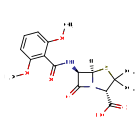
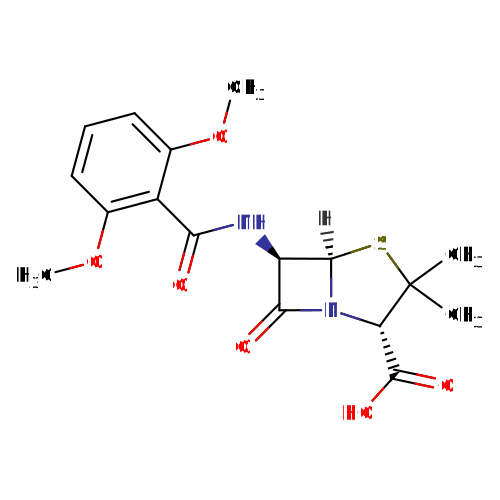
Structure for Meticillin (DB01603)
- Weight
- Average: 380.415
Monoisotopic: 380.104207072 - Chemical Formula
- C17H20N2O6S
- Synonyms
- (2,6-Dimethoxyphenyl)penicillin
- (2S,5R,6R)-6-[(2,6-dimethoxybenzoyl)amino]-3,3-dimethyl-7-oxo-4-thia-1-azabicyclo[3.2.0]heptane-2-carboxylic acid
- 6-(2,6-Dimethoxybenzamido)penicillanic acid
- 6β-(2,6-dimethoxybenzamido)penicillanic acid
- Methicillin
- Methicillinum
- Methycillin
- Meticilina
- Meticillin
- Meticillina
- Meticilline
- Meticillinum

Pharmacology
- Indication
Used to treat infections caused by susceptible Gram-positive bacteria, particularly beta-lactamase-producing organisms such as Staphylococcus aureus that would otherwise be resistant to most penicillins.
 Reduce drug development failure ratesBuild, train, & validate machine-learning modelswith evidence-based and structured datasets.Build, train, & validate predictive machine-learning models with structured datasets.
- Contraindications & Blackbox Warnings
 Prevent Adverse Drug Events TodayTap into our Clinical API for life-saving information on contraindications & blackbox warnings, population restrictions, harmful risks, & more.Avoid life-threatening adverse drug events with our Clinical API
- Pharmacodynamics
Meticillin (INN, BAN) or methicillin (USAN) is a narrow spectrum beta-lactam antibiotic of the penicillin class. It is no longer clinically used. Its role in therapy has been largely replaced by flucloxacillin and dicloxacillin, however the term methicillin-resistant Staphylococcus aureus (MRSA) continues to be used to describe Staphylococcus aureus strains resistant to all penicillins.
- Mechanism of action
Similar to other beta-lactam antimicrobials, meticillin blocks synthesis of the bacterial cell wall. Meticillin stops cross-linkage between the peptidoglycan polymer chains, which make up a large portion of gram-positive bacterial cell walls. It does this by binding to and competitively inhibiting the transpeptidase enzyme used by bacteria to cross-link the peptide (D-alanyl-alanine) used in peptidogylcan synthesis.
Target Actions Organism AMecA PBP2' (penicillin binding protein 2') inhibitorStaphylococcus aureus APenicillin-binding protein 2a inhibitorStreptococcus pneumoniae (strain ATCC BAA-255 / R6) APenicillin-binding protein 1b inhibitorStreptococcus pneumoniae (strain ATCC BAA-255 / R6) APenicillin-binding protein 2B inhibitorStreptococcus pneumoniae (strain ATCC BAA-255 / R6) APenicillin-binding protein 3 inhibitorStreptococcus pneumoniae APenicillin-binding protein 1A inhibitorStreptococcus pneumoniae (strain ATCC BAA-255 / R6) - Absorption
Not absorbed following oral administration.
- Volume of distribution
Not Available
- Protein binding
Not Available
- Metabolism
Hepatic (20-40%).
- Route of elimination
Not Available
- Half-life
25-60 minutes
- Clearance
Not Available
- Adverse Effects
 Improve decision support & research outcomesWith structured adverse effects data, including: blackbox warnings, adverse reactions, warning & precautions, & incidence rates. View sample adverse effects data in our new Data Library!Improve decision support & research outcomes with our structured adverse effects data.
- Toxicity
Not Available
- Pathways
- Not Available
- Pharmacogenomic Effects/ADRs
- Not Available
Interactions
- Drug Interactions
- This information should not be interpreted without the help of a healthcare provider. If you believe you are experiencing an interaction, contact a healthcare provider immediately. The absence of an interaction does not necessarily mean no interactions exist.
Drug Interaction Integrate drug-drug
interactions in your softwareAcemetacin Acemetacin may decrease the excretion rate of Meticillin which could result in a higher serum level. Acenocoumarol Meticillin may increase the anticoagulant activities of Acenocoumarol. Ambroxol The risk or severity of methemoglobinemia can be increased when Meticillin is combined with Ambroxol. Amikacin The serum concentration of Amikacin can be decreased when it is combined with Meticillin. Articaine The risk or severity of methemoglobinemia can be increased when Meticillin is combined with Articaine. - Food Interactions
- Not Available
Products
 Drug product information from 10+ global regionsOur datasets provide approved product information including:dosage, form, labeller, route of administration, and marketing period.Access drug product information from over 10 global regions.
- Product Ingredients
Ingredient UNII CAS InChI Key Methicillin sodium AO9YF4MN30 7246-14-2 NRZPASQBOYNGHR-HWROMZCQSA-M - International/Other Brands
- Dimocillin / Metacillin
Categories
- ATC Codes
- J01CR50 — Combinations of penicillins
- J01CR — Combinations of penicillins, incl. beta-lactamase inhibitors
- J01C — BETA-LACTAM ANTIBACTERIALS, PENICILLINS
- J01 — ANTIBACTERIALS FOR SYSTEMIC USE
- J — ANTIINFECTIVES FOR SYSTEMIC USE
- Drug Categories
- Chemical TaxonomyProvided by Classyfire
- Description
- This compound belongs to the class of organic compounds known as dipeptides. These are organic compounds containing a sequence of exactly two alpha-amino acids joined by a peptide bond.
- Kingdom
- Organic compounds
- Super Class
- Organic acids and derivatives
- Class
- Carboxylic acids and derivatives
- Sub Class
- Amino acids, peptides, and analogues
- Direct Parent
- Dipeptides
- Alternative Parents
- Penicillins / N-acyl-alpha amino acids and derivatives / Dimethoxybenzenes / Benzamides / Anisoles / Benzoyl derivatives / Phenoxy compounds / Alkyl aryl ethers / Tertiary carboxylic acid amides / Thiazolidines show 12 more
- Substituents
- Alkyl aryl ether / Alpha-amino acid or derivatives / Alpha-dipeptide / Anisole / Aromatic heteropolycyclic compound / Azacycle / Azetidine / Benzamide / Benzenoid / Benzoic acid or derivatives show 31 more
- Molecular Framework
- Aromatic heteropolycyclic compounds
- External Descriptors
- penicillin (CHEBI:6827)
- Affected organisms
- Enteric bacteria and other eubacteria
- Gram-positive Bacteria
- Streptococcus pyogenes
- Streptococcus pneumoniae
- Staphylococcus aureus
- Staphylococcus epidermidis
Chemical Identifiers
- UNII
- Q91FH1328A
- CAS number
- 61-32-5
- InChI Key
- RJQXTJLFIWVMTO-TYNCELHUSA-N
- InChI
- InChI=1S/C17H20N2O6S/c1-17(2)12(16(22)23)19-14(21)11(15(19)26-17)18-13(20)10-8(24-3)6-5-7-9(10)25-4/h5-7,11-12,15H,1-4H3,(H,18,20)(H,22,23)/t11-,12+,15-/m1/s1
- IUPAC Name
- (2S,5R,6R)-6-(2,6-dimethoxybenzamido)-3,3-dimethyl-7-oxo-4-thia-1-azabicyclo[3.2.0]heptane-2-carboxylic acid
- SMILES
- [H][C@]12SC(C)(C)[C@@H](N1C(=O)[C@H]2NC(=O)C1=C(OC)C=CC=C1OC)C(O)=O
References
- General References
- Not Available
- External Links
- Human Metabolome Database
- HMDB0015541
- KEGG Compound
- C07177
- PubChem Compound
- 6087
- PubChem Substance
- 46508973
- ChemSpider
- 5862
- BindingDB
- 50103523
- 2181306
- ChEBI
- 6827
- ChEMBL
- CHEMBL575
- ZINC
- ZINC000003831070
- Therapeutic Targets Database
- DAP001170
- PharmGKB
- PA164777034
- PDBe Ligand
- MII
- Wikipedia
- Methicillin
- PDB Entries
- 3kp4
Clinical Trials
- Clinical Trials
Phase Status Purpose Conditions Count 0 Terminated Treatment Osteomyelitis 1
Pharmacoeconomics
- Manufacturers
- Not Available
- Packagers
- Not Available
- Dosage Forms
- Not Available
- Prices
- Not Available
- Patents
- Not Available
Properties
- State
- Solid
- Experimental Properties
Property Value Source logP 1.22 HANSCH,C ET AL. (1995) pKa 2.77 SANGSTER (1994) - Predicted Properties
Property Value Source Water Solubility 0.31 mg/mL ALOGPS logP 1.79 ALOGPS logP 0.79 Chemaxon logS -3.1 ALOGPS pKa (Strongest Acidic) 2.96 Chemaxon pKa (Strongest Basic) -2.1 Chemaxon Physiological Charge -1 Chemaxon Hydrogen Acceptor Count 6 Chemaxon Hydrogen Donor Count 2 Chemaxon Polar Surface Area 105.17 Å2 Chemaxon Rotatable Bond Count 5 Chemaxon Refractivity 93.4 m3·mol-1 Chemaxon Polarizability 37.27 Å3 Chemaxon Number of Rings 3 Chemaxon Bioavailability 1 Chemaxon Rule of Five Yes Chemaxon Ghose Filter Yes Chemaxon Veber's Rule No Chemaxon MDDR-like Rule No Chemaxon - Predicted ADMET Features
Property Value Probability Human Intestinal Absorption - 0.9304 Blood Brain Barrier - 0.9958 Caco-2 permeable - 0.6628 P-glycoprotein substrate Substrate 0.5813 P-glycoprotein inhibitor I Non-inhibitor 0.9099 P-glycoprotein inhibitor II Non-inhibitor 0.9535 Renal organic cation transporter Non-inhibitor 0.9476 CYP450 2C9 substrate Non-substrate 0.7962 CYP450 2D6 substrate Non-substrate 0.8715 CYP450 3A4 substrate Non-substrate 0.5144 CYP450 1A2 substrate Non-inhibitor 0.8626 CYP450 2C9 inhibitor Non-inhibitor 0.8793 CYP450 2D6 inhibitor Non-inhibitor 0.921 CYP450 2C19 inhibitor Non-inhibitor 0.8738 CYP450 3A4 inhibitor Non-inhibitor 0.7747 CYP450 inhibitory promiscuity Low CYP Inhibitory Promiscuity 0.95 Ames test Non AMES toxic 0.8607 Carcinogenicity Non-carcinogens 0.6826 Biodegradation Not ready biodegradable 0.9376 Rat acute toxicity 1.8893 LD50, mol/kg Not applicable hERG inhibition (predictor I) Weak inhibitor 0.9995 hERG inhibition (predictor II) Non-inhibitor 0.8358
Spectra
- Mass Spec (NIST)
- Not Available
- Spectra
Spectrum Spectrum Type Splash Key Predicted GC-MS Spectrum - GC-MS Predicted GC-MS splash10-00xu-9756000000-82b89a7719dfc1d955bc Predicted MS/MS Spectrum - 10V, Positive (Annotated) Predicted LC-MS/MS splash10-08n9-0952000000-27671195db3f75a37a4b Predicted MS/MS Spectrum - 10V, Negative (Annotated) Predicted LC-MS/MS splash10-000i-0092000000-7c8bb16a3518e4b3af36 Predicted MS/MS Spectrum - 20V, Negative (Annotated) Predicted LC-MS/MS splash10-000i-3196000000-c66876a3a3336c08a3e0 Predicted MS/MS Spectrum - 20V, Positive (Annotated) Predicted LC-MS/MS splash10-0006-0910000000-01dad17cf2dd6e79cc8a Predicted MS/MS Spectrum - 40V, Negative (Annotated) Predicted LC-MS/MS splash10-0007-9353000000-41599eab6b706d962437 Predicted MS/MS Spectrum - 40V, Positive (Annotated) Predicted LC-MS/MS splash10-02ti-2910000000-ca11a713844b4acd9f67 Predicted 1H NMR Spectrum 1D NMR Not Applicable Predicted 13C NMR Spectrum 1D NMR Not Applicable - Chromatographic Properties
Collision Cross Sections (CCS)
Adduct CCS Value (Å2) Source type Source [M-H]- 185.2156452 predictedDarkChem Lite v0.1.0 [M-H]- 187.84529 predictedDeepCCS 1.0 (2019) [M+H]+ 184.6931452 predictedDarkChem Lite v0.1.0 [M+H]+ 190.24084 predictedDeepCCS 1.0 (2019) [M+Na]+ 184.7561452 predictedDarkChem Lite v0.1.0 [M+Na]+ 196.31056 predictedDeepCCS 1.0 (2019)
Targets

- Kind
- Protein
- Organism
- Staphylococcus aureus
- Pharmacological action
- Yes
- Actions
- Inhibitor
- General Function
- Penicillin binding
- Specific Function
- Not Available
- Gene Name
- mecA
- Uniprot ID
- Q53707
- Uniprot Name
- MecA PBP2' (penicillin binding protein 2')
- Molecular Weight
- 76265.485 Da
References
- Gardete S, de Lencastre H, Tomasz A: A link in transcription between the native pbpB and the acquired mecA gene in a strain of Staphylococcus aureus. Microbiology. 2006 Sep;152(Pt 9):2549-58. [Article]
- Kind
- Protein
- Organism
- Streptococcus pneumoniae (strain ATCC BAA-255 / R6)
- Pharmacological action
- Yes
- Actions
- Inhibitor
- General Function
- Transferase activity, transferring acyl groups
- Specific Function
- Not Available
- Gene Name
- pbp2a
- Uniprot ID
- Q8DNB6
- Uniprot Name
- Penicillin-binding protein 2a
- Molecular Weight
- 80797.94 Da
References
- Williamson R, Hakenbeck R, Tomasz A: In vivo interaction of beta-lactam antibiotics with the penicillin-binding proteins of Streptococcus pneumoniae. Antimicrob Agents Chemother. 1980 Oct;18(4):629-37. [Article]
- Kind
- Protein
- Organism
- Streptococcus pneumoniae (strain ATCC BAA-255 / R6)
- Pharmacological action
- Yes
- Actions
- Inhibitor
- General Function
- Transferase activity, transferring acyl groups
- Specific Function
- Not Available
- Gene Name
- pbp1b
- Uniprot ID
- Q7CRA4
- Uniprot Name
- Penicillin-binding protein 1b
- Molecular Weight
- 89479.92 Da
References
- Williamson R, Hakenbeck R, Tomasz A: In vivo interaction of beta-lactam antibiotics with the penicillin-binding proteins of Streptococcus pneumoniae. Antimicrob Agents Chemother. 1980 Oct;18(4):629-37. [Article]
- Kind
- Protein
- Organism
- Streptococcus pneumoniae (strain ATCC BAA-255 / R6)
- Pharmacological action
- Yes
- Actions
- Inhibitor
- General Function
- Not Available
- Specific Function
- Penicillin binding
- Gene Name
- penA
- Uniprot ID
- P0A3M6
- Uniprot Name
- Penicillin-binding protein 2B
- Molecular Weight
- 73872.305 Da
References
- Williamson R, Hakenbeck R, Tomasz A: In vivo interaction of beta-lactam antibiotics with the penicillin-binding proteins of Streptococcus pneumoniae. Antimicrob Agents Chemother. 1980 Oct;18(4):629-37. [Article]
- Kind
- Protein
- Organism
- Streptococcus pneumoniae
- Pharmacological action
- Yes
- Actions
- Inhibitor
- General Function
- Serine-type d-ala-d-ala carboxypeptidase activity
- Specific Function
- Not Available
- Gene Name
- pbp3
- Uniprot ID
- Q75Y35
- Uniprot Name
- Penicillin-binding protein 3
- Molecular Weight
- 45209.84 Da
References
- Williamson R, Hakenbeck R, Tomasz A: In vivo interaction of beta-lactam antibiotics with the penicillin-binding proteins of Streptococcus pneumoniae. Antimicrob Agents Chemother. 1980 Oct;18(4):629-37. [Article]
- Kind
- Protein
- Organism
- Streptococcus pneumoniae (strain ATCC BAA-255 / R6)
- Pharmacological action
- Yes
- Actions
- Inhibitor
- General Function
- Penicillin binding
- Specific Function
- Cell wall formation.
- Gene Name
- pbpA
- Uniprot ID
- Q8DR59
- Uniprot Name
- Penicillin-binding protein 1A
- Molecular Weight
- 79700.9 Da
References
- Williamson R, Hakenbeck R, Tomasz A: In vivo interaction of beta-lactam antibiotics with the penicillin-binding proteins of Streptococcus pneumoniae. Antimicrob Agents Chemother. 1980 Oct;18(4):629-37. [Article]

Drug created at August 29, 2007 18:47 / Updated at February 02, 2024 22:55