Identification
- Summary
Amyl Nitrite is a fast acting vasodilator used for rapid relief of angina pectoris.
- Generic Name
- Amyl Nitrite
- DrugBank Accession Number
- DB01612
- Background
Amyl Nitrite is an antihypertensive medicine. Amyl nitrite is employed medically to treat heart diseases such as angina and to treat cyanide poisoning. Its use as a prescription medicine comes from its ability to lower blood pressure. As an inhalant, it also has psychoactive effect which has led to illegal drug use.
- Type
- Small Molecule
- Groups
- Approved
- Structure
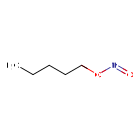
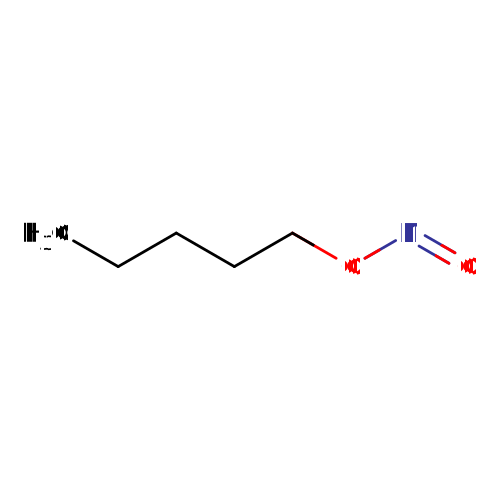
Structure for Amyl Nitrite (DB01612)
- Weight
- Average: 117.1463
Monoisotopic: 117.078978601 - Chemical Formula
- C5H11NO2
- Synonyms
- 1-nitropentane
- n-Amyl nitrite
- n-pentyl nitrite
- Nitramyl
- pentyl nitrite

Pharmacology
- Indication
For the rapid relief of angina pectoris.
 Reduce drug development failure ratesBuild, train, & validate machine-learning modelswith evidence-based and structured datasets.Build, train, & validate predictive machine-learning models with structured datasets.
- Contraindications & Blackbox Warnings
 Prevent Adverse Drug Events TodayTap into our Clinical API for life-saving information on contraindications & blackbox warnings, population restrictions, harmful risks, & more.Avoid life-threatening adverse drug events with our Clinical API
- Pharmacodynamics
Amyl nitrite, in common with other alkyl nitrites, is a potent vasodilator. It expands blood vessels, resulting in lowering of the blood pressure. Alkyl nitrite functions as a source of nitric oxide, which signals for relaxation of the involuntary muscles. Adverse effects are related to this pharmacological activity and include hypotension, headache, flushing of the face, tachycardia, dizziness, and relaxation of involuntary muscles, especially the blood vessel walls and the anal sphincter.
- Mechanism of action
Amyl nitrite's antianginal action is thought to be the result of a reduction in systemic and pulmonary arterial pressure (afterload) and decreased cardiac output because of peripheral vasodilation, rather than coronary artery dilation. Amyl nitrite is a source of nitric oxide, which accounts for the mechanism described above. As an antidote (to cyanide poisoning), amyl nitrite promotes formation of methemoglobin, which combines with cyanide to form nontoxic cyanmethemoglobin.
Target Actions Organism AAtrial natriuretic peptide receptor 1 agonistHumans - Absorption
Amyl nitrite vapors are absorbed rapidly through the pulmonary alveoli, manifesting therapeutic effects within one minute after inhalation.
- Volume of distribution
Not Available
- Protein binding
Not Available
- Metabolism
Hepatic. The drug is metabolized rapidly, probably by hydrolytic denitration; approximately one-third of the inhaled amyl nitrite is excreted in the urine.
- Route of elimination
Not Available
- Half-life
Not Available
- Clearance
Not Available
- Adverse Effects
 Improve decision support & research outcomesWith structured adverse effects data, including: blackbox warnings, adverse reactions, warning & precautions, & incidence rates. View sample adverse effects data in our new Data Library!Improve decision support & research outcomes with our structured adverse effects data.
- Toxicity
Overdose symptoms include nausea, emesis (vomiting), hypotension, hypoventilation, dyspnea (shortness of breath), and syncope (fainting)
- Pathways
- Not Available
- Pharmacogenomic Effects/ADRs
- Not Available
Interactions
- Drug Interactions
- This information should not be interpreted without the help of a healthcare provider. If you believe you are experiencing an interaction, contact a healthcare provider immediately. The absence of an interaction does not necessarily mean no interactions exist.
Drug Interaction Integrate drug-drug
interactions in your softwareAbaloparatide The risk or severity of adverse effects can be increased when Amyl Nitrite is combined with Abaloparatide. Acebutolol The risk or severity of adverse effects can be increased when Acebutolol is combined with Amyl Nitrite. Acetaminophen The risk or severity of methemoglobinemia can be increased when Acetaminophen is combined with Amyl Nitrite. Aldesleukin The risk or severity of adverse effects can be increased when Aldesleukin is combined with Amyl Nitrite. Aliskiren The risk or severity of adverse effects can be increased when Amyl Nitrite is combined with Aliskiren. - Food Interactions
- Avoid alcohol. The use of alcohol with amyl nitrite may worsen hypotension and has the potential to cause cardiovascular collapse.
Products
 Drug product information from 10+ global regionsOur datasets provide approved product information including:dosage, form, labeller, route of administration, and marketing period.Access drug product information from over 10 global regions.
- International/Other Brands
- Aspiral / Vaporole
- Brand Name Prescription Products
Name Dosage Strength Route Labeller Marketing Start Marketing End Region Image Amyl Nitrite Inhalant 0.3 g/0.3mL Respiratory (inhalation) James Alexander Corporation 1979-02-07 Not applicable US 
Amyl Nitrite Vitrellae Bpc Liq 0.33 Ml/cap Liquid 0.33 mL Respiratory (inhalation) Shire Pharma Canada Ulc 1997-04-01 2001-10-01 Canada 
Amylnitrite Glass Cap 5min Liquid .3 mL / amp Respiratory (inhalation) Allen & Hanburys A Glaxo Canada Ltd. Co. 1951-12-31 1999-08-06 Canada - Over the Counter Products
Name Dosage Strength Route Labeller Marketing Start Marketing End Region Image AMYL NITRITE INHALANT USP 0.3 ml/ampoule Solution 0.3 ml/ampoule Respiratory (inhalation) MEDSUPPLY INTERNATIONAL PTE. LTD. 1989-04-22 Not applicable Singapore 
- Unapproved/Other Products
Name Ingredients Dosage Route Labeller Marketing Start Marketing End Region Image Amyl Nitrite Amyl Nitrite (0.3 g/0.3mL) Inhalant Respiratory (inhalation) James Alexander Corporation 1979-02-07 Not applicable US
Categories
- ATC Codes
- V03AB22 — Amyl nitrite
- Drug Categories
- Chemical TaxonomyProvided by Classyfire
- Description
- This compound belongs to the class of organic compounds known as organic o-nitroso compounds. These are organic compounds containing a n-nitroso group -ON=O.
- Kingdom
- Organic compounds
- Super Class
- Organic nitrogen compounds
- Class
- Organonitrogen compounds
- Sub Class
- Organic nitroso compounds
- Direct Parent
- Organic O-nitroso compounds
- Alternative Parents
- Alkyl nitrites / Organooxygen compounds / Organic oxides / Hydrocarbon derivatives
- Substituents
- Aliphatic acyclic compound / Alkyl nitrite / Hydrocarbon derivative / Organic nitrite / Organic o-nitroso compound / Organic oxide / Organic oxygen compound / Organooxygen compound
- Molecular Framework
- Aliphatic acyclic compounds
- External Descriptors
- nitrite esters (CHEBI:55344)
- Affected organisms
- Humans and other mammals
Chemical Identifiers
- UNII
- H2HUX79FYK
- CAS number
- 8017-89-8
- InChI Key
- CSDTZUBPSYWZDX-UHFFFAOYSA-N
- InChI
- InChI=1S/C5H11NO2/c1-2-3-4-5-8-6-7/h2-5H2,1H3
- IUPAC Name
- pentyl nitrite
- SMILES
- CCCCCON=O
References
- General References
- Not Available
- External Links
- Human Metabolome Database
- HMDB0015550
- KEGG Drug
- D00517
- KEGG Compound
- C07457
- PubChem Compound
- 10026
- PubChem Substance
- 46507839
- ChemSpider
- 9632
- 742
- ChEBI
- 55344
- ChEMBL
- CHEMBL3188202
- ZINC
- ZINC000020230701
- PharmGKB
- PA164750570
- RxList
- RxList Drug Page
- Drugs.com
- Drugs.com Drug Page
- Wikipedia
- Amyl_nitrite
Clinical Trials
- Clinical Trials
Phase Status Purpose Conditions Count Not Available Withdrawn Diagnostic Achalasia / Dysphagia 1 Not Available Withdrawn Diagnostic Hypertrophic Cardiomyopathy (HCM) / Obstructive Hypertrophic Cardiomyopathy 1
Pharmacoeconomics
- Manufacturers
- Not Available
- Packagers
- James Alexander Corp.
- Keystone Pharmaceuticals Inc.
- X-Gen Pharmaceuticals
- Dosage Forms
Form Route Strength Inhalant Respiratory (inhalation) 0.3 g/0.3mL Solution Respiratory (inhalation) 0.3 ml/ampoule Liquid Respiratory (inhalation) 0.33 mL Liquid Respiratory (inhalation) .3 mL / amp - Prices
- Not Available
- Patents
- Not Available
Properties
- State
- Liquid
- Experimental Properties
- Not Available
- Predicted Properties
Property Value Source Water Solubility 3.97 mg/mL ALOGPS logP 1.98 ALOGPS logP 2.31 Chemaxon logS -1.5 ALOGPS pKa (Strongest Basic) -1.8 Chemaxon Physiological Charge 0 Chemaxon Hydrogen Acceptor Count 2 Chemaxon Hydrogen Donor Count 0 Chemaxon Polar Surface Area 38.66 Å2 Chemaxon Rotatable Bond Count 5 Chemaxon Refractivity 31.68 m3·mol-1 Chemaxon Polarizability 12.84 Å3 Chemaxon Number of Rings 0 Chemaxon Bioavailability 1 Chemaxon Rule of Five Yes Chemaxon Ghose Filter No Chemaxon Veber's Rule Yes Chemaxon MDDR-like Rule No Chemaxon - Predicted ADMET Features
Property Value Probability Human Intestinal Absorption + 1.0 Blood Brain Barrier + 0.9773 Caco-2 permeable + 0.526 P-glycoprotein substrate Non-substrate 0.6604 P-glycoprotein inhibitor I Non-inhibitor 0.7026 P-glycoprotein inhibitor II Non-inhibitor 0.9824 Renal organic cation transporter Non-inhibitor 0.7921 CYP450 2C9 substrate Non-substrate 0.8507 CYP450 2D6 substrate Non-substrate 0.7958 CYP450 3A4 substrate Non-substrate 0.5675 CYP450 1A2 substrate Non-inhibitor 0.6096 CYP450 2C9 inhibitor Non-inhibitor 0.7695 CYP450 2D6 inhibitor Non-inhibitor 0.8751 CYP450 2C19 inhibitor Non-inhibitor 0.7554 CYP450 3A4 inhibitor Non-inhibitor 0.9522 CYP450 inhibitory promiscuity Low CYP Inhibitory Promiscuity 0.7004 Ames test AMES toxic 0.9107 Carcinogenicity Carcinogens 0.7429 Biodegradation Ready biodegradable 0.962 Rat acute toxicity 2.8290 LD50, mol/kg Not applicable hERG inhibition (predictor I) Weak inhibitor 0.5604 hERG inhibition (predictor II) Non-inhibitor 0.773
Spectra
- Mass Spec (NIST)
- Download (9.66 KB)
- Spectra
Spectrum Spectrum Type Splash Key Predicted GC-MS Spectrum - GC-MS Predicted GC-MS splash10-01tc-9000000000-457ef12e6cef0d524875 Predicted MS/MS Spectrum - 10V, Positive (Annotated) Predicted LC-MS/MS splash10-006x-9000000000-851cd7fd8003386d8a33 Predicted MS/MS Spectrum - 10V, Negative (Annotated) Predicted LC-MS/MS splash10-00kb-9700000000-acdcbf8708c75dd3b46e Predicted MS/MS Spectrum - 20V, Positive (Annotated) Predicted LC-MS/MS splash10-0596-9000000000-8f54769b39dc2e3b3ad7 Predicted MS/MS Spectrum - 20V, Negative (Annotated) Predicted LC-MS/MS splash10-0002-9000000000-dafef70ed52102bffebb Predicted MS/MS Spectrum - 40V, Positive (Annotated) Predicted LC-MS/MS splash10-00kf-9000000000-7fecd3bf76766b7428a5 Predicted MS/MS Spectrum - 40V, Negative (Annotated) Predicted LC-MS/MS splash10-0002-9000000000-7960a05141a45f897475 Predicted 1H NMR Spectrum 1D NMR Not Applicable Predicted 13C NMR Spectrum 1D NMR Not Applicable - Chromatographic Properties
Collision Cross Sections (CCS)
Adduct CCS Value (Å2) Source type Source [M-H]- 124.0902618 predictedDarkChem Lite v0.1.0 [M-H]- 123.9533618 predictedDarkChem Lite v0.1.0 [M-H]- 131.12057 predictedDeepCCS 1.0 (2019) [M+H]+ 124.1577618 predictedDarkChem Lite v0.1.0 [M+H]+ 124.1068618 predictedDarkChem Lite v0.1.0 [M+H]+ 133.01598 predictedDeepCCS 1.0 (2019) [M+Na]+ 124.5008618 predictedDarkChem Lite v0.1.0 [M+Na]+ 124.4879618 predictedDarkChem Lite v0.1.0 [M+Na]+ 141.25108 predictedDeepCCS 1.0 (2019)
Targets

- Kind
- Protein
- Organism
- Humans
- Pharmacological action
- Yes
- Actions
- Agonist
- General Function
- Protein kinase activity
- Specific Function
- Receptor for the atrial natriuretic peptide NPPA/ANP and the brain natriuretic peptide NPPB/BNP which are potent vasoactive hormones playing a key role in cardiovascular homeostasis. Has guanylate ...
- Gene Name
- NPR1
- Uniprot ID
- P16066
- Uniprot Name
- Atrial natriuretic peptide receptor 1
- Molecular Weight
- 118918.11 Da
References
- Madhani M, Scotland RS, MacAllister RJ, Hobbs AJ: Vascular natriuretic peptide receptor-linked particulate guanylate cyclases are modulated by nitric oxide-cyclic GMP signalling. Br J Pharmacol. 2003 Aug;139(7):1289-96. [Article]
- Bauersachs J: Aminoethyl nitrate--the novel super nitrate? Br J Pharmacol. 2009 Sep;158(2):507-9. doi: 10.1111/j.1476-5381.2009.00414.x. [Article]
Enzymes
- Kind
- Protein
- Organism
- Humans
- Pharmacological action
- Unknown
- Actions
- Substrate
- General Function
- Electron carrier activity
- Specific Function
- Not Available
- Gene Name
- ALDH2
- Uniprot ID
- P05091
- Uniprot Name
- Aldehyde dehydrogenase, mitochondrial
- Molecular Weight
- 56380.93 Da
References
- Badejo AM Jr, Hodnette C, Dhaliwal JS, Casey DB, Pankey E, Murthy SN, Nossaman BD, Hyman AL, Kadowitz PJ: Mitochondrial aldehyde dehydrogenase mediates vasodilator responses of glyceryl trinitrate and sodium nitrite in the pulmonary vascular bed of the rat. Am J Physiol Heart Circ Physiol. 2010 Sep;299(3):H819-26. doi: 10.1152/ajpheart.00959.2009. Epub 2010 Jun 11. [Article]


Drug created at August 29, 2007 20:03 / Updated at September 28, 2021 21:54