Identification
- Generic Name
- Patupilone
- DrugBank Accession Number
- DB03010
- Background
Epothilone B is a 16-membered macrolide that mimics the biological effects of taxol.
- Type
- Small Molecule
- Groups
- Experimental, Investigational
- Structure
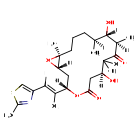
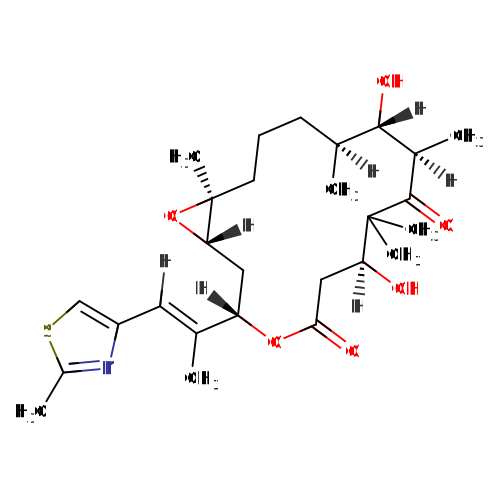
Structure for Patupilone (DB03010)
- Weight
- Average: 507.683
Monoisotopic: 507.265458739 - Chemical Formula
- C27H41NO6S
- Synonyms
- (−)-epothilone B
- Epo B
- Epothilone B
- patupilona
- Patupilone
- External IDs
- EPO 906
- EPO 906A
- EPO-906
- EPO-906A

Pharmacology
- Indication
Investigated for use/treatment in ovarian cancer, lung cancer, brain cancer, breast cancer, and gastric cancer.
 Reduce drug development failure ratesBuild, train, & validate machine-learning modelswith evidence-based and structured datasets.Build, train, & validate predictive machine-learning models with structured datasets.
- Contraindications & Blackbox Warnings
 Prevent Adverse Drug Events TodayTap into our Clinical API for life-saving information on contraindications & blackbox warnings, population restrictions, harmful risks, & more.Avoid life-threatening adverse drug events with our Clinical API
- Pharmacodynamics
Not Available
- Mechanism of action
The principal mechanism of the epothilone class is inhibition of microtubule function. Microtubules are essential to cell division, and epothilones therefore stop cells from properly dividing. Epothilone B possess the same biological effects as taxol both in vitro and in cultured cells. This is because they share the same binding site, as well as binding affinity to the microtubule. Like taxol, epothilone B binds to the αβ-tubulin heterodimer subunit. Once bound, the rate of αβ-tubulin dissociation decreases, thus stabilizing the microtubules. Furthermore, epothilone B has also been shown to induce tubulin polymerization into microtubules without the presence of GTP. This is caused by formation of microtubule bundles throughout the cytoplasm. Finally, epothilone B also causes cell cycle arrest at the G2-M transition phase, thus leading to cytotoxicity and eventually cell apoptosis.
Target Actions Organism UTubulin alpha 3C/D chain Not Available Humans UTubulin beta chain Not Available Humans UTubulin beta-1 chain Not Available Humans UTubulin beta-4B chain Not Available Humans UTubulin beta-4A chain Not Available Humans UTubulin alpha-4A chain Not Available Humans UTubulin beta-3 chain Not Available Humans UTubulin alpha-1C chain Not Available Humans UTubulin alpha-8 chain Not Available Humans UTubulin alpha-1B chain Not Available Humans UTubulin alpha-1A chain Not Available Humans - Absorption
Not Available
- Volume of distribution
Not Available
- Protein binding
Not Available
- Metabolism
- Not Available
- Route of elimination
Not Available
- Half-life
Not Available
- Clearance
Not Available
- Adverse Effects
 Improve decision support & research outcomesWith structured adverse effects data, including: blackbox warnings, adverse reactions, warning & precautions, & incidence rates. View sample adverse effects data in our new Data Library!Improve decision support & research outcomes with our structured adverse effects data.
- Toxicity
Not Available
- Pathways
- Not Available
- Pharmacogenomic Effects/ADRs
- Not Available
Interactions
- Drug Interactions
- This information should not be interpreted without the help of a healthcare provider. If you believe you are experiencing an interaction, contact a healthcare provider immediately. The absence of an interaction does not necessarily mean no interactions exist.
Drug Interaction Integrate drug-drug
interactions in your softwareAbemaciclib The serum concentration of Abemaciclib can be increased when it is combined with Patupilone. Acalabrutinib The serum concentration of Acalabrutinib can be increased when it is combined with Patupilone. Acenocoumarol The serum concentration of Acenocoumarol can be increased when it is combined with Patupilone. Acetyldigitoxin The serum concentration of Acetyldigitoxin can be increased when it is combined with Patupilone. Albendazole The metabolism of Albendazole can be decreased when combined with Patupilone. - Food Interactions
- Not Available
Categories
- Drug Categories
- Chemical TaxonomyProvided by Classyfire
- Description
- This compound belongs to the class of organic compounds known as epothilones and analogues. These are macrolides consisting of a 16-member lactone ring conjugated at the carbon 16 with a 1-(2-methyl-1,3-thiazol-4-yl)prop-1-en-2-yl group. Some epothilone analogues containing a lactam ring instead of the lactone ring.
- Kingdom
- Organic compounds
- Super Class
- Phenylpropanoids and polyketides
- Class
- Macrolides and analogues
- Sub Class
- Epothilones and analogues
- Direct Parent
- Epothilones and analogues
- Alternative Parents
- 2,4-disubstituted thiazoles / Heteroaromatic compounds / Secondary alcohols / Lactones / Cyclic ketones / Carboxylic acid esters / Oxacyclic compounds / Monocarboxylic acids and derivatives / Epoxides / Dialkyl ethers show 5 more
- Substituents
- 2,4-disubstituted 1,3-thiazole / Alcohol / Aromatic heteropolycyclic compound / Azacycle / Azole / Carbonyl group / Carboxylic acid derivative / Carboxylic acid ester / Cyclic ketone / Dialkyl ether show 18 more
- Molecular Framework
- Aromatic heteropolycyclic compounds
- External Descriptors
- 1,3-thiazole, oxabicycloalkane (CHEBI:42432) / Macrolides and lactone polyketides (C12154) / Macrolides and lactone polyketides (LMPK04000041)
- Affected organisms
- Humans and other mammals
Chemical Identifiers
- UNII
- UEC0H0URSE
- CAS number
- 152044-54-7
- InChI Key
- QXRSDHAAWVKZLJ-PVYNADRNSA-N
- InChI
- InChI=1S/C27H41NO6S/c1-15-9-8-10-27(7)22(34-27)12-20(16(2)11-19-14-35-18(4)28-19)33-23(30)13-21(29)26(5,6)25(32)17(3)24(15)31/h11,14-15,17,20-22,24,29,31H,8-10,12-13H2,1-7H3/b16-11+/t15-,17+,20-,21-,22-,24-,27+/m0/s1
- IUPAC Name
- (1S,3S,7S,10R,11S,12S,16R)-7,11-dihydroxy-8,8,10,12,16-pentamethyl-3-[(1E)-1-(2-methyl-1,3-thiazol-4-yl)prop-1-en-2-yl]-4,17-dioxabicyclo[14.1.0]heptadecane-5,9-dione
- SMILES
- [H]\C(=C(\C)[C@]1([H])C[C@]2([H])O[C@]2(C)CCC[C@]([H])(C)[C@]([H])(O)[C@@]([H])(C)C(=O)C(C)(C)[C@@]([H])(O)CC(=O)O1)C1=CSC(C)=N1
References
- Synthesis Reference
Richard Taylor, "Derivatives of epothilone B and D and synthesis thereof." U.S. Patent US20030176473, issued September 18, 2003.
US20030176473- General References
- Not Available
- External Links
- KEGG Compound
- C12154
- PubChem Compound
- 448013
- PubChem Substance
- 46505629
- ChemSpider
- 10213816
- BindingDB
- 50103627
- ChEBI
- 31550
- ChEMBL
- CHEMBL94657
- ZINC
- ZINC000003951737
- Therapeutic Targets Database
- DNC000616
- PDBe Ligand
- EPB
- PDB Entries
- 1q5d / 6s8m / 7dae
Clinical Trials
- Clinical Trials
Pharmacoeconomics
- Manufacturers
- Not Available
- Packagers
- Not Available
- Dosage Forms
- Not Available
- Prices
- Not Available
- Patents
- Not Available
Properties
- State
- Solid
- Experimental Properties
- Not Available
- Predicted Properties
Property Value Source Water Solubility 0.00342 mg/mL ALOGPS logP 3.7 ALOGPS logP 4.12 Chemaxon logS -5.2 ALOGPS pKa (Strongest Acidic) 14.09 Chemaxon pKa (Strongest Basic) 2.73 Chemaxon Physiological Charge 0 Chemaxon Hydrogen Acceptor Count 6 Chemaxon Hydrogen Donor Count 2 Chemaxon Polar Surface Area 109.25 Å2 Chemaxon Rotatable Bond Count 2 Chemaxon Refractivity 134.76 m3·mol-1 Chemaxon Polarizability 56.11 Å3 Chemaxon Number of Rings 3 Chemaxon Bioavailability 1 Chemaxon Rule of Five No Chemaxon Ghose Filter No Chemaxon Veber's Rule No Chemaxon MDDR-like Rule No Chemaxon - Predicted ADMET Features
Property Value Probability Human Intestinal Absorption + 0.8471 Blood Brain Barrier + 0.6791 Caco-2 permeable - 0.5935 P-glycoprotein substrate Substrate 0.7384 P-glycoprotein inhibitor I Non-inhibitor 0.8232 P-glycoprotein inhibitor II Non-inhibitor 0.9779 Renal organic cation transporter Non-inhibitor 0.9193 CYP450 2C9 substrate Non-substrate 0.84 CYP450 2D6 substrate Non-substrate 0.8309 CYP450 3A4 substrate Substrate 0.622 CYP450 1A2 substrate Inhibitor 0.5065 CYP450 2C9 inhibitor Non-inhibitor 0.7468 CYP450 2D6 inhibitor Non-inhibitor 0.9114 CYP450 2C19 inhibitor Non-inhibitor 0.6114 CYP450 3A4 inhibitor Non-inhibitor 0.7163 CYP450 inhibitory promiscuity Low CYP Inhibitory Promiscuity 0.8841 Ames test Non AMES toxic 0.5816 Carcinogenicity Non-carcinogens 0.933 Biodegradation Ready biodegradable 0.5 Rat acute toxicity 2.7983 LD50, mol/kg Not applicable hERG inhibition (predictor I) Weak inhibitor 0.9924 hERG inhibition (predictor II) Non-inhibitor 0.935
Spectra
- Mass Spec (NIST)
- Not Available
- Spectra
- Chromatographic Properties
Collision Cross Sections (CCS)
Adduct CCS Value (Å2) Source type Source [M-H]- 232.3404614 predictedDarkChem Lite v0.1.0 [M-H]- 218.2938614 predictedDarkChem Lite v0.1.0 [M-H]- 217.65941 predictedDeepCCS 1.0 (2019) [M+H]+ 232.1324614 predictedDarkChem Lite v0.1.0 [M+H]+ 218.9551614 predictedDarkChem Lite v0.1.0 [M+H]+ 219.72212 predictedDeepCCS 1.0 (2019) [M+Na]+ 232.5744614 predictedDarkChem Lite v0.1.0 [M+Na]+ 218.4275614 predictedDarkChem Lite v0.1.0 [M+Na]+ 225.9652 predictedDeepCCS 1.0 (2019)
Targets

- Kind
- Protein
- Organism
- Humans
- Pharmacological action
- Unknown
- General Function
- Structural constituent of cytoskeleton
- Specific Function
- Tubulin is the major constituent of microtubules. It binds two moles of GTP, one at an exchangeable site on the beta chain and one at a non-exchangeable site on the alpha chain.
- Gene Name
- TUBA3C
- Uniprot ID
- Q13748
- Uniprot Name
- Tubulin alpha-3C/D chain
- Molecular Weight
- 49959.145 Da
References
- Kind
- Protein
- Organism
- Humans
- Pharmacological action
- Unknown
- General Function
- Ubiquitin protein ligase binding
- Specific Function
- Tubulin is the major constituent of microtubules. It binds two moles of GTP, one at an exchangeable site on the beta chain and one at a non-exchangeable site on the alpha chain.
- Gene Name
- TUBB
- Uniprot ID
- P07437
- Uniprot Name
- Tubulin beta chain
- Molecular Weight
- 49670.515 Da
References
- Kind
- Protein
- Organism
- Humans
- Pharmacological action
- Unknown
- General Function
- Structural constituent of cytoskeleton
- Specific Function
- Tubulin is the major constituent of microtubules. It binds two moles of GTP, one at an exchangeable site on the beta chain and one at a non-exchangeable site on the alpha chain (By similarity).
- Gene Name
- TUBB1
- Uniprot ID
- Q9H4B7
- Uniprot Name
- Tubulin beta-1 chain
- Molecular Weight
- 50326.56 Da
References
- Kind
- Protein
- Organism
- Humans
- Pharmacological action
- Unknown
- General Function
- Unfolded protein binding
- Specific Function
- Tubulin is the major constituent of microtubules. It binds two moles of GTP, one at an exchangeable site on the beta chain and one at a non-exchangeable site on the alpha chain.
- Gene Name
- TUBB4B
- Uniprot ID
- P68371
- Uniprot Name
- Tubulin beta-4B chain
- Molecular Weight
- 49830.72 Da
References
- Kind
- Protein
- Organism
- Humans
- Pharmacological action
- Unknown
- General Function
- Structural constituent of cytoskeleton
- Specific Function
- Tubulin is the major constituent of microtubules. It binds two moles of GTP, one at an exchangeable site on the beta chain and one at a non-exchangeable site on the alpha chain.
- Gene Name
- TUBB4A
- Uniprot ID
- P04350
- Uniprot Name
- Tubulin beta-4A chain
- Molecular Weight
- 49585.475 Da
References
- Kind
- Protein
- Organism
- Humans
- Pharmacological action
- Unknown
- General Function
- Structural constituent of cytoskeleton
- Specific Function
- Tubulin is the major constituent of microtubules. It binds two moles of GTP, one at an exchangeable site on the beta chain and one at a non-exchangeable site on the alpha chain.
- Gene Name
- TUBA4A
- Uniprot ID
- P68366
- Uniprot Name
- Tubulin alpha-4A chain
- Molecular Weight
- 49923.995 Da
References
- Kind
- Protein
- Organism
- Humans
- Pharmacological action
- Unknown
- General Function
- Structural constituent of cytoskeleton
- Specific Function
- Tubulin is the major constituent of microtubules. It binds two moles of GTP, one at an exchangeable site on the beta chain and one at a non-exchangeable site on the alpha chain. TUBB3 plays a criti...
- Gene Name
- TUBB3
- Uniprot ID
- Q13509
- Uniprot Name
- Tubulin beta-3 chain
- Molecular Weight
- 50432.355 Da
References
- Kind
- Protein
- Organism
- Humans
- Pharmacological action
- Unknown
- General Function
- Structural molecule activity
- Specific Function
- Tubulin is the major constituent of microtubules. It binds two moles of GTP, one at an exchangeable site on the beta chain and one at a non-exchangeable site on the alpha chain.
- Gene Name
- TUBA1C
- Uniprot ID
- Q9BQE3
- Uniprot Name
- Tubulin alpha-1C chain
- Molecular Weight
- 49894.93 Da
References
- Kind
- Protein
- Organism
- Humans
- Pharmacological action
- Unknown
- General Function
- Tubulin is the major constituent of microtubules. It binds two moles of GTP, one at an exchangeable site on the beta chain and one at a non-exchangeable site on the alpha chain.
- Specific Function
- Gtp binding
- Gene Name
- TUBA8
- Uniprot ID
- Q9NY65
- Uniprot Name
- Tubulin alpha-8 chain
- Molecular Weight
- 50093.12 Da
References
- Kind
- Protein
- Organism
- Humans
- Pharmacological action
- Unknown
- General Function
- Ubiquitin protein ligase binding
- Specific Function
- Tubulin is the major constituent of microtubules. It binds two moles of GTP, one at an exchangeable site on the beta chain and one at a non-exchangeable site on the alpha chain.
- Gene Name
- TUBA1B
- Uniprot ID
- P68363
- Uniprot Name
- Tubulin alpha-1B chain
- Molecular Weight
- 50151.24 Da
References
- Kind
- Protein
- Organism
- Humans
- Pharmacological action
- Unknown
- General Function
- Tubulin is the major constituent of microtubules. It binds two moles of GTP, one at an exchangeable site on the beta chain and one at a non-exchangeable site on the alpha chain.
- Specific Function
- Gtp binding
- Gene Name
- TUBA1A
- Uniprot ID
- Q71U36
- Uniprot Name
- Tubulin alpha-1A chain
- Molecular Weight
- 50135.25 Da
References
Enzymes
- Kind
- Protein
- Organism
- Humans
- Pharmacological action
- No
- Actions
- Inhibitor
- General Function
- Vitamin d3 25-hydroxylase activity
- Specific Function
- Cytochromes P450 are a group of heme-thiolate monooxygenases. In liver microsomes, this enzyme is involved in an NADPH-dependent electron transport pathway. It performs a variety of oxidation react...
- Gene Name
- CYP3A4
- Uniprot ID
- P08684
- Uniprot Name
- Cytochrome P450 3A4
- Molecular Weight
- 57342.67 Da
References
- Kuper JI, D'Aprile M: Drug-Drug interactions of clinical significance in the treatment of patients with Mycobacterium avium complex disease. Clin Pharmacokinet. 2000 Sep;39(3):203-14. doi: 10.2165/00003088-200039030-00003. [Article]

Drug created at June 13, 2005 13:24 / Updated at January 14, 2023 19:03