Identification
- Generic Name
- Thymidine
- DrugBank Accession Number
- DB04485
- Background
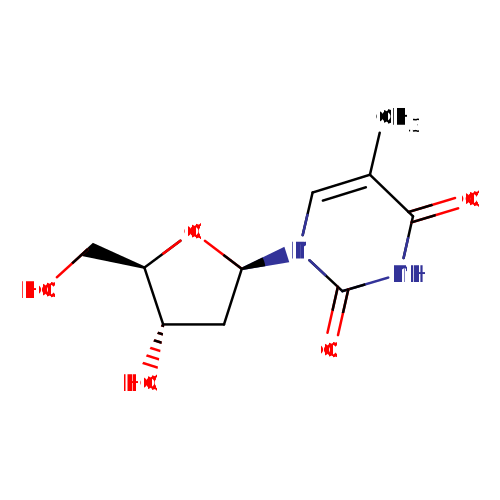
Thymidine is a pyrimidine deoxynucleoside. Thymidine is the DNA nucleoside T, which pairs with deoxyadenosine (A) in double-stranded DNA. In cell biology it is used to synchronize the cells in S phase.
- Type
- Small Molecule
- Groups
- Experimental, Investigational
- Structure
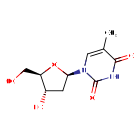
Structure for Thymidine (DB04485)
- Weight
- Average: 242.2286
Monoisotopic: 242.090271568 - Chemical Formula
- C10H14N2O5
- Synonyms
- 2'-deoxy-5-methyluridine
- 2'-deoxythymidine
- 2'-thymidine
- Deoxyribosylthymine
- Deoxythymidine
- dThd
- Thymidine
- Thymine 2'-deoxyriboside
- Thymine deoxyriboside
- External IDs
- NSC-21548

Pharmacology
- Indication
Not Available
 Reduce drug development failure ratesBuild, train, & validate machine-learning modelswith evidence-based and structured datasets.Build, train, & validate predictive machine-learning models with structured datasets.
- Contraindications & Blackbox Warnings
 Prevent Adverse Drug Events TodayTap into our Clinical API for life-saving information on contraindications & blackbox warnings, population restrictions, harmful risks, & more.Avoid life-threatening adverse drug events with our Clinical API
- Pharmacodynamics
Not Available
- Mechanism of action
Target Actions Organism UThymidylate kinase substrateMycobacterium tuberculosis UUridine phosphorylase Not Available Escherichia coli (strain K12) UThymidine kinase substrateEHV-4 UThymidine kinase 2, mitochondrial substrateHumans UNucleoside-specific channel-forming protein tsx Not Available Escherichia coli (strain K12) UGlucose-1-phosphate thymidylyltransferase Not Available Pseudomonas aeruginosa (strain ATCC 15692 / PAO1 / 1C / PRS 101 / LMG 12228) UThymidine kinase, cytosolic substrateHumans - Absorption
Not Available
- Volume of distribution
Not Available
- Protein binding
Not Available
- Metabolism
- Not Available
- Route of elimination
Not Available
- Half-life
Not Available
- Clearance
Not Available
- Adverse Effects
 Improve decision support & research outcomesWith structured adverse effects data, including: blackbox warnings, adverse reactions, warning & precautions, & incidence rates. View sample adverse effects data in our new Data Library!Improve decision support & research outcomes with our structured adverse effects data.
- Toxicity
Not Available
- Pathways
Pathway Category Pyrimidine Metabolism Metabolic MNGIE (Mitochondrial Neurogastrointestinal Encephalopathy) Disease beta-Ureidopropionase Deficiency Disease Dihydropyrimidinase Deficiency Disease UMP Synthase Deficiency (Orotic Aciduria) Disease - Pharmacogenomic Effects/ADRs
- Not Available
Interactions
- Drug Interactions
- This information should not be interpreted without the help of a healthcare provider. If you believe you are experiencing an interaction, contact a healthcare provider immediately. The absence of an interaction does not necessarily mean no interactions exist.Not Available
- Food Interactions
- Not Available
Categories
- Drug Categories
- Chemical TaxonomyProvided by Classyfire
- Description
- This compound belongs to the class of organic compounds known as pyrimidine 2'-deoxyribonucleosides. These are compounds consisting of a pyrimidine linked to a ribose which lacks a hydroxyl group at position 2.
- Kingdom
- Organic compounds
- Super Class
- Nucleosides, nucleotides, and analogues
- Class
- Pyrimidine nucleosides
- Sub Class
- Pyrimidine 2'-deoxyribonucleosides
- Direct Parent
- Pyrimidine 2'-deoxyribonucleosides
- Alternative Parents
- Pyrimidones / Hydroxypyrimidines / Hydropyrimidines / Tetrahydrofurans / Heteroaromatic compounds / Secondary alcohols / Oxacyclic compounds / Azacyclic compounds / Primary alcohols / Organopnictogen compounds show 3 more
- Substituents
- Alcohol / Aromatic heteromonocyclic compound / Azacycle / Heteroaromatic compound / Hydrocarbon derivative / Hydropyrimidine / Hydroxypyrimidine / Organic nitrogen compound / Organic oxide / Organic oxygen compound show 11 more
- Molecular Framework
- Aromatic heteromonocyclic compounds
- External Descriptors
- pyrimidine 2'-deoxyribonucleoside (CHEBI:17748) / Deoxyribonucleosides (C00214)
- Affected organisms
- Not Available
Chemical Identifiers
- UNII
- VC2W18DGKR
- CAS number
- 50-89-5
- InChI Key
- IQFYYKKMVGJFEH-XLPZGREQSA-N
- InChI
- InChI=1S/C10H14N2O5/c1-5-3-12(10(16)11-9(5)15)8-2-6(14)7(4-13)17-8/h3,6-8,13-14H,2,4H2,1H3,(H,11,15,16)/t6-,7+,8+/m0/s1
- IUPAC Name
- 1-[(2R,4S,5R)-4-hydroxy-5-(hydroxymethyl)oxolan-2-yl]-5-methyl-1,2,3,4-tetrahydropyrimidine-2,4-dione
- SMILES
- CC1=CN([C@H]2C[C@H](O)[C@@H](CO)O2)C(=O)NC1=O
References
- Synthesis Reference
Jeffrey D. Wilson, "Preparation of 3'azido-3-'-deoxythymidine." U.S. Patent US4921950, issued October, 1986.
US4921950- General References
- Not Available
- External Links
- Human Metabolome Database
- HMDB0000273
- KEGG Compound
- C00214
- PubChem Compound
- 5789
- PubChem Substance
- 46507598
- ChemSpider
- 5585
- BindingDB
- 1
- 1372538
- ChEBI
- 17748
- ChEMBL
- CHEMBL52609
- ZINC
- ZINC000000025672
- PDBe Ligand
- THM
- Wikipedia
- Thymidine
- PDB Entries
- 1e2j / 1g0r / 1h5r / 1kim / 1ot3 / 1p6x / 1p72 / 1p7c / 1rxu / 1tlw … show 45 more
Clinical Trials
- Clinical Trials
Pharmacoeconomics
- Manufacturers
- Not Available
- Packagers
- Not Available
- Dosage Forms
- Not Available
- Prices
- Not Available
- Patents
- Not Available
Properties
- State
- Solid
- Experimental Properties
Property Value Source melting point (°C) 186.5 °C PhysProp logP -0.93 SANGSTER (1993) - Predicted Properties
Property Value Source Water Solubility 66.8 mg/mL ALOGPS logP -1.3 ALOGPS logP -1.1 Chemaxon logS -0.56 ALOGPS pKa (Strongest Acidic) 9.96 Chemaxon pKa (Strongest Basic) -3 Chemaxon Physiological Charge 0 Chemaxon Hydrogen Acceptor Count 5 Chemaxon Hydrogen Donor Count 3 Chemaxon Polar Surface Area 99.1 Å2 Chemaxon Rotatable Bond Count 2 Chemaxon Refractivity 55.41 m3·mol-1 Chemaxon Polarizability 23.06 Å3 Chemaxon Number of Rings 2 Chemaxon Bioavailability 1 Chemaxon Rule of Five Yes Chemaxon Ghose Filter No Chemaxon Veber's Rule No Chemaxon MDDR-like Rule No Chemaxon - Predicted ADMET Features
Property Value Probability Human Intestinal Absorption + 0.971 Blood Brain Barrier + 0.5902 Caco-2 permeable - 0.8851 P-glycoprotein substrate Non-substrate 0.6468 P-glycoprotein inhibitor I Non-inhibitor 0.8872 P-glycoprotein inhibitor II Non-inhibitor 0.9128 Renal organic cation transporter Non-inhibitor 0.9072 CYP450 2C9 substrate Non-substrate 0.6893 CYP450 2D6 substrate Non-substrate 0.8834 CYP450 3A4 substrate Non-substrate 0.5083 CYP450 1A2 substrate Non-inhibitor 0.9529 CYP450 2C9 inhibitor Non-inhibitor 0.9392 CYP450 2D6 inhibitor Non-inhibitor 0.9491 CYP450 2C19 inhibitor Non-inhibitor 0.9479 CYP450 3A4 inhibitor Non-inhibitor 0.9308 CYP450 inhibitory promiscuity Low CYP Inhibitory Promiscuity 0.9415 Ames test Non AMES toxic 0.9133 Carcinogenicity Non-carcinogens 0.7872 Biodegradation Not ready biodegradable 0.5131 Rat acute toxicity 1.8754 LD50, mol/kg Not applicable hERG inhibition (predictor I) Weak inhibitor 0.9358 hERG inhibition (predictor II) Non-inhibitor 0.8734
Spectra
- Mass Spec (NIST)
- Not Available
- Spectra
- Chromatographic Properties
Collision Cross Sections (CCS)
Adduct CCS Value (Å2) Source type Source [M-H]- 165.3222703 predictedDarkChem Lite v0.1.0 [M-H]- 165.2723703 predictedDarkChem Lite v0.1.0 [M-H]- 159.55038 predictedDeepCCS 1.0 (2019) [M+H]+ 169.4346703 predictedDarkChem Lite v0.1.0 [M+H]+ 167.1993703 predictedDarkChem Lite v0.1.0 [M+H]+ 161.94594 predictedDeepCCS 1.0 (2019) [M+Na]+ 165.1244703 predictedDarkChem Lite v0.1.0 [M+Na]+ 165.7023703 predictedDarkChem Lite v0.1.0 [M+Na]+ 167.85847 predictedDeepCCS 1.0 (2019)
Targets

Build, predict & validate machine-learning models
Use our structured and evidence-based datasets to unlock newinsights and accelerate drug research.
Use our structured and evidence-based datasets to unlock new insights and accelerate drug research.
- Kind
- Protein
- Organism
- Mycobacterium tuberculosis
- Pharmacological action
- Unknown
- Actions
- Substrate
- General Function
- Catalyzes the reversible phosphorylation of deoxythymidine monophosphate (dTMP) to deoxythymidine diphosphate (dTDP), using ATP as its preferred phosphoryl donor. Situated at the junction of both de novo and salvage pathways of deoxythymidine triphosphate (dTTP) synthesis, is essential for DNA synthesis and cellular growth. Has a broad specificity for nucleoside triphosphates, being highly active with ATP or dATP as phosphate donors, and less active with ITP, GTP, CTP and UTP.
- Specific Function
- Atp binding
- Gene Name
- tmk
- Uniprot ID
- P9WKE1
- Uniprot Name
- Thymidylate kinase
- Molecular Weight
- 22634.285 Da
References
- Kind
- Protein
- Organism
- Escherichia coli (strain K12)
- Pharmacological action
- Unknown
- General Function
- Uridine phosphorylase activity
- Specific Function
- Catalyzes the reversible phosphorylytic cleavage of uridine and deoxyuridine to uracil and ribose- or deoxyribose-1-phosphate. The produced molecules are then utilized as carbon and energy sources ...
- Gene Name
- udp
- Uniprot ID
- P12758
- Uniprot Name
- Uridine phosphorylase
- Molecular Weight
- 27158.88 Da
References
- Kind
- Protein
- Organism
- EHV-4
- Pharmacological action
- Unknown
- Actions
- Substrate
- General Function
- Thymidine kinase activity
- Specific Function
- In latent infection, may allow the virus to be reactivated and to grow in cells lacking a high concentration of phosphorylated nucleic acid precursors, such as nerve cells that do not replicate the...
- Gene Name
- TK
- Uniprot ID
- P24425
- Uniprot Name
- Thymidine kinase
- Molecular Weight
- 38784.035 Da
References
- Kind
- Protein
- Organism
- Humans
- Pharmacological action
- Unknown
- Actions
- Substrate
- General Function
- Thymidine kinase activity
- Specific Function
- Deoxyribonucleoside kinase that phosphorylates thymidine, deoxycytidine, and deoxyuridine. Also phosphorylates anti-viral and anti-cancer nucleoside analogs.
- Gene Name
- TK2
- Uniprot ID
- O00142
- Uniprot Name
- Thymidine kinase 2, mitochondrial
- Molecular Weight
- 31004.53 Da
References
- Overington JP, Al-Lazikani B, Hopkins AL: How many drug targets are there? Nat Rev Drug Discov. 2006 Dec;5(12):993-6. [Article]
- Imming P, Sinning C, Meyer A: Drugs, their targets and the nature and number of drug targets. Nat Rev Drug Discov. 2006 Oct;5(10):821-34. [Article]
- Berman HM, Westbrook J, Feng Z, Gilliland G, Bhat TN, Weissig H, Shindyalov IN, Bourne PE: The Protein Data Bank. Nucleic Acids Res. 2000 Jan 1;28(1):235-42. [Article]
- Kind
- Protein
- Organism
- Escherichia coli (strain K12)
- Pharmacological action
- Unknown
- General Function
- Nucleoside-specific channel forming porin activity
- Specific Function
- Constitutes the receptor for colicin K and phage T6, and functions as substrate-specific channel for nucleosides and deoxynucleosides.
- Gene Name
- tsx
- Uniprot ID
- P0A927
- Uniprot Name
- Nucleoside-specific channel-forming protein tsx
- Molecular Weight
- 33588.835 Da
References
- Kind
- Protein
- Organism
- Pseudomonas aeruginosa (strain ATCC 15692 / PAO1 / 1C / PRS 101 / LMG 12228)
- Pharmacological action
- Unknown
- General Function
- Nucleotide binding
- Specific Function
- Catalyzes the formation of dTDP-glucose, from dTTP and glucose 1-phosphate, as well as its pyrophosphorolysis.
- Gene Name
- rmlA
- Uniprot ID
- Q9HU22
- Uniprot Name
- Glucose-1-phosphate thymidylyltransferase
- Molecular Weight
- 32456.65 Da
- Kind
- Protein
- Organism
- Humans
- Pharmacological action
- Unknown
- Actions
- Substrate
- General Function
- Zinc ion binding
- Specific Function
- Not Available
- Gene Name
- TK1
- Uniprot ID
- P04183
- Uniprot Name
- Thymidine kinase, cytosolic
- Molecular Weight
- 25468.455 Da
References
- Munch-Petersen B, Cloos L, Jensen HK, Tyrsted G: Human thymidine kinase 1. Regulation in normal and malignant cells. Adv Enzyme Regul. 1995;35:69-89. doi: 10.1016/0065-2571(94)00014-t. [Article]
Transporters
- Kind
- Protein
- Organism
- Humans
- Pharmacological action
- Unknown
- General Function
- Pyrimidine- and adenine-specific:sodium symporter activity
- Specific Function
- Sodium-dependent, pyrimidine- and purine-selective. Involved in the homeostasis of endogenous nucleosides. Exhibits the transport characteristics of the nucleoside transport system cib or N3 subtyp...
- Gene Name
- SLC28A3
- Uniprot ID
- Q9HAS3
- Uniprot Name
- Solute carrier family 28 member 3
- Molecular Weight
- 76929.61 Da
References
- Badagnani I, Chan W, Castro RA, Brett CM, Huang CC, Stryke D, Kawamoto M, Johns SJ, Ferrin TE, Carlson EJ, Burchard EG, Giacomini KM: Functional analysis of genetic variants in the human concentrative nucleoside transporter 3 (CNT3; SLC28A3). Pharmacogenomics J. 2005;5(3):157-65. [Article]

Drug created at June 13, 2005 13:24 / Updated at April 30, 2023 10:33