Identification
- Generic Name
- Quinestrol
- DrugBank Accession Number
- DB04575
- Background
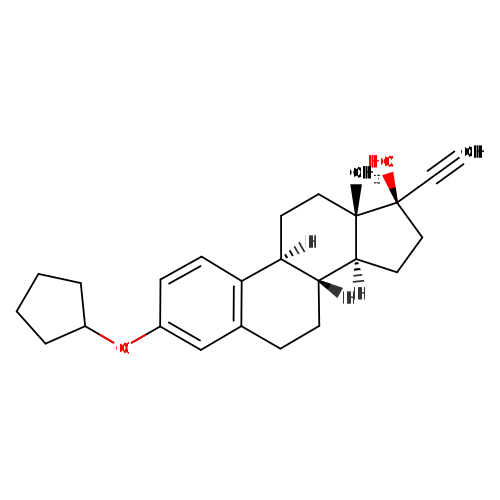
The 3-cyclopentyl ether of ethinyl estradiol.
- Type
- Small Molecule
- Groups
- Approved
- Structure
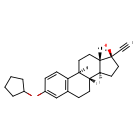
Structure for Quinestrol (DB04575)
- Weight
- Average: 364.5204
Monoisotopic: 364.240230268 - Chemical Formula
- C25H32O2
- Synonyms
- 17-alpha-Ethinylestradiol 3-cyclopentyl ether
- 17alpha-Ethynylestradiol 3-cyclopentyl ether
- Estradiol-17-beta 3-cyclopentyl ether
- Quinestrol
- Quinestrolo
- Quinestrolum
- External IDs
- W 3566
- W-3566

Pharmacology
- Indication
Used in hormone replacement therapy, treating symptoms of menopause such as hot flashes. Also used to treat breast and prostate cancer.
 Reduce drug development failure ratesBuild, train, & validate machine-learning modelswith evidence-based and structured datasets.Build, train, & validate predictive machine-learning models with structured datasets.
- Contraindications & Blackbox Warnings
 Prevent Adverse Drug Events TodayTap into our Clinical API for life-saving information on contraindications & blackbox warnings, population restrictions, harmful risks, & more.Avoid life-threatening adverse drug events with our Clinical API
- Pharmacodynamics
Quinestrol is the 3-cyclopentyl ether of ethinyl estradiol (the active metabolite). After gastrointestinal absorption, it is stored in adipose tissue where it is slowly released and metabolized principally to the parent compound, ethinyl estradiol. Ethinyl estradiol is a synthetic derivative of the natural estrogen estradiol.
- Mechanism of action
Estrogens diffuse into their target cells and interact with a protein receptor (the estrogen receptor). Estrogen interacts with a target cell receptor. When the estrogen receptor has bound its ligand it can enter the nucleus of the target cell, and regulate gene transcription which leads to formation of messenger RNA. The mRNA interacts with ribosomes to produce specific proteins that express the effect of estradiol upon the target cell. Estrogens increase the hepatic synthesis of sex hormone binding globulin (SHBG), thyroid-binding globulin (TBG), and other serum proteins and suppress follicle-stimulating hormone (FSH) from the anterior pituitary. Target cells include the female reproductive tract, the mammary gland, the hypothalamus, and the pituitary. Estrogens increase the hepatic synthesis of sex hormone binding globulin (SHBG), thyroid-binding globulin (TBG), and other serum proteins and suppress follicle-stimulating hormone (FSH) from the anterior pituitary. The combination of an estrogen with a progestin suppresses the hypothalamic-pituitary system, decreasing the secretion of gonadotropin-releasing hormone (GnRH).
Target Actions Organism AEstrogen receptor alpha agonistmodulatorHumans - Absorption
Absorbed following oral administration.
- Volume of distribution
Not Available
- Protein binding
Not Available
- Metabolism
Metabolized principally to the parent compound, ethinyl estradiol. Ethinyl estradiol is metabolized in the liver. Quantitatively, the major metabolic pathway for ethinyl estradiol, both in rats and in humans, is aromatic hydroxylation, as it is for the natural estrogens.
Hover over products below to view reaction partners
- Route of elimination
Not Available
- Half-life
Not Available
- Clearance
Not Available
- Adverse Effects
 Improve decision support & research outcomesWith structured adverse effects data, including: blackbox warnings, adverse reactions, warning & precautions, & incidence rates. View sample adverse effects data in our new Data Library!Improve decision support & research outcomes with our structured adverse effects data.
- Toxicity
Symptoms of overdose include nausea and vomiting, and withdrawal bleeding may occur in females.
- Pathways
- Not Available
- Pharmacogenomic Effects/ADRs
- Not Available
Interactions
- Drug Interactions
- This information should not be interpreted without the help of a healthcare provider. If you believe you are experiencing an interaction, contact a healthcare provider immediately. The absence of an interaction does not necessarily mean no interactions exist.
Drug Interaction Integrate drug-drug
interactions in your softwareAbciximab Quinestrol may decrease the anticoagulant activities of Abciximab. Aceclofenac Aceclofenac may increase the thrombogenic activities of Quinestrol. Acenocoumarol Quinestrol may decrease the anticoagulant activities of Acenocoumarol. Acetohexamide The therapeutic efficacy of Acetohexamide can be decreased when used in combination with Quinestrol. Adalimumab Quinestrol may increase the thrombogenic activities of Adalimumab. - Food Interactions
- Not Available
Products
 Drug product information from 10+ global regionsOur datasets provide approved product information including:dosage, form, labeller, route of administration, and marketing period.Access drug product information from over 10 global regions.
- International/Other Brands
- Estrovis / Estrovis 4000 / Estrovister / Plestrovis
Categories
- Drug Categories
- Chemical TaxonomyProvided by Classyfire
- Description
- This compound belongs to the class of organic compounds known as estrane steroids. These are steroids with a structure based on the estrane skeleton.
- Kingdom
- Organic compounds
- Super Class
- Lipids and lipid-like molecules
- Class
- Steroids and steroid derivatives
- Sub Class
- Estrane steroids
- Direct Parent
- Estrane steroids
- Alternative Parents
- 17-hydroxysteroids / Phenanthrenes and derivatives / Tetralins / Alkyl aryl ethers / Ynones / Tertiary alcohols / Cyclic alcohols and derivatives / Acetylides / Hydrocarbon derivatives
- Substituents
- 17-hydroxysteroid / Acetylide / Alcohol / Alkyl aryl ether / Aromatic homopolycyclic compound / Benzenoid / Cyclic alcohol / Estrane-skeleton / Ether / Hydrocarbon derivative
- Molecular Framework
- Aromatic homopolycyclic compounds
- External Descriptors
- terminal acetylenic compound, 17-hydroxy steroid (CHEBI:8716) / C18 steroids (estrogens) and derivatives (C07619) / C18 steroids (estrogens) and derivatives (LMST02010037)
- Affected organisms
- Humans and other mammals
Chemical Identifiers
- UNII
- JR0N7XD5GZ
- CAS number
- 152-43-2
- InChI Key
- PWZUUYSISTUNDW-VAFBSOEGSA-N
- InChI
- InChI=1S/C25H32O2/c1-3-25(26)15-13-23-22-10-8-17-16-19(27-18-6-4-5-7-18)9-11-20(17)21(22)12-14-24(23,25)2/h1,9,11,16,18,21-23,26H,4-8,10,12-15H2,2H3/t21-,22-,23+,24+,25+/m1/s1
- IUPAC Name
- (1R,3aS,3bR,9bS,11aS)-7-(cyclopentyloxy)-1-ethynyl-11a-methyl-1H,2H,3H,3aH,3bH,4H,5H,9bH,10H,11H,11aH-cyclopenta[a]phenanthren-1-ol
- SMILES
- [H][C@@]12CC[C@@](O)(C#C)[C@@]1(C)CC[C@]1([H])C3=C(CC[C@@]21[H])C=C(OC1CCCC1)C=C3
References
- General References
- Not Available
- External Links
- Human Metabolome Database
- HMDB0015579
- KEGG Drug
- D00576
- KEGG Compound
- C07619
- PubChem Compound
- 9046
- PubChem Substance
- 46508939
- ChemSpider
- 8694
- 9066
- ChEBI
- 8716
- ChEMBL
- CHEMBL1201165
- ZINC
- ZINC000003875993
- Therapeutic Targets Database
- DAP001016
- PharmGKB
- PA164749042
- Wikipedia
- Quinestrol
Clinical Trials
Pharmacoeconomics
- Manufacturers
- Not Available
- Packagers
- Not Available
- Dosage Forms
- Not Available
- Prices
- Not Available
- Patents
- Not Available
Properties
- State
- Solid
- Experimental Properties
Property Value Source melting point (°C) 107.5 °C PhysProp - Predicted Properties
Property Value Source Water Solubility 0.00157 mg/mL ALOGPS logP 5.19 ALOGPS logP 5.4 Chemaxon logS -5.4 ALOGPS pKa (Strongest Acidic) 17.59 Chemaxon pKa (Strongest Basic) -1.7 Chemaxon Physiological Charge 0 Chemaxon Hydrogen Acceptor Count 2 Chemaxon Hydrogen Donor Count 1 Chemaxon Polar Surface Area 29.46 Å2 Chemaxon Rotatable Bond Count 2 Chemaxon Refractivity 108.27 m3·mol-1 Chemaxon Polarizability 44.04 Å3 Chemaxon Number of Rings 5 Chemaxon Bioavailability 1 Chemaxon Rule of Five No Chemaxon Ghose Filter Yes Chemaxon Veber's Rule Yes Chemaxon MDDR-like Rule No Chemaxon - Predicted ADMET Features
Property Value Probability Human Intestinal Absorption + 0.997 Blood Brain Barrier + 0.9483 Caco-2 permeable + 0.8214 P-glycoprotein substrate Substrate 0.6542 P-glycoprotein inhibitor I Non-inhibitor 0.585 P-glycoprotein inhibitor II Non-inhibitor 0.8718 Renal organic cation transporter Non-inhibitor 0.8168 CYP450 2C9 substrate Non-substrate 0.7004 CYP450 2D6 substrate Non-substrate 0.9177 CYP450 3A4 substrate Substrate 0.7205 CYP450 1A2 substrate Inhibitor 0.8321 CYP450 2C9 inhibitor Non-inhibitor 0.8873 CYP450 2D6 inhibitor Non-inhibitor 0.9494 CYP450 2C19 inhibitor Inhibitor 0.7307 CYP450 3A4 inhibitor Non-inhibitor 0.5178 CYP450 inhibitory promiscuity Low CYP Inhibitory Promiscuity 0.73 Ames test Non AMES toxic 0.9105 Carcinogenicity Non-carcinogens 0.8635 Biodegradation Not ready biodegradable 0.9812 Rat acute toxicity 1.9408 LD50, mol/kg Not applicable hERG inhibition (predictor I) Weak inhibitor 0.8631 hERG inhibition (predictor II) Inhibitor 0.5854
Spectra
- Mass Spec (NIST)
- Not Available
- Spectra
- Chromatographic Properties
Collision Cross Sections (CCS)
Adduct CCS Value (Å2) Source type Source [M-H]- 201.1245659 predictedDarkChem Lite v0.1.0 [M-H]- 203.5993659 predictedDarkChem Lite v0.1.0 [M-H]- 199.13835 predictedDeepCCS 1.0 (2019) [M+H]+ 200.8493659 predictedDarkChem Lite v0.1.0 [M+H]+ 203.6336659 predictedDarkChem Lite v0.1.0 [M+H]+ 201.03377 predictedDeepCCS 1.0 (2019) [M+Na]+ 200.7959659 predictedDarkChem Lite v0.1.0 [M+Na]+ 203.6410659 predictedDarkChem Lite v0.1.0 [M+Na]+ 206.81172 predictedDeepCCS 1.0 (2019)
Targets

- Kind
- Protein
- Organism
- Humans
- Pharmacological action
- Yes
- Actions
- AgonistModulator
- General Function
- Zinc ion binding
- Specific Function
- Nuclear hormone receptor. The steroid hormones and their receptors are involved in the regulation of eukaryotic gene expression and affect cellular proliferation and differentiation in target tissu...
- Gene Name
- ESR1
- Uniprot ID
- P03372
- Uniprot Name
- Estrogen receptor
- Molecular Weight
- 66215.45 Da
References
- Overington JP, Al-Lazikani B, Hopkins AL: How many drug targets are there? Nat Rev Drug Discov. 2006 Dec;5(12):993-6. [Article]
- Imming P, Sinning C, Meyer A: Drugs, their targets and the nature and number of drug targets. Nat Rev Drug Discov. 2006 Oct;5(10):821-34. [Article]
- Chen X, Ji ZL, Chen YZ: TTD: Therapeutic Target Database. Nucleic Acids Res. 2002 Jan 1;30(1):412-5. [Article]
- Shyu C, Cavileer TD, Nagler JJ, Ytreberg FM: Computational estimation of rainbow trout estrogen receptor binding affinities for environmental estrogens. Toxicol Appl Pharmacol. 2011 Feb 1;250(3):322-6. doi: 10.1016/j.taap.2010.11.005. Epub 2010 Nov 12. [Article]

Drug created at September 07, 2007 21:29 / Updated at June 12, 2020 16:52