Identification
- Generic Name
- Gentamicin C1a
- DrugBank Accession Number
- DB04729
- Background
Not Available
- Type
- Small Molecule
- Groups
- Experimental
- Structure
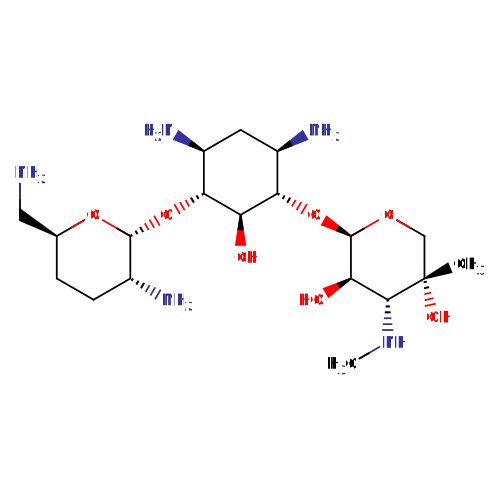
Structure for Gentamicin C1a (DB04729)
- Weight
- Average: 449.5423
Monoisotopic: 449.284948627 - Chemical Formula
- C19H39N5O7
- Synonyms
- Gentamycin C12

Pharmacology
- Indication
Not Available
 Reduce drug development failure ratesBuild, train, & validate machine-learning modelswith evidence-based and structured datasets.Build, train, & validate predictive machine-learning models with structured datasets.
- Contraindications & Blackbox Warnings
 Prevent Adverse Drug Events TodayTap into our Clinical API for life-saving information on contraindications & blackbox warnings, population restrictions, harmful risks, & more.Avoid life-threatening adverse drug events with our Clinical API
- Pharmacodynamics
Not Available
- Mechanism of action
Target Actions Organism A30S ribosomal protein S12 adductEscherichia coli (strain K12) A16S ribosomal RNA adductEnteric bacteria and other eubacteria - Absorption
Not Available
- Volume of distribution
Not Available
- Protein binding
Not Available
- Metabolism
- Not Available
- Route of elimination
Not Available
- Half-life
Not Available
- Clearance
Not Available
- Adverse Effects
 Improve decision support & research outcomesWith structured adverse effects data, including: blackbox warnings, adverse reactions, warning & precautions, & incidence rates. View sample adverse effects data in our new Data Library!Improve decision support & research outcomes with our structured adverse effects data.
- Toxicity
Not Available
- Pathways
- Not Available
- Pharmacogenomic Effects/ADRs
- Not Available
Interactions
- Drug Interactions
- This information should not be interpreted without the help of a healthcare provider. If you believe you are experiencing an interaction, contact a healthcare provider immediately. The absence of an interaction does not necessarily mean no interactions exist.
Drug Interaction Integrate drug-drug
interactions in your softwareAbacavir Abacavir may decrease the excretion rate of Gentamicin C1a which could result in a higher serum level. Aceclofenac Aceclofenac may decrease the excretion rate of Gentamicin C1a which could result in a higher serum level. Acemetacin Acemetacin may decrease the excretion rate of Gentamicin C1a which could result in a higher serum level. Acenocoumarol The risk or severity of bleeding can be increased when Gentamicin C1a is combined with Acenocoumarol. Acetaminophen Acetaminophen may decrease the excretion rate of Gentamicin C1a which could result in a higher serum level. - Food Interactions
- Not Available
Products
 Drug product information from 10+ global regionsOur datasets provide approved product information including:dosage, form, labeller, route of administration, and marketing period.Access drug product information from over 10 global regions.
- Product Ingredients
Ingredient UNII CAS InChI Key Gentamicin c1a sulfate S7K05PO157 37713-04-5 HNCAOLPMSASREN-UCMBPTNBSA-N
Categories
- Drug Categories
- Chemical TaxonomyProvided by Classyfire
- Description
- This compound belongs to the class of organic compounds known as aminocyclitol glycosides. These are organic compounds containing an amicocyclitol moiety glycosidically linked to a carbohydrate moiety. There are two major classes of aminoglycosides containing a 2-streptamine core. They are called 4,5- and 4,6-disubstituted 2-deoxystreptamines.
- Kingdom
- Organic compounds
- Super Class
- Organic oxygen compounds
- Class
- Organooxygen compounds
- Sub Class
- Carbohydrates and carbohydrate conjugates
- Direct Parent
- Aminocyclitol glycosides
- Alternative Parents
- 2-deoxystreptamine aminoglycosides / O-glycosyl compounds / Aminocyclitols and derivatives / Cyclohexylamines / Cyclohexanols / Oxanes / Monosaccharides / Tertiary alcohols / 1,2-aminoalcohols / Oxacyclic compounds show 5 more
- Substituents
- 1,2-aminoalcohol / 2-deoxystreptamine aminoglycoside / Acetal / Alcohol / Aliphatic heteromonocyclic compound / Amine / Amino cyclitol glycoside / Aminocyclitol or derivatives / Cyclic alcohol / Cyclitol or derivatives show 18 more
- Molecular Framework
- Aliphatic heteromonocyclic compounds
- External Descriptors
- gentamycin C (CHEBI:27784)
- Affected organisms
- Not Available
Chemical Identifiers
- UNII
- AV4A72IATD
- CAS number
- 26098-04-4
- InChI Key
- VEGXETMJINRLTH-BOZYPMBZSA-N
- InChI
- InChI=1S/C19H39N5O7/c1-19(27)7-28-18(13(26)16(19)24-2)31-15-11(23)5-10(22)14(12(15)25)30-17-9(21)4-3-8(6-20)29-17/h8-18,24-27H,3-7,20-23H2,1-2H3/t8-,9+,10-,11+,12-,13+,14+,15-,16+,17+,18+,19-/m0/s1
- IUPAC Name
- (2R,3R,4R,5R)-2-{[(1S,2S,3R,4S,6R)-4,6-diamino-3-{[(2R,3R,6S)-3-amino-6-(aminomethyl)oxan-2-yl]oxy}-2-hydroxycyclohexyl]oxy}-5-methyl-4-(methylamino)oxane-3,5-diol
- SMILES
- CN[C@@H]1[C@@H](O)[C@@H](O[C@H]2[C@H](N)C[C@H](N)[C@@H](O[C@H]3O[C@H](CN)CC[C@H]3N)[C@@H]2O)OC[C@]1(C)O
References
- General References
- Not Available
- External Links
- KEGG Compound
- C00908
- PubChem Compound
- 72396
- PubChem Substance
- 46505724
- ChemSpider
- 65329
- ChEBI
- 27784
- ChEMBL
- CHEMBL194126
- ZINC
- ZINC000008216590
- PDBe Ligand
- LLL
- PDB Entries
- 2et3 / 3ham / 4lf4 / 4lf9 / 4v53 / 4v55 / 5obm / 6mn1 / 6mn5 / 6np3 … show 4 more
Clinical Trials
Pharmacoeconomics
- Manufacturers
- Not Available
- Packagers
- Not Available
- Dosage Forms
- Not Available
- Prices
- Not Available
- Patents
- Not Available
Properties
- State
- Solid
- Experimental Properties
- Not Available
- Predicted Properties
Property Value Source Water Solubility 20.5 mg/mL ALOGPS logP -2.2 ALOGPS logP -4 Chemaxon logS -1.3 ALOGPS pKa (Strongest Acidic) 12.55 Chemaxon pKa (Strongest Basic) 9.9 Chemaxon Physiological Charge 5 Chemaxon Hydrogen Acceptor Count 12 Chemaxon Hydrogen Donor Count 8 Chemaxon Polar Surface Area 213.72 Å2 Chemaxon Rotatable Bond Count 6 Chemaxon Refractivity 108.83 m3·mol-1 Chemaxon Polarizability 47.35 Å3 Chemaxon Number of Rings 3 Chemaxon Bioavailability 0 Chemaxon Rule of Five No Chemaxon Ghose Filter No Chemaxon Veber's Rule No Chemaxon MDDR-like Rule Yes Chemaxon - Predicted ADMET Features
Property Value Probability Human Intestinal Absorption - 0.9691 Blood Brain Barrier - 0.9812 Caco-2 permeable - 0.7232 P-glycoprotein substrate Substrate 0.7767 P-glycoprotein inhibitor I Non-inhibitor 0.659 P-glycoprotein inhibitor II Non-inhibitor 0.873 Renal organic cation transporter Non-inhibitor 0.8371 CYP450 2C9 substrate Non-substrate 0.8321 CYP450 2D6 substrate Non-substrate 0.7952 CYP450 3A4 substrate Substrate 0.5286 CYP450 1A2 substrate Non-inhibitor 0.9169 CYP450 2C9 inhibitor Non-inhibitor 0.9187 CYP450 2D6 inhibitor Non-inhibitor 0.9049 CYP450 2C19 inhibitor Non-inhibitor 0.8876 CYP450 3A4 inhibitor Non-inhibitor 0.9756 CYP450 inhibitory promiscuity Low CYP Inhibitory Promiscuity 0.9421 Ames test Non AMES toxic 0.7877 Carcinogenicity Non-carcinogens 0.96 Biodegradation Not ready biodegradable 0.9876 Rat acute toxicity 1.8005 LD50, mol/kg Not applicable hERG inhibition (predictor I) Weak inhibitor 0.978 hERG inhibition (predictor II) Non-inhibitor 0.6741
Spectra
- Mass Spec (NIST)
- Not Available
- Spectra
Spectrum Spectrum Type Splash Key Predicted MS/MS Spectrum - 10V, Positive (Annotated) Predicted LC-MS/MS splash10-0fb9-0900800000-40985c2e4d208dce5a36 Predicted MS/MS Spectrum - 10V, Negative (Annotated) Predicted LC-MS/MS splash10-052b-0701900000-95db4e769ad88641da5b Predicted MS/MS Spectrum - 20V, Positive (Annotated) Predicted LC-MS/MS splash10-0ir0-0940200000-f6978628f983966966e0 Predicted MS/MS Spectrum - 20V, Negative (Annotated) Predicted LC-MS/MS splash10-0002-0910300000-ef4d82f100a841f0417b Predicted MS/MS Spectrum - 40V, Positive (Annotated) Predicted LC-MS/MS splash10-0f8a-5943300000-4b811ac318c5f61b5b80 Predicted MS/MS Spectrum - 40V, Negative (Annotated) Predicted LC-MS/MS splash10-052n-1941400000-cafab7fb62f607360e50 Predicted 1H NMR Spectrum 1D NMR Not Applicable Predicted 13C NMR Spectrum 1D NMR Not Applicable - Chromatographic Properties
Collision Cross Sections (CCS)
Adduct CCS Value (Å2) Source type Source [M-H]- 219.0926704 predictedDarkChem Lite v0.1.0 [M-H]- 208.67491 predictedDeepCCS 1.0 (2019) [M+H]+ 219.8709704 predictedDarkChem Lite v0.1.0 [M+H]+ 210.5756 predictedDeepCCS 1.0 (2019) [M+Na]+ 219.2781704 predictedDarkChem Lite v0.1.0 [M+Na]+ 216.45572 predictedDeepCCS 1.0 (2019)
Targets

Build, predict & validate machine-learning models
Use our structured and evidence-based datasets to unlock newinsights and accelerate drug research.
Use our structured and evidence-based datasets to unlock new insights and accelerate drug research.
- Kind
- Protein
- Organism
- Escherichia coli (strain K12)
- Pharmacological action
- Yes
- Actions
- Adduct
- General Function
- Trna binding
- Specific Function
- With S4 and S5 plays an important role in translational accuracy.Interacts with and stabilizes bases of the 16S rRNA that are involved in tRNA selection in the A site and with the mRNA backbone. Lo...
- Gene Name
- rpsL
- Uniprot ID
- P0A7S3
- Uniprot Name
- 30S ribosomal protein S12
- Molecular Weight
- 13736.995 Da
References
- Overington JP, Al-Lazikani B, Hopkins AL: How many drug targets are there? Nat Rev Drug Discov. 2006 Dec;5(12):993-6. [Article]
- Imming P, Sinning C, Meyer A: Drugs, their targets and the nature and number of drug targets. Nat Rev Drug Discov. 2006 Oct;5(10):821-34. [Article]
- Gill AE, Amyes SG: The contribution of a novel ribosomal S12 mutation to aminoglycoside resistance of Escherichia coli mutants. J Chemother. 2004 Aug;16(4):347-9. [Article]
- Tamehiro N, Hosaka T, Xu J, Hu H, Otake N, Ochi K: Innovative approach for improvement of an antibiotic-overproducing industrial strain of Streptomyces albus. Appl Environ Microbiol. 2003 Nov;69(11):6412-7. [Article]
- Hu H, Ochi K: Novel approach for improving the productivity of antibiotic-producing strains by inducing combined resistant mutations. Appl Environ Microbiol. 2001 Apr;67(4):1885-92. [Article]
- Schroeder R, Waldsich C, Wank H: Modulation of RNA function by aminoglycoside antibiotics. EMBO J. 2000 Jan 4;19(1):1-9. [Article]
Yes
Adduct
References
- Overington JP, Al-Lazikani B, Hopkins AL: How many drug targets are there? Nat Rev Drug Discov. 2006 Dec;5(12):993-6. [Article]
- Imming P, Sinning C, Meyer A: Drugs, their targets and the nature and number of drug targets. Nat Rev Drug Discov. 2006 Oct;5(10):821-34. [Article]
- Doi Y, de Oliveira Garcia D, Adams J, Paterson DL: Coproduction of novel 16S rRNA methylase RmtD and metallo-beta-lactamase SPM-1 in a panresistant Pseudomonas aeruginosa isolate from Brazil. Antimicrob Agents Chemother. 2007 Mar;51(3):852-6. Epub 2006 Dec 11. [Article]
- Bogaerts P, Galimand M, Bauraing C, Deplano A, Vanhoof R, De Mendonca R, Rodriguez-Villalobos H, Struelens M, Glupczynski Y: Emergence of ArmA and RmtB aminoglycoside resistance 16S rRNA methylases in Belgium. J Antimicrob Chemother. 2007 Mar;59(3):459-64. Epub 2007 Jan 15. [Article]
- Aslangul E, Massias L, Meulemans A, Chau F, Andremont A, Courvalin P, Fantin B, Ruimy R: Acquired gentamicin resistance by permeability impairment in Enterococcus faecalis. Antimicrob Agents Chemother. 2006 Nov;50(11):3615-21. [Article]
- Schroeder R, Waldsich C, Wank H: Modulation of RNA function by aminoglycoside antibiotics. EMBO J. 2000 Jan 4;19(1):1-9. [Article]

Drug created at September 11, 2007 17:49 / Updated at June 12, 2020 16:52