Identification
- Summary
Sertindole is an atypical antipsychotic indicated in the treatment of schizophrenia.
- Generic Name
- Sertindole
- DrugBank Accession Number
- DB06144
- Background
Sertindole, a neuroleptic, is one of the newer antipsychotic medications available. Serdolect is developed by the Danish pharmaceutical company H. Lundbeck. It is a phenylindole derivative used in the treatment of schizophrenia. It was first marketed in 1996 in several European countries before being withdrawn two years later because of numerous cardiac adverse effects. It has once again been approved and should soon be available on the French and Australian market.
- Type
- Small Molecule
- Groups
- Approved, Investigational, Withdrawn
- Structure
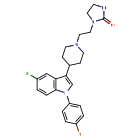
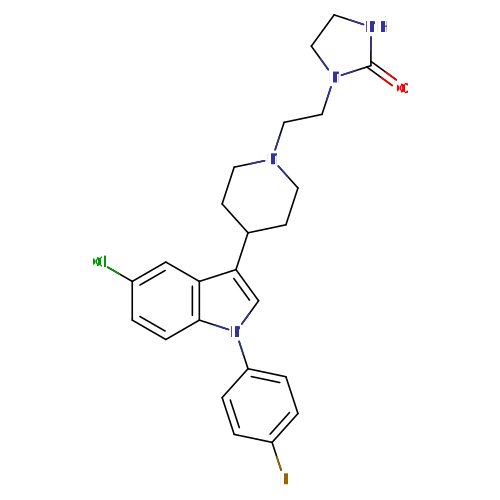
Structure for Sertindole (DB06144)
- Weight
- Average: 440.941
Monoisotopic: 440.177917386 - Chemical Formula
- C24H26ClFN4O
- Synonyms
- 1-[2-[4-[5-chloro-1-(4-fluorophenyl)-indol-3-yl]-1-piperidyl]ethyl]imidazolidin-2-one
- Sertindol
- Sertindole
- Sertindolum
- External IDs
- LU-23-174

Pharmacology
- Indication
Used in the treatment of schizophrenia.
 Reduce drug development failure ratesBuild, train, & validate machine-learning modelswith evidence-based and structured datasets.Build, train, & validate predictive machine-learning models with structured datasets.
- Associated Conditions
Indication Type Indication Combined Product Details Approval Level Age Group Patient Characteristics Dose Form Treatment of Schizophrenia •••••••••••• •••••• - Contraindications & Blackbox Warnings
 Prevent Adverse Drug Events TodayTap into our Clinical API for life-saving information on contraindications & blackbox warnings, population restrictions, harmful risks, & more.Avoid life-threatening adverse drug events with our Clinical API
- Pharmacodynamics
Sertindole is an atypical antipsychotic at least as effective as haloperidol and risperidone in the treatment of neuroleptic-responsive schizophrenia. Sertindole improves negative symptoms, and is also effective for the treatment of neuroleptic-resistant schizophrenia. Sertindole is generally well tolerated and is associated with a low rate of extrapyramidal symptoms (EPS).
- Mechanism of action
Sertindole is an antipsychotic drug with affinity for dopamine D2, serotonin 5-HT2A and 5-HT2C, and alpha1-adrenoreceptors. Preclinical studies suggest that sertindole acts preferentially on limbic and cortical dopaminergic neurons and clinical trials have confirmed that sertindole is effective at a low dopamine D2 occupancy level.
Target Actions Organism ADopamine D2 receptor antagonistHumans A5-hydroxytryptamine receptor 2A antagonistHumans A5-hydroxytryptamine receptor 2C antagonistHumans A5-hydroxytryptamine receptor 6 antagonistHumans UPotassium voltage-gated channel subfamily H member 2 inhibitorHumans UAlpha-1A adrenergic receptor Not Available Humans UAlpha-1B adrenergic receptor Not Available Humans UAlpha-1D adrenergic receptor Not Available Humans - Absorption
Orally available.
- Volume of distribution
Not Available
- Protein binding
Not Available
- Metabolism
Hepatic. Sertindole is metabolized by cytochrome P450 isoenzymes CYP 2D6 and CYP 3A4.
- Route of elimination
Not Available
- Half-life
3 days
- Clearance
Not Available
- Adverse Effects
 Improve decision support & research outcomesWith structured adverse effects data, including: blackbox warnings, adverse reactions, warning & precautions, & incidence rates. View sample adverse effects data in our new Data Library!Improve decision support & research outcomes with our structured adverse effects data.
- Toxicity
Not Available
- Pathways
- Not Available
- Pharmacogenomic Effects/ADRs
- Not Available
Interactions
- Drug Interactions
- This information should not be interpreted without the help of a healthcare provider. If you believe you are experiencing an interaction, contact a healthcare provider immediately. The absence of an interaction does not necessarily mean no interactions exist.
Drug Interaction Integrate drug-drug
interactions in your software1,2-Benzodiazepine The risk or severity of CNS depression can be increased when Sertindole is combined with 1,2-Benzodiazepine. Abametapir The serum concentration of Sertindole can be increased when it is combined with Abametapir. Abatacept The metabolism of Sertindole can be increased when combined with Abatacept. Abiraterone The metabolism of Sertindole can be decreased when combined with Abiraterone. Acebutolol The metabolism of Sertindole can be decreased when combined with Acebutolol. - Food Interactions
- Not Available
Products
 Drug product information from 10+ global regionsOur datasets provide approved product information including:dosage, form, labeller, route of administration, and marketing period.Access drug product information from over 10 global regions.
- International/Other Brands
- Serdolect / SerLect
Categories
- ATC Codes
- N05AE03 — Sertindole
- Drug Categories
- Antidepressive Agents
- Antipsychotic Agents
- Antipsychotic Agents (Second Generation [Atypical])
- Central Nervous System Agents
- Central Nervous System Depressants
- Cytochrome P-450 CYP2D6 Substrates
- Cytochrome P-450 CYP3A Substrates
- Cytochrome P-450 CYP3A4 Substrates
- Cytochrome P-450 Substrates
- Dopamine Antagonists
- Dopamine D2 Receptor Antagonists
- Heterocyclic Compounds, Fused-Ring
- Indole Derivatives
- Nervous System
- Neurotoxic agents
- Psycholeptics
- Psychotropic Drugs
- QTc Prolonging Agents
- Serotonergic Drugs Shown to Increase Risk of Serotonin Syndrome
- Serotonin 5-HT2 Receptor Antagonists
- Serotonin 5-HT2A Receptor Antagonists
- Serotonin 5-HT2C Receptor Antagonists
- Serotonin Agents
- Serotonin Receptor Antagonists
- Tranquilizing Agents
- Chemical TaxonomyProvided by Classyfire
- Description
- This compound belongs to the class of organic compounds known as phenylpyrroles. These are polycyclic aromatic compounds containing a benzene ring linked to a pyrrole ring through a CC or CN bond.
- Kingdom
- Organic compounds
- Super Class
- Organoheterocyclic compounds
- Class
- Pyrroles
- Sub Class
- Substituted pyrroles
- Direct Parent
- Phenylpyrroles
- Alternative Parents
- 3-alkylindoles / Aralkylamines / Fluorobenzenes / Piperidines / Aryl chlorides / Aryl fluorides / Imidazolidinones / Heteroaromatic compounds / Ureas / Trialkylamines show 7 more
- Substituents
- 1-phenylpyrrole / 3-alkylindole / Amine / Aralkylamine / Aromatic heteropolycyclic compound / Aryl chloride / Aryl fluoride / Aryl halide / Azacycle / Benzenoid show 24 more
- Molecular Framework
- Aromatic heteropolycyclic compounds
- External Descriptors
- organofluorine compound, organochlorine compound, imidazolidinone, heteroarylpiperidine, phenylindole (CHEBI:9122)
- Affected organisms
- Humans and other mammals
Chemical Identifiers
- UNII
- GVV4Z879SP
- CAS number
- 106516-24-9
- InChI Key
- GZKLJWGUPQBVJQ-UHFFFAOYSA-N
- InChI
- InChI=1S/C24H26ClFN4O/c25-18-1-6-23-21(15-18)22(16-30(23)20-4-2-19(26)3-5-20)17-7-10-28(11-8-17)13-14-29-12-9-27-24(29)31/h1-6,15-17H,7-14H2,(H,27,31)
- IUPAC Name
- 1-(2-{4-[5-chloro-1-(4-fluorophenyl)-1H-indol-3-yl]piperidin-1-yl}ethyl)imidazolidin-2-one
- SMILES
- FC1=CC=C(C=C1)N1C=C(C2CCN(CCN3CCNC3=O)CC2)C2=C1C=CC(Cl)=C2
References
- General References
- Kane JM, Tamminga CA: Sertindole (Serdolect): preclinical and clinical findings of a new atypical antipsychotic. Expert Opin Investig Drugs. 1997 Nov;6(11):1729-41. [Article]
- Lewis R, Bagnall AM, Leitner M: Sertindole for schizophrenia. Cochrane Database Syst Rev. 2005 Jul 20;(3):CD001715. [Article]
- Perquin LN: Treatment with the new antipsychotic sertindole for late-occurring undesirable movement effects. Int Clin Psychopharmacol. 2005 Nov;20(6):335-8. [Article]
- Murdoch D, Keating GM: Sertindole : a review of its use in schizophrenia. CNS Drugs. 2006;20(3):233-55. [Article]
- Authors unspecified: Sertindole: new drug. Another "atypical" neuroleptic; QT prolongation. Prescrire Int. 2007 Apr;16(88):59-62. [Article]
- Lindstrom E, Levander S: Sertindole: efficacy and safety in schizophrenia. Expert Opin Pharmacother. 2006 Sep;7(13):1825-34. [Article]
- Hertel P: Comparing sertindole to other new generation antipsychotics on preferential dopamine output in limbic versus striatal projection regions: mechanism of action. Synapse. 2006 Dec 1;60(7):543-52. [Article]
- External Links
- Human Metabolome Database
- HMDB0015618
- KEGG Drug
- D00561
- KEGG Compound
- C07567
- PubChem Compound
- 60149
- PubChem Substance
- 46504717
- ChemSpider
- 54229
- BindingDB
- 50001786
- 41996
- ChEBI
- 9122
- ChEMBL
- CHEMBL12713
- ZINC
- ZINC000000538337
- Therapeutic Targets Database
- DAP000832
- PharmGKB
- PA164784002
- Guide to Pharmacology
- GtP Drug Page
- Wikipedia
- Sertindole
Clinical Trials
- Clinical Trials
Phase Status Purpose Conditions Count 4 Completed Treatment Schizoaffective Disorders / Schizophrenia / Schizophrenia and Disorders With Psychotic Features 1 4 Completed Treatment Schizophrenia 1 4 Terminated Basic Science Schizophrenia 1 4 Unknown Status Treatment Schizophrenia 1 3 Completed Prevention Schizophrenia 1
Pharmacoeconomics
- Manufacturers
- Not Available
- Packagers
- Not Available
- Dosage Forms
Form Route Strength Tablet Tablet, film coated Oral Tablet, film coated Oral 12 mg Tablet, film coated Oral 16 mg Tablet, film coated Oral 20 mg Tablet, film coated Oral 4 mg - Prices
- Not Available
- Patents
- Not Available
Properties
- State
- Solid
- Experimental Properties
- Not Available
- Predicted Properties
Property Value Source Water Solubility 0.00963 mg/mL ALOGPS logP 4.29 ALOGPS logP 4.15 Chemaxon logS -4.7 ALOGPS pKa (Strongest Acidic) 14.33 Chemaxon pKa (Strongest Basic) 8.56 Chemaxon Physiological Charge 1 Chemaxon Hydrogen Acceptor Count 2 Chemaxon Hydrogen Donor Count 1 Chemaxon Polar Surface Area 40.51 Å2 Chemaxon Rotatable Bond Count 5 Chemaxon Refractivity 131.77 m3·mol-1 Chemaxon Polarizability 47.18 Å3 Chemaxon Number of Rings 5 Chemaxon Bioavailability 1 Chemaxon Rule of Five Yes Chemaxon Ghose Filter No Chemaxon Veber's Rule No Chemaxon MDDR-like Rule No Chemaxon - Predicted ADMET Features
Property Value Probability Human Intestinal Absorption + 1.0 Blood Brain Barrier + 0.9781 Caco-2 permeable - 0.7081 P-glycoprotein substrate Substrate 0.683 P-glycoprotein inhibitor I Inhibitor 0.903 P-glycoprotein inhibitor II Inhibitor 0.7529 Renal organic cation transporter Inhibitor 0.6044 CYP450 2C9 substrate Non-substrate 0.7898 CYP450 2D6 substrate Substrate 0.8919 CYP450 3A4 substrate Substrate 0.6803 CYP450 1A2 substrate Inhibitor 0.7945 CYP450 2C9 inhibitor Inhibitor 0.5 CYP450 2D6 inhibitor Non-inhibitor 0.6155 CYP450 2C19 inhibitor Inhibitor 0.624 CYP450 3A4 inhibitor Inhibitor 0.5802 CYP450 inhibitory promiscuity High CYP Inhibitory Promiscuity 0.8995 Ames test Non AMES toxic 0.6144 Carcinogenicity Non-carcinogens 0.8988 Biodegradation Not ready biodegradable 1.0 Rat acute toxicity 2.5452 LD50, mol/kg Not applicable hERG inhibition (predictor I) Strong inhibitor 0.8038 hERG inhibition (predictor II) Inhibitor 0.9186
Spectra
- Mass Spec (NIST)
- Not Available
- Spectra
Spectrum Spectrum Type Splash Key Predicted GC-MS Spectrum - GC-MS Predicted GC-MS splash10-006x-9316000000-4bb52e2e5e8e2a9184d6 Predicted MS/MS Spectrum - 10V, Positive (Annotated) Predicted LC-MS/MS splash10-0006-0000900000-fa590c84510d819d3e9c Predicted MS/MS Spectrum - 10V, Negative (Annotated) Predicted LC-MS/MS splash10-000i-0000900000-4463fb8c8b26b4443200 Predicted MS/MS Spectrum - 20V, Positive (Annotated) Predicted LC-MS/MS splash10-0006-0001900000-9221793e06069e04b8d7 Predicted MS/MS Spectrum - 20V, Negative (Annotated) Predicted LC-MS/MS splash10-007x-4009800000-d6ba1a4b6319f7d6b12a Predicted MS/MS Spectrum - 40V, Positive (Annotated) Predicted LC-MS/MS splash10-05fr-7329200000-e56fdbcf8181a3b932b8 Predicted MS/MS Spectrum - 40V, Negative (Annotated) Predicted LC-MS/MS splash10-001i-9017300000-d63e37d77b974967bd97 Predicted 1H NMR Spectrum 1D NMR Not Applicable Predicted 13C NMR Spectrum 1D NMR Not Applicable - Chromatographic Properties
Collision Cross Sections (CCS)
Adduct CCS Value (Å2) Source type Source [M-H]- 214.0991438 predictedDarkChem Lite v0.1.0 [M-H]- 200.39662 predictedDeepCCS 1.0 (2019) [M+H]+ 214.3966438 predictedDarkChem Lite v0.1.0 [M+H]+ 202.75462 predictedDeepCCS 1.0 (2019) [M+Na]+ 214.4565438 predictedDarkChem Lite v0.1.0 [M+Na]+ 209.87285 predictedDeepCCS 1.0 (2019)
Targets

- Kind
- Protein
- Organism
- Humans
- Pharmacological action
- Yes
- Actions
- Antagonist
- General Function
- Potassium channel regulator activity
- Specific Function
- Dopamine receptor whose activity is mediated by G proteins which inhibit adenylyl cyclase.
- Gene Name
- DRD2
- Uniprot ID
- P14416
- Uniprot Name
- D(2) dopamine receptor
- Molecular Weight
- 50618.91 Da
References
- Lindstrom E, Levander S: Sertindole: efficacy and safety in schizophrenia. Expert Opin Pharmacother. 2006 Sep;7(13):1825-34. [Article]
- Chen X, Ji ZL, Chen YZ: TTD: Therapeutic Target Database. Nucleic Acids Res. 2002 Jan 1;30(1):412-5. [Article]
- Mork A, Witten LM, Arnt J: Effect of sertindole on extracellular dopamine, acetylcholine, and glutamate in the medial prefrontal cortex of conscious rats: a comparison with risperidone and exploration of mechanisms involved. Psychopharmacology (Berl). 2009 Sep;206(1):39-49. doi: 10.1007/s00213-009-1578-4. Epub 2009 Jun 9. [Article]
- Seeman P: Dopamine D2(High) receptors moderately elevated by sertindole. Synapse. 2008 May;62(5):389-93. doi: 10.1002/syn.20498. [Article]
- Cincotta SL, Rodefer JS: Emerging role of sertindole in the management of schizophrenia. Neuropsychiatr Dis Treat. 2010 Sep 7;6:429-41. [Article]
- Kind
- Protein
- Organism
- Humans
- Pharmacological action
- Yes
- Actions
- Antagonist
- General Function
- Virus receptor activity
- Specific Function
- G-protein coupled receptor for 5-hydroxytryptamine (serotonin). Also functions as a receptor for various drugs and psychoactive substances, including mescaline, psilocybin, 1-(2,5-dimethoxy-4-iodop...
- Gene Name
- HTR2A
- Uniprot ID
- P28223
- Uniprot Name
- 5-hydroxytryptamine receptor 2A
- Molecular Weight
- 52602.58 Da
References
- Lindstrom E, Levander S: Sertindole: efficacy and safety in schizophrenia. Expert Opin Pharmacother. 2006 Sep;7(13):1825-34. [Article]
- Schreiber R, Brocco M, Millan MJ: Blockade of the discriminative stimulus effects of DOI by MDL 100,907 and the 'atypical' antipsychotics, clozapine and risperidone. Eur J Pharmacol. 1994 Oct 13;264(1):99-102. [Article]
- Hietala J, Kuonnamaki M, Palvimaki EP, Laakso A, Majasuo H, Syvalahti E: Sertindole is a serotonin 5-HT2c inverse agonist and decreases agonist but not antagonist binding to 5-HT2c receptors after chronic treatment. Psychopharmacology (Berl). 2001 Sep;157(2):180-7. [Article]
- Kind
- Protein
- Organism
- Humans
- Pharmacological action
- Yes
- Actions
- Antagonist
- General Function
- Serotonin receptor activity
- Specific Function
- G-protein coupled receptor for 5-hydroxytryptamine (serotonin). Also functions as a receptor for various drugs and psychoactive substances, including ergot alkaloid derivatives, 1-2,5,-dimethoxy-4-...
- Gene Name
- HTR2C
- Uniprot ID
- P28335
- Uniprot Name
- 5-hydroxytryptamine receptor 2C
- Molecular Weight
- 51820.705 Da
References
- Lindstrom E, Levander S: Sertindole: efficacy and safety in schizophrenia. Expert Opin Pharmacother. 2006 Sep;7(13):1825-34. [Article]
- Hietala J, Kuonnamaki M, Palvimaki EP, Laakso A, Majasuo H, Syvalahti E: Sertindole is a serotonin 5-HT2c inverse agonist and decreases agonist but not antagonist binding to 5-HT2c receptors after chronic treatment. Psychopharmacology (Berl). 2001 Sep;157(2):180-7. [Article]
- Kind
- Protein
- Organism
- Humans
- Pharmacological action
- Yes
- Actions
- Antagonist
- General Function
- Serotonin receptor activity
- Specific Function
- This is one of the several different receptors for 5-hydroxytryptamine (serotonin), a biogenic hormone that functions as a neurotransmitter, a hormone, and a mitogen. The activity of this receptor ...
- Gene Name
- HTR6
- Uniprot ID
- P50406
- Uniprot Name
- 5-hydroxytryptamine receptor 6
- Molecular Weight
- 46953.625 Da
References
- Pouzet B, Didriksen M, Arnt J: Effects of the 5-HT(6) receptor antagonist, SB-271046, in animal models for schizophrenia. Pharmacol Biochem Behav. 2002 Apr;71(4):635-43. [Article]
- Mork A, Witten LM, Arnt J: Effect of sertindole on extracellular dopamine, acetylcholine, and glutamate in the medial prefrontal cortex of conscious rats: a comparison with risperidone and exploration of mechanisms involved. Psychopharmacology (Berl). 2009 Sep;206(1):39-49. doi: 10.1007/s00213-009-1578-4. Epub 2009 Jun 9. [Article]
- Kind
- Protein
- Organism
- Humans
- Pharmacological action
- Unknown
- Actions
- Inhibitor
- General Function
- Voltage-gated potassium channel activity involved in ventricular cardiac muscle cell action potential repolarization
- Specific Function
- Pore-forming (alpha) subunit of voltage-gated inwardly rectifying potassium channel. Channel properties are modulated by cAMP and subunit assembly. Mediates the rapidly activating component of the ...
- Gene Name
- KCNH2
- Uniprot ID
- Q12809
- Uniprot Name
- Potassium voltage-gated channel subfamily H member 2
- Molecular Weight
- 126653.52 Da
References
- Rampe D, Murawsky MK, Grau J, Lewis EW: The antipsychotic agent sertindole is a high affinity antagonist of the human cardiac potassium channel HERG. J Pharmacol Exp Ther. 1998 Aug;286(2):788-93. [Article]
- Kang J, Chen XL, Rampe D: The antipsychotic drugs sertindole and pimozide block erg3, a human brain K(+) channel. Biochem Biophys Res Commun. 2001 Aug 24;286(3):499-504. [Article]
- Tang W, Kang J, Wu X, Rampe D, Wang L, Shen H, Li Z, Dunnington D, Garyantes T: Development and evaluation of high throughput functional assay methods for HERG potassium channel. J Biomol Screen. 2001 Oct;6(5):325-31. [Article]
- Kind
- Protein
- Organism
- Humans
- Pharmacological action
- Unknown
- General Function
- Protein heterodimerization activity
- Specific Function
- This alpha-adrenergic receptor mediates its action by association with G proteins that activate a phosphatidylinositol-calcium second messenger system. Its effect is mediated by G(q) and G(11) prot...
- Gene Name
- ADRA1A
- Uniprot ID
- P35348
- Uniprot Name
- Alpha-1A adrenergic receptor
- Molecular Weight
- 51486.005 Da
References
- Lindstrom E, Levander S: Sertindole: efficacy and safety in schizophrenia. Expert Opin Pharmacother. 2006 Sep;7(13):1825-34. [Article]
- Hietala J, Kuonnamaki M, Palvimaki EP, Laakso A, Majasuo H, Syvalahti E: Sertindole is a serotonin 5-HT2c inverse agonist and decreases agonist but not antagonist binding to 5-HT2c receptors after chronic treatment. Psychopharmacology (Berl). 2001 Sep;157(2):180-7. [Article]
- Kind
- Protein
- Organism
- Humans
- Pharmacological action
- Unknown
- General Function
- Protein heterodimerization activity
- Specific Function
- This alpha-adrenergic receptor mediates its action by association with G proteins that activate a phosphatidylinositol-calcium second messenger system. Its effect is mediated by G(q) and G(11) prot...
- Gene Name
- ADRA1B
- Uniprot ID
- P35368
- Uniprot Name
- Alpha-1B adrenergic receptor
- Molecular Weight
- 56835.375 Da
References
- Lindstrom E, Levander S: Sertindole: efficacy and safety in schizophrenia. Expert Opin Pharmacother. 2006 Sep;7(13):1825-34. [Article]
- Kind
- Protein
- Organism
- Humans
- Pharmacological action
- Unknown
- General Function
- Alpha1-adrenergic receptor activity
- Specific Function
- This alpha-adrenergic receptor mediates its effect through the influx of extracellular calcium.
- Gene Name
- ADRA1D
- Uniprot ID
- P25100
- Uniprot Name
- Alpha-1D adrenergic receptor
- Molecular Weight
- 60462.205 Da
References
- Lindstrom E, Levander S: Sertindole: efficacy and safety in schizophrenia. Expert Opin Pharmacother. 2006 Sep;7(13):1825-34. [Article]
Enzymes
- Kind
- Protein
- Organism
- Humans
- Pharmacological action
- Unknown
- Actions
- Substrate
- General Function
- Steroid hydroxylase activity
- Specific Function
- Responsible for the metabolism of many drugs and environmental chemicals that it oxidizes. It is involved in the metabolism of drugs such as antiarrhythmics, adrenoceptor antagonists, and tricyclic...
- Gene Name
- CYP2D6
- Uniprot ID
- P10635
- Uniprot Name
- Cytochrome P450 2D6
- Molecular Weight
- 55768.94 Da
References
- Prior TI, Chue PS, Tibbo P, Baker GB: Drug metabolism and atypical antipsychotics. Eur Neuropsychopharmacol. 1999 Jun;9(4):301-9. [Article]
- Spina E, de Leon J: Metabolic drug interactions with newer antipsychotics: a comparative review. Basic Clin Pharmacol Toxicol. 2007 Jan;100(1):4-22. doi: 10.1111/j.1742-7843.2007.00017.x. [Article]
- Kind
- Protein
- Organism
- Humans
- Pharmacological action
- Unknown
- Actions
- Substrate
- General Function
- Vitamin d3 25-hydroxylase activity
- Specific Function
- Cytochromes P450 are a group of heme-thiolate monooxygenases. In liver microsomes, this enzyme is involved in an NADPH-dependent electron transport pathway. It performs a variety of oxidation react...
- Gene Name
- CYP3A4
- Uniprot ID
- P08684
- Uniprot Name
- Cytochrome P450 3A4
- Molecular Weight
- 57342.67 Da
References
- Spina E, de Leon J: Metabolic drug interactions with newer antipsychotics: a comparative review. Basic Clin Pharmacol Toxicol. 2007 Jan;100(1):4-22. doi: 10.1111/j.1742-7843.2007.00017.x. [Article]

Drug created at November 19, 2007 16:49 / Updated at June 12, 2021 10:53