Identification
- Summary
Temsirolimus is a antineoplastic agent used in the treatment of renal cell carcinoma (RCC) that works by inhibiting mTOR.
- Brand Names
- Torisel
- Generic Name
- Temsirolimus
- DrugBank Accession Number
- DB06287
- Background
Temsirolimus is a derivative of sirolimus used in the treatment of renal cell carcinoma (RCC). It was developed by Wyeth Pharmaceuticals under the trade name Torisel. Temsirolimus was approved by the FDA in late May 2007 as well as the European Medicines Agency (EMEA) on November 2007.
- Type
- Small Molecule
- Groups
- Approved
- Structure
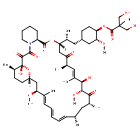
Structure for Temsirolimus (DB06287)

- Weight
- Average: 1030.2871
Monoisotopic: 1029.602485741 - Chemical Formula
- C56H87NO16
- Synonyms
- Temsirolimus
- External IDs
- CCI 779
- CCI-779
- WAY-CCI 779

Pharmacology
- Indication
For the treatment of renal cell carcinoma (RCC). Also investigated for use/treatment in breast cancer, lymphoma (unspecified), rheumatoid arthritis, and multiple myeloma.
 Reduce drug development failure ratesBuild, train, & validate machine-learning modelswith evidence-based and structured datasets.Build, train, & validate predictive machine-learning models with structured datasets.
- Associated Conditions
Indication Type Indication Combined Product Details Approval Level Age Group Patient Characteristics Dose Form Treatment of Advanced renal cell carcinoma •••••••••••• - Contraindications & Blackbox Warnings
 Prevent Adverse Drug Events TodayTap into our Clinical API for life-saving information on contraindications & blackbox warnings, population restrictions, harmful risks, & more.Avoid life-threatening adverse drug events with our Clinical API
- Pharmacodynamics
Not Available
- Mechanism of action
Temsirolimus is an inhibitor of mTOR (mammalian target of rapamycin). Temsirolimus binds to an intracellular protein (FKBP-12), and the protein-drug complex inhibits the activity of mTOR that controls cell division. Inhibition of mTOR activity resulted in a G1 growth arrest in treated tumor cells. When mTOR was inhibited, its ability to phosphorylate p70S6k and S6 ribosomal protein, which are downstream of mTOR in the PI3 kinase/AKT pathway was blocked. In in vitro studies using renal cell carcinoma cell lines, temsirolimus inhibited the activity of mTOR and resulted in reduced levels of the hypoxia-inducible factors HIF-1 and HIF-2 alpha, and the vascular endothelial growth factor.
Target Actions Organism ASerine/threonine-protein kinase mTOR inhibitorHumans - Absorption
Infused intravenous over 30 - 60 minutes. Cmax is typically observed at the end of infusion
- Volume of distribution
172 L in whole blood of cancer patients; both temsirolimus and sirolimus are extensive distributed partitioned into formed blood elements
- Protein binding
87% bound to plasma proteins in vitro at a concentration of 100 ng/ml
- Metabolism
Primarily metabolized by cytochrome P450 3A4 in the human liver. Sirolimus, an equally potent metabolite, is the primary metabolite in humans following IV infusion. Other metabolic pathways observed in in vitro temsirolimus metabolism studies include hydroxylation, reduction and demethylation.
Hover over products below to view reaction partners
- Route of elimination
Excreted predominantly in feces (76%), 4.6% of drug and metabolites recovered in urine. 17% of drug was not recovered by either route following a 14-day sample collection.
- Half-life
Temsirolimus exhibits a bi-exponential decline in whole blood concentrations and the mean half-lives of temsirolimus and sirolimus were 17.3 hr and 54.6 hr, respectively.
- Clearance
16.2 L/h (22%)
- Adverse Effects
 Improve decision support & research outcomesWith structured adverse effects data, including: blackbox warnings, adverse reactions, warning & precautions, & incidence rates. View sample adverse effects data in our new Data Library!Improve decision support & research outcomes with our structured adverse effects data.
- Toxicity
Temsirolimus has been administered to patients with cancer in phase 1 and 2 trials with repeated intravenous doses as high as 220 mg/m2. The risk of several serious adverse events, including thrombosis, bowel perforation, interstitial lung disease (ILD), seizure, and psychosis, is increased with doses of temsirolimus greater than 25 mg.
- Pathways
- Not Available
- Pharmacogenomic Effects/ADRs
- Not Available
Interactions
- Drug Interactions
- This information should not be interpreted without the help of a healthcare provider. If you believe you are experiencing an interaction, contact a healthcare provider immediately. The absence of an interaction does not necessarily mean no interactions exist.
Drug Interaction Integrate drug-drug
interactions in your softwareAbametapir The serum concentration of Temsirolimus can be increased when it is combined with Abametapir. Abatacept The metabolism of Temsirolimus can be increased when combined with Abatacept. Abciximab The risk or severity of bleeding can be increased when Abciximab is combined with Temsirolimus. Abemaciclib The serum concentration of Abemaciclib can be increased when it is combined with Temsirolimus. Abrocitinib The serum concentration of Temsirolimus can be increased when it is combined with Abrocitinib. - Food Interactions
- Avoid grapefruit products. Grapefruit inhibits the CYP3A4 metabolism of temsirolimus, which may increase its serum concentration.
- Avoid St. John's Wort. This herb induces the CYP3A4 metabolism of temsirolimus and may reduce its serum concentration.
Products
 Drug product information from 10+ global regionsOur datasets provide approved product information including:dosage, form, labeller, route of administration, and marketing period.Access drug product information from over 10 global regions.
- Brand Name Prescription Products
Name Dosage Strength Route Labeller Marketing Start Marketing End Region Image Torisel Solution 25 mg / mL Intravenous Pfizer Canada Ulc 2008-01-11 Not applicable Canada 
Torisel Injection, solution, concentrate; Kit 25 mg/1mL Intravenous Wyeth Pharmaceuticals Llc, a Subsidiary of Pfizer Inc. 2007-07-01 Not applicable US 
Torisel Injection, solution, concentrate 30 mg Intravenous Pfizer Europe Ma Eeig 2016-09-08 Not applicable EU 
- Generic Prescription Products
Name Dosage Strength Route Labeller Marketing Start Marketing End Region Image Gd-temsirolimus Solution 25 mg / mL Intravenous Genmed A Division Of Pfizer Canada Ulc Not applicable Not applicable Canada Temsirolimus Injection, solution, concentrate; Kit 25 mg/1mL Intravenous Gland Pharma Limited 2019-08-26 Not applicable US Temsirolimus Kit 25 mg/1mL Intravenous Fresenius Kabi USA, LLC 2020-11-20 Not applicable US Temsirolimus Injection, solution, concentrate; Kit 25 mg/1mL Intravenous Accord Healthcare Inc. 2018-08-13 Not applicable US Temsirolimus Injection, solution, concentrate; Kit 25 mg/1mL Intravenous Almaject, Inc. 2020-05-08 Not applicable US
Categories
- ATC Codes
- L01EG01 — Temsirolimus
- Drug Categories
- Agents causing angioedema
- Anti-Bacterial Agents
- Antineoplastic Agents
- Antineoplastic and Immunomodulating Agents
- Cytochrome P-450 CYP2D6 Inhibitors
- Cytochrome P-450 CYP2D6 Inhibitors (weak)
- Cytochrome P-450 CYP3A Inhibitors
- Cytochrome P-450 CYP3A Substrates
- Cytochrome P-450 CYP3A4 Substrates
- Cytochrome P-450 CYP3A4 Substrates with a Narrow Therapeutic Index
- Cytochrome P-450 CYP3A5 Inhibitors
- Cytochrome P-450 CYP3A5 Inhibitors (strength unknown)
- Cytochrome P-450 CYP3A5 Substrates
- Cytochrome P-450 CYP3A5 Substrates with a Narrow Therapeutic Index
- Cytochrome P-450 CYP3A7 Substrates
- Cytochrome P-450 CYP3A7 Substrates with a Narrow Therapeutic Index
- Cytochrome P-450 Enzyme Inhibitors
- Cytochrome P-450 Substrates
- Enzyme Inhibitors
- Hyperglycemia-Associated Agents
- Immunologic Factors
- Immunosuppressive Agents
- Kinase Inhibitor
- Lactones
- Macrolides
- Mammalian target of rapamycin (mTOR) kinase inhibitors
- mTOR Inhibitors
- Myelosuppressive Agents
- Narrow Therapeutic Index Drugs
- P-glycoprotein inhibitors
- P-glycoprotein substrates
- P-glycoprotein substrates with a Narrow Therapeutic Index
- Polyketides
- Protein Kinase Inhibitors
- Sirolimus and Prodrugs
- Chemical TaxonomyProvided by Classyfire
- Description
- This compound belongs to the class of organic compounds known as macrolide lactams. These are cyclic polyketides containing both a cyclic amide and a cyclic ester group.
- Kingdom
- Organic compounds
- Super Class
- Phenylpropanoids and polyketides
- Class
- Macrolide lactams
- Sub Class
- Not Available
- Direct Parent
- Macrolide lactams
- Alternative Parents
- Alpha amino acid esters / Macrolides and analogues / Beta hydroxy acids and derivatives / Piperidines / Oxanes / Dicarboxylic acids and derivatives / Tertiary carboxylic acid amides / Secondary alcohols / Carboxylic acid esters / Cyclic ketones show 11 more
- Substituents
- Alcohol / Aliphatic heteropolycyclic compound / Alpha-amino acid ester / Alpha-amino acid or derivatives / Azacycle / Beta-hydroxy acid / Carbonyl group / Carboxamide group / Carboxylic acid derivative / Carboxylic acid ester show 25 more
- Molecular Framework
- Aliphatic heteropolycyclic compounds
- External Descriptors
- lactam, macrolide (CHEBI:79699)
- Affected organisms
- Humans and other mammals
Chemical Identifiers
- UNII
- 624KN6GM2T
- CAS number
- 162635-04-3
- InChI Key
- CBPNZQVSJQDFBE-FUXHJELOSA-N
- InChI
- InChI=1S/C56H87NO16/c1-33-17-13-12-14-18-34(2)45(68-9)29-41-22-20-39(7)56(67,73-41)51(63)52(64)57-24-16-15-19-42(57)53(65)71-46(30-43(60)35(3)26-38(6)49(62)50(70-11)48(61)37(5)25-33)36(4)27-40-21-23-44(47(28-40)69-10)72-54(66)55(8,31-58)32-59/h12-14,17-18,26,33,35-37,39-42,44-47,49-50,58-59,62,67H,15-16,19-25,27-32H2,1-11H3/b14-12+,17-13+,34-18+,38-26+/t33-,35-,36-,37-,39-,40+,41+,42+,44-,45+,46+,47-,49-,50+,56-/m1/s1
- IUPAC Name
- (1R,2R,4S)-4-[(2R)-2-[(1R,9S,12S,15R,16E,18R,19R,21R,23S,24E,26E,28E,30S,32S,35R)-1,18-dihydroxy-19,30-dimethoxy-15,17,21,23,29,35-hexamethyl-2,3,10,14,20-pentaoxo-11,36-dioxa-4-azatricyclo[30.3.1.0^{4,9}]hexatriaconta-16,24,26,28-tetraen-12-yl]propyl]-2-methoxycyclohexyl 3-hydroxy-2-(hydroxymethyl)-2-methylpropanoate
- SMILES
- OCC(C)(CO)C(=O)O[C@@H]1CC[C@@H](C[C@@H](C)[C@]2([H])CC(=O)[C@H](C)\C=C(C)\[C@@H](O)[C@@H](OC)C(=O)[C@H](C)C[C@H](C)\C=C\C=C\C=C(C)\[C@@H](OC)C[C@]3([H])CC[C@@H](C)[C@@](O)(O3)C(=O)C(=O)N3CCCC[C@H]3C(=O)O2)C[C@H]1OC
References
- Synthesis Reference
Kwang-Chung Lee, Ting-Huei Lee, Yen-Shih Tung, Chia-Chen Kao, Tzu-Ai Lee, "Process for preparation of temsirolimus." U.S. Patent US20100249415, issued September 30, 2010.
US20100249415- General References
- Boni J, Leister C, Burns J, Cincotta M, Hug B, Moore L: Pharmacokinetic profile of temsirolimus with concomitant administration of cytochrome p450-inducing medications. J Clin Pharmacol. 2007 Nov;47(11):1430-9. Epub 2007 Oct 3. [Article]
- External Links
- Human Metabolome Database
- HMDB0015632
- KEGG Drug
- D06068
- KEGG Compound
- C15182
- PubChem Compound
- 23724530
- PubChem Substance
- 99443243
- ChemSpider
- 21468899
- BindingDB
- 50343413
- 657797
- ChEBI
- 79699
- ChEMBL
- CHEMBL1201182
- Therapeutic Targets Database
- DAP001222
- PharmGKB
- PA164746890
- PDBe Ligand
- A4I
- RxList
- RxList Drug Page
- Drugs.com
- Drugs.com Drug Page
- Wikipedia
- Temsirolimus
- PDB Entries
- 7sq9
- FDA label
- Download (402 KB)
Clinical Trials
- Clinical Trials
Phase Status Purpose Conditions Count 4 Completed Treatment Non-Hodgkin's Lymphoma (NHL) 1 4 Not Yet Recruiting Treatment Hemangioendothelioma of Liver 1 3 Active Not Recruiting Treatment Botryoid-Type Embryonal Rhabdomyosarcoma / Embryonal Rhabdomyosarcoma / Rhabdomyosarcoma, Alveolar / Rhabdomyosarcomas / Sclerosing Rhabdomyosarcoma / Spindle Cell Rhabdomyosarcoma 1 3 Active Not Recruiting Treatment PRETEXT I Hepatoblastoma / PRETEXT II Hepatoblastoma / PRETEXT III Hepatoblastoma / PRETEXT IV Hepatoblastoma 1 3 Completed Treatment Lymphoma 1
Pharmacoeconomics
- Manufacturers
- Not Available
- Packagers
- Ben Venue Laboratories Inc.
- Chunghwa Chemical Synthesis and Biotech Co. Ltd.
- Pierre Fabre
- Wyeth Pharmaceuticals
- Dosage Forms
Form Route Strength Injection, solution, concentrate; kit Intravenous 25 mg/1mL Kit Intravenous 25 mg/1mL Injection, solution, concentrate Intravenous 30 mg Injection, solution, concentrate Intravenous; Parenteral 30 MG Solution Intravenous 25 mg / mL Solution Intravenous 30 mg Injection, solution Intravenous 25 mg/ml Injection, solution, concentrate Intravenous 25 mg/mL Solution Intravenous 25 mg/1ml - Prices
Unit description Cost Unit Torisel 25 mg kit 1467.89USD ml DrugBank does not sell nor buy drugs. Pricing information is supplied for informational purposes only.- Patents
Patent Number Pediatric Extension Approved Expires (estimated) Region CA2429020 No 2009-05-26 2021-11-13 Canada CA2187024 No 2004-08-10 2015-04-14 Canada US8791097 Yes 2014-07-29 2032-11-10 US US8455539 Yes 2013-06-04 2024-01-25 US US5362718 Yes 1994-11-08 2019-08-15 US US8722700 Yes 2014-05-13 2024-01-25 US US8026276 Yes 2011-09-27 2026-07-20 US USRE44768 Yes 2014-02-18 2019-08-15 US US8299116 Yes 2012-10-30 2024-01-25 US
Properties
- State
- Solid
- Experimental Properties
- Not Available
- Predicted Properties
Property Value Source Water Solubility 0.00235 mg/mL ALOGPS logP 4.39 ALOGPS logP 7.13 Chemaxon logS -5.6 ALOGPS pKa (Strongest Acidic) 9.96 Chemaxon pKa (Strongest Basic) -2.9 Chemaxon Physiological Charge 0 Chemaxon Hydrogen Acceptor Count 14 Chemaxon Hydrogen Donor Count 4 Chemaxon Polar Surface Area 241.96 Å2 Chemaxon Rotatable Bond Count 11 Chemaxon Refractivity 277.07 m3·mol-1 Chemaxon Polarizability 112.7 Å3 Chemaxon Number of Rings 4 Chemaxon Bioavailability 0 Chemaxon Rule of Five No Chemaxon Ghose Filter No Chemaxon Veber's Rule No Chemaxon MDDR-like Rule Yes Chemaxon - Predicted ADMET Features
Property Value Probability Human Intestinal Absorption - 0.8908 Blood Brain Barrier - 0.9494 Caco-2 permeable - 0.664 P-glycoprotein substrate Substrate 0.8122 P-glycoprotein inhibitor I Inhibitor 0.8098 P-glycoprotein inhibitor II Inhibitor 0.7467 Renal organic cation transporter Non-inhibitor 0.7636 CYP450 2C9 substrate Non-substrate 0.8699 CYP450 2D6 substrate Non-substrate 0.8845 CYP450 3A4 substrate Substrate 0.7533 CYP450 1A2 substrate Non-inhibitor 0.9126 CYP450 2C9 inhibitor Non-inhibitor 0.8957 CYP450 2D6 inhibitor Non-inhibitor 0.942 CYP450 2C19 inhibitor Non-inhibitor 0.9155 CYP450 3A4 inhibitor Non-inhibitor 0.9558 CYP450 inhibitory promiscuity Low CYP Inhibitory Promiscuity 0.9398 Ames test Non AMES toxic 0.6087 Carcinogenicity Non-carcinogens 0.9367 Biodegradation Not ready biodegradable 0.9522 Rat acute toxicity 2.8760 LD50, mol/kg Not applicable hERG inhibition (predictor I) Weak inhibitor 0.9703 hERG inhibition (predictor II) Non-inhibitor 0.7479
Spectra
- Mass Spec (NIST)
- Not Available
- Spectra
- Chromatographic Properties
Collision Cross Sections (CCS)
Adduct CCS Value (Å2) Source type Source [M-H]- 328.2328061 predictedDarkChem Lite v0.1.0 [M-H]- 309.20334 predictedDeepCCS 1.0 (2019) [M+H]+ 332.0695061 predictedDarkChem Lite v0.1.0 [M+H]+ 310.85654 predictedDeepCCS 1.0 (2019) [M+Na]+ 329.7570061 predictedDarkChem Lite v0.1.0 [M+Na]+ 317.0134 predictedDeepCCS 1.0 (2019)
Targets

- Kind
- Protein
- Organism
- Humans
- Pharmacological action
- Yes
- Actions
- Inhibitor
- General Function
- Tfiiic-class transcription factor binding
- Specific Function
- Serine/threonine protein kinase which is a central regulator of cellular metabolism, growth and survival in response to hormones, growth factors, nutrients, energy and stress signals. MTOR directly...
- Gene Name
- MTOR
- Uniprot ID
- P42345
- Uniprot Name
- Serine/threonine-protein kinase mTOR
- Molecular Weight
- 288889.05 Da
References
- Patard JJ, Pouessel D, Bensalah K, Culine S: Targeted therapy in renal cell carcinoma. World J Urol. 2008 Apr;26(2):135-40. doi: 10.1007/s00345-008-0237-4. Epub 2008 Feb 12. [Article]
- Radulovic S, Bjelogrlic SK: Sunitinib, sorafenib and mTOR inhibitors in renal cancer. J BUON. 2007 Sep;12 Suppl 1:S151-62. [Article]
- Chen X, Ji ZL, Chen YZ: TTD: Therapeutic Target Database. Nucleic Acids Res. 2002 Jan 1;30(1):412-5. [Article]
Enzymes
- Kind
- Protein
- Organism
- Humans
- Pharmacological action
- Unknown
- Actions
- Inhibitor
- General Function
- Steroid hydroxylase activity
- Specific Function
- Responsible for the metabolism of many drugs and environmental chemicals that it oxidizes. It is involved in the metabolism of drugs such as antiarrhythmics, adrenoceptor antagonists, and tricyclic...
- Gene Name
- CYP2D6
- Uniprot ID
- P10635
- Uniprot Name
- Cytochrome P450 2D6
- Molecular Weight
- 55768.94 Da
- Kind
- Protein
- Organism
- Humans
- Pharmacological action
- Unknown
- Actions
- Substrate
- General Function
- Vitamin d3 25-hydroxylase activity
- Specific Function
- Cytochromes P450 are a group of heme-thiolate monooxygenases. In liver microsomes, this enzyme is involved in an NADPH-dependent electron transport pathway. It performs a variety of oxidation react...
- Gene Name
- CYP3A4
- Uniprot ID
- P08684
- Uniprot Name
- Cytochrome P450 3A4
- Molecular Weight
- 57342.67 Da
References
- Flockhart Table of Drug Interactions [Link]
- Kind
- Protein
- Organism
- Humans
- Pharmacological action
- Unknown
- Actions
- SubstrateInhibitor
- General Function
- Oxygen binding
- Specific Function
- Cytochromes P450 are a group of heme-thiolate monooxygenases. In liver microsomes, this enzyme is involved in an NADPH-dependent electron transport pathway. It oxidizes a variety of structurally un...
- Gene Name
- CYP3A5
- Uniprot ID
- P20815
- Uniprot Name
- Cytochrome P450 3A5
- Molecular Weight
- 57108.065 Da
References
- Flockhart Table of Drug Interactions [Link]
- Kind
- Protein
- Organism
- Humans
- Pharmacological action
- Unknown
- Actions
- Substrate
- General Function
- Oxygen binding
- Specific Function
- Cytochromes P450 are a group of heme-thiolate monooxygenases. In liver microsomes, this enzyme is involved in an NADPH-dependent electron transport pathway. It oxidizes a variety of structurally un...
- Gene Name
- CYP3A7
- Uniprot ID
- P24462
- Uniprot Name
- Cytochrome P450 3A7
- Molecular Weight
- 57525.03 Da
References
- Flockhart Table of Drug Interactions [Link]
Transporters
- Kind
- Protein
- Organism
- Humans
- Pharmacological action
- Unknown
- Actions
- SubstrateInhibitor
- General Function
- Xenobiotic-transporting atpase activity
- Specific Function
- Energy-dependent efflux pump responsible for decreased drug accumulation in multidrug-resistant cells.
- Gene Name
- ABCB1
- Uniprot ID
- P08183
- Uniprot Name
- Multidrug resistance protein 1
- Molecular Weight
- 141477.255 Da

Drug created at March 19, 2008 16:22 / Updated at April 27, 2024 09:44