Identification
- Summary
Ticlopidine is a platelet aggregation inhibitor used in the prevention of conditions associated with thrombi, such as stroke and transient ischemic attacks (TIA).
- Generic Name
- Ticlopidine
- DrugBank Accession Number
- DB00208
- Background
Ticlopidine is an effective inhibitor of platelet aggregation. It is a prodrug that is metabolised to an active form, which blocks the ADP receptor that is involved in GPIIb/IIIa receptor activation leading to platelet aggregation. Ticlopidine is marketed under the brand name Ticlid and is indicated for patients who cannot take aspirin or in whom aspirin has not worked to prevent a thrombotic stroke. The FDA label includes a black-box warning of neutropenia, aplastic anemia, thrombotic thrombocytopenia purpura, and agranulocytosis, so it is necessary to monitor patients' WBC and platelets when they are taking ticlopidine.
- Type
- Small Molecule
- Groups
- Approved
- Structure

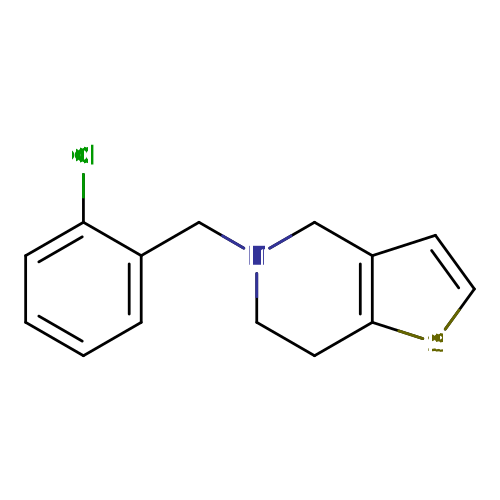
Structure for Ticlopidine (DB00208)
- Weight
- Average: 263.786
Monoisotopic: 263.05354785 - Chemical Formula
- C14H14ClNS
- Synonyms
- Ticlopidina
- Ticlopidine
- Ticlopidinum

Pharmacology
- Indication
Used in patients, who have had a stroke or stroke precursors and who cannot take aspirin or aspirin has not worked, to try to prevent another thrombotic stroke.
 Reduce drug development failure ratesBuild, train, & validate machine-learning modelswith evidence-based and structured datasets.Build, train, & validate predictive machine-learning models with structured datasets.
- Associated Conditions
Indication Type Indication Combined Product Details Approval Level Age Group Patient Characteristics Dose Form Adjunct therapy in prevention of Stent thrombosis •••••••••••• Prevention of Stroke •••••••••••• Prevention of Thrombotic stroke •••••••••••• •••••••••• •• •• •••••••••• •• •••••••• •••••••• •••••• •••••• Prevention of Thrombotic stroke •••••••••••• ••••••••••• •••••• ••••••••••• •••••••••• •• •• •••••••••• •• ••••••• •••••• Adjunct therapy in prevention of Subacute stent thrombosis •••••••••••• •••••••• ••••• •••••••••••• •••••• - Contraindications & Blackbox Warnings
 Prevent Adverse Drug Events TodayTap into our Clinical API for life-saving information on contraindications & blackbox warnings, population restrictions, harmful risks, & more.Avoid life-threatening adverse drug events with our Clinical API
- Pharmacodynamics
Ticlopidine is a prodrug that is metabolised to an as yet undetermined metabolite that acts as a platelet aggregation inhibitor. Inhibition of platelet aggregation causes a prolongation of bleeding time. In its prodrug form, ticlopidine has no significant in vitro activity at the concentrations attained in vivo.
- Mechanism of action
The active metabolite of ticlopidine prevents binding of adenosine diphosphate (ADP) to its platelet receptor, impairing the ADP-mediated activation of the glycoprotein GPIIb/IIIa complex. It is proposed that the inhibition involves a defect in the mobilization from the storage sites of the platelet granules to the outer membrane. No direct interference occurs with the GPIIb/IIIa receptor. As the glycoprotein GPIIb/IIIa complex is the major receptor for fibrinogen, its impaired activation prevents fibrinogen binding to platelets and inhibits platelet aggregation. By blocking the amplification of platelet activation by released ADP, platelet aggregation induced by agonists other than ADP is also inhibited by the active metabolite of ticlopidine.
Target Actions Organism AP2Y purinoceptor 12 antagonistHumans - Absorption
Absorption is greater than 80%. Food increases absorption by approximately 20%.
- Volume of distribution
The volume of distribution was not quantified.
- Protein binding
Binds reversibly (98%) to plasma proteins, mainly to serum albumin and lipoproteins. The binding to albumin and lipoproteins is nonsaturable over a wide concentration range. Ticlopidine also binds to alpha-1 acid glycoprotein (about 15% or less).
- Metabolism
Ticlopidine is metabolized extensively by the liver with only trace amounts of intact drug detected. At least 20 metabolites have been identified.
Hover over products below to view reaction partners
- Route of elimination
Ticlopidine is eliminated mostly in the urine (60%) and somewhat in the feces (23%).
- Half-life
Half-life following a single 250-mg dose is approximately 7.9 hours in subjects 20 to 43 years of age and 12.6 hours in subjects 65 to 76 years of age. With repeated dosing (250 mg twice a day), half-life is about 4 days in subjects 20 to 43 years of age and about 5 days in subjects 65 to 76 years of age.
- Clearance
Ticlopidine clearance was not quantified, but clearance decreases with age.
- Adverse Effects
 Improve decision support & research outcomesWith structured adverse effects data, including: blackbox warnings, adverse reactions, warning & precautions, & incidence rates. View sample adverse effects data in our new Data Library!Improve decision support & research outcomes with our structured adverse effects data.
- Toxicity
Single oral doses of ticlopidine at 1600 mg/kg and 500 mg/kg were lethal to rats and mice, respectively. Symptoms of acute toxicity were GI hemorrhage, convulsions, hypothermia, dyspnea, loss of equilibrium and abnormal gait. The FDA label includes a black-box warning of neutropenia, aplastic anemia, thrombotic thrombocytopenia purpura, and agranulocytosis, so it is necessary to monitor patients' WBC and platelets when they are taking ticlopidine.
- Pathways
Pathway Category Ticlopidine Action Pathway Drug action Ticlopidine Metabolism Pathway Drug metabolism - Pharmacogenomic Effects/ADRs
- Not Available
Interactions
- Drug Interactions
- This information should not be interpreted without the help of a healthcare provider. If you believe you are experiencing an interaction, contact a healthcare provider immediately. The absence of an interaction does not necessarily mean no interactions exist.
Drug Interaction Integrate drug-drug
interactions in your softwareAbacavir Ticlopidine may decrease the excretion rate of Abacavir which could result in a higher serum level. Abatacept The metabolism of Ticlopidine can be increased when combined with Abatacept. Abciximab The risk or severity of bleeding can be increased when Ticlopidine is combined with Abciximab. Abiraterone The metabolism of Ticlopidine can be decreased when combined with Abiraterone. Abrocitinib The risk or severity of bleeding and thrombocytopenia can be increased when Ticlopidine is combined with Abrocitinib. - Food Interactions
- Take with a high fat meal. High fat meals will increase ticlopidine absorption.
- Take with food. Food can help ticlopidine-induced stomach upset.
Products
 Drug product information from 10+ global regionsOur datasets provide approved product information including:dosage, form, labeller, route of administration, and marketing period.Access drug product information from over 10 global regions.
- Product Ingredients
Ingredient UNII CAS InChI Key Ticlopidine hydrochloride A1L4914FMF 53885-35-1 MTKNGOHFNXIVOS-UHFFFAOYSA-N - Product Images


- Brand Name Prescription Products
Name Dosage Strength Route Labeller Marketing Start Marketing End Region Image Ticlid Tablet, film coated 250 mg/1 Oral Physicians Total Care, Inc. 1996-06-05 2001-06-30 US 
Ticlid Tablet, film coated 250 mg/1 Oral Genentech, Inc. 1991-10-31 2011-07-18 US Ticlid 250mg Tablets Tablet 250 mg Oral Hoffmann La Roche 1995-12-31 2006-07-25 Canada 
Ticlid Tab 250mg Tablet 250 mg / tab Oral Syntex Inc. 1992-12-31 1996-09-30 Canada Ticlopidine Tablet 250 mg Oral Aa Pharma Inc 1998-03-30 Not applicable Canada - Generic Prescription Products
Name Dosage Strength Route Labeller Marketing Start Marketing End Region Image Alti-ticlopidine - Tab 250mg Tablet 250 mg Oral Altimed Pharma Inc. 1996-12-31 2005-05-27 Canada Dom-ticlopidine Tablet 250 mg Oral Dominion Pharmacal 2001-05-23 2016-10-25 Canada Mylan-ticlopidine Tablet 250 mg Oral Mylan Pharmaceuticals 1999-03-04 2017-01-09 Canada PMS-ticlopidine Tablet 250 mg Oral Pharmascience Inc 2001-02-23 2016-10-28 Canada Sandoz Ticlopidine Tablet 250 mg Oral Sandoz Canada Incorporated 2001-05-14 2011-10-21 Canada


Categories
- ATC Codes
- B01AC05 — Ticlopidine
- Drug Categories
- Antiplatelet agents
- Blood and Blood Forming Organs
- Cardiovascular Agents
- Cytochrome P-450 CYP1A2 Inhibitors
- Cytochrome P-450 CYP1A2 Inhibitors (strength unknown)
- Cytochrome P-450 CYP2B6 Inhibitors
- Cytochrome P-450 CYP2B6 Inhibitors (moderate)
- Cytochrome P-450 CYP2B6 Inhibitors (strong)
- Cytochrome P-450 CYP2C19 Inhibitors
- Cytochrome P-450 CYP2C19 Inhibitors (moderate)
- Cytochrome P-450 CYP2C19 Inhibitors (strong)
- Cytochrome P-450 CYP2C19 Substrates
- Cytochrome P-450 CYP2C8 Inhibitors
- Cytochrome P-450 CYP2C8 Inhibitors (weak)
- Cytochrome P-450 CYP2C9 Inhibitors
- Cytochrome P-450 CYP2C9 Inhibitors (weak)
- Cytochrome P-450 CYP2D6 Inhibitors
- Cytochrome P-450 CYP2D6 Inhibitors (strength unknown)
- Cytochrome P-450 CYP2D6 Substrates
- Cytochrome P-450 CYP2E1 Inhibitors
- Cytochrome P-450 CYP2E1 Inhibitors (weak)
- Cytochrome P-450 Enzyme Inhibitors
- Cytochrome P-450 Substrates
- Decreased Platelet Aggregation
- Drugs that are Mainly Renally Excreted
- Enzyme Inhibitors
- Fibrin Modulating Agents
- Hematologic Agents
- Heterocyclic Compounds, Fused-Ring
- Neurotransmitter Agents
- Platelet Aggregation Inhibitors Excl. Heparin
- Purinergic Agents
- Purinergic Antagonists
- Purinergic P2 Receptor Antagonists
- Purinergic P2Y Receptor Antagonists
- Pyridines
- Sulfur Compounds
- Thienopyridines
- Thiophenes
- Chemical TaxonomyProvided by Classyfire
- Description
- This compound belongs to the class of organic compounds known as thienopyridines. These are heterocyclic compounds containing a thiophene ring fused to a pyridine ring. Thiophene is 5-membered ring consisting of four carbon atoms and one sulfur atom. Pyridine is a 6-membered ring consisting of five carbon atoms and one nitrogen center.
- Kingdom
- Organic compounds
- Super Class
- Organoheterocyclic compounds
- Class
- Thienopyridines
- Sub Class
- Not Available
- Direct Parent
- Thienopyridines
- Alternative Parents
- Phenylmethylamines / Benzylamines / Chlorobenzenes / Aralkylamines / Pyridines and derivatives / Aryl chlorides / Thiophenes / Heteroaromatic compounds / Trialkylamines / Azacyclic compounds show 3 more
- Substituents
- Amine / Aralkylamine / Aromatic heteropolycyclic compound / Aryl chloride / Aryl halide / Azacycle / Benzenoid / Benzylamine / Chlorobenzene / Halobenzene show 14 more
- Molecular Framework
- Aromatic heteropolycyclic compounds
- External Descriptors
- monochlorobenzenes, thienopyridine (CHEBI:9588)
- Affected organisms
- Humans and other mammals
Chemical Identifiers
- UNII
- OM90ZUW7M1
- CAS number
- 55142-85-3
- InChI Key
- PHWBOXQYWZNQIN-UHFFFAOYSA-N
- InChI
- InChI=1S/C14H14ClNS/c15-13-4-2-1-3-11(13)9-16-7-5-14-12(10-16)6-8-17-14/h1-4,6,8H,5,7,9-10H2
- IUPAC Name
- 5-[(2-chlorophenyl)methyl]-4H,5H,6H,7H-thieno[3,2-c]pyridine
- SMILES
- ClC1=CC=CC=C1CN1CCC2=C(C1)C=CS2
References
- General References
- FDA Approved Drug Products: TICLID (ticlopidine hydrochloride) tablets [Link]
- External Links
- Human Metabolome Database
- HMDB0014353
- KEGG Drug
- D08594
- KEGG Compound
- C07140
- PubChem Compound
- 5472
- PubChem Substance
- 46504438
- ChemSpider
- 5273
- BindingDB
- 85509
- 10594
- ChEBI
- 9588
- ChEMBL
- CHEMBL833
- ZINC
- ZINC000019594599
- Therapeutic Targets Database
- DAP000723
- PharmGKB
- PA451686
- PDBe Ligand
- TIC
- RxList
- RxList Drug Page
- Drugs.com
- Drugs.com Drug Page
- Wikipedia
- Ticlopidine
- PDB Entries
- 3kw4
- FDA label
- Download (916 KB)
- MSDS
- Download (106 KB)
Clinical Trials
- Clinical Trials
Phase Status Purpose Conditions Count 4 Completed Basic Science Pharmacodynamics / Pharmacokinetics 1 4 Completed Prevention Infarction Cerebral / Stroke 1 4 Completed Treatment Coronary Artery Disease (CAD) 1 3 Completed Prevention Myocardial Infarction / Stable Angina (SA) 1 3 Completed Prevention Peripheral Arterial Disease (PAD) 1
Pharmacoeconomics
- Manufacturers
- Roche palo alto llc
- Actavis elizabeth llc
- Apotex inc
- Caraco pharmaceutical laboratories ltd
- Genpharm inc
- Mylan pharmaceuticals inc
- Sandoz inc
- Teva pharmaceuticals usa inc
- Watson laboratories inc
- Packagers
- Apotex Inc.
- AQ Pharmaceuticals Inc.
- Caraco Pharmaceutical Labs
- Eon Labs
- F Hoffmann-La Roche Ltd.
- Major Pharmaceuticals
- Mylan
- Physicians Total Care Inc.
- Resource Optimization and Innovation LLC
- Sandhills Packaging Inc.
- Teva Pharmaceutical Industries Ltd.
- Torpharm Inc.
- Dosage Forms
Form Route Strength Tablet Oral Pill 250 MG Tablet, sugar coated Oral 250 mg Tablet, film coated Oral Tablet, film coated Oral 250 mg/1 Tablet Oral 250 mg Tablet, film coated Oral 250 mg Tablet Oral 250 mg / tab Pill Tablet, coated Oral Tablet, coated Oral 250 mg/1 Tablet, film coated Oral 250 mg/tablet Tablet, coated Oral 250 mg Capsule 250 mg - Prices
Unit description Cost Unit Ticlid 30 250 mg tablet Bottle 87.36USD bottle Ticlid 250 mg tablet 2.61USD tablet Ticlopidine HCl 250 mg tablet 2.1USD tablet Ticlopidine 250 mg tablet 1.86USD tablet Apo-Ticlopidine 250 mg Tablet 0.72USD tablet Mylan-Ticlopidine 250 mg Tablet 0.72USD tablet Novo-Ticlopidine 250 mg Tablet 0.72USD tablet Nu-Ticlopidine 250 mg Tablet 0.72USD tablet Sandoz Ticlopidine 250 mg Tablet 0.72USD tablet Ticlopidine 250 mg Tablet 0.72USD tablet DrugBank does not sell nor buy drugs. Pricing information is supplied for informational purposes only.- Patents
- Not Available
Properties
- State
- Solid
- Experimental Properties
Property Value Source melting point (°C) approx. 1 189°C From Remington: The Science and Practice of Pharmacy water solubility Freely soluble From Remington: The Science and Practice of Pharmacy logP 2.9 Not Available - Predicted Properties
Property Value Source Water Solubility 0.0219 mg/mL ALOGPS logP 4.25 ALOGPS logP 4.2 Chemaxon logS -4.1 ALOGPS pKa (Strongest Basic) 6.94 Chemaxon Physiological Charge 0 Chemaxon Hydrogen Acceptor Count 1 Chemaxon Hydrogen Donor Count 0 Chemaxon Polar Surface Area 3.24 Å2 Chemaxon Rotatable Bond Count 2 Chemaxon Refractivity 74.33 m3·mol-1 Chemaxon Polarizability 27.99 Å3 Chemaxon Number of Rings 3 Chemaxon Bioavailability 1 Chemaxon Rule of Five Yes Chemaxon Ghose Filter Yes Chemaxon Veber's Rule Yes Chemaxon MDDR-like Rule No Chemaxon - Predicted ADMET Features
Property Value Probability Human Intestinal Absorption + 0.9902 Blood Brain Barrier + 0.9906 Caco-2 permeable + 0.6062 P-glycoprotein substrate Substrate 0.6111 P-glycoprotein inhibitor I Inhibitor 0.8 P-glycoprotein inhibitor II Inhibitor 0.8513 Renal organic cation transporter Inhibitor 0.8152 CYP450 2C9 substrate Non-substrate 0.8234 CYP450 2D6 substrate Non-substrate 0.9115 CYP450 3A4 substrate Non-substrate 0.5155 CYP450 1A2 substrate Inhibitor 0.9107 CYP450 2C9 inhibitor Non-inhibitor 0.907 CYP450 2D6 inhibitor Inhibitor 0.9209 CYP450 2C19 inhibitor Inhibitor 0.8994 CYP450 3A4 inhibitor Non-inhibitor 0.8808 CYP450 inhibitory promiscuity High CYP Inhibitory Promiscuity 0.9666 Ames test Non AMES toxic 0.6773 Carcinogenicity Non-carcinogens 0.9414 Biodegradation Not ready biodegradable 0.9959 Rat acute toxicity 2.2022 LD50, mol/kg Not applicable hERG inhibition (predictor I) Strong inhibitor 0.6392 hERG inhibition (predictor II) Inhibitor 0.6333
Spectra
- Mass Spec (NIST)
- Not Available
- Spectra
- Chromatographic Properties
Collision Cross Sections (CCS)
Adduct CCS Value (Å2) Source type Source [M-H]- 157.8419929 predictedDarkChem Lite v0.1.0 [M-H]- 150.90477 predictedDeepCCS 1.0 (2019) [M+H]+ 158.4948929 predictedDarkChem Lite v0.1.0 [M+H]+ 153.26277 predictedDeepCCS 1.0 (2019) [M+Na]+ 158.0462929 predictedDarkChem Lite v0.1.0 [M+Na]+ 159.64182 predictedDeepCCS 1.0 (2019)
Targets

- Kind
- Protein
- Organism
- Humans
- Pharmacological action
- Yes
- Actions
- Antagonist
- General Function
- Guanyl-nucleotide exchange factor activity
- Specific Function
- Receptor for ADP and ATP coupled to G-proteins that inhibit the adenylyl cyclase second messenger system. Not activated by UDP and UTP. Required for normal platelet aggregation and blood coagulation.
- Gene Name
- P2RY12
- Uniprot ID
- Q9H244
- Uniprot Name
- P2Y purinoceptor 12
- Molecular Weight
- 39438.355 Da
References
- Storey RF: The P2Y12 receptor as a therapeutic target in cardiovascular disease. Platelets. 2001 Jun;12(4):197-209. [Article]
- Boeynaems JM, van Giezen H, Savi P, Herbert JM: P2Y receptor antagonists in thrombosis. Curr Opin Investig Drugs. 2005 Mar;6(3):275-82. [Article]
- Gachet C: The platelet P2 receptors as molecular targets for old and new antiplatelet drugs. Pharmacol Ther. 2005 Nov;108(2):180-92. Epub 2005 Jun 13. [Article]
- Zhan C, Yang J, Dong XC, Wang YL: Molecular modeling of purinergic receptor P2Y12 and interaction with its antagonists. J Mol Graph Model. 2007 Jul;26(1):20-31. Epub 2006 Sep 26. [Article]
- Chen X, Ji ZL, Chen YZ: TTD: Therapeutic Target Database. Nucleic Acids Res. 2002 Jan 1;30(1):412-5. [Article]
Enzymes
- Kind
- Protein
- Organism
- Humans
- Pharmacological action
- Unknown
- Actions
- SubstrateInhibitor
- Curator comments
- Moderate to strong inhibition of 2C19.
- General Function
- Steroid hydroxylase activity
- Specific Function
- Responsible for the metabolism of a number of therapeutic agents such as the anticonvulsant drug S-mephenytoin, omeprazole, proguanil, certain barbiturates, diazepam, propranolol, citalopram and im...
- Gene Name
- CYP2C19
- Uniprot ID
- P33261
- Uniprot Name
- Cytochrome P450 2C19
- Molecular Weight
- 55930.545 Da
References
- Zhou SF, Zhou ZW, Yang LP, Cai JP: Substrates, inducers, inhibitors and structure-activity relationships of human Cytochrome P450 2C9 and implications in drug development. Curr Med Chem. 2009;16(27):3480-675. Epub 2009 Sep 1. [Article]
- Richter T, Murdter TE, Heinkele G, Pleiss J, Tatzel S, Schwab M, Eichelbaum M, Zanger UM: Potent mechanism-based inhibition of human CYP2B6 by clopidogrel and ticlopidine. J Pharmacol Exp Ther. 2004 Jan;308(1):189-97. doi: 10.1124/jpet.103.056127. Epub 2003 Oct 16. [Article]
- Donahue SR, Flockhart DA, Abernethy DR, Ko JW: Ticlopidine inhibition of phenytoin metabolism mediated by potent inhibition of CYP2C19. Clin Pharmacol Ther. 1997 Nov;62(5):572-7. doi: 10.1016/S0009-9236(97)90054-0. [Article]
- Donahue S, Flockhart DA, Abernethy DR: Ticlopidine inhibits phenytoin clearance. Clin Pharmacol Ther. 1999 Dec;66(6):563-8. doi: 10.1053/cp.1999.v66.103277001. [Article]
- Giancarlo GM, Venkatakrishnan K, Granda BW, von Moltke LL, Greenblatt DJ: Relative contributions of CYP2C9 and 2C19 to phenytoin 4-hydroxylation in vitro: inhibition by sulfaphenazole, omeprazole, and ticlopidine. Eur J Clin Pharmacol. 2001 Apr;57(1):31-6. [Article]
- Tateishi T, Kumai T, Watanabe M, Nakura H, Tanaka M, Kobayashi S: Ticlopidine decreases the in vivo activity of CYP2C19 as measured by omeprazole metabolism. Br J Clin Pharmacol. 1999 Apr;47(4):454-7. doi: 10.1046/j.1365-2125.1999.00914.x. [Article]
- Talakad JC, Shah MB, Walker GS, Xiang C, Halpert JR, Dalvie D: Comparison of in vitro metabolism of ticlopidine by human cytochrome P450 2B6 and rabbit cytochrome P450 2B4. Drug Metab Dispos. 2011 Mar;39(3):539-50. doi: 10.1124/dmd.110.037101. Epub 2010 Dec 14. [Article]
- Flockhart Table of Drug Interactions [Link]
- Drug Interactions & Labeling - FDA [Link]
- Ticlopidine Hydrochloride - Drug Summary - PDR [Link]
- Kind
- Protein
- Organism
- Humans
- Pharmacological action
- Unknown
- Actions
- SubstrateInhibitor
- Curator comments
- Moderate to strong inhibition of 2D6.
- General Function
- Steroid hydroxylase activity
- Specific Function
- Responsible for the metabolism of many drugs and environmental chemicals that it oxidizes. It is involved in the metabolism of drugs such as antiarrhythmics, adrenoceptor antagonists, and tricyclic...
- Gene Name
- CYP2D6
- Uniprot ID
- P10635
- Uniprot Name
- Cytochrome P450 2D6
- Molecular Weight
- 55768.94 Da
References
- Zhou SF, Zhou ZW, Yang LP, Cai JP: Substrates, inducers, inhibitors and structure-activity relationships of human Cytochrome P450 2C9 and implications in drug development. Curr Med Chem. 2009;16(27):3480-675. Epub 2009 Sep 1. [Article]
- Ko JW, Desta Z, Soukhova NV, Tracy T, Flockhart DA: In vitro inhibition of the cytochrome P450 (CYP450) system by the antiplatelet drug ticlopidine: potent effect on CYP2C19 and CYP2D6. Br J Clin Pharmacol. 2000 Apr;49(4):343-51. doi: 10.1046/j.1365-2125.2000.00175.x. [Article]
- Sasaki T, Sato Y, Kumagai T, Yoshinari K, Nagata K: Effect of health foods on cytochrome P450-mediated drug metabolism. J Pharm Health Care Sci. 2017 May 10;3:14. doi: 10.1186/s40780-017-0083-x. eCollection 2017. [Article]
- Flockhart Table of Drug Interactions [Link]
- Kind
- Protein
- Organism
- Humans
- Pharmacological action
- Unknown
- Actions
- Substrate
- General Function
- Peroxidase activity
- Specific Function
- Part of the host defense system of polymorphonuclear leukocytes. It is responsible for microbicidal activity against a wide range of organisms. In the stimulated PMN, MPO catalyzes the production o...
- Gene Name
- MPO
- Uniprot ID
- P05164
- Uniprot Name
- Myeloperoxidase
- Molecular Weight
- 83867.71 Da
References
- Zhou SF, Zhou ZW, Yang LP, Cai JP: Substrates, inducers, inhibitors and structure-activity relationships of human Cytochrome P450 2C9 and implications in drug development. Curr Med Chem. 2009;16(27):3480-675. Epub 2009 Sep 1. [Article]
- Kind
- Protein
- Organism
- Humans
- Pharmacological action
- Unknown
- Actions
- Inhibitor
- General Function
- Steroid hydroxylase activity
- Specific Function
- Cytochromes P450 are a group of heme-thiolate monooxygenases. In liver microsomes, this enzyme is involved in an NADPH-dependent electron transport pathway. It oxidizes a variety of structurally un...
- Gene Name
- CYP2C9
- Uniprot ID
- P11712
- Uniprot Name
- Cytochrome P450 2C9
- Molecular Weight
- 55627.365 Da
References
- Giancarlo GM, Venkatakrishnan K, Granda BW, von Moltke LL, Greenblatt DJ: Relative contributions of CYP2C9 and 2C19 to phenytoin 4-hydroxylation in vitro: inhibition by sulfaphenazole, omeprazole, and ticlopidine. Eur J Clin Pharmacol. 2001 Apr;57(1):31-6. [Article]
- Donahue SR, Flockhart DA, Abernethy DR, Ko JW: Ticlopidine inhibition of phenytoin metabolism mediated by potent inhibition of CYP2C19. Clin Pharmacol Ther. 1997 Nov;62(5):572-7. doi: 10.1016/S0009-9236(97)90054-0. [Article]
- Yang SH, Cho YA, Choi JS: Effects of ticlopidine on pharmacokinetics of losartan and its main metabolite EXP-3174 in rats. Acta Pharmacol Sin. 2011 Jul;32(7):967-72. doi: 10.1038/aps.2011.32. Epub 2011 Jun 13. [Article]
- Kind
- Protein
- Organism
- Humans
- Pharmacological action
- Unknown
- Actions
- Inhibitor
- General Function
- Steroid hydroxylase activity
- Specific Function
- Cytochromes P450 are a group of heme-thiolate monooxygenases. In liver microsomes, this enzyme is involved in an NADPH-dependent electron transport pathway. It oxidizes a variety of structurally un...
- Gene Name
- CYP2C8
- Uniprot ID
- P10632
- Uniprot Name
- Cytochrome P450 2C8
- Molecular Weight
- 55824.275 Da
References
- Backman JT, Filppula AM, Niemi M, Neuvonen PJ: Role of Cytochrome P450 2C8 in Drug Metabolism and Interactions. Pharmacol Rev. 2016 Jan;68(1):168-241. doi: 10.1124/pr.115.011411. [Article]
- Kind
- Protein
- Organism
- Humans
- Pharmacological action
- Unknown
- Actions
- Inhibitor
- General Function
- Oxidoreductase activity, acting on paired donors, with incorporation or reduction of molecular oxygen, reduced flavin or flavoprotein as one donor, and incorporation of one atom of oxygen
- Specific Function
- Cytochromes P450 are a group of heme-thiolate monooxygenases. In liver microsomes, this enzyme is involved in an NADPH-dependent electron transport pathway. It oxidizes a variety of structurally un...
- Gene Name
- CYP1A2
- Uniprot ID
- P05177
- Uniprot Name
- Cytochrome P450 1A2
- Molecular Weight
- 58293.76 Da
References
- Richter T, Murdter TE, Heinkele G, Pleiss J, Tatzel S, Schwab M, Eichelbaum M, Zanger UM: Potent mechanism-based inhibition of human CYP2B6 by clopidogrel and ticlopidine. J Pharmacol Exp Ther. 2004 Jan;308(1):189-97. doi: 10.1124/jpet.103.056127. Epub 2003 Oct 16. [Article]
- Aleil B, Rochoux G, Monassier JP, Cazenave JP, Gachet C: Ticlopidine could be an alternative therapy in the case of pharmacological resistance to clopidogrel: a report of three cases. J Thromb Haemost. 2007 Apr;5(4):879-81. doi: 10.1111/j.1538-7836.2007.02338.x. [Article]
- Rendic S: Summary of information on human CYP enzymes: human P450 metabolism data. Drug Metab Rev. 2002 Feb-May;34(1-2):83-448. [Article]
- Ko JW, Desta Z, Soukhova NV, Tracy T, Flockhart DA: In vitro inhibition of the cytochrome P450 (CYP450) system by the antiplatelet drug ticlopidine: potent effect on CYP2C19 and CYP2D6. Br J Clin Pharmacol. 2000 Apr;49(4):343-51. doi: 10.1046/j.1365-2125.2000.00175.x. [Article]
- Flockhart Table of Drug Interactions [Link]
- Ticlopidine Hydrochloride - Drug Summary - PDR [Link]
- Kind
- Protein
- Organism
- Humans
- Pharmacological action
- Unknown
- Actions
- Inhibitor
- General Function
- Steroid hydroxylase activity
- Specific Function
- Cytochromes P450 are a group of heme-thiolate monooxygenases. In liver microsomes, this enzyme is involved in an NADPH-dependent electron transport pathway. It oxidizes a variety of structurally un...
- Gene Name
- CYP2B6
- Uniprot ID
- P20813
- Uniprot Name
- Cytochrome P450 2B6
- Molecular Weight
- 56277.81 Da
References
- Walsky RL, Astuccio AV, Obach RS: Evaluation of 227 drugs for in vitro inhibition of cytochrome P450 2B6. J Clin Pharmacol. 2006 Dec;46(12):1426-38. [Article]
- Richter T, Murdter TE, Heinkele G, Pleiss J, Tatzel S, Schwab M, Eichelbaum M, Zanger UM: Potent mechanism-based inhibition of human CYP2B6 by clopidogrel and ticlopidine. J Pharmacol Exp Ther. 2004 Jan;308(1):189-97. doi: 10.1124/jpet.103.056127. Epub 2003 Oct 16. [Article]
- Flockhart Table of Drug Interactions [Link]
- Ticlopidine Hydrochloride - Drug Summary - PDR [Link]
- Kind
- Protein
- Organism
- Humans
- Pharmacological action
- Unknown
- Actions
- Inhibitor
- General Function
- Steroid hydroxylase activity
- Specific Function
- Metabolizes several precarcinogens, drugs, and solvents to reactive metabolites. Inactivates a number of drugs and xenobiotics and also bioactivates many xenobiotic substrates to their hepatotoxic ...
- Gene Name
- CYP2E1
- Uniprot ID
- P05181
- Uniprot Name
- Cytochrome P450 2E1
- Molecular Weight
- 56848.42 Da
References
- Ko JW, Desta Z, Soukhova NV, Tracy T, Flockhart DA: In vitro inhibition of the cytochrome P450 (CYP450) system by the antiplatelet drug ticlopidine: potent effect on CYP2C19 and CYP2D6. Br J Clin Pharmacol. 2000 Apr;49(4):343-51. doi: 10.1046/j.1365-2125.2000.00175.x. [Article]

Drug created at June 13, 2005 13:24 / Updated at April 26, 2024 00:45