Identification
- Summary
Desogestrel is a synthetic progestin used in contraception, often in combination with ethinyl estradiol.
- Brand Names
- Apri 28 Day, Azurette 28 Day, Bekyree 28 Day, Caziant 28 Day, Cesia 28 Day, Cyred 28 Day, Emoquette, Enskyce 28 Day, Freya, Isibloom 28 Day, Juleber 28 Day, Kalliga, Kariva 28 Day, Linessa, Marvelon, Mircette 28 Day, Pimtrea Pack, Reclipsen, Simliya, Velivet 28 Day, Viorele 28 Day, Volnea 28 Day
- Generic Name
- Desogestrel
- DrugBank Accession Number
- DB00304
- Background
Desogestrel, a prodrug, is a third generation progestogen1 and hence, a member of the gonane family which was largely used in Europe before being approved in the US and Canada.4 It was firstly generated from a study that showed that 11-beta and 11-alkylidene substituent in nortestosterone can enhance the biological activity.10 Desogestrel is now produced semi-synthetically from naturally occurred plant steroids.14 In the US, desogestrel is found only in combination with ethinyl estradiol.5 The first approved drug containing desogestrel was developed by Organon USA Inc in 1972 and FDA approved in 1992.11
- Type
- Small Molecule
- Groups
- Approved
- Structure
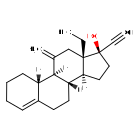
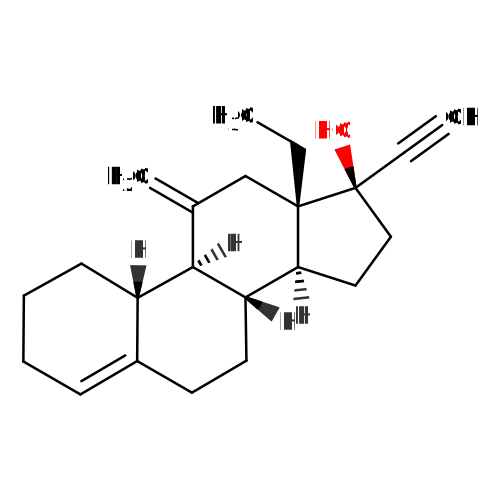
Structure for Desogestrel (DB00304)
- Weight
- Average: 310.473
Monoisotopic: 310.229665582 - Chemical Formula
- C22H30O
- Synonyms
- 13-Ethyl-11-methylene-18,19-dinor-17α-pregn-4-en-20-yn-17-ol
- Desogestrel
- Désogestrel
- Desogestrelum
- External IDs
- ORG 2969
- ORG-2969

Pharmacology
- Indication
Oral desogestrel is used in combination with ethinylestradiol as a contraceptive agent for the prevention of pregnancy.Label
Desogestrel is part of the combined oral contraceptives that contain a mix of estrogen and progestin which inhibit ovulation.12
 Reduce drug development failure ratesBuild, train, & validate machine-learning modelswith evidence-based and structured datasets.Build, train, & validate predictive machine-learning models with structured datasets.
- Associated Therapies
- Contraindications & Blackbox Warnings
 Prevent Adverse Drug Events TodayTap into our Clinical API for life-saving information on contraindications & blackbox warnings, population restrictions, harmful risks, & more.Avoid life-threatening adverse drug events with our Clinical API
- Pharmacodynamics
The effects of desogestrel are divided on reproductive including modification of luteinizing hormone and follicle stimulating hormone, declines on the onset of menstruation, and increases the viscosity of the vaginal fluid; and on metabolic that includes increase insulin secretion and resistance, increased lipase activity, and increased fat deposition.9 The effect of desogestrel on the lipids has been studied extensively and the results are contradictory.
Desogestrel main therapeutic effect due to its mechanism of action is known to be related to the inhibition of the ovulation in 97% of the cycles. This effect was proven in clinical trials in non-breastfeeding women from which the Pearl failure rate was reported to be of 0.17 per 100 women-years. This result indicated that desogestrel is more efficient when compared to other progestogen-only pills.6 All the therapeutic effect is produced by a transformation of the endometrium followed by an inhibition of the ovulation due to the suppression of other hormones.10
Desogestrel has been widely confirmed to be related to an increase in the risk of venous thromboembolism due to the driven increased in blood coagulation factors, leading to a pronounced prothrombotic state.1 However, the effects of desogestrel are known to not impact significantly the level of total cholesterol remaining in the range of change of 10% which allows it to be a molecule that presents a favorable lipid profile.4
- Mechanism of action
Desogestrel enters the cell passively and acts by binding selectively to the progesterone receptor and generating low androgenic activity.8 Its binding produces an effect like a transcription factor and thus, it produces modifications in the mRNA synthesis.9
The active metabolite of desogestrel, etonogestrel, presents a combination of high progestational activity with minimal intrinsic androgenicity.Label
Target Actions Organism AProgesterone receptor agonistHumans AEstrogen receptor alpha agonistHumans - Absorption
After oral administration, desogestrel is rapidly absorbed and it reaches a peak concentration of 2 ng/ml after 1.5 hours. The bioavailability of desogestrel is reported to be in the range of 60-80% and the reported AUC is of 3000 ng.h/ml.14 Almost all the administered dose is modified to the active metabolite, etonogestrel.7
- Volume of distribution
The apparent volume of distribution of desogestrel is of 1.5 L/kg.14
- Protein binding
The main metabolite of desogestrel is mainly found bound to albumin and sex-hormone binding globulin. Around 96-98% of the administered dose of desogestrel is found bound to plasma proteins from which 40-70% is found bound to sex-hormone binding globulin.14
- Metabolism
Desogestrel is rapidly metabolized in the intestinal mucosa and by first-pass hepatic metabolism8 to form the major metabolite of desogestrel is etonogestrel which is the biologically active metabolite.2,3 This modification is described by the hydroxylation in C3 of the desogestrel molecule.7 Later, etonogestrel is metabolized following the normal pathways of steroid metabolism. On the other hand, due to the 11-methylene side chain, desogestrel cannot be metabolized to other progestins.14
Hover over products below to view reaction partners
- Route of elimination
The elimination of desogestrel is found to be mainly renal corresponding to about 6 times the dose eliminated in the bile.14 The elimination of desogestrel is only done as the metabolites and not as the unchanged drug and about 85% of the administered dose can be excreted as metabolites after 6-8 days.10
- Half-life
The terminal half-life of desogestrel is determined to be of 30 hours.14
- Clearance
The metabolic clearance rate of desogestrel is reported to be of about 2 ml/min/kg.14
- Adverse Effects
 Improve decision support & research outcomesWith structured adverse effects data, including: blackbox warnings, adverse reactions, warning & precautions, & incidence rates. View sample adverse effects data in our new Data Library!Improve decision support & research outcomes with our structured adverse effects data.
- Toxicity
Administration of large quantities of desogestrel has been shown to produce strong hormonal effects but to lack chronic toxicity. The reported LD50 in rats after oral administration of desogestrel is higher than 2000 mg/kg.10 Overdose hasn't reported serious effects but only symptoms of nausea and withdrawal of bleeding.Label
Most reports haven't linked the administration of desogestrel with the increased risk of breast cancer. The increased risk has been reported to be related to the duration of use. However, several reports indicate a desogestrel-driven increased risk in cervical intra-epithelial neoplasia but the results are still not conclusive.Label
- Pathways
- Not Available
- Pharmacogenomic Effects/ADRs
- Not Available
Interactions
- Drug Interactions
- This information should not be interpreted without the help of a healthcare provider. If you believe you are experiencing an interaction, contact a healthcare provider immediately. The absence of an interaction does not necessarily mean no interactions exist.
Drug Interaction Integrate drug-drug
interactions in your softwareAbacavir The metabolism of Abacavir can be increased when combined with Desogestrel. Abametapir The serum concentration of Desogestrel can be increased when it is combined with Abametapir. Abatacept The metabolism of Desogestrel can be increased when combined with Abatacept. Abciximab The risk or severity of adverse effects can be increased when Desogestrel is combined with Abciximab. Abrocitinib The metabolism of Abrocitinib can be decreased when combined with Desogestrel. - Food Interactions
- No interactions found.
Products
 Drug product information from 10+ global regionsOur datasets provide approved product information including:dosage, form, labeller, route of administration, and marketing period.Access drug product information from over 10 global regions.
- Product Images
- International/Other Brands
- Cerazette (Organon) / Marvelon (Adcock Ingram Pharmaceuticals)
- Mixture Products
Name Ingredients Dosage Route Labeller Marketing Start Marketing End Region Image Apri Desogestrel (0.15 mg/1) + Ethinylestradiol (0.03 mg/1) Kit Oral Physicians Total Care, Inc. 2003-03-10 Not applicable US 

Apri 21 Desogestrel (0.15 mg) + Ethinylestradiol (0.03 mg) Tablet Oral TEVA Canada Limited 2008-09-29 Not applicable Canada 
Apri 28 Desogestrel (0.15 mg) + Ethinylestradiol (0.03 mg) Tablet Oral TEVA Canada Limited 2008-09-29 Not applicable Canada Apri 28 Day Desogestrel (0.15 mg/1) + Ethinylestradiol (0.03 mg/1) Kit Oral Teva Pharmaceuticals USA, Inc. 1999-10-22 Not applicable US 
Apri 28 Day Desogestrel (0.15 mg/1) + Ethinylestradiol (0.03 mg/1) Kit Oral A-S Medication Solutions 1999-10-22 Not applicable US - Unapproved/Other Products
Name Ingredients Dosage Route Labeller Marketing Start Marketing End Region Image Mercilon Desogestrel (0.15 mg/1) + Ethinylestradiol (0.02 mg/1) Tablet Oral OASIS TRADING 2018-11-22 Not applicable US


Categories
- ATC Codes
- G03AC09 — Desogestrel
- G03AC — Progestogens
- G03A — HORMONAL CONTRACEPTIVES FOR SYSTEMIC USE
- G03 — SEX HORMONES AND MODULATORS OF THE GENITAL SYSTEM
- G — GENITO URINARY SYSTEM AND SEX HORMONES
- G03FB — Progestogens and estrogens, sequential preparations
- G03F — PROGESTOGENS AND ESTROGENS IN COMBINATION
- G03 — SEX HORMONES AND MODULATORS OF THE GENITAL SYSTEM
- G — GENITO URINARY SYSTEM AND SEX HORMONES
- G03AB — Progestogens and estrogens, sequential preparations
- G03A — HORMONAL CONTRACEPTIVES FOR SYSTEMIC USE
- G03 — SEX HORMONES AND MODULATORS OF THE GENITAL SYSTEM
- G — GENITO URINARY SYSTEM AND SEX HORMONES
- Drug Categories
- Adrenal Cortex Hormones
- Combination Contraceptives (with Estrogen and derivatives)
- Contraceptive Agents, Female
- Contraceptive Agents, Hormonal
- Contraceptives, Oral
- Contraceptives, Oral, Hormonal
- Contraceptives, Oral, Synthetic
- Cytochrome P-450 CYP2C9 Substrates
- Cytochrome P-450 CYP3A Substrates
- Cytochrome P-450 CYP3A4 Substrates
- Cytochrome P-450 Enzyme Inhibitors
- Cytochrome P-450 Substrates
- Fused-Ring Compounds
- Genito Urinary System and Sex Hormones
- Hormonal Contraceptives for Systemic Use
- Hormones
- Hormones, Hormone Substitutes, and Hormone Antagonists
- Hyperglycemia-Associated Agents
- Norpregnanes
- Norpregnenes
- Norsteroids
- Progestin Contraceptives
- Progestins
- Progestogens and Estrogens, Sequential Preparations
- Reproductive Control Agents
- Sex Hormones and Modulators of the Genital System
- Steroids
- UGT1A1 Inducers
- Chemical TaxonomyProvided by Classyfire
- Description
- This compound belongs to the class of organic compounds known as estrane steroids. These are steroids with a structure based on the estrane skeleton.
- Kingdom
- Organic compounds
- Super Class
- Lipids and lipid-like molecules
- Class
- Steroids and steroid derivatives
- Sub Class
- Estrane steroids
- Direct Parent
- Estrane steroids
- Alternative Parents
- 17-hydroxysteroids / Delta-4-steroids / Ynones / Tertiary alcohols / Cyclic alcohols and derivatives / Acetylides / Hydrocarbon derivatives
- Substituents
- 17-hydroxysteroid / Acetylide / Alcohol / Aliphatic homopolycyclic compound / Cyclic alcohol / Delta-4-steroid / Estrane-skeleton / Hydrocarbon derivative / Hydroxysteroid / Organic oxygen compound
- Molecular Framework
- Aliphatic homopolycyclic compounds
- External Descriptors
- terminal acetylenic compound, 17beta-hydroxy steroid (CHEBI:4453) / C21 steroids (gluco/mineralocorticoids, progestogens) and derivatives (C07629) / C21 steroids (gluco/mineralocorticoids, progestogins) and derivatives (LMST02030104)
- Affected organisms
- Humans and other mammals
Chemical Identifiers
- UNII
- 81K9V7M3A3
- CAS number
- 54024-22-5
- InChI Key
- RPLCPCMSCLEKRS-BPIQYHPVSA-N
- InChI
- InChI=1S/C22H30O/c1-4-21-14-15(3)20-17-9-7-6-8-16(17)10-11-18(20)19(21)12-13-22(21,23)5-2/h2,8,17-20,23H,3-4,6-7,9-14H2,1H3/t17-,18-,19-,20+,21-,22-/m0/s1
- IUPAC Name
- (1R,3aS,3bS,9aR,9bS,11aS)-11a-ethyl-1-ethynyl-10-methylidene-1H,2H,3H,3aH,3bH,4H,5H,7H,8H,9H,9aH,9bH,10H,11H,11aH-cyclopenta[a]phenanthren-1-ol
- SMILES
- [H][C@@]12CC[C@@](O)(C#C)[C@@]1(CC)CC(=C)[C@]1([H])[C@@]3([H])CCCC=C3CC[C@@]21[H]
References
- Synthesis Reference
- US20130123523
- General References
- Park MJ, Jeon GH: Pulmonary embolism in a healthy woman using the oral contraceptives containing desogestrel. Obstet Gynecol Sci. 2017 Mar;60(2):232-235. doi: 10.5468/ogs.2017.60.2.232. Epub 2017 Mar 16. [Article]
- Schrager S, Paddock E, Dalby J, Knudsen L: Contraception in Wisconsin: a review. WMJ. 2010 Dec;109(6):326-31. [Article]
- Shimoni N, Westhoff C: Review of the vaginal contraceptive ring (NuvaRing). J Fam Plann Reprod Health Care. 2008 Oct;34(4):247-50. doi: 10.1783/147118908786000370. [Article]
- Laurendeau L: [Desogestrel contraceptives: the perfect pill for lipids?]. Can Fam Physician. 1996 Jan;42:62-71. [Article]
- Authors unspecified: Desogestrel . [Article]
- Guillebaud J: CEU New Product Review of the desogestrel-only pill. J Fam Plann Reprod Health Care. 2004 Jan;30(1):64; author reply 64-5. [Article]
- McClamrock HD, Adashi EY: Pharmacokinetics of desogestrel. Am J Obstet Gynecol. 1993 Mar;168(3 Pt 2):1021-8. [Article]
- Lemke T., Williams D., Roche V. and Zito W. (2008). Foye's Principles of Medicinal Chemistry (6th) (6th ed.). Lippincott Williams & Wilkins. [ISBN:978-0-7817-6879-5]
- Bardal S, Waechter J, Martin D. (2011). Applied Pharmacology. Elsevier Health Sciences. [ISBN:978-1-4377-0310-8]
- Runnebaum B., Rabe K. and Kiesel L. (1988). Female contraception. Springer-Verlag. [ISBN:978-3-642-73792-3]
- FDA approvals [Link]
- NIH [Link]
- FDA Approved Drug Products: DESOGEN Tablets (desogestrel and ethinyl estradiol tablets USP) [Link]
- MADELINE (desogestrel and ethinyl estradiol) Australian monograph [File]
- External Links
- Human Metabolome Database
- HMDB0014449
- KEGG Drug
- D02367
- KEGG Compound
- C07629
- PubChem Compound
- 40973
- PubChem Substance
- 46505739
- ChemSpider
- 37400
- BindingDB
- 50423510
- 22656
- ChEBI
- 4453
- ChEMBL
- CHEMBL1533
- ZINC
- ZINC000004097416
- Therapeutic Targets Database
- DAP001209
- PharmGKB
- PA449238
- RxList
- RxList Drug Page
- Wikipedia
- Desogestrel
- FDA label
- Download (653 KB)
- MSDS
- Download (99.3 KB)
Clinical Trials
- Clinical Trials
Phase Status Purpose Conditions Count 4 Active Not Recruiting Basic Science Other Disorders of Bone Development and Growth 1 4 Completed Basic Science Bone; Disorder, Development and Growth 1 4 Completed Basic Science Contraception 1 4 Completed Treatment Acne Vulgaris 1 4 Completed Treatment Infertility 1
Pharmacoeconomics
- Manufacturers
- Not Available
- Packagers
- Organon Pharmaceuticals
- Dosage Forms
Form Route Strength Tablet, film coated Oral Tablet Oral 0.075 mg Tablet, coated Oral 75 mcg Tablet, film coated Oral Tablet, film coated Oral 75 mcg Tablet, coated Oral 0.075 mg Kit Oral Tablet, film coated Oral 0.075 mg Tablet, film coated Oral 75 MICROGRAMMI Tablet Oral Kit; tablet Oral Tablet Oral 0.150 mg Tablet Oral Tablet Oral 75 MICROGRAMMI Kit; tablet, film coated Oral Tablet, coated Oral Tablet, delayed release Oral 0.075 mg - Prices
Unit description Cost Unit Mircette 28 0.15-0.02/0.01 mg (21/5) tablet Disp Pack 79.99USD disp Kariva 28 0.15-0.02/0.01 mg (21/5) tablet Disp Pack 62.38USD disp Cyclessa 28 tablet Disp Pack 56.39USD disp Desogen 28 day tablet 1.86USD tablet Cyclessa 28 day tablet 1.82USD tablet DrugBank does not sell nor buy drugs. Pricing information is supplied for informational purposes only.- Patents
- Not Available
Properties
- State
- Solid
- Experimental Properties
Property Value Source melting point (°C) 109-110ºC Van den Broek, A.J.; US. Patent 3,927,046; December 16, 1975; assigned to Akzona, Inc. boiling point (°C) 428ºC ChemicalBook water solubility <1 mg/ml MADELINE (desogestrel and ethinyl estradiol) Australian monograph logP 5.65 'MSDS' pKa 13.04 ChemicalBook - Predicted Properties
Property Value Source Water Solubility 0.00301 mg/mL ALOGPS logP 4.3 ALOGPS logP 4.42 Chemaxon logS -5 ALOGPS pKa (Strongest Acidic) 17.99 Chemaxon pKa (Strongest Basic) -1.5 Chemaxon Physiological Charge 0 Chemaxon Hydrogen Acceptor Count 1 Chemaxon Hydrogen Donor Count 1 Chemaxon Polar Surface Area 20.23 Å2 Chemaxon Rotatable Bond Count 1 Chemaxon Refractivity 95.73 m3·mol-1 Chemaxon Polarizability 37.51 Å3 Chemaxon Number of Rings 4 Chemaxon Bioavailability 1 Chemaxon Rule of Five Yes Chemaxon Ghose Filter Yes Chemaxon Veber's Rule Yes Chemaxon MDDR-like Rule No Chemaxon - Predicted ADMET Features
Property Value Probability Human Intestinal Absorption + 0.9941 Blood Brain Barrier + 0.9619 Caco-2 permeable + 0.774 P-glycoprotein substrate Substrate 0.6665 P-glycoprotein inhibitor I Inhibitor 0.6013 P-glycoprotein inhibitor II Non-inhibitor 0.8924 Renal organic cation transporter Non-inhibitor 0.7478 CYP450 2C9 substrate Non-substrate 0.8183 CYP450 2D6 substrate Non-substrate 0.9115 CYP450 3A4 substrate Substrate 0.6794 CYP450 1A2 substrate Non-inhibitor 0.8353 CYP450 2C9 inhibitor Non-inhibitor 0.7484 CYP450 2D6 inhibitor Non-inhibitor 0.9132 CYP450 2C19 inhibitor Inhibitor 0.8537 CYP450 3A4 inhibitor Non-inhibitor 0.764 CYP450 inhibitory promiscuity High CYP Inhibitory Promiscuity 0.6204 Ames test Non AMES toxic 0.923 Carcinogenicity Non-carcinogens 0.9213 Biodegradation Not ready biodegradable 0.9935 Rat acute toxicity 2.3315 LD50, mol/kg Not applicable hERG inhibition (predictor I) Weak inhibitor 0.7135 hERG inhibition (predictor II) Non-inhibitor 0.7626
Spectra
- Mass Spec (NIST)
- Not Available
- Spectra
Spectrum Spectrum Type Splash Key Predicted GC-MS Spectrum - GC-MS Predicted GC-MS splash10-001i-1290000000-9475ca0bf2f8bacf92e6 Predicted MS/MS Spectrum - 10V, Positive (Annotated) Predicted LC-MS/MS splash10-03di-0009000000-85108c702465b710e075 Predicted MS/MS Spectrum - 20V, Positive (Annotated) Predicted LC-MS/MS splash10-02ai-0941000000-c4de8213792527f8b670 Predicted MS/MS Spectrum - 10V, Negative (Annotated) Predicted LC-MS/MS splash10-0a4i-0009000000-a1d2f1f27f8a78b9a374 Predicted MS/MS Spectrum - 20V, Negative (Annotated) Predicted LC-MS/MS splash10-0a4i-0009000000-9369861e57e637307f00 Predicted MS/MS Spectrum - 40V, Positive (Annotated) Predicted LC-MS/MS splash10-02wi-0910000000-0b91286be4d24f2d31d3 Predicted MS/MS Spectrum - 40V, Negative (Annotated) Predicted LC-MS/MS splash10-0a4i-0092000000-ff5261989d03d4d8666a Predicted 1H NMR Spectrum 1D NMR Not Applicable Predicted 13C NMR Spectrum 1D NMR Not Applicable - Chromatographic Properties
Collision Cross Sections (CCS)
Adduct CCS Value (Å2) Source type Source [M-H]- 185.3705892 predictedDarkChem Lite v0.1.0 [M-H]- 185.9818892 predictedDarkChem Lite v0.1.0 [M-H]- 178.29167 predictedDeepCCS 1.0 (2019) [M+H]+ 185.4676892 predictedDarkChem Lite v0.1.0 [M+H]+ 186.0440892 predictedDarkChem Lite v0.1.0 [M+H]+ 180.40553 predictedDeepCCS 1.0 (2019) [M+Na]+ 184.9555892 predictedDarkChem Lite v0.1.0 [M+Na]+ 185.9029892 predictedDarkChem Lite v0.1.0 [M+Na]+ 187.65337 predictedDeepCCS 1.0 (2019)
Targets

- Kind
- Protein
- Organism
- Humans
- Pharmacological action
- Yes
- Actions
- Agonist
- General Function
- Zinc ion binding
- Specific Function
- The steroid hormones and their receptors are involved in the regulation of eukaryotic gene expression and affect cellular proliferation and differentiation in target tissues. Progesterone receptor ...
- Gene Name
- PGR
- Uniprot ID
- P06401
- Uniprot Name
- Progesterone receptor
- Molecular Weight
- 98979.96 Da
References
- Bergink EW, van Meel F, Turpijn EW, van der Vies J: Binding of progestagens to receptor proteins in MCF-7 cells. J Steroid Biochem. 1983 Nov;19(5):1563-70. [Article]
- Fuhrmann U, Slater EP, Fritzemeier KH: Characterization of the novel progestin gestodene by receptor binding studies and transactivation assays. Contraception. 1995 Jan;51(1):45-52. [Article]
- Kloosterboer HJ, Vonk-Noordegraaf CA, Turpijn EW: Selectivity in progesterone and androgen receptor binding of progestagens used in oral contraceptives. Contraception. 1988 Sep;38(3):325-32. [Article]
- Macpherson AM, Archer DF, Leslie S, Charnock-Jones DS, Makkink WK, Smith SK: The effect of etonogestrel on VEGF, oestrogen and progesterone receptor immunoreactivity and endothelial cell number in human endometrium. Hum Reprod. 1999 Dec;14(12):3080-7. [Article]
- Charnock-Jones DS, Macpherson AM, Archer DF, Leslie S, Makkink WK, Sharkey AM, Smith SK: The effect of progestins on vascular endothelial growth factor, oestrogen receptor and progesterone receptor immunoreactivity and endothelial cell density in human endometrium. Hum Reprod. 2000 Aug;15 Suppl 3:85-95. [Article]
- Chen X, Ji ZL, Chen YZ: TTD: Therapeutic Target Database. Nucleic Acids Res. 2002 Jan 1;30(1):412-5. [Article]
- Kind
- Protein
- Organism
- Humans
- Pharmacological action
- Yes
- Actions
- Agonist
- General Function
- Zinc ion binding
- Specific Function
- Nuclear hormone receptor. The steroid hormones and their receptors are involved in the regulation of eukaryotic gene expression and affect cellular proliferation and differentiation in target tissu...
- Gene Name
- ESR1
- Uniprot ID
- P03372
- Uniprot Name
- Estrogen receptor
- Molecular Weight
- 66215.45 Da
References
- Fuhrmann U, Slater EP, Fritzemeier KH: Characterization of the novel progestin gestodene by receptor binding studies and transactivation assays. Contraception. 1995 Jan;51(1):45-52. [Article]
- Rabe T, Bohlmann MK, Rehberger-Schneider S, Prifti S: Induction of estrogen receptor-alpha and -beta activities by synthetic progestins. Gynecol Endocrinol. 2000 Apr;14(2):118-26. [Article]
- Juchem M, Pollow K: Binding of oral contraceptive progestogens to serum proteins and cytoplasmic receptor. Am J Obstet Gynecol. 1990 Dec;163(6 Pt 2):2171-83. doi: 10.1016/0002-9378(90)90559-p. [Article]
Enzymes
- Kind
- Protein
- Organism
- Humans
- Pharmacological action
- No
- Actions
- Substrate
- General Function
- Vitamin d3 25-hydroxylase activity
- Specific Function
- Cytochromes P450 are a group of heme-thiolate monooxygenases. In liver microsomes, this enzyme is involved in an NADPH-dependent electron transport pathway. It performs a variety of oxidation react...
- Gene Name
- CYP3A4
- Uniprot ID
- P08684
- Uniprot Name
- Cytochrome P450 3A4
- Molecular Weight
- 57342.67 Da
References
- Korhonen T, Tolonen A, Uusitalo J, Lundgren S, Jalonen J, Laine K: The role of CYP2C and CYP3A in the disposition of 3-keto-desogestrel after administration of desogestrel. Br J Clin Pharmacol. 2005 Jul;60(1):69-75. [Article]
- Kind
- Protein
- Organism
- Humans
- Pharmacological action
- No
- Actions
- Substrate
- General Function
- Steroid hydroxylase activity
- Specific Function
- Cytochromes P450 are a group of heme-thiolate monooxygenases. In liver microsomes, this enzyme is involved in an NADPH-dependent electron transport pathway. It oxidizes a variety of structurally un...
- Gene Name
- CYP2C9
- Uniprot ID
- P11712
- Uniprot Name
- Cytochrome P450 2C9
- Molecular Weight
- 55627.365 Da
References
- Lemke T., Williams D., Roche V. and Zito W. (2008). Foye's Principles of Medicinal Chemistry (6th) (6th ed.). Lippincott Williams & Wilkins. [ISBN:978-0-7817-6879-5]
- Kind
- Protein
- Organism
- Humans
- Pharmacological action
- No
- Actions
- Inducer
- General Function
- Steroid binding
- Specific Function
- UDPGT is of major importance in the conjugation and subsequent elimination of potentially toxic xenobiotics and endogenous compounds. This isoform glucuronidates bilirubin IX-alpha to form both the...
- Gene Name
- UGT1A1
- Uniprot ID
- P22309
- Uniprot Name
- UDP-glucuronosyltransferase 1-1
- Molecular Weight
- 59590.91 Da
Carriers
- Kind
- Protein
- Organism
- Humans
- Pharmacological action
- No
- Actions
- Binder
- General Function
- Toxic substance binding
- Specific Function
- Serum albumin, the main protein of plasma, has a good binding capacity for water, Ca(2+), Na(+), K(+), fatty acids, hormones, bilirubin and drugs. Its main function is the regulation of the colloid...
- Gene Name
- ALB
- Uniprot ID
- P02768
- Uniprot Name
- Serum albumin
- Molecular Weight
- 69365.94 Da
References
- MADELINE (desogestrel and ethinyl estradiol) Australian monograph [File]
- Kind
- Protein
- Organism
- Humans
- Pharmacological action
- No
- Actions
- Binder
- General Function
- Androgen binding
- Specific Function
- Functions as an androgen transport protein, but may also be involved in receptor mediated processes. Each dimer binds one molecule of steroid. Specific for 5-alpha-dihydrotestosterone, testosterone...
- Gene Name
- SHBG
- Uniprot ID
- P04278
- Uniprot Name
- Sex hormone-binding globulin
- Molecular Weight
- 43778.755 Da
References
- MADELINE (desogestrel and ethinyl estradiol) Australian monograph [File]

Drug created at June 13, 2005 13:24 / Updated at March 03, 2024 02:23