Identification
- Summary
Vindesine is a vinca alkaloid derived from vinblastine used for various types of malignancies, but mainly acute lymphocytic leukemia (ALL).
- Generic Name
- Vindesine
- DrugBank Accession Number
- DB00309
- Background
Vinblastine derivative with antineoplastic activity against cancer. Major side effects are myelosuppression and neurotoxicity. Vindesine is used extensively in chemotherapy protocols (antineoplastic combined chemotherapy protocols).
- Type
- Small Molecule
- Groups
- Approved, Investigational
- Structure
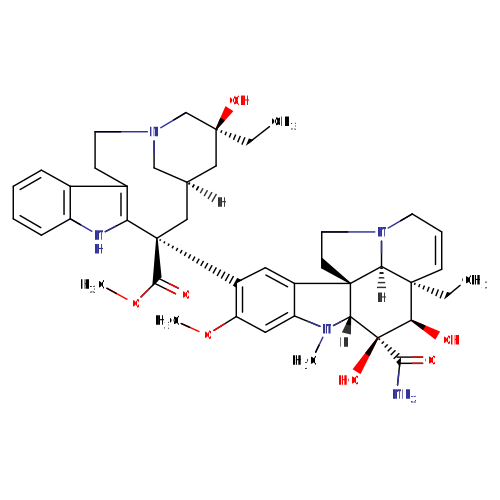
Structure for Vindesine (DB00309)
- Weight
- Average: 753.941
Monoisotopic: 753.410149131 - Chemical Formula
- C43H55N5O7
- Synonyms
- 3-(aminocarbonyl)-O4-deacetyl-3-de(methoxycarbonyl)vincaleukoblastine
- 3-carbamoyl-4-deacetyl-3-de(methoxycarbonyl)vincaleukoblastine
- Desacetylvinblastine amide
- Vindesina
- Vindesine
- Vindesinum
- External IDs
- Lilly 112531

Pharmacology
- Indication
For the treatment of acute leukaemia, malignant lymphoma, Hodgkin's disease, acute erythraemia and acute panmyelosis
 Reduce drug development failure ratesBuild, train, & validate machine-learning modelswith evidence-based and structured datasets.Build, train, & validate predictive machine-learning models with structured datasets.
- Associated Conditions
Indication Type Indication Combined Product Details Approval Level Age Group Patient Characteristics Dose Form Treatment of Acute lymphocytic leukemia (all) •••••••••••• ••••••••• ••••••••• •• •••••••••••• ••••••• •••••••••• ••••••• ••• •••••••• Treatment of Blast crisis •••••••••••• •••••••••• ••••••• ••• •••••••• Treatment of Melanoma, malignant •••••••••••• ••••••••• •• •••••••••••• ••••••• •••••••••• ••••••• ••• •••••••• - Contraindications & Blackbox Warnings
 Prevent Adverse Drug Events TodayTap into our Clinical API for life-saving information on contraindications & blackbox warnings, population restrictions, harmful risks, & more.Avoid life-threatening adverse drug events with our Clinical API
- Pharmacodynamics
Vindesine is indicated for the treatment of acute lymphocytic leukemia of childhood that is resistant to vincristine and non-oat cell lung cancer. Vindesine causes the arrest of cells in metaphase mitosis. It is three times more potent than vincristine and nearly 10 times more potent than vinblastine in causing mitotic arrest in in vitro studies at doses designed to arrest from 10 to 15% of the cells in mitosis. Vindesine and vincristine are approximately equipotent at dose levels that arrest 40 to 50% of the cells in mitosis. Unlike vinblastine, vindesine produces very few postmetaphase cells. Vindesine has demonstrated activity in patients who have relapsed while receiving multiple-agent treatment that included vincristine.
- Mechanism of action
Vindesine acts by causing the arrest of cells in metaphase mitosis through its inhibition tubulin mitotic funcitoning. The drug is cell-cycle specific for the S phase.
Target Actions Organism ATubulin beta-1 chain inhibitorHumans - Absorption
Not Available
- Volume of distribution
Not Available
- Protein binding
65-75%
- Metabolism
Hepatic
- Route of elimination
Not Available
- Half-life
24 hours.
- Clearance
Not Available
- Adverse Effects
 Improve decision support & research outcomesWith structured adverse effects data, including: blackbox warnings, adverse reactions, warning & precautions, & incidence rates. View sample adverse effects data in our new Data Library!Improve decision support & research outcomes with our structured adverse effects data.
- Toxicity
Not Available
- Pathways
Pathway Category Vindesine Action Pathway Drug action - Pharmacogenomic Effects/ADRs
- Not Available
Interactions
- Drug Interactions
- This information should not be interpreted without the help of a healthcare provider. If you believe you are experiencing an interaction, contact a healthcare provider immediately. The absence of an interaction does not necessarily mean no interactions exist.
Drug Interaction Integrate drug-drug
interactions in your softwareAbametapir The serum concentration of Vindesine can be increased when it is combined with Abametapir. Abatacept The metabolism of Vindesine can be increased when combined with Abatacept. Abciximab The risk or severity of bleeding can be increased when Abciximab is combined with Vindesine. Acalabrutinib The metabolism of Vindesine can be decreased when combined with Acalabrutinib. Acenocoumarol The risk or severity of bleeding can be increased when Acenocoumarol is combined with Vindesine. - Food Interactions
- Exercise caution with grapefruit products. Vindesine is metabolized by CYP3A4, and grapefruit inhibits CYP3A4 metabolism, which may increase vindesine serum levels.
- Exercise caution with St. John's Wort. Vindesine is metabolized by CYP3A4 and this herb induces CYP3A4 metabolism, which may reduce vindesine serum levels.
Products
 Drug product information from 10+ global regionsOur datasets provide approved product information including:dosage, form, labeller, route of administration, and marketing period.Access drug product information from over 10 global regions.
- Product Ingredients
Ingredient UNII CAS InChI Key Vindesine sulfate CPH2U7DNDY 59917-39-4 COFJBSXICYYSKG-OAUVCNBTSA-N - International/Other Brands
- Eldesine / Eldisine
- Brand Name Prescription Products
Name Dosage Strength Route Labeller Marketing Start Marketing End Region Image Eldisine Inj 5mg/2ml Powder, for solution 5 mg / vial Intravenous Eli Lilly & Co. Ltd. 1982-12-31 2000-08-03 Canada 
Categories
- ATC Codes
- L01CA03 — Vindesine
- Drug Categories
- Alkaloids
- Antimitotic Agents
- Antineoplastic Agents
- Antineoplastic Agents, Phytogenic
- Antineoplastic and Immunomodulating Agents
- Cardiotoxic antineoplastic agents
- Cytochrome P-450 CYP3A Substrates
- Cytochrome P-450 CYP3A4 Substrates
- Cytochrome P-450 CYP3A4 Substrates with a Narrow Therapeutic Index
- Cytochrome P-450 Substrates
- Heterocyclic Compounds, Fused-Ring
- Immunosuppressive Agents
- Indole Alkaloids
- Indoles
- Indolizidines
- Indolizines
- Mitosis Modulators
- Myelosuppressive Agents
- Narrow Therapeutic Index Drugs
- Secologanin Tryptamine Alkaloids
- Tubulin Modulators
- Vinca Alkaloids
- Classification
- Not classified
- Affected organisms
- Humans and other mammals
Chemical Identifiers
- UNII
- RSA8KO39WH
- CAS number
- 53643-48-4
- InChI Key
- HHJUWIANJFBDHT-ZVTSDNJWSA-N
- InChI
- InChI=1S/C43H55N5O7/c1-6-39(52)21-25-22-42(38(51)55-5,33-27(13-17-47(23-25)24-39)26-11-8-9-12-30(26)45-33)29-19-28-31(20-32(29)54-4)46(3)35-41(28)15-18-48-16-10-14-40(7-2,34(41)48)36(49)43(35,53)37(44)50/h8-12,14,19-20,25,34-36,45,49,52-53H,6-7,13,15-18,21-24H2,1-5H3,(H2,44,50)/t25-,34-,35+,36+,39-,40+,41+,42-,43-/m0/s1
- IUPAC Name
- methyl (13S,15R,17S)-13-[(1R,9R,10S,11R,12R,19R)-10-carbamoyl-12-ethyl-10,11-dihydroxy-5-methoxy-8-methyl-8,16-diazapentacyclo[10.6.1.0^{1,9}.0^{2,7}.0^{16,19}]nonadeca-2,4,6,13-tetraen-4-yl]-17-ethyl-17-hydroxy-1,11-diazatetracyclo[13.3.1.0^{4,12}.0^{5,10}]nonadeca-4(12),5(10),6,8-tetraene-13-carboxylate
- SMILES
- [H][C@@]12N3CC[C@@]11C4=CC(=C(OC)C=C4N(C)[C@@]1([H])[C@](O)([C@H](O)[C@]2(CC)C=CC3)C(N)=O)[C@]1(C[C@@]2([H])CN(C[C@](O)(CC)C2)CCC2=C1NC1=C2C=CC=C1)C(=O)OC
References
- Synthesis Reference
Stanislaw Rolski, "Method of preparing vindesine sulfate." U.S. Patent US4259242, issued September, 1965.
US4259242- General References
- Not Available
- External Links
- Human Metabolome Database
- HMDB0014454
- KEGG Drug
- D01769
- PubChem Compound
- 40839
- PubChem Substance
- 46504548
- ChemSpider
- 9818189
- 11204
- ChEBI
- 36373
- ChEMBL
- CHEMBL238071
- ZINC
- ZINC000008214470
- Therapeutic Targets Database
- DAP000949
- PharmGKB
- PA10232
- RxList
- RxList Drug Page
- Wikipedia
- Vindesine
Clinical Trials
- Clinical Trials
Phase Status Purpose Conditions Count 4 Completed Treatment Anaplastic Large Cell Lymphoma / Burkitt Lymphoma / Burkitt's Leukemia / Lymphoblastic Lymphoma / Mediastinal Neoplasms 1 4 Completed Treatment Leukemia, Lymphocytic, Acute, Adult 3 4 Completed Treatment Lymphoblastic Lymphoma 1 4 Unknown Status Treatment Metastatic Melanoma 1 3 Active Not Recruiting Treatment Acute Lymphoblastic Leukemia (ALL) / Lymphoblastic Lymphoma 1
Pharmacoeconomics
- Manufacturers
- Not Available
- Packagers
- Not Available
- Dosage Forms
Form Route Strength Injection, powder, for solution Parenteral 5 mg Injection, powder, for solution Intravenous; Parenteral 5 MG Powder, for solution Intravenous 5 mg Powder, for solution Intravenous 5 mg / vial - Prices
- Not Available
- Patents
- Not Available
Properties
- State
- Solid
- Experimental Properties
Property Value Source melting point (°C) 230-232 °C Not Available logP 2.9 Not Available - Predicted Properties
Property Value Source logP 2.79 Chemaxon pKa (Strongest Acidic) 11.34 Chemaxon pKa (Strongest Basic) 9.09 Chemaxon Physiological Charge 2 Chemaxon Hydrogen Acceptor Count 9 Chemaxon Hydrogen Donor Count 5 Chemaxon Polar Surface Area 164.82 Å2 Chemaxon Rotatable Bond Count 7 Chemaxon Refractivity 210.32 m3·mol-1 Chemaxon Polarizability 81.39 Å3 Chemaxon Number of Rings 9 Chemaxon Bioavailability 1 Chemaxon Rule of Five No Chemaxon Ghose Filter No Chemaxon Veber's Rule No Chemaxon MDDR-like Rule Yes Chemaxon - Predicted ADMET Features
Property Value Probability Human Intestinal Absorption + 0.9027 Blood Brain Barrier - 0.9821 Caco-2 permeable - 0.5154 P-glycoprotein substrate Substrate 0.9164 P-glycoprotein inhibitor I Non-inhibitor 0.5717 P-glycoprotein inhibitor II Non-inhibitor 0.6577 Renal organic cation transporter Non-inhibitor 0.8851 CYP450 2C9 substrate Non-substrate 0.8468 CYP450 2D6 substrate Non-substrate 0.9116 CYP450 3A4 substrate Substrate 0.7597 CYP450 1A2 substrate Non-inhibitor 0.8766 CYP450 2C9 inhibitor Non-inhibitor 0.8798 CYP450 2D6 inhibitor Non-inhibitor 0.8911 CYP450 2C19 inhibitor Non-inhibitor 0.8814 CYP450 3A4 inhibitor Non-inhibitor 0.811 CYP450 inhibitory promiscuity Low CYP Inhibitory Promiscuity 0.933 Ames test Non AMES toxic 0.8682 Carcinogenicity Non-carcinogens 0.8976 Biodegradation Not ready biodegradable 1.0 Rat acute toxicity 2.9430 LD50, mol/kg Not applicable hERG inhibition (predictor I) Weak inhibitor 0.9892 hERG inhibition (predictor II) Inhibitor 0.6584
Spectra
- Mass Spec (NIST)
- Not Available
- Spectra
- Chromatographic Properties
Collision Cross Sections (CCS)
Not Available
Targets

- Kind
- Protein
- Organism
- Humans
- Pharmacological action
- Yes
- Actions
- Inhibitor
- General Function
- Structural constituent of cytoskeleton
- Specific Function
- Tubulin is the major constituent of microtubules. It binds two moles of GTP, one at an exchangeable site on the beta chain and one at a non-exchangeable site on the alpha chain (By similarity).
- Gene Name
- TUBB1
- Uniprot ID
- Q9H4B7
- Uniprot Name
- Tubulin beta-1 chain
- Molecular Weight
- 50326.56 Da
References
- Overington JP, Al-Lazikani B, Hopkins AL: How many drug targets are there? Nat Rev Drug Discov. 2006 Dec;5(12):993-6. [Article]
- Imming P, Sinning C, Meyer A: Drugs, their targets and the nature and number of drug targets. Nat Rev Drug Discov. 2006 Oct;5(10):821-34. [Article]
- Natsume T, Watanabe J, Tamaoki S, Fujio N, Miyasaka K, Kobayashi M: Characterization of the interaction of TZT-1027, a potent antitumor agent, with tubulin. Jpn J Cancer Res. 2000 Jul;91(7):737-47. [Article]
- Yoshida M, Matsui Y, Ikarashi Y, Usui T, Osada H, Wakasugi H: Antiproliferating activity of the mitotic inhibitor pironetin against vindesine- and paclitaxel-resistant human small cell lung cancer H69 cells. Anticancer Res. 2007 Mar-Apr;27(2):729-36. [Article]
- Fiebig HH, Schuler J, Bausch N, Hofmann M, Metz T, Korrat A: Gene signatures developed from patient tumor explants grown in nude mice to predict tumor response to 11 cytotoxic drugs. Cancer Genomics Proteomics. 2007 May-Jun;4(3):197-209. [Article]
Enzymes
- Kind
- Protein
- Organism
- Humans
- Pharmacological action
- Unknown
- Actions
- Substrate
- General Function
- Vitamin d3 25-hydroxylase activity
- Specific Function
- Cytochromes P450 are a group of heme-thiolate monooxygenases. In liver microsomes, this enzyme is involved in an NADPH-dependent electron transport pathway. It performs a variety of oxidation react...
- Gene Name
- CYP3A4
- Uniprot ID
- P08684
- Uniprot Name
- Cytochrome P450 3A4
- Molecular Weight
- 57342.67 Da
References
- Ekins S, Bravi G, Wikel JH, Wrighton SA: Three-dimensional-quantitative structure activity relationship analysis of cytochrome P-450 3A4 substrates. J Pharmacol Exp Ther. 1999 Oct;291(1):424-33. [Article]
- Smith NF, Mani S, Schuetz EG, Yasuda K, Sissung TM, Bates SE, Figg WD, Sparreboom A: Induction of CYP3A4 by vinblastine: Role of the nuclear receptor NR1I2. Ann Pharmacother. 2010 Nov;44(11):1709-17. doi: 10.1345/aph.1P354. Epub 2010 Oct 19. [Article]
- Zhou XJ, Zhou-Pan XR, Gauthier T, Placidi M, Maurel P, Rahmani R: Human liver microsomal cytochrome P450 3A isozymes mediated vindesine biotransformation. Metabolic drug interactions. Biochem Pharmacol. 1993 Feb 24;45(4):853-61. [Article]

Drug created at June 13, 2005 13:24 / Updated at March 03, 2024 02:31