Identification
- Summary
Piperacillin is a penicillin antibiotic combined with tazobactam to treat piperacillin-resistant, piperacillin/tazobactam susceptible, β-lactamase generating strains of several bacteria.
- Brand Names
- Pipracil, Zosyn
- Generic Name
- Piperacillin
- DrugBank Accession Number
- DB00319
- Background
Semisynthetic, broad-spectrum, ampicillin derived ureidopenicillin antibiotic proposed for pseudomonas infections. It is also used in combination with other antibiotics.
- Type
- Small Molecule
- Groups
- Approved
- Structure
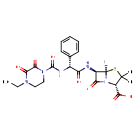
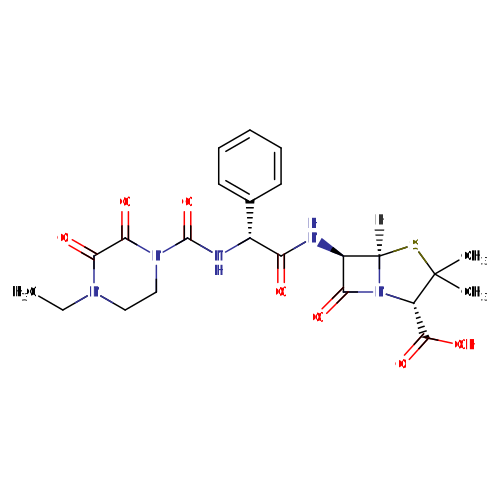
Structure for Piperacillin (DB00319)
- Weight
- Average: 517.555
Monoisotopic: 517.163118933 - Chemical Formula
- C23H27N5O7S
- Synonyms
- (2S,5R,6R)-6-{[(2R)-2-{[(4-ethyl-2,3-dioxopiperazin-1-yl)carbonyl]amino}-2-phenylacetyl]amino}-3,3-dimethyl-7-oxo-4-thia-1-azabicyclo[3.2.0]heptane-2-carboxylic acid
- Piperacilina
- Piperacillin
- Piperacillin anhydrous
- Piperacillina
- Pipéracilline
- Piperacillinum
- External IDs
- BL-P 1908
- CI 867
- CL 227193
- T 1220

Pharmacology
- Indication
For the treatment of polymicrobial infections.
 Reduce drug development failure ratesBuild, train, & validate machine-learning modelswith evidence-based and structured datasets.Build, train, & validate predictive machine-learning models with structured datasets.
- Associated Conditions
Indication Type Indication Combined Product Details Approval Level Age Group Patient Characteristics Dose Form Used in combination to treat Animal bite Combination Product in combination with: Tazobactam (DB01606) ••• ••••• Prophylaxis of Bacterial infections •••••••••••• Treatment of Bone and joint infections •••••••••••• Used in combination to treat Community acquired pneumonia (cap) Combination Product in combination with: Tazobactam (DB01606) •••••••••••• ••••• Treatment of Gynaecological infection •••••••••••• - Contraindications & Blackbox Warnings
 Prevent Adverse Drug Events TodayTap into our Clinical API for life-saving information on contraindications & blackbox warnings, population restrictions, harmful risks, & more.Avoid life-threatening adverse drug events with our Clinical API
- Pharmacodynamics
Piperacillin is a penicillin beta-lactam antibiotic used in the treatment of bacterial infections caused by susceptible, usually gram-positive, organisms. The name "penicillin" can either refer to several variants of penicillin available, or to the group of antibiotics derived from the penicillins. Piperacillin has in vitro activity against gram-positive and gram-negative aerobic and anaerobic bacteria. The bactericidal activity of Piperacillin results from the inhibition of cell wall synthesis and is mediated through Piperacillin binding to penicillin binding proteins (PBPs). Piperacillin is stable against hydrolysis by a variety of beta-lactamases, including penicillinases, and cephalosporinases and extended spectrum beta-lactamases.
- Mechanism of action
By binding to specific penicillin-binding proteins (PBPs) located inside the bacterial cell wall, Piperacillin inhibits the third and last stage of bacterial cell wall synthesis. Cell lysis is then mediated by bacterial cell wall autolytic enzymes such as autolysins; it is possible that Piperacillin interferes with an autolysin inhibitor.
Target Actions Organism APenicillin-binding protein 3 inhibitorStreptococcus pneumoniae APenicillin-binding protein 2B inhibitorStreptococcus pneumoniae (strain ATCC BAA-255 / R6) APenicillin-binding protein 2a inhibitorStreptococcus pneumoniae (strain ATCC BAA-255 / R6) APenicillin-binding protein 1b inhibitorStreptococcus pneumoniae (strain ATCC BAA-255 / R6) - Absorption
Not absorbed following oral administration.
- Volume of distribution
- 101 mL/kg [intravenous administration of 50 mg/kg (5-minute infusion) in neonates]
- Protein binding
Not Available
- Metabolism
Largely not metabolized.
- Route of elimination
As with other penicillins, PIPRACIL is eliminated primarily by glomerular filtration and tubular secretion; it is excreted rapidly as unchanged drug in high concentrations in the urine. Because PIPRACIL is excreted by the biliary route as well as by the renal route, it can be used safely in appropriate dosage in patients with severely restricted kidney function.
- Half-life
36-72 minutes
- Clearance
- 32 - 41 mL/min/1.73 m2
- 124 - 160 mL/min/1.73 m2 [older pediatric patients]
- Adverse Effects
 Improve decision support & research outcomesWith structured adverse effects data, including: blackbox warnings, adverse reactions, warning & precautions, & incidence rates. View sample adverse effects data in our new Data Library!Improve decision support & research outcomes with our structured adverse effects data.
- Toxicity
Not Available
- Pathways
- Not Available
- Pharmacogenomic Effects/ADRs
- Not Available
Interactions
- Drug Interactions
- This information should not be interpreted without the help of a healthcare provider. If you believe you are experiencing an interaction, contact a healthcare provider immediately. The absence of an interaction does not necessarily mean no interactions exist.
Drug Interaction Integrate drug-drug
interactions in your softwareAbacavir Piperacillin may decrease the excretion rate of Abacavir which could result in a higher serum level. Aceclofenac Aceclofenac may decrease the excretion rate of Piperacillin which could result in a higher serum level. Acemetacin Acemetacin may decrease the excretion rate of Piperacillin which could result in a higher serum level. Acenocoumarol Piperacillin may increase the anticoagulant activities of Acenocoumarol. Acetaminophen Acetaminophen may decrease the excretion rate of Piperacillin which could result in a higher serum level. - Food Interactions
- No interactions found.
Products
 Drug product information from 10+ global regionsOur datasets provide approved product information including:dosage, form, labeller, route of administration, and marketing period.Access drug product information from over 10 global regions.
- Product Ingredients
Ingredient UNII CAS InChI Key Piperacillin sodium M98T69Q7HP 59703-84-3 WCMIIGXFCMNQDS-IDYPWDAWSA-M - International/Other Brands
- Ecosette (Farmaceutici T.S.) / Farecillin (SF Group) / Penmalin (Sawai Seiyaku) / Pentcillin (Toyama Kagaku) / Peracin (Pharmadica) / Piciliant (Shiono Kemikaru) / Picillin (CT) / Picillina (CCPC) / Piperac (Klonal) / Stepten (Aversi) / Tronazam (Richmond)
- Brand Name Prescription Products
Name Dosage Strength Route Labeller Marketing Start Marketing End Region Image Piperacillin for Injection Powder, for solution 2 g / vial Intramuscular; Intravenous Hospira Healthcare Ulc 2003-01-23 2017-07-17 Canada 
Piperacillin for Injection Powder, for solution 2 g / vial Intramuscular; Intravenous Fresenius Kabi 2004-07-29 2021-10-07 Canada Piperacillin for Injection Powder, for solution 4 g / vial Intramuscular; Intravenous Fresenius Kabi 2004-08-05 2021-10-07 Canada Piperacillin for Injection Powder, for solution 3 g / vial Intramuscular; Intravenous Hospira Healthcare Ulc 2003-01-23 2019-04-01 Canada Piperacillin for Injection Powder, for solution 3 g / vial Intramuscular; Intravenous Fresenius Kabi 2004-08-05 2021-10-07 Canada - Mixture Products
Name Ingredients Dosage Route Labeller Marketing Start Marketing End Region Image ALBACTAM Piperacillin (2 G/1VIAL) + Tazobactam (250 MG/1VIAL) Injection, powder, for solution บริษัท อาร์เอ็กซ์ จำกัด 2017-02-16 Not applicable Thailand 
ALVOTAZ POWDER FOR SOLUTION FOR INJECTION/INFUSION 4.5G/VIAL Piperacillin sodium (4 g) + Tazobactam sodium (500 mg) Injection, powder, for solution Intravenous ALVOGEN SINGAPORE PTE. LTD. 2014-10-24 Not applicable Singapore 
AVITAZ 2.25 G I.V. ENJEKSIYONLUK LIYOFILIZE TOZ IÇEREN FLAKON ,FLAKON, 1 ADET Piperacillin (2 g) + Tazobactam (250 mg) Injection, powder, lyophilized, for solution Intravenous AVİS İLAÇ SAN. VE TİC. A.Ş. 2020-08-14 Not applicable Turkey 
AVITAZ 4.5 G I.V. ENJEKSIYONLUK LIYOFILIZE TOZ IÇEREN FLAKON ,FLAKON, 1 ADET Piperacillin (4 g) + Tazobactam (500 mg) Injection, powder, lyophilized, for solution Intravenous AVİS İLAÇ SAN. VE TİC. A.Ş. 2015-09-17 Not applicable Turkey DBL PIPERACILLIN AND TAZOBACTAM FOR INJECTION 4.5 G Piperacillin (4 G/1VIAL) + Tazobactam (500 MG/1VIAL) Injection, powder, for solution บริษัท ไฟเซอร์ พาร์ค เดวิส (ประเทศไทย) จำกัด 2017-05-23 2020-09-29 Thailand - Unapproved/Other Products
Name Ingredients Dosage Route Labeller Marketing Start Marketing End Region Image Piperacillin, Tazobactam Piperacillin sodium (4 g/50mL) + Tazobactam sodium (0.5 g/50mL) Injection, powder, lyophilized, for solution Intravenous X-GEN Pharmaceuticals, Inc. 2017-02-14 2017-11-30 US 
Piperacillin, Tazobactam Piperacillin sodium (3 g/20mL) + Tazobactam sodium (0.375 g/20mL) Injection, powder, lyophilized, for solution Intravenous X-GEN Pharmaceuticals, Inc. 2017-02-14 2017-11-30 US Piperacillin, Tazobactam Piperacillin sodium (36 g/200mL) + Tazobactam sodium (4.5 g/200mL) Injection, powder, lyophilized, for solution Intravenous X-GEN Pharmaceuticals, Inc. 2017-02-14 2017-10-31 US
Categories
- ATC Codes
- J01CR50 — Combinations of penicillins
- J01CR — Combinations of penicillins, incl. beta-lactamase inhibitors
- J01C — BETA-LACTAM ANTIBACTERIALS, PENICILLINS
- J01 — ANTIBACTERIALS FOR SYSTEMIC USE
- J — ANTIINFECTIVES FOR SYSTEMIC USE
- Drug Categories
- Agents that produce neuromuscular block (indirect)
- Amides
- Anti-Bacterial Agents
- Anti-Infective Agents
- Antibacterials for Systemic Use
- Antiinfectives for Systemic Use
- Beta-Lactam Antibacterials
- beta-Lactams
- Drugs that are Mainly Renally Excreted
- Extended-spectrum Penicillins
- Heterocyclic Compounds, Fused-Ring
- Lactams
- OAT1/SLC22A6 inhibitors
- OAT3/SLC22A8 Substrates
- Penicillin G
- Penicillins
- Penicillins With Extended Spectrum
- Sulfur Compounds
- Chemical TaxonomyProvided by Classyfire
- Description
- This compound belongs to the class of organic compounds known as peptides. These are compounds containing an amide derived from two or more amino carboxylic acid molecules (the same or different) by formation of a covalent bond from the carbonyl carbon of one to the nitrogen atom of another.
- Kingdom
- Organic compounds
- Super Class
- Organic acids and derivatives
- Class
- Carboxylic acids and derivatives
- Sub Class
- Amino acids, peptides, and analogues
- Direct Parent
- Peptides
- Alternative Parents
- Penicillins / N-acyl-alpha amino acids and derivatives / N-carbamoyl-alpha amino acids and derivatives / Alpha amino acid amides / Phenylacetamides / Piperazine carboxamides / Dioxopiperazines / N-acyl ureas / N-alkylpiperazines / Tertiary carboxylic acid amides show 14 more
- Substituents
- 1,4-diazinane / Alpha peptide / Alpha-amino acid amide / Alpha-amino acid or derivatives / Aromatic heteropolycyclic compound / Azacycle / Azetidine / Benzenoid / Beta-lactam / Carbonic acid derivative show 34 more
- Molecular Framework
- Aromatic heteropolycyclic compounds
- External Descriptors
- penicillin (CHEBI:8232)
- Affected organisms
- Enteric bacteria and other eubacteria
Chemical Identifiers
- UNII
- 9I628532GX
- CAS number
- 66258-76-2
- InChI Key
- IVBHGBMCVLDMKU-GXNBUGAJSA-N
- InChI
- InChI=1S/C23H27N5O7S/c1-4-26-10-11-27(19(32)18(26)31)22(35)25-13(12-8-6-5-7-9-12)16(29)24-14-17(30)28-15(21(33)34)23(2,3)36-20(14)28/h5-9,13-15,20H,4,10-11H2,1-3H3,(H,24,29)(H,25,35)(H,33,34)/t13-,14-,15+,20-/m1/s1
- IUPAC Name
- (2S,5R,6R)-6-[(2R)-2-[(4-ethyl-2,3-dioxopiperazine-1-carbonyl)amino]-2-phenylacetamido]-3,3-dimethyl-7-oxo-4-thia-1-azabicyclo[3.2.0]heptane-2-carboxylic acid
- SMILES
- [H][C@]12SC(C)(C)[C@@H](N1C(=O)[C@H]2NC(=O)[C@H](NC(=O)N1CCN(CC)C(=O)C1=O)C1=CC=CC=C1)C(O)=O
References
- Synthesis Reference
Bruce E. Haeger, "Composition of matter comprising a low bulk density lyophilized preparation of Sodium Piperacillin." U.S. Patent US4534977, issued October, 1984.
US4534977- General References
- Lau WK, Mercer D, Itani KM, Nicolau DP, Kuti JL, Mansfield D, Dana A: Randomized, open-label, comparative study of piperacillin-tazobactam administered by continuous infusion versus intermittent infusion for treatment of hospitalized patients with complicated intra-abdominal infection. Antimicrob Agents Chemother. 2006 Nov;50(11):3556-61. Epub 2006 Aug 28. [Article]
- FDA Approved Drug Products: PIPRACIL (piperacillin) injection [Link]
- FDA Approved Drug Products: ZOSYN (piperacillin and tazobactam) injection [Link]
- External Links
- Human Metabolome Database
- HMDB0014464
- KEGG Drug
- D00466
- KEGG Compound
- C14034
- PubChem Compound
- 43672
- PubChem Substance
- 46504757
- ChemSpider
- 39798
- BindingDB
- 50240426
- 1546000
- ChEBI
- 8232
- ChEMBL
- CHEMBL702
- ZINC
- ZINC000003913937
- Therapeutic Targets Database
- DAP001164
- PharmGKB
- PA450975
- PDBe Ligand
- WPP
- RxList
- RxList Drug Page
- Drugs.com
- Drugs.com Drug Page
- Wikipedia
- Piperacillin
- PDB Entries
- 3q07
- MSDS
- Download (50.5 KB)
Clinical Trials
- Clinical Trials
Phase Status Purpose Conditions Count 4 Completed Health Services Research Bacterial Infections 1 4 Completed Prevention Bacterial Infections 1 4 Completed Treatment Appendicitis 2 4 Completed Treatment Appendicitis / Complicated Appendicitis / Perforated Appendicitis / Ruptured Appendicitis 1 4 Completed Treatment Bacterial Infections 1
Pharmacoeconomics
- Manufacturers
- Istituto biochimico italiano giovanni lorenzini
- Wyeth pharmaceuticals inc
- Packagers
- APP Pharmaceuticals
- Ibi Istituto Biochimico Italiano Giovanni Lorenzini SPA
- Dosage Forms
Form Route Strength Powder, for solution Intravenous Injection, powder, for solution Intramuscular Solution Intravenous Injection, powder, for solution Injection, powder, for solution Intramuscular Powder, for solution Intravenous Injection, powder, for solution Intravenous Injection, powder, for solution Intravenous; Parenteral Injection, powder, lyophilized, for solution Intravenous Injection, powder, lyophilized, for solution Intravenous; Parenteral Powder Not applicable Injection, powder, for solution Intravenous 4000 mg Injection, powder, for solution Intravenous 4 g Injection, powder, for solution Parenteral Injection, powder, for solution Parenteral Injection, powder, for solution Parenteral 1 G Injection, powder, for solution Parenteral 2 G Injection, powder, for solution 1 G Injection, powder, for solution Intramuscular; Intravenous 2 G/4ML Injection, powder, for solution Parenteral 1 G/2ML Injection, powder, for solution Parenteral 2 G/4ML Injection, powder, for solution Intramuscular; Parenteral 1 G Injection, powder, for solution Intramuscular; Parenteral 2 G Injection, powder, for solution Intravenous Injection, powder, for solution 2 G Injection, powder, for solution Intramuscular 1 G/2ML Injection, powder, for solution Intramuscular 2 G/4ML Powder, for solution Parenteral 4 G Injection, powder, for solution Parenteral 4 G Injection, powder, lyophilized, for solution Intramuscular; Intravenous 2 g/1 Injection, powder, lyophilized, for solution Intramuscular; Intravenous 3 g/1 Injection, powder, lyophilized, for solution Intramuscular; Intravenous 4 g/1 Powder, for solution Intravenous 40 g / vial Powder, for solution Intramuscular; Intravenous 4 g / vial Powder, for solution Intramuscular; Intravenous 2 g / vial Powder, for solution Intramuscular; Intravenous 3 g / vial Injection, powder, for solution Intravenous 4 g Injection, powder, for solution Intravenous 0 - Solution Parenteral Injection, powder, for solution Injection, powder, lyophilized, for solution Intravenous 2 g Injection, powder, lyophilized, for solution Intravenous 4.5 g Injection, powder, lyophilized, for solution Powder Injection Intravenous 2.25 g Injection Intravenous 4.5 g Solution Intravenous 4.170 g Injection, solution Intravenous - Prices
Unit description Cost Unit Piperacillin 40 gm bulk vial 154.8USD vial Piperacillin 4 gm vial 16.7USD vial Piperacillin 3 gm vial 12.53USD vial Piperacillin 2 gm vial 8.35USD vial DrugBank does not sell nor buy drugs. Pricing information is supplied for informational purposes only.- Patents
Patent Number Pediatric Extension Approved Expires (estimated) Region US6900184 No 2005-05-31 2023-04-14 US US8133883 No 2012-03-13 2023-04-14 US US7915229 No 2011-03-29 2023-04-14 US US6207661 No 2001-03-27 2019-02-22 US
Properties
- State
- Solid
- Experimental Properties
Property Value Source logP 0.3 Not Available - Predicted Properties
Property Value Source Water Solubility 0.119 mg/mL ALOGPS logP 0.67 ALOGPS logP -0.26 Chemaxon logS -3.6 ALOGPS pKa (Strongest Acidic) 3.49 Chemaxon pKa (Strongest Basic) -4.3 Chemaxon Physiological Charge -1 Chemaxon Hydrogen Acceptor Count 7 Chemaxon Hydrogen Donor Count 3 Chemaxon Polar Surface Area 156.43 Å2 Chemaxon Rotatable Bond Count 6 Chemaxon Refractivity 126.3 m3·mol-1 Chemaxon Polarizability 51.77 Å3 Chemaxon Number of Rings 4 Chemaxon Bioavailability 1 Chemaxon Rule of Five No Chemaxon Ghose Filter No Chemaxon Veber's Rule No Chemaxon MDDR-like Rule Yes Chemaxon - Predicted ADMET Features
Property Value Probability Human Intestinal Absorption - 0.8753 Blood Brain Barrier - 0.9958 Caco-2 permeable - 0.7121 P-glycoprotein substrate Substrate 0.9442 P-glycoprotein inhibitor I Non-inhibitor 0.6043 P-glycoprotein inhibitor II Non-inhibitor 0.991 Renal organic cation transporter Non-inhibitor 0.8791 CYP450 2C9 substrate Non-substrate 0.7392 CYP450 2D6 substrate Non-substrate 0.8002 CYP450 3A4 substrate Substrate 0.5889 CYP450 1A2 substrate Non-inhibitor 0.8597 CYP450 2C9 inhibitor Non-inhibitor 0.7568 CYP450 2D6 inhibitor Non-inhibitor 0.9002 CYP450 2C19 inhibitor Non-inhibitor 0.7289 CYP450 3A4 inhibitor Non-inhibitor 0.8856 CYP450 inhibitory promiscuity Low CYP Inhibitory Promiscuity 0.948 Ames test Non AMES toxic 0.9133 Carcinogenicity Non-carcinogens 0.9021 Biodegradation Not ready biodegradable 0.8093 Rat acute toxicity 2.3925 LD50, mol/kg Not applicable hERG inhibition (predictor I) Weak inhibitor 0.9902 hERG inhibition (predictor II) Inhibitor 0.6173
Spectra
- Mass Spec (NIST)
- Not Available
- Spectra
- Chromatographic Properties
Collision Cross Sections (CCS)
Adduct CCS Value (Å2) Source type Source [M-H]- 234.5792401 predictedDarkChem Lite v0.1.0 [M-H]- 235.1900401 predictedDarkChem Lite v0.1.0 [M-H]- 210.65627 predictedDeepCCS 1.0 (2019) [M+H]+ 235.9019401 predictedDarkChem Lite v0.1.0 [M+H]+ 234.3073401 predictedDarkChem Lite v0.1.0 [M+H]+ 212.55168 predictedDeepCCS 1.0 (2019) [M+Na]+ 235.2660401 predictedDarkChem Lite v0.1.0 [M+Na]+ 234.3693401 predictedDarkChem Lite v0.1.0 [M+Na]+ 218.17079 predictedDeepCCS 1.0 (2019)
Targets

- Kind
- Protein
- Organism
- Streptococcus pneumoniae
- Pharmacological action
- Yes
- Actions
- Inhibitor
- General Function
- Serine-type d-ala-d-ala carboxypeptidase activity
- Specific Function
- Not Available
- Gene Name
- pbp3
- Uniprot ID
- Q75Y35
- Uniprot Name
- Penicillin-binding protein 3
- Molecular Weight
- 45209.84 Da
References
- Williamson R, Hakenbeck R, Tomasz A: In vivo interaction of beta-lactam antibiotics with the penicillin-binding proteins of Streptococcus pneumoniae. Antimicrob Agents Chemother. 1980 Oct;18(4):629-37. [Article]
- Kind
- Protein
- Organism
- Streptococcus pneumoniae (strain ATCC BAA-255 / R6)
- Pharmacological action
- Yes
- Actions
- Inhibitor
- General Function
- Not Available
- Specific Function
- Penicillin binding
- Gene Name
- penA
- Uniprot ID
- P0A3M6
- Uniprot Name
- Penicillin-binding protein 2B
- Molecular Weight
- 73872.305 Da
References
- Williamson R, Hakenbeck R, Tomasz A: In vivo interaction of beta-lactam antibiotics with the penicillin-binding proteins of Streptococcus pneumoniae. Antimicrob Agents Chemother. 1980 Oct;18(4):629-37. [Article]
- Kind
- Protein
- Organism
- Streptococcus pneumoniae (strain ATCC BAA-255 / R6)
- Pharmacological action
- Yes
- Actions
- Inhibitor
- General Function
- Transferase activity, transferring acyl groups
- Specific Function
- Not Available
- Gene Name
- pbp2a
- Uniprot ID
- Q8DNB6
- Uniprot Name
- Penicillin-binding protein 2a
- Molecular Weight
- 80797.94 Da
References
- Williamson R, Hakenbeck R, Tomasz A: In vivo interaction of beta-lactam antibiotics with the penicillin-binding proteins of Streptococcus pneumoniae. Antimicrob Agents Chemother. 1980 Oct;18(4):629-37. [Article]
- Kind
- Protein
- Organism
- Streptococcus pneumoniae (strain ATCC BAA-255 / R6)
- Pharmacological action
- Yes
- Actions
- Inhibitor
- General Function
- Transferase activity, transferring acyl groups
- Specific Function
- Not Available
- Gene Name
- pbp1b
- Uniprot ID
- Q7CRA4
- Uniprot Name
- Penicillin-binding protein 1b
- Molecular Weight
- 89479.92 Da
References
- Williamson R, Hakenbeck R, Tomasz A: In vivo interaction of beta-lactam antibiotics with the penicillin-binding proteins of Streptococcus pneumoniae. Antimicrob Agents Chemother. 1980 Oct;18(4):629-37. [Article]
Transporters
- Kind
- Protein
- Organism
- Humans
- Pharmacological action
- Unknown
- Actions
- Inhibitor
- General Function
- Sodium-independent organic anion transmembrane transporter activity
- Specific Function
- Involved in the renal elimination of endogenous and exogenous organic anions. Functions as organic anion exchanger when the uptake of one molecule of organic anion is coupled with an efflux of one ...
- Gene Name
- SLC22A6
- Uniprot ID
- Q4U2R8
- Uniprot Name
- Solute carrier family 22 member 6
- Molecular Weight
- 61815.78 Da
References
- Jariyawat S, Sekine T, Takeda M, Apiwattanakul N, Kanai Y, Sophasan S, Endou H: The interaction and transport of beta-lactam antibiotics with the cloned rat renal organic anion transporter 1. J Pharmacol Exp Ther. 1999 Aug;290(2):672-7. [Article]
- Kind
- Protein
- Organism
- Humans
- Pharmacological action
- Unknown
- Actions
- Substrate
- General Function
- Sodium-independent organic anion transmembrane transporter activity
- Specific Function
- Plays an important role in the excretion/detoxification of endogenous and exogenous organic anions, especially from the brain and kidney. Involved in the transport basolateral of steviol, fexofenad...
- Gene Name
- SLC22A8
- Uniprot ID
- Q8TCC7
- Uniprot Name
- Solute carrier family 22 member 8
- Molecular Weight
- 59855.585 Da
References
- Wen S, Wang C, Duan Y, Huo X, Meng Q, Liu Z, Yang S, Zhu Y, Sun H, Ma X, Yang S, Liu K: OAT1 and OAT3 also mediate the drug-drug interaction between piperacillin and tazobactam. Int J Pharm. 2018 Feb 15;537(1-2):172-182. doi: 10.1016/j.ijpharm.2017.12.037. Epub 2017 Dec 23. [Article]

Drug created at June 13, 2005 13:24 / Updated at April 27, 2024 09:44