Identification
- Summary
Profenamine is an antidyskinetic phenothiazine used to treat the symptoms of Parkinson's disease.
- Generic Name
- Profenamine
- DrugBank Accession Number
- DB00392
- Background
Profenamine (also known as ethopropazine) is a medication derived from phenothiazine. It is primarily used as an antidyskinetic to treat Parkinsonism. It is sold under the trade name Parsitan in Canada.1 In the US, the marketing of profenamine has been discontinued.2
- Type
- Small Molecule
- Groups
- Approved
- Structure
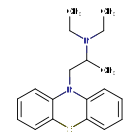
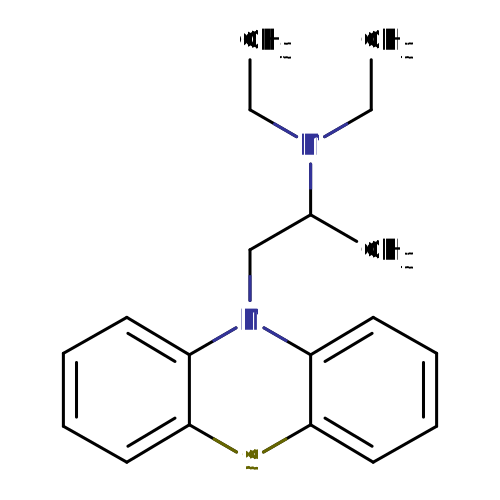
Structure for Profenamine (DB00392)
- Weight
- Average: 312.472
Monoisotopic: 312.166019468 - Chemical Formula
- C19H24N2S
- Synonyms
- 10-(2-diethylaminopropyl)phenothiazine
- 10-[2-(diethylamino)-1-propyl]phenothiazine
- 10-[2-(diethylamino)-2-methylethyl]phenothiazine
- 10-[2-(diethylamino)propyl]phenothiazine
- 2-diethylamino-1-propyl-N-dibenzoparathiazine
- Ethopropazine
- N,N-diethyl-1-(10H-phenothiazin-10-yl)-2-propanamine
- N,N-diethyl-α-methyl-10H-phenothiazine-10-ethanamine
- Profenamina
- Profenamine
- Profénamine
- Profenaminum
- External IDs
- RP-3356
- SC-2538
- W-483

Pharmacology
- Indication
Profenamine is indicated in the symptomatic treatment of drug-induced extrapyramidal reactions and of the manifestations (rigidity, akinesia, sialorrhea, oculogyric crisis, tremor, etc.) of Parkinson's disease of encephalitic, arteriosclerotic or idiopathic origin.1 It is also used to control severe reactions to certain medicines such as reserpine.
 Reduce drug development failure ratesBuild, train, & validate machine-learning modelswith evidence-based and structured datasets.Build, train, & validate predictive machine-learning models with structured datasets.
- Associated Conditions
Indication Type Indication Combined Product Details Approval Level Age Group Patient Characteristics Dose Form Symptomatic treatment of Drug induced parkinsonism •••••••••••• •••••• Symptomatic treatment of Parkinsonism •••••••••••• •••••• - Contraindications & Blackbox Warnings
 Prevent Adverse Drug Events TodayTap into our Clinical API for life-saving information on contraindications & blackbox warnings, population restrictions, harmful risks, & more.Avoid life-threatening adverse drug events with our Clinical API
- Pharmacodynamics
Profenamine, a phenothiazine and antidyskinetic, is used in the treatment of Parkinson's disease. By improving muscle control and reducing stiffness, this drug permits more normal movements of the body as the disease symptoms are reduced. It is also used to control severe reactions to certain medicines such as reserpine, phenothiazines, chlorprothixene, thiothixene, loxapine, and haloperidol. Unlike other NMDA antagonists, profenamine — because of its anticholinergic action — is largely devoid of neurotoxic side effects. Profenamine also has a slight antihistaminic and local anesthetic effect.
- Mechanism of action
Profenamine's anti-Parkinson action can be attributed to its anticholinergic properties. Profenamine partially blocks central (striatal) cholinergic receptors, thereby helping to balance cholinergic and dopaminergic activity in the basal ganglia; salivation may be decreased, and smooth muscle may be relaxed. Drug-induced extrapyramidal symptoms and those due to parkinsonism may be relieved, but tardive dyskinesia is not alleviated and may be aggravated by anticholinergic effects. Profenamine's local anesthetic effect is due to its antagonism of the NMDA glutamate receptor. Glutamate is recognized as an important transmitter in nociceptive pathways, and the N-methyl-D-aspartate (NMDA) subtype of the glutamate receptor, in particular, has been implicated in the mediation of neuropathic pain. Excessive release of glutamate at NMDA receptors on dorsal horn neurons of the spinal cord results in hyperactivation and hypersensitivity of these receptors (perceived as hyperalgesia), thought to be an integral feature of neuropathic pain.
Target Actions Organism AMuscarinic acetylcholine receptor M1 antagonistHumans AGlutamate receptor ionotropic, NMDA 3A antagonistHumans UMuscarinic acetylcholine receptor M2 antagonistHumans - Absorption
Well-absorbed from the gastrointestinal tract.
- Volume of distribution
Not Available
- Protein binding
93%
- Metabolism
- Not Available
- Route of elimination
Not Available
- Half-life
1 to 2 hours
- Clearance
Not Available
- Adverse Effects
 Improve decision support & research outcomesWith structured adverse effects data, including: blackbox warnings, adverse reactions, warning & precautions, & incidence rates. View sample adverse effects data in our new Data Library!Improve decision support & research outcomes with our structured adverse effects data.
- Toxicity
Symptoms of overdose include severe clumsiness or unsteadiness, severe drowsiness, severe dryness of mouth, nose, or throat, fast heartbeat, shortness of breath or troubled breathing, and warmth, dryness, and flushing of skin.
- Pathways
- Not Available
- Pharmacogenomic Effects/ADRs
- Not Available
Interactions
- Drug Interactions
- This information should not be interpreted without the help of a healthcare provider. If you believe you are experiencing an interaction, contact a healthcare provider immediately. The absence of an interaction does not necessarily mean no interactions exist.
Drug Interaction Integrate drug-drug
interactions in your softwareAcebutolol Profenamine may increase the bradycardic activities of Acebutolol. Acetylcholine The risk or severity of adverse effects can be increased when Profenamine is combined with Acetylcholine. Aclidinium The risk or severity of adverse effects can be increased when Profenamine is combined with Aclidinium. Adenosine The risk or severity of Tachycardia can be increased when Profenamine is combined with Adenosine. Albuterol The therapeutic efficacy of Salbutamol can be decreased when used in combination with Profenamine. - Food Interactions
- No interactions found.
Products
 Drug product information from 10+ global regionsOur datasets provide approved product information including:dosage, form, labeller, route of administration, and marketing period.Access drug product information from over 10 global regions.
- Product Ingredients
Ingredient UNII CAS InChI Key Ethopropazine hydrochloride O00T1I1VRN 1094-08-2 VXPCQISYVPFYRK-UHFFFAOYSA-N - International/Other Brands
- Dibutil (Bayer) / Parkin (Tanabe) / Parsidol / Parsitan
- Brand Name Prescription Products
Name Dosage Strength Route Labeller Marketing Start Marketing End Region Image Parsitan 50 Tablet 50 mg Oral Searchlight Pharma Inc 1952-12-31 Not applicable Canada 
Categories
- ATC Codes
- N04AA05 — Profenamine
- Drug Categories
- Adrenergic Agents
- Adrenergic Antagonists
- Agents producing tachycardia
- Anti-Parkinson Drugs
- Anticholinergic Agents
- Cholinergic Agents
- Cholinesterase Inhibitors
- Heterocyclic Compounds, Fused-Ring
- Histamine Agents
- Muscarinic Antagonists
- Nervous System
- Neurotransmitter Agents
- NMDA Receptor Antagonists
- Sulfur Compounds
- Tertiary Amines
- Chemical TaxonomyProvided by Classyfire
- Description
- This compound belongs to the class of organic compounds known as phenothiazines. These are polycyclic aromatic compounds containing a phenothiazine moiety, which is a linear tricyclic system that consists of a two benzene rings joined by a para-thiazine ring.
- Kingdom
- Organic compounds
- Super Class
- Organoheterocyclic compounds
- Class
- Benzothiazines
- Sub Class
- Phenothiazines
- Direct Parent
- Phenothiazines
- Alternative Parents
- Alkyldiarylamines / Diarylthioethers / Benzenoids / 1,4-thiazines / Trialkylamines / Azacyclic compounds / Organopnictogen compounds / Hydrocarbon derivatives
- Substituents
- Alkyldiarylamine / Amine / Aromatic heteropolycyclic compound / Aryl thioether / Azacycle / Benzenoid / Diarylthioether / Hydrocarbon derivative / Organic nitrogen compound / Organonitrogen compound
- Molecular Framework
- Aromatic heteropolycyclic compounds
- External Descriptors
- phenothiazines, tertiary amino compound (CHEBI:313639)
- Affected organisms
- Humans and other mammals
Chemical Identifiers
- UNII
- 7WI4P02YN1
- CAS number
- 522-00-9
- InChI Key
- CDOZDBSBBXSXLB-UHFFFAOYSA-N
- InChI
- InChI=1S/C19H24N2S/c1-4-20(5-2)15(3)14-21-16-10-6-8-12-18(16)22-19-13-9-7-11-17(19)21/h6-13,15H,4-5,14H2,1-3H3
- IUPAC Name
- diethyl[1-(10H-phenothiazin-10-yl)propan-2-yl]amine
- SMILES
- CCN(CC)C(C)CN1C2=CC=CC=C2SC2=CC=CC=C12
References
- Synthesis Reference
Berg, S.S. and Ashley, J.N.; U.S. Patent 2,607,773; August 19,1952; assigned to Societe des Usines Chimiques Rhone-Poulenc, France.
- General References
- External Links
- Human Metabolome Database
- HMDB0014536
- KEGG Drug
- D01118
- PubChem Compound
- 3290
- PubChem Substance
- 46507375
- ChemSpider
- 3174
- BindingDB
- 8958
- 4134
- ChEBI
- 313639
- ChEMBL
- CHEMBL1206
- Therapeutic Targets Database
- DAP001119
- PharmGKB
- PA449531
- Wikipedia
- Profenamine
- MSDS
- Download (74 KB)
Clinical Trials
Pharmacoeconomics
- Manufacturers
- Parke davis div warner lambert co
- Packagers
- Not Available
- Dosage Forms
Form Route Strength Tablet Oral 50 mg - Prices
Unit description Cost Unit Parsitan 50 mg Tablet 0.23USD tablet DrugBank does not sell nor buy drugs. Pricing information is supplied for informational purposes only.- Patents
- Not Available
Properties
- State
- Solid
- Experimental Properties
Property Value Source melting point (°C) 166-168 Berg, S.S. and Ashley, J.N.; U.S. Patent 2,607,773; August 19,1952; assigned to Societe des Usines Chimiques Rhone-Poulenc, France. water solubility 0.693 mg/L Not Available logP 5.2 Not Available - Predicted Properties
Property Value Source Water Solubility 0.00524 mg/mL ALOGPS logP 5.75 ALOGPS logP 5 Chemaxon logS -4.8 ALOGPS pKa (Strongest Basic) 9.6 Chemaxon Physiological Charge 1 Chemaxon Hydrogen Acceptor Count 2 Chemaxon Hydrogen Donor Count 0 Chemaxon Polar Surface Area 6.48 Å2 Chemaxon Rotatable Bond Count 5 Chemaxon Refractivity 98 m3·mol-1 Chemaxon Polarizability 36.34 Å3 Chemaxon Number of Rings 3 Chemaxon Bioavailability 1 Chemaxon Rule of Five No Chemaxon Ghose Filter Yes Chemaxon Veber's Rule Yes Chemaxon MDDR-like Rule No Chemaxon - Predicted ADMET Features
Property Value Probability Human Intestinal Absorption + 0.9898 Blood Brain Barrier + 0.9915 Caco-2 permeable + 0.766 P-glycoprotein substrate Substrate 0.8802 P-glycoprotein inhibitor I Inhibitor 0.8555 P-glycoprotein inhibitor II Non-inhibitor 0.8161 Renal organic cation transporter Non-inhibitor 0.5524 CYP450 2C9 substrate Non-substrate 0.815 CYP450 2D6 substrate Substrate 0.7193 CYP450 3A4 substrate Non-substrate 0.5838 CYP450 1A2 substrate Inhibitor 0.9108 CYP450 2C9 inhibitor Non-inhibitor 0.9071 CYP450 2D6 inhibitor Inhibitor 0.8931 CYP450 2C19 inhibitor Non-inhibitor 0.885 CYP450 3A4 inhibitor Non-inhibitor 0.8035 CYP450 inhibitory promiscuity High CYP Inhibitory Promiscuity 0.6592 Ames test Non AMES toxic 0.798 Carcinogenicity Non-carcinogens 0.8551 Biodegradation Not ready biodegradable 1.0 Rat acute toxicity 2.4696 LD50, mol/kg Not applicable hERG inhibition (predictor I) Weak inhibitor 0.9544 hERG inhibition (predictor II) Inhibitor 0.8448
Spectra
- Mass Spec (NIST)
- Download (7.73 KB)
- Spectra
- Chromatographic Properties
Collision Cross Sections (CCS)
Adduct CCS Value (Å2) Source type Source [M-H]- 181.5376776 predictedDarkChem Lite v0.1.0 [M-H]- 165.00821 predictedDeepCCS 1.0 (2019) [M+H]+ 181.9534776 predictedDarkChem Lite v0.1.0 [M+H]+ 167.36621 predictedDeepCCS 1.0 (2019) [M+Na]+ 181.4039776 predictedDarkChem Lite v0.1.0 [M+Na]+ 173.45937 predictedDeepCCS 1.0 (2019)
Targets

- Kind
- Protein
- Organism
- Humans
- Pharmacological action
- Yes
- Actions
- Antagonist
- General Function
- Phosphatidylinositol phospholipase c activity
- Specific Function
- The muscarinic acetylcholine receptor mediates various cellular responses, including inhibition of adenylate cyclase, breakdown of phosphoinositides and modulation of potassium channels through the...
- Gene Name
- CHRM1
- Uniprot ID
- P11229
- Uniprot Name
- Muscarinic acetylcholine receptor M1
- Molecular Weight
- 51420.375 Da
References
- Imming P, Sinning C, Meyer A: Drugs, their targets and the nature and number of drug targets. Nat Rev Drug Discov. 2006 Oct;5(10):821-34. [Article]
- Burke RE: The relative selectivity of anticholinergic drugs for the M1 and M2 muscarinic receptor subtypes. Mov Disord. 1986;1(2):135-44. [Article]
- Katayama S, Ishizaki F, Yamamura Y, Khoriyama T, Kito S: Effects of anticholinergic antiparkinsonian drugs on binding of muscarinic receptor subtypes in rat brain. Res Commun Chem Pathol Pharmacol. 1990 Sep;69(3):261-70. [Article]
- Chen X, Ji ZL, Chen YZ: TTD: Therapeutic Target Database. Nucleic Acids Res. 2002 Jan 1;30(1):412-5. [Article]
- Kind
- Protein
- Organism
- Humans
- Pharmacological action
- Yes
- Actions
- Antagonist
- General Function
- Protein phosphatase 2a binding
- Specific Function
- NMDA receptor subtype of glutamate-gated ion channels with reduced single-channel conductance, low calcium permeability and low voltage-dependent sensitivity to magnesium. Mediated by glycine. May ...
- Gene Name
- GRIN3A
- Uniprot ID
- Q8TCU5
- Uniprot Name
- Glutamate receptor ionotropic, NMDA 3A
- Molecular Weight
- 125464.07 Da
References
- Overington JP, Al-Lazikani B, Hopkins AL: How many drug targets are there? Nat Rev Drug Discov. 2006 Dec;5(12):993-6. [Article]
- Imming P, Sinning C, Meyer A: Drugs, their targets and the nature and number of drug targets. Nat Rev Drug Discov. 2006 Oct;5(10):821-34. [Article]
- Jevtovic-Todorovic V, Meyenburg AP, Olney JW, Wozniak DF: Anti-parkinsonian agents procyclidine and ethopropazine alleviate thermal hyperalgesia in neuropathic rats. Neuropharmacology. 2003 May;44(6):739-48. [Article]
- Reynolds IJ, Miller RJ: [3H]MK801 binding to the N-methyl-D-aspartate receptor reveals drug interactions with the zinc and magnesium binding sites. J Pharmacol Exp Ther. 1988 Dec;247(3):1025-31. [Article]
- Kind
- Protein
- Organism
- Humans
- Pharmacological action
- Unknown
- Actions
- Antagonist
- General Function
- G-protein coupled acetylcholine receptor activity
- Specific Function
- The muscarinic acetylcholine receptor mediates various cellular responses, including inhibition of adenylate cyclase, breakdown of phosphoinositides and modulation of potassium channels through the...
- Gene Name
- CHRM2
- Uniprot ID
- P08172
- Uniprot Name
- Muscarinic acetylcholine receptor M2
- Molecular Weight
- 51714.605 Da
References
- Burke RE: The relative selectivity of anticholinergic drugs for the M1 and M2 muscarinic receptor subtypes. Mov Disord. 1986;1(2):135-44. [Article]
- Katayama S, Ishizaki F, Yamamura Y, Khoriyama T, Kito S: Effects of anticholinergic antiparkinsonian drugs on binding of muscarinic receptor subtypes in rat brain. Res Commun Chem Pathol Pharmacol. 1990 Sep;69(3):261-70. [Article]
Enzymes
- Kind
- Protein
- Organism
- Humans
- Pharmacological action
- Unknown
- Actions
- Inhibitor
- General Function
- Identical protein binding
- Specific Function
- Esterase with broad substrate specificity. Contributes to the inactivation of the neurotransmitter acetylcholine. Can degrade neurotoxic organophosphate esters.
- Gene Name
- BCHE
- Uniprot ID
- P06276
- Uniprot Name
- Cholinesterase
- Molecular Weight
- 68417.575 Da
References
- Reiner E, Bosak A, Simeon-Rudolf V: Activity of cholinesterases in human whole blood measured with acetylthiocholine as substrate and ethopropazine as selective inhibitor of plasma butyrylcholinesterase. Arh Hig Rada Toksikol. 2004 Apr;55(1):1-4. [Article]
- Sinko G, Kovarik Z, Reiner E, Simeon-Rudolf V, Stojan J: Mechanism of stereoselective interaction between butyrylcholinesterase and ethopropazine enantiomers. Biochimie. 2011 Oct;93(10):1797-807. doi: 10.1016/j.biochi.2011.06.023. Epub 2011 Jun 29. [Article]


Drug created at June 13, 2005 13:24 / Updated at March 03, 2024 02:34