Identification
- Summary
Promazine is a phenothiazine used to manage schizophrenia.
- Generic Name
- Promazine
- DrugBank Accession Number
- DB00420
- Background
A phenothiazine with actions similar to chlorpromazine but with less antipsychotic activity. It is primarily used in short-term treatment of disturbed behavior and as an antiemetic. It is currently not approved for use in the United States.
- Type
- Small Molecule
- Groups
- Approved, Vet approved
- Structure
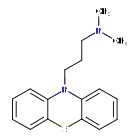
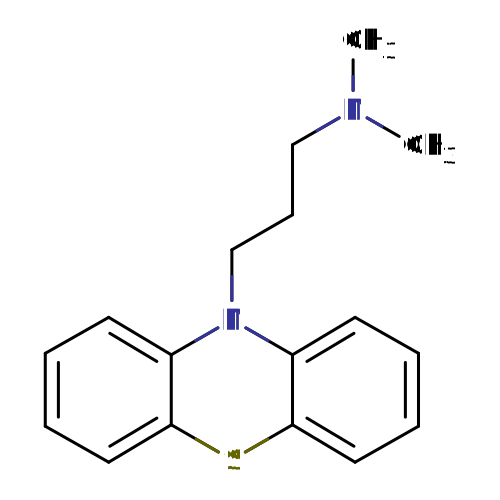
Structure for Promazine (DB00420)
- Weight
- Average: 284.419
Monoisotopic: 284.13471934 - Chemical Formula
- C17H20N2S
- Synonyms
- 10-(3-(Dimethylamino)propyl)phenothiazine
- N-(3-Dimethylaminopropyl)phenothiazine
- N-Dimethylamino-1-methylethyl thiodiphenylamine
- N,N-dimethyl-3-(10H-phenothiazin-10-yl)-propan-1-amine
- Promazin
- Promazina
- Promazine
- Promazinum
- External IDs
- A 145
- RP 3276
- Wy 1094

Pharmacology
- Indication
Used as an adjunct for short term treatment of moderate and severe psychomotor agitation. Also used to treat agitation or restlessness in the elderly.
 Reduce drug development failure ratesBuild, train, & validate machine-learning modelswith evidence-based and structured datasets.Build, train, & validate predictive machine-learning models with structured datasets.
- Associated Conditions
Indication Type Indication Combined Product Details Approval Level Age Group Patient Characteristics Dose Form Treatment of Psychomotor agitation •••••••••••• •••••••••• ••••••••• •••••••• • ••••• Treatment of Psychosis •••••••••••• •••••••••• ••••••••• •••••••• • ••••• Treatment of Schizophrenia •••••••••••• •••••••••• ••••••••• •••••••• • ••••• Treatment of Violent aggressive behavior •••••••••••• •••••••••• ••••••••• •••••••• • ••••• - Contraindications & Blackbox Warnings
 Prevent Adverse Drug Events TodayTap into our Clinical API for life-saving information on contraindications & blackbox warnings, population restrictions, harmful risks, & more.Avoid life-threatening adverse drug events with our Clinical API
- Pharmacodynamics
Promazine belongs to a group of medications known as the phenothiazine antipsychotics. It acts by blocking a variety of receptors in the brain, particularly dopamine receptors. Dopamine is involved in transmitting signals between brain cells. When there is an excess amount of dopamine in the brain it causes over-stimulation of dopamine receptors. These receptors normally act to modify behaviour and over-stimulation may result in psychotic illness. Promazine hydrochloride blocks these receptors and stops them becoming over-stimulated, thereby helping to control psychotic illness. Promazine has weak extrapyramidal and autonomic side effects which lead to its use in the elderly, for restless or psychotic patients. Its anti-psychotic effect is also weaker and it is not useful in general psychiatry.
- Mechanism of action
Promazine is an antagonist at types 1, 2, and 4 dopamine receptors, 5-HT receptor types 2A and 2C, muscarinic receptors 1 through 5, alpha(1)-receptors, and histamine H1-receptors. Promazine's antipsychotic effect is due to antagonism at dopamine and serotonin type 2 receptors, with greater activity at serotonin 5-HT2 receptors than at dopamine type-2 receptors. This may explain the lack of extrapyramidal effects. Promazine does not appear to block dopamine within the tubero-infundibular tract, explaining the lower incidence of hyperprolactinemia than with typical antipsychotic agents or risperidone. Antagonism at muscarinic receptors, H1-receptors, and alpha(1)-receptors also occurs with promazine.
Target Actions Organism ADopamine D2 receptor antagonistHumans U5-hydroxytryptamine receptor 2A antagonistHumans U5-hydroxytryptamine receptor 2C antagonistHumans UAlpha-1A adrenergic receptor antagonistHumans UMuscarinic acetylcholine receptor M1 antagonistHumans UHistamine H1 receptor antagonistHumans - Absorption
Absorption may be erratic and peak plasma concentrations show large interindividual differences.
- Volume of distribution
Not Available
- Protein binding
94%
- Metabolism
Hepatic, primarily to N-desmethylpromazine and promazine sulfoxide.
Hover over products below to view reaction partners
- Route of elimination
Not Available
- Half-life
Not Available
- Clearance
Not Available
- Adverse Effects
 Improve decision support & research outcomesWith structured adverse effects data, including: blackbox warnings, adverse reactions, warning & precautions, & incidence rates. View sample adverse effects data in our new Data Library!Improve decision support & research outcomes with our structured adverse effects data.
- Toxicity
Side effects include: extrapyramidal symptoms, drowsiness, weight gain, dry mouth, constipation, endocrine effects (such as gynaecomastia and menstrual disturbance), sensitivity to sunlight and haemolytic anaemia.
- Pathways
- Not Available
- Pharmacogenomic Effects/ADRs
- Not Available
Interactions
- Drug Interactions
- This information should not be interpreted without the help of a healthcare provider. If you believe you are experiencing an interaction, contact a healthcare provider immediately. The absence of an interaction does not necessarily mean no interactions exist.
Drug Interaction Integrate drug-drug
interactions in your software1,2-Benzodiazepine The risk or severity of CNS depression can be increased when Promazine is combined with 1,2-Benzodiazepine. Abametapir The serum concentration of Promazine can be increased when it is combined with Abametapir. Abatacept The metabolism of Promazine can be increased when combined with Abatacept. Abiraterone The serum concentration of Promazine can be increased when it is combined with Abiraterone. Abrocitinib The metabolism of Abrocitinib can be decreased when combined with Promazine. - Food Interactions
- Avoid alcohol. Additive CNS depression may occur if alcohol is consumed.
- Avoid antacids. The absorption of promazine may be reduced by antacid use.
Products
 Drug product information from 10+ global regionsOur datasets provide approved product information including:dosage, form, labeller, route of administration, and marketing period.Access drug product information from over 10 global regions.
- Product Ingredients
Ingredient UNII CAS InChI Key Promazine hydrochloride U16EOR79U4 53-60-1 JIVSXRLRGOICGA-UHFFFAOYSA-N - International/Other Brands
- Combelen / Prazine (Pliva) / Sparine / Talofen (Abbott)
- Brand Name Prescription Products
Name Dosage Strength Route Labeller Marketing Start Marketing End Region Image Promazine HCl Inj 50mg/ml Liquid 50 mg / mL Intramuscular; Intravenous Abbott 1981-12-31 2008-06-06 Canada 
Categories
- ATC Codes
- N05AA03 — Promazine
- Drug Categories
- Adrenergic alpha-1 Receptor Antagonists
- Adrenergic alpha-Antagonists
- Adrenergic Antagonists
- Agents producing tachycardia
- Agents that produce hypertension
- Amino Acids
- Amino Acids, Branched-Chain
- Amino Acids, Peptides, and Proteins
- Anticholinergic Agents
- Antidepressive Agents
- Antiemetics
- Antipsychotic Agents
- Antipsychotic Agents (First Generation [Typical])
- Autonomic Agents
- Central Nervous System Agents
- Central Nervous System Depressants
- Cytochrome P-450 CYP1A2 Inhibitors
- Cytochrome P-450 CYP1A2 Inhibitors (strength unknown)
- Cytochrome P-450 CYP1A2 Substrates
- Cytochrome P-450 CYP2C19 Substrates
- Cytochrome P-450 CYP2C9 Substrates
- Cytochrome P-450 CYP2D6 Substrates
- Cytochrome P-450 CYP3A Substrates
- Cytochrome P-450 CYP3A4 Substrates
- Cytochrome P-450 Enzyme Inhibitors
- Cytochrome P-450 Substrates
- Dopamine Agents
- Dopamine Antagonists
- Dopamine D2 Receptor Antagonists
- Gastrointestinal Agents
- Heterocyclic Compounds, Fused-Ring
- Histamine Antagonists
- Histamine H1 Antagonists
- Moderate Risk QTc-Prolonging Agents
- Muscarinic Antagonists
- Nervous System
- Neurotoxic agents
- Neurotransmitter Agents
- Peripheral Nervous System Agents
- Phenothiazines
- Phenothiazines With Aliphatic Side-Chain
- Psycholeptics
- Psychotropic Drugs
- QTc Prolonging Agents
- Serotonergic Drugs Shown to Increase Risk of Serotonin Syndrome
- Serotonin 5-HT2 Receptor Antagonists
- Serotonin 5-HT2A Receptor Antagonists
- Serotonin 5-HT2C Receptor Antagonists
- Serotonin Agents
- Serotonin Receptor Antagonists
- Sulfur Compounds
- Tranquilizing Agents
- Chemical TaxonomyProvided by Classyfire
- Description
- This compound belongs to the class of organic compounds known as phenothiazines. These are polycyclic aromatic compounds containing a phenothiazine moiety, which is a linear tricyclic system that consists of a two benzene rings joined by a para-thiazine ring.
- Kingdom
- Organic compounds
- Super Class
- Organoheterocyclic compounds
- Class
- Benzothiazines
- Sub Class
- Phenothiazines
- Direct Parent
- Phenothiazines
- Alternative Parents
- Alkyldiarylamines / Diarylthioethers / Benzenoids / 1,4-thiazines / Trialkylamines / Azacyclic compounds / Organopnictogen compounds / Hydrocarbon derivatives
- Substituents
- Alkyldiarylamine / Amine / Aromatic heteropolycyclic compound / Aryl thioether / Azacycle / Benzenoid / Diarylthioether / Hydrocarbon derivative / Organic nitrogen compound / Organonitrogen compound
- Molecular Framework
- Aromatic heteropolycyclic compounds
- External Descriptors
- phenothiazines, tertiary amine (CHEBI:8459)
- Affected organisms
- Humans and other mammals
Chemical Identifiers
- UNII
- O9M39HTM5W
- CAS number
- 58-40-2
- InChI Key
- ZGUGWUXLJSTTMA-UHFFFAOYSA-N
- InChI
- InChI=1S/C17H20N2S/c1-18(2)12-7-13-19-14-8-3-5-10-16(14)20-17-11-6-4-9-15(17)19/h3-6,8-11H,7,12-13H2,1-2H3
- IUPAC Name
- dimethyl[3-(10H-phenothiazin-10-yl)propyl]amine
- SMILES
- CN(C)CCCN1C2=CC=CC=C2SC2=CC=CC=C12
References
- Synthesis Reference
- US2519886
- General References
- Cubala WJ, Jakuszkowiak-Wojten K, Burkiewicz A, Wronska A: Promazine in the treatment of delusional parasitosis. Psychiatr Danub. 2011 Jun;23(2):198-9. [Article]
- External Links
- PDB Entries
- 4ma7 / 7lgi
- MSDS
- Download (75.4 KB)
Clinical Trials
Pharmacoeconomics
- Manufacturers
- Wyeth ayerst laboratories
- Watson laboratories inc
- Baxter healthcare corp anesthesia critical care
- Apothecon sub bristol myers squibb co
- Apothecon inc div bristol myers squibb
- Bristol myers squibb co
- Packagers
- Baxter International Inc.
- Liberty Pharmaceuticals
- Prescript Pharmaceuticals
- Primedics Laboratories
- Sandoz
- Dosage Forms
Form Route Strength Solution / drops Oral Liquid Intramuscular; Intravenous 50 mg / mL Injection, solution 25 MG/ML Solution / drops Oral 40 mg/ml Tablet 25 MG - Prices
Unit description Cost Unit Chlorpromazine 25 mg/ml amp 8.04USD ml Chlorpromazine 200 mg tablet 1.05USD tablet Chlorpromazine Hcl 25 mg/ml 0.88USD ml Chlorpromazine 100 mg tablet 0.39USD tablet Novo-Chlorpromazine 100 mg Tablet 0.35USD tablet Chlorpromazine 10 mg tablet 0.32USD tablet Chlorpromazine 50 mg tablet 0.3USD tablet Novo-Chlorpromazine 50 mg Tablet 0.21USD tablet Novo-Chlorpromazine 25 mg Tablet 0.18USD tablet Chlorpromazine 25 mg tablet 0.17USD tablet DrugBank does not sell nor buy drugs. Pricing information is supplied for informational purposes only.- Patents
- Not Available
Properties
- State
- Liquid
- Experimental Properties
Property Value Source melting point (°C) < 25 °C PhysProp boiling point (°C) 203-210 °C at 3.00E-01 mm Hg PhysProp water solubility 14.2 mg/L (at 24 °C) YALKOWSKY,SH & DANNENFELSER,RM (1992) logP 4.55 HANSCH,C ET AL. (1995) logS -4.3 ADME Research, USCD pKa 9.36 SANGSTER (1994) - Predicted Properties
Property Value Source Water Solubility 0.0207 mg/mL ALOGPS logP 4.63 ALOGPS logP 3.93 Chemaxon logS -4.1 ALOGPS pKa (Strongest Basic) 9.2 Chemaxon Physiological Charge 1 Chemaxon Hydrogen Acceptor Count 2 Chemaxon Hydrogen Donor Count 0 Chemaxon Polar Surface Area 6.48 Å2 Chemaxon Rotatable Bond Count 4 Chemaxon Refractivity 88.95 m3·mol-1 Chemaxon Polarizability 32.74 Å3 Chemaxon Number of Rings 3 Chemaxon Bioavailability 1 Chemaxon Rule of Five Yes Chemaxon Ghose Filter Yes Chemaxon Veber's Rule Yes Chemaxon MDDR-like Rule No Chemaxon - Predicted ADMET Features
Property Value Probability Human Intestinal Absorption + 0.9718 Blood Brain Barrier + 0.987 Caco-2 permeable + 0.8813 P-glycoprotein substrate Substrate 0.7933 P-glycoprotein inhibitor I Inhibitor 0.6857 P-glycoprotein inhibitor II Inhibitor 0.6352 Renal organic cation transporter Inhibitor 0.7561 CYP450 2C9 substrate Non-substrate 0.7526 CYP450 2D6 substrate Substrate 0.9334 CYP450 3A4 substrate Substrate 0.5578 CYP450 1A2 substrate Inhibitor 0.8935 CYP450 2C9 inhibitor Non-inhibitor 0.9483 CYP450 2D6 inhibitor Inhibitor 0.9622 CYP450 2C19 inhibitor Non-inhibitor 0.798 CYP450 3A4 inhibitor Non-inhibitor 0.9166 CYP450 inhibitory promiscuity Low CYP Inhibitory Promiscuity 0.6784 Ames test Non AMES toxic 0.9176 Carcinogenicity Non-carcinogens 0.9545 Biodegradation Not ready biodegradable 0.9921 Rat acute toxicity 2.9416 LD50, mol/kg Not applicable hERG inhibition (predictor I) Weak inhibitor 0.9662 hERG inhibition (predictor II) Inhibitor 0.7828
Spectra
- Mass Spec (NIST)
- Download (9.05 KB)
- Spectra
- Chromatographic Properties
Collision Cross Sections (CCS)
Adduct CCS Value (Å2) Source type Source [M-H]- 177.2699147 predictedDarkChem Lite v0.1.0 [M-H]- 177.4233147 predictedDarkChem Lite v0.1.0 [M-H]- 156.12703 predictedDeepCCS 1.0 (2019) [M+H]+ 177.5065147 predictedDarkChem Lite v0.1.0 [M+H]+ 179.2467147 predictedDarkChem Lite v0.1.0 [M+H]+ 158.48503 predictedDeepCCS 1.0 (2019) [M+Na]+ 177.7167147 predictedDarkChem Lite v0.1.0 [M+Na]+ 177.8213147 predictedDarkChem Lite v0.1.0 [M+Na]+ 164.57817 predictedDeepCCS 1.0 (2019)
Targets

- Kind
- Protein
- Organism
- Humans
- Pharmacological action
- Yes
- Actions
- Antagonist
- General Function
- Potassium channel regulator activity
- Specific Function
- Dopamine receptor whose activity is mediated by G proteins which inhibit adenylyl cyclase.
- Gene Name
- DRD2
- Uniprot ID
- P14416
- Uniprot Name
- D(2) dopamine receptor
- Molecular Weight
- 50618.91 Da
References
- Strange PG: Antipsychotic drug action: antagonism, inverse agonism or partial agonism. Trends Pharmacol Sci. 2008 Jun;29(6):314-21. doi: 10.1016/j.tips.2008.03.009. Epub 2008 May 28. [Article]
- Kim DH, Maneen MJ, Stahl SM: Building a better antipsychotic: receptor targets for the treatment of multiple symptom dimensions of schizophrenia. Neurotherapeutics. 2009 Jan;6(1):78-85. doi: 10.1016/j.nurt.2008.10.020. [Article]
- Kind
- Protein
- Organism
- Humans
- Pharmacological action
- Unknown
- Actions
- Antagonist
- General Function
- Virus receptor activity
- Specific Function
- G-protein coupled receptor for 5-hydroxytryptamine (serotonin). Also functions as a receptor for various drugs and psychoactive substances, including mescaline, psilocybin, 1-(2,5-dimethoxy-4-iodop...
- Gene Name
- HTR2A
- Uniprot ID
- P28223
- Uniprot Name
- 5-hydroxytryptamine receptor 2A
- Molecular Weight
- 52602.58 Da
References
- Govitrapong P, Chagkutip J, Turakitwanakan W, Srikiatkhachorn A: Platelet 5-HT(2A) receptors in schizophrenic patients with and without neuroleptic treatment. Psychiatry Res. 2000 Sep 25;96(1):41-50. [Article]
- Govitrapong P, Mukda S, Turakitwanakan W, Dumrongphol H, Chindaduangratn C, Sanvarinda Y: Platelet serotonin transporter in schizophrenic patients with and without neuroleptic treatment. Neurochem Int. 2002 Oct;41(4):209-16. [Article]
- Kim DH, Maneen MJ, Stahl SM: Building a better antipsychotic: receptor targets for the treatment of multiple symptom dimensions of schizophrenia. Neurotherapeutics. 2009 Jan;6(1):78-85. doi: 10.1016/j.nurt.2008.10.020. [Article]
- Kind
- Protein
- Organism
- Humans
- Pharmacological action
- Unknown
- Actions
- Antagonist
- General Function
- Serotonin receptor activity
- Specific Function
- G-protein coupled receptor for 5-hydroxytryptamine (serotonin). Also functions as a receptor for various drugs and psychoactive substances, including ergot alkaloid derivatives, 1-2,5,-dimethoxy-4-...
- Gene Name
- HTR2C
- Uniprot ID
- P28335
- Uniprot Name
- 5-hydroxytryptamine receptor 2C
- Molecular Weight
- 51820.705 Da
References
- Kim DH, Maneen MJ, Stahl SM: Building a better antipsychotic: receptor targets for the treatment of multiple symptom dimensions of schizophrenia. Neurotherapeutics. 2009 Jan;6(1):78-85. doi: 10.1016/j.nurt.2008.10.020. [Article]
- Kind
- Protein
- Organism
- Humans
- Pharmacological action
- Unknown
- Actions
- Antagonist
- General Function
- Protein heterodimerization activity
- Specific Function
- This alpha-adrenergic receptor mediates its action by association with G proteins that activate a phosphatidylinositol-calcium second messenger system. Its effect is mediated by G(q) and G(11) prot...
- Gene Name
- ADRA1A
- Uniprot ID
- P35348
- Uniprot Name
- Alpha-1A adrenergic receptor
- Molecular Weight
- 51486.005 Da
References
- Kim DH, Maneen MJ, Stahl SM: Building a better antipsychotic: receptor targets for the treatment of multiple symptom dimensions of schizophrenia. Neurotherapeutics. 2009 Jan;6(1):78-85. doi: 10.1016/j.nurt.2008.10.020. [Article]
- Leung JY, Barr AM, Procyshyn RM, Honer WG, Pang CC: Cardiovascular side-effects of antipsychotic drugs: the role of the autonomic nervous system. Pharmacol Ther. 2012 Aug;135(2):113-22. doi: 10.1016/j.pharmthera.2012.04.003. Epub 2012 Apr 27. [Article]
- Kind
- Protein
- Organism
- Humans
- Pharmacological action
- Unknown
- Actions
- Antagonist
- General Function
- Phosphatidylinositol phospholipase c activity
- Specific Function
- The muscarinic acetylcholine receptor mediates various cellular responses, including inhibition of adenylate cyclase, breakdown of phosphoinositides and modulation of potassium channels through the...
- Gene Name
- CHRM1
- Uniprot ID
- P11229
- Uniprot Name
- Muscarinic acetylcholine receptor M1
- Molecular Weight
- 51420.375 Da
References
- Kim DH, Maneen MJ, Stahl SM: Building a better antipsychotic: receptor targets for the treatment of multiple symptom dimensions of schizophrenia. Neurotherapeutics. 2009 Jan;6(1):78-85. doi: 10.1016/j.nurt.2008.10.020. [Article]
- Kind
- Protein
- Organism
- Humans
- Pharmacological action
- Unknown
- Actions
- Antagonist
- General Function
- Histamine receptor activity
- Specific Function
- In peripheral tissues, the H1 subclass of histamine receptors mediates the contraction of smooth muscles, increase in capillary permeability due to contraction of terminal venules, and catecholamin...
- Gene Name
- HRH1
- Uniprot ID
- P35367
- Uniprot Name
- Histamine H1 receptor
- Molecular Weight
- 55783.61 Da
References
- Hals PA, Hall H, Dahl SG: Muscarinic cholinergic and histamine H1 receptor binding of phenothiazine drug metabolites. Life Sci. 1988;43(5):405-12. [Article]
- Kim DH, Maneen MJ, Stahl SM: Building a better antipsychotic: receptor targets for the treatment of multiple symptom dimensions of schizophrenia. Neurotherapeutics. 2009 Jan;6(1):78-85. doi: 10.1016/j.nurt.2008.10.020. [Article]
Enzymes
- Kind
- Protein
- Organism
- Humans
- Pharmacological action
- Unknown
- Actions
- SubstrateInhibitor
- Curator comments
- This enzyme action is supported by limited in vitro studies.
- General Function
- Oxidoreductase activity, acting on paired donors, with incorporation or reduction of molecular oxygen, reduced flavin or flavoprotein as one donor, and incorporation of one atom of oxygen
- Specific Function
- Cytochromes P450 are a group of heme-thiolate monooxygenases. In liver microsomes, this enzyme is involved in an NADPH-dependent electron transport pathway. It oxidizes a variety of structurally un...
- Gene Name
- CYP1A2
- Uniprot ID
- P05177
- Uniprot Name
- Cytochrome P450 1A2
- Molecular Weight
- 58293.76 Da
References
- Wojcikowski J, Boksa J, Daniel WA: Main contribution of the cytochrome P450 isoenzyme 1A2 (CYP1A2) to N-demethylation and 5-sulfoxidation of the phenothiazine neuroleptic chlorpromazine in human liver--A comparison with other phenothiazines. Biochem Pharmacol. 2010 Oct 15;80(8):1252-9. doi: 10.1016/j.bcp.2010.06.045. Epub 2010 Jul 6. [Article]
- Daniel WA, Kot M, Wojcikowski J: Influence of classic and atypical neuroleptics on caffeine oxidation in rat liver microsomes. Pol J Pharmacol. 2003 Nov-Dec;55(6):1055-61. [Article]
- Wojcikowski J, Pichard-Garcia L, Maurel P, Daniel WA: Contribution of human cytochrome p-450 isoforms to the metabolism of the simplest phenothiazine neuroleptic promazine. Br J Pharmacol. 2003 Apr;138(8):1465-74. doi: 10.1038/sj.bjp.0705195. [Article]
- Kind
- Protein
- Organism
- Humans
- Pharmacological action
- Unknown
- Actions
- Substrate
- General Function
- Vitamin d3 25-hydroxylase activity
- Specific Function
- Cytochromes P450 are a group of heme-thiolate monooxygenases. In liver microsomes, this enzyme is involved in an NADPH-dependent electron transport pathway. It performs a variety of oxidation react...
- Gene Name
- CYP3A4
- Uniprot ID
- P08684
- Uniprot Name
- Cytochrome P450 3A4
- Molecular Weight
- 57342.67 Da
References
- Wojcikowski J, Pichard-Garcia L, Maurel P, Daniel WA: Contribution of human cytochrome p-450 isoforms to the metabolism of the simplest phenothiazine neuroleptic promazine. Br J Pharmacol. 2003 Apr;138(8):1465-74. doi: 10.1038/sj.bjp.0705195. [Article]
- Kind
- Protein
- Organism
- Humans
- Pharmacological action
- Unknown
- Actions
- Substrate
- General Function
- Steroid hydroxylase activity
- Specific Function
- Cytochromes P450 are a group of heme-thiolate monooxygenases. In liver microsomes, this enzyme is involved in an NADPH-dependent electron transport pathway. It oxidizes a variety of structurally un...
- Gene Name
- CYP2C9
- Uniprot ID
- P11712
- Uniprot Name
- Cytochrome P450 2C9
- Molecular Weight
- 55627.365 Da
References
- Zhou SF, Zhou ZW, Yang LP, Cai JP: Substrates, inducers, inhibitors and structure-activity relationships of human Cytochrome P450 2C9 and implications in drug development. Curr Med Chem. 2009;16(27):3480-675. Epub 2009 Sep 1. [Article]
- Wojcikowski J, Pichard-Garcia L, Maurel P, Daniel WA: Contribution of human cytochrome p-450 isoforms to the metabolism of the simplest phenothiazine neuroleptic promazine. Br J Pharmacol. 2003 Apr;138(8):1465-74. doi: 10.1038/sj.bjp.0705195. [Article]
- Kind
- Protein
- Organism
- Humans
- Pharmacological action
- Unknown
- Actions
- Substrate
- General Function
- Steroid hydroxylase activity
- Specific Function
- Responsible for the metabolism of many drugs and environmental chemicals that it oxidizes. It is involved in the metabolism of drugs such as antiarrhythmics, adrenoceptor antagonists, and tricyclic...
- Gene Name
- CYP2D6
- Uniprot ID
- P10635
- Uniprot Name
- Cytochrome P450 2D6
- Molecular Weight
- 55768.94 Da
References
- Wojcikowski J, Pichard-Garcia L, Maurel P, Daniel WA: Contribution of human cytochrome p-450 isoforms to the metabolism of the simplest phenothiazine neuroleptic promazine. Br J Pharmacol. 2003 Apr;138(8):1465-74. doi: 10.1038/sj.bjp.0705195. [Article]
- Kind
- Protein
- Organism
- Humans
- Pharmacological action
- Unknown
- Actions
- Substrate
- General Function
- Steroid hydroxylase activity
- Specific Function
- Responsible for the metabolism of a number of therapeutic agents such as the anticonvulsant drug S-mephenytoin, omeprazole, proguanil, certain barbiturates, diazepam, propranolol, citalopram and im...
- Gene Name
- CYP2C19
- Uniprot ID
- P33261
- Uniprot Name
- Cytochrome P450 2C19
- Molecular Weight
- 55930.545 Da
References
- Zhou SF, Zhou ZW, Yang LP, Cai JP: Substrates, inducers, inhibitors and structure-activity relationships of human Cytochrome P450 2C9 and implications in drug development. Curr Med Chem. 2009;16(27):3480-675. Epub 2009 Sep 1. [Article]
- Wojcikowski J, Pichard-Garcia L, Maurel P, Daniel WA: Contribution of human cytochrome p-450 isoforms to the metabolism of the simplest phenothiazine neuroleptic promazine. Br J Pharmacol. 2003 Apr;138(8):1465-74. doi: 10.1038/sj.bjp.0705195. [Article]


Drug created at June 13, 2005 13:24 / Updated at April 09, 2024 18:19