Identification
- Summary
Streptozocin is a nitrosourea antineoplastic agent used in the treatment of metastatic pancreatic islet cell carcinoma.
- Brand Names
- Zanosar
- Generic Name
- Streptozocin
- DrugBank Accession Number
- DB00428
- Background
An antibiotic that is produced by Stretomyces achromogenes. It is used as an antineoplastic agent and to induce diabetes in experimental animals.
- Type
- Small Molecule
- Groups
- Approved, Investigational
- Structure
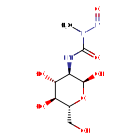
Structure for Streptozocin (DB00428)

- Weight
- Average: 265.2206
Monoisotopic: 265.090999849 - Chemical Formula
- C8H15N3O7
- Synonyms
- 2-Deoxy-2-(((methylnitrosoamino)carbonyl)amino)-D-glucopyranose
- 2-Deoxy-2-(3-methyl-3-nitrosoureido)-D-glucopyranose
- Estreptozocina
- N-D-Glucosyl-(2)-N'-nitrosomethylharnstoff
- N-D-Glucosyl-(2)-N'-nitrosomethylurea
- Streptozocin
- Streptozocine
- Streptozocinium
- Streptozocinum
- Streptozotocin

Pharmacology
- Indication
For the treatment of malignant neoplasms of pancreas (metastatic islet cell carcinoma).
 Reduce drug development failure ratesBuild, train, & validate machine-learning modelswith evidence-based and structured datasets.Build, train, & validate predictive machine-learning models with structured datasets.
- Associated Conditions
Indication Type Indication Combined Product Details Approval Level Age Group Patient Characteristics Dose Form Treatment of Metastatic islet cell carcinoma •••••••••••• •••••••••• ••••••• ••• •••••••• - Contraindications & Blackbox Warnings
 Prevent Adverse Drug Events TodayTap into our Clinical API for life-saving information on contraindications & blackbox warnings, population restrictions, harmful risks, & more.Avoid life-threatening adverse drug events with our Clinical API
- Pharmacodynamics
Streptozocin is an antitumour antibiotic consisting of a nitrosourea moiety interposed between a methyl group and a glucosamine. Streptozocin is indicated in the treatment of metastatic islet cell carcinoma of the pancreas. Streptozocin inhibits DNA synthesis in bacterial and mammalian cells. In bacterial cells, a specific interaction with cytosine moieties leads to degradation of DNA. The biochemical mechanism leading to mammalian cell death has not been definitely established; streptozocin inhibits cell proliferation at a considerably lower level than that needed to inhibit precursor incorporation into DNA or to inhibit several of the enzymes involved in DNA synthesis. Although streptozocin inhibits the progression of cells into mitosis, no specific phase of the cell cycle is particularly sensitive to its lethal effects.
- Mechanism of action
Although its mechanism of action is not completely clear, streptozocin is known to inhibit DNA synthesis, interfere with biochemical reactions of NAD and NADH, and inhibit some enzymes involved in gluconeogenesis. Its activity appears to occur as a result of formation of methylcarbonium ions, which alkylate or bind with many intracellular molecular structures including nucleic acids. Its cytotoxic action is probably due to cross-linking of strands of DNA, resulting in inhibition of DNA synthesis.
Target Actions Organism AO-GlcNAcase BT_4395 antagonistBacteroides thetaiotaomicron (strain ATCC 29148 / DSM 2079 / NCTC 10582 / E50 / VPI-5482) ADNA cross-linking/alkylationHumans USolute carrier family 2, facilitated glucose transporter member 2 ligandHumans UBifunctional protein NCOAT Not Available Humans - Absorption
Poor oral absorption (17-25%)
- Volume of distribution
Not Available
- Protein binding
Not Available
- Metabolism
Primarily hepatic
- Route of elimination
As much as 20% of the drug (or metabolites containing an N-nitrosourea group) is metabolized and/or excreted by the kidney.
- Half-life
5-15 minutes
- Clearance
Not Available
- Adverse Effects
 Improve decision support & research outcomesWith structured adverse effects data, including: blackbox warnings, adverse reactions, warning & precautions, & incidence rates. View sample adverse effects data in our new Data Library!Improve decision support & research outcomes with our structured adverse effects data.
- Toxicity
Symptoms of overdose include nausea and vomiting, anorexia, myelosuppression; and nephrotoxicity.
- Pathways
- Not Available
- Pharmacogenomic Effects/ADRs
- Not Available
Interactions
- Drug Interactions
- This information should not be interpreted without the help of a healthcare provider. If you believe you are experiencing an interaction, contact a healthcare provider immediately. The absence of an interaction does not necessarily mean no interactions exist.
Drug Interaction Integrate drug-drug
interactions in your softwareAbatacept The risk or severity of adverse effects can be increased when Streptozocin is combined with Abatacept. Abciximab The risk or severity of bleeding can be increased when Abciximab is combined with Streptozocin. Acenocoumarol The risk or severity of bleeding can be increased when Acenocoumarol is combined with Streptozocin. Acetaminophen Streptozocin may increase the hepatotoxic activities of Acetaminophen. Acetylsalicylic acid The risk or severity of bleeding can be increased when Acetylsalicylic acid is combined with Streptozocin. - Food Interactions
- No interactions found.
Products
 Drug product information from 10+ global regionsOur datasets provide approved product information including:dosage, form, labeller, route of administration, and marketing period.Access drug product information from over 10 global regions.
- Brand Name Prescription Products
Name Dosage Strength Route Labeller Marketing Start Marketing End Region Image Zanosar Powder, for solution 100 mg/1mL Intravenous Teva Parenteral Medicines, Inc. 2003-12-03 Not applicable US 
Zanosar Powder, for solution 1 g/10mL Intravenous Esteve Pharmaceuticals, S.A. 2023-02-01 Not applicable US Zanosar Sterile Powder Powder, for solution 1 g / vial Intravenous Paladin Labs Inc 1985-12-31 2017-12-19 Canada 
- Unapproved/Other Products
Name Ingredients Dosage Route Labeller Marketing Start Marketing End Region Image Zanosar Streptozocin (1 g/10mL) Powder, for solution Intravenous Esteve Pharmaceuticals, S.A. 2023-02-01 Not applicable US
Categories
- ATC Codes
- L01AD04 — Streptozocin
- Drug Categories
- Alkylating Activity
- Alkylating Drugs
- Amides
- Antibiotics, Antineoplastic
- Antineoplastic Agents
- Antineoplastic Agents, Alkylating
- Antineoplastic and Immunomodulating Agents
- Carbohydrates
- Cytochrome P-450 CYP1A2 Inducers
- Cytochrome P-450 CYP1A2 Inducers (strength unknown)
- Cytochrome P-450 CYP2E1 Inducers
- Cytochrome P-450 CYP2E1 Inducers (strength unknown)
- Cytochrome P-450 Enzyme Inducers
- Glycosides
- Immunosuppressive Agents
- Myelosuppressive Agents
- Narrow Therapeutic Index Drugs
- Nitroso Compounds
- Nitrosourea Compounds
- Nitrosoureas
- P-glycoprotein inducers
- Chemical TaxonomyProvided by Classyfire
- Description
- This compound belongs to the class of organic compounds known as hexoses. These are monosaccharides in which the sugar unit is a is a six-carbon containing moeity.
- Kingdom
- Organic compounds
- Super Class
- Organic oxygen compounds
- Class
- Organooxygen compounds
- Sub Class
- Carbohydrates and carbohydrate conjugates
- Direct Parent
- Hexoses
- Alternative Parents
- N-methylnitrosoureas / Oxanes / Semicarbazides / Nitrosamides / Secondary alcohols / Hemiacetals / Polyols / Oxacyclic compounds / Primary alcohols / Organopnictogen compounds show 3 more
- Substituents
- Alcohol / Aliphatic heteromonocyclic compound / Carbonic acid derivative / Carbonyl group / Hemiacetal / Hexose monosaccharide / Hydrocarbon derivative / N-methylnitrosourea / Nitrosamide / Nitrosourea show 13 more
- Molecular Framework
- Aliphatic heteromonocyclic compounds
- External Descriptors
- N-nitrosoureas, N-acylglucosamine (CHEBI:9288)
- Affected organisms
- Humans and other mammals
Chemical Identifiers
- UNII
- 8H27GUR065
- CAS number
- 66395-18-4
- InChI Key
- ZSJLQEPLLKMAKR-GKHCUFPYSA-N
- InChI
- InChI=1S/C8H15N3O7/c1-11(10-17)8(16)9-4-6(14)5(13)3(2-12)18-7(4)15/h3-7,12-15H,2H2,1H3,(H,9,16)/t3-,4-,5-,6-,7+/m1/s1
- IUPAC Name
- 3-methyl-3-nitroso-1-[(2S,3R,4R,5S,6R)-2,4,5-trihydroxy-6-(hydroxymethyl)oxan-3-yl]urea
- SMILES
- CN(N=O)C(=O)N[C@H]1[C@@H](O)O[C@H](CO)[C@@H](O)[C@@H]1O
References
- General References
- Brentjens R, Saltz L: Islet cell tumors of the pancreas: the medical oncologist's perspective. Surg Clin North Am. 2001 Jun;81(3):527-42. [Article]
- Wang Z, Gleichmann H: GLUT2 in pancreatic islets: crucial target molecule in diabetes induced with multiple low doses of streptozotocin in mice. Diabetes. 1998 Jan;47(1):50-6. [Article]
- Schnedl WJ, Ferber S, Johnson JH, Newgard CB: STZ transport and cytotoxicity. Specific enhancement in GLUT2-expressing cells. Diabetes. 1994 Nov;43(11):1326-33. [Article]
- VAVRA JJ, DEBOER C, DIETZ A, HANKA LJ, SOKOLSKI WT: Streptozotocin, a new antibacterial antibiotic. Antibiot Annu. 1959-1960;7:230-5. [Article]
- Mansford KR, Opie L: Comparison of metabolic abnormalities in diabetes mellitus induced by streptozotocin or by alloxan. Lancet. 1968 Mar 30;1(7544):670-1. [Article]
- Link [Link]
- External Links
- Human Metabolome Database
- HMDB0014572
- KEGG Drug
- D05932
- KEGG Compound
- C07313
- PubChem Compound
- 29327
- PubChem Substance
- 46508872
- ChemSpider
- 27273
- 10114
- ChEBI
- 9288
- ChEMBL
- CHEMBL1603
- ZINC
- ZINC000003977737
- Therapeutic Targets Database
- DAP000984
- PharmGKB
- PA451514
- RxList
- RxList Drug Page
- Drugs.com
- Drugs.com Drug Page
- Wikipedia
- Streptozotocin
- MSDS
- Download (76.6 KB)
Clinical Trials
- Clinical Trials
Phase Status Purpose Conditions Count 3 Completed Treatment Adrenocortical Carcinoma 1 2 Completed Treatment Anaplastic Astrocytoma (AA) / Anaplastic Oligodendroglioma (AO) / Glioblastoma Multiforme (GBM) / Mixed Gliomas / Recurrent Brain Tumors 1 2 Completed Treatment Gastrointestinal Carcinoid Tumor / Pancreatic Islet Cell Tumors 1 2 Completed Treatment Islet Cell Adenoma / Metastatic Cancer / Zollinger-Ellison Syndrome 1 2 Completed Treatment Neoplasm 1
Pharmacoeconomics
- Manufacturers
- Teva parenteral medicines inc
- Packagers
- Pharmacia Inc.
- Prescript Pharmaceuticals
- Teva Pharmaceutical Industries Ltd.
- Dosage Forms
Form Route Strength Injection, powder, for solution 1 G Powder, for solution Intravenous 1 g/10mL Powder, for solution Intravenous 100 mg/1mL Powder, for solution Intravenous 1 g / vial - Prices
Unit description Cost Unit Zanosar 1 gm powder vial 78.82USD vial DrugBank does not sell nor buy drugs. Pricing information is supplied for informational purposes only.- Patents
- Not Available
Properties
- State
- Solid
- Experimental Properties
Property Value Source melting point (°C) 115 °C PhysProp water solubility 5070 mg/L Not Available logP -1.45 HANSCH,C ET AL. (1995) - Predicted Properties
Property Value Source Water Solubility 33.5 mg/mL ALOGPS logP -1.7 ALOGPS logP -2.7 Chemaxon logS -0.9 ALOGPS pKa (Strongest Acidic) 11.43 Chemaxon pKa (Strongest Basic) -3 Chemaxon Physiological Charge 0 Chemaxon Hydrogen Acceptor Count 7 Chemaxon Hydrogen Donor Count 5 Chemaxon Polar Surface Area 151.92 Å2 Chemaxon Rotatable Bond Count 3 Chemaxon Refractivity 55.96 m3·mol-1 Chemaxon Polarizability 23.74 Å3 Chemaxon Number of Rings 1 Chemaxon Bioavailability 1 Chemaxon Rule of Five Yes Chemaxon Ghose Filter No Chemaxon Veber's Rule No Chemaxon MDDR-like Rule No Chemaxon - Predicted ADMET Features
Property Value Probability Human Intestinal Absorption - 0.8406 Blood Brain Barrier - 0.9659 Caco-2 permeable - 0.6495 P-glycoprotein substrate Non-substrate 0.6244 P-glycoprotein inhibitor I Non-inhibitor 0.7667 P-glycoprotein inhibitor II Non-inhibitor 0.9787 Renal organic cation transporter Non-inhibitor 0.9509 CYP450 2C9 substrate Non-substrate 0.6998 CYP450 2D6 substrate Non-substrate 0.846 CYP450 3A4 substrate Non-substrate 0.5462 CYP450 1A2 substrate Non-inhibitor 0.9046 CYP450 2C9 inhibitor Non-inhibitor 0.9071 CYP450 2D6 inhibitor Non-inhibitor 0.9231 CYP450 2C19 inhibitor Non-inhibitor 0.9026 CYP450 3A4 inhibitor Non-inhibitor 0.9636 CYP450 inhibitory promiscuity Low CYP Inhibitory Promiscuity 0.9893 Ames test AMES toxic 0.9107 Carcinogenicity Non-carcinogens 0.9182 Biodegradation Ready biodegradable 0.7191 Rat acute toxicity 2.6715 LD50, mol/kg Not applicable hERG inhibition (predictor I) Weak inhibitor 0.793 hERG inhibition (predictor II) Non-inhibitor 0.9288
Spectra
- Mass Spec (NIST)
- Not Available
- Spectra
Spectrum Spectrum Type Splash Key Predicted GC-MS Spectrum - GC-MS Predicted GC-MS splash10-02mj-5940000000-8fb8f1885498bea8bc01 Predicted MS/MS Spectrum - 10V, Positive (Annotated) Predicted LC-MS/MS splash10-000t-1090000000-a3712cb6ab0e1446c94b Predicted MS/MS Spectrum - 10V, Negative (Annotated) Predicted LC-MS/MS splash10-0fdp-0970000000-18adf5e6f0210193048f Predicted MS/MS Spectrum - 20V, Positive (Annotated) Predicted LC-MS/MS splash10-0006-9000000000-e5d735487de79e1c98ca Predicted MS/MS Spectrum - 20V, Negative (Annotated) Predicted LC-MS/MS splash10-000x-9200000000-3be569e0778266d6e524 Predicted MS/MS Spectrum - 40V, Positive (Annotated) Predicted LC-MS/MS splash10-03di-9300000000-6d1ab1360a5427f5d979 Predicted MS/MS Spectrum - 40V, Negative (Annotated) Predicted LC-MS/MS splash10-0a4i-9200000000-7b91e03077a9104670f9 Predicted 1H NMR Spectrum 1D NMR Not Applicable Predicted 13C NMR Spectrum 1D NMR Not Applicable - Chromatographic Properties
Collision Cross Sections (CCS)
Adduct CCS Value (Å2) Source type Source [M-H]- 159.5292799 predictedDarkChem Lite v0.1.0 [M-H]- 150.1463325 predictedDarkChem Lite v0.1.0 [M-H]- 164.7824799 predictedDarkChem Lite v0.1.0 [M-H]- 157.69673 predictedDeepCCS 1.0 (2019) [M+H]+ 159.1744799 predictedDarkChem Lite v0.1.0 [M+H]+ 155.740934 predictedDarkChem Lite v0.1.0 [M+H]+ 165.3517799 predictedDarkChem Lite v0.1.0 [M+H]+ 160.0923 predictedDeepCCS 1.0 (2019) [M+Na]+ 159.2871799 predictedDarkChem Lite v0.1.0 [M+Na]+ 163.7324253 predictedDarkChem Lite v0.1.0 [M+Na]+ 164.8657799 predictedDarkChem Lite v0.1.0 [M+Na]+ 166.89705 predictedDeepCCS 1.0 (2019)
Targets

- Kind
- Protein
- Organism
- Bacteroides thetaiotaomicron (strain ATCC 29148 / DSM 2079 / NCTC 10582 / E50 / VPI-5482)
- Pharmacological action
- Yes
- Actions
- Antagonist
- General Function
- Beta-n-acetylglucosaminidase activity
- Specific Function
- Can hydrolyze the glycosidic link of O-GlcNAcylated proteins. Can use p-nitrophenyl-beta-GlcNAc and 4-methylumbelliferone-GlcNAc as substrates (in vitro).
- Gene Name
- Not Available
- Uniprot ID
- Q89ZI2
- Uniprot Name
- O-GlcNAcase BT_4395
- Molecular Weight
- 84484.62 Da
References
- He Y, Martinez-Fleites C, Bubb A, Gloster TM, Davies GJ: Structural insight into the mechanism of streptozotocin inhibition of O-GlcNAcase. Carbohydr Res. 2009 Mar 31;344(5):627-31. doi: 10.1016/j.carres.2008.12.007. Epub 2008 Dec 13. [Article]
References
- Bennett RA, Pegg AE: Alkylation of DNA in rat tissues following administration of streptozotocin. Cancer Res. 1981 Jul;41(7):2786-90. [Article]
- Kind
- Protein
- Organism
- Humans
- Pharmacological action
- Unknown
- Actions
- Ligand
- General Function
- Hexose transmembrane transporter activity
- Specific Function
- Facilitative glucose transporter. This isoform likely mediates the bidirectional transfer of glucose across the plasma membrane of hepatocytes and is responsible for uptake of glucose by the beta c...
- Gene Name
- SLC2A2
- Uniprot ID
- P11168
- Uniprot Name
- Solute carrier family 2, facilitated glucose transporter member 2
- Molecular Weight
- 57488.955 Da
References
- Wang Z, Gleichmann H: GLUT2 in pancreatic islets: crucial target molecule in diabetes induced with multiple low doses of streptozotocin in mice. Diabetes. 1998 Jan;47(1):50-6. [Article]
- Schnedl WJ, Ferber S, Johnson JH, Newgard CB: STZ transport and cytotoxicity. Specific enhancement in GLUT2-expressing cells. Diabetes. 1994 Nov;43(11):1326-33. [Article]
- Kind
- Protein
- Organism
- Humans
- Pharmacological action
- Unknown
- General Function
- Hyalurononglucosaminidase activity
- Specific Function
- Isoform 1: Cleaves GlcNAc but not GalNAc from O-glycosylated proteins. Can use p-nitrophenyl-beta-GlcNAc and 4-methylumbelliferone-GlcNAc as substrates but not p-nitrophenyl-beta-GalNAc or p-nitrop...
- Gene Name
- MGEA5
- Uniprot ID
- O60502
- Uniprot Name
- Protein O-GlcNAcase
- Molecular Weight
- 102914.215 Da
References
- Pathak S, Dorfmueller HC, Borodkin VS, van Aalten DM: Chemical dissection of the link between streptozotocin, O-GlcNAc, and pancreatic cell death. Chem Biol. 2008 Aug 25;15(8):799-807. doi: 10.1016/j.chembiol.2008.06.010. [Article]
Enzymes
- Kind
- Protein
- Organism
- Humans
- Pharmacological action
- Unknown
- Actions
- Inducer
- General Function
- Vitamin d 24-hydroxylase activity
- Specific Function
- Cytochromes P450 are a group of heme-thiolate monooxygenases. In liver microsomes, this enzyme is involved in an NADPH-dependent electron transport pathway. It oxidizes a variety of structurally un...
- Gene Name
- CYP1A1
- Uniprot ID
- P04798
- Uniprot Name
- Cytochrome P450 1A1
- Molecular Weight
- 58164.815 Da
References
- Choi YH, Lee AK, Bae SK, Kim SO, Lee MG: Pharmacokinetics of 5-fluorouracil in rats with diabetes mellitus induced by streptozotocin. Biopharm Drug Dispos. 2005 Apr;26(3):93-8. [Article]
- Kind
- Protein
- Organism
- Humans
- Pharmacological action
- Unknown
- Actions
- Inducer
- General Function
- Oxidoreductase activity, acting on paired donors, with incorporation or reduction of molecular oxygen, reduced flavin or flavoprotein as one donor, and incorporation of one atom of oxygen
- Specific Function
- Cytochromes P450 are a group of heme-thiolate monooxygenases. In liver microsomes, this enzyme is involved in an NADPH-dependent electron transport pathway. It oxidizes a variety of structurally un...
- Gene Name
- CYP1A2
- Uniprot ID
- P05177
- Uniprot Name
- Cytochrome P450 1A2
- Molecular Weight
- 58293.76 Da
References
- Choi YH, Lee AK, Bae SK, Kim SO, Lee MG: Pharmacokinetics of 5-fluorouracil in rats with diabetes mellitus induced by streptozotocin. Biopharm Drug Dispos. 2005 Apr;26(3):93-8. [Article]
- Kind
- Protein
- Organism
- Humans
- Pharmacological action
- Unknown
- Actions
- Inducer
- General Function
- Steroid hydroxylase activity
- Specific Function
- Metabolizes several precarcinogens, drugs, and solvents to reactive metabolites. Inactivates a number of drugs and xenobiotics and also bioactivates many xenobiotic substrates to their hepatotoxic ...
- Gene Name
- CYP2E1
- Uniprot ID
- P05181
- Uniprot Name
- Cytochrome P450 2E1
- Molecular Weight
- 56848.42 Da
References
- Kataoka S, Yasui H, Hiromura M, Sakurai H: Effect of insulin-mimetic vanadyl sulfate on cytochrome P450 2E1-dependent p-nitrophenol hydroxylation in the liver microsomes of streptozotocin-induced type 1 diabetic rats. Life Sci. 2005 Oct 14;77(22):2814-29. [Article]
Transporters
- Kind
- Protein
- Organism
- Humans
- Pharmacological action
- Unknown
- Actions
- Inducer
- General Function
- Xenobiotic-transporting atpase activity
- Specific Function
- Energy-dependent efflux pump responsible for decreased drug accumulation in multidrug-resistant cells.
- Gene Name
- ABCB1
- Uniprot ID
- P08183
- Uniprot Name
- Multidrug resistance protein 1
- Molecular Weight
- 141477.255 Da
References
- Brady JM, Cherrington NJ, Hartley DP, Buist SC, Li N, Klaassen CD: Tissue distribution and chemical induction of multiple drug resistance genes in rats. Drug Metab Dispos. 2002 Jul;30(7):838-44. [Article]

Drug created at June 13, 2005 13:24 / Updated at May 10, 2024 22:29