Identification
- Summary
Epirubicin is an anthracycline topoisomerase II inhibitor used as an adjuvant to treating axillary node metastases in patients who have undergone surgical resection of primary breast cancer.
- Brand Names
- Ellence, Pharmorubicin PFS
- Generic Name
- Epirubicin
- DrugBank Accession Number
- DB00445
- Background
An anthracycline which is the 4'-epi-isomer of doxorubicin. The compound exerts its antitumor effects by interference with the synthesis and function of DNA.
- Type
- Small Molecule
- Groups
- Approved
- Structure
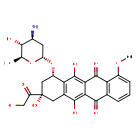
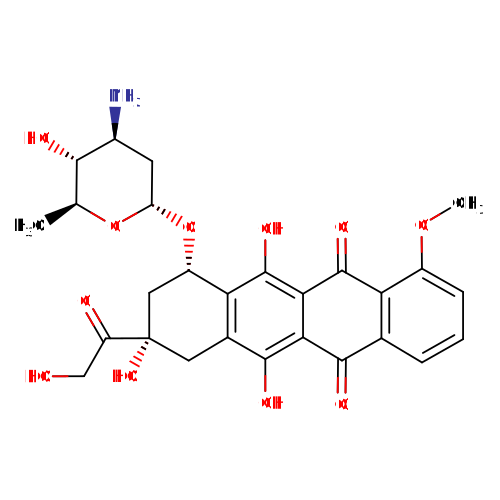
Structure for Epirubicin (DB00445)
- Weight
- Average: 543.5193
Monoisotopic: 543.174060775 - Chemical Formula
- C27H29NO11
- Synonyms
- (1S,3S)-3-GLYCOLOYL-1,2,3,4,6,11-HEXAHYDRO-3,5,12-TRIHYDROXY-10-METHOXY-6,11-DIOXO-1-NAPHTHACENYL 3-AMINO-2,3,6-TRIDEOXY-.ALPHA.-L-ARABINO-HEXOPYRANOSIDE
- 4'-EPI-ADRIAMYCIN
- 4'-Epiadriamycin
- 5,12-NAPHTHACENEDIONE, 10-((3-AMINO-2,3,6-TRIDEOXY-.ALPHA.-L-ARABINO-HEXOPYRANOSYL)OXY)-7,8,9,10-TETRAHYDRO-6,8,11-TRIHYDROXY-8-(HYDROXYACETYL)-1-METHOXY-, (8S-CIS)-
- Epiadriamycin
- Epirubicin
- epirubicin-conjugated polymer micelles
- Epirubicina
- Epirubicine
- Epirubicinum
- Pidorubicina
- Pidorubicine
- Pidorubicinum
- External IDs
- NSC-256942

Pharmacology
- Indication
For use as a component of adjuvant therapy in patients with evidence of axillary node tumor involvement following resection of primary breast cancer.
 Reduce drug development failure ratesBuild, train, & validate machine-learning modelswith evidence-based and structured datasets.Build, train, & validate predictive machine-learning models with structured datasets.
- Associated Conditions
Indication Type Indication Combined Product Details Approval Level Age Group Patient Characteristics Dose Form Treatment of Breast cancer •••••••••••• ••••••••• Treatment of Colorectal cancers •••••••••••• ••••••••• Treatment of Hormone refractory prostate cancer •••••••••••• ••••••••• Treatment of Non-small cell lung carcinoma (nsclc) •••••••••••• ••••••••• Treatment of Ovarian cancer •••••••••••• ••••••••• - Contraindications & Blackbox Warnings
 Prevent Adverse Drug Events TodayTap into our Clinical API for life-saving information on contraindications & blackbox warnings, population restrictions, harmful risks, & more.Avoid life-threatening adverse drug events with our Clinical API
- Pharmacodynamics
Epirubicin is an antineoplastic in the anthracycline class. General properties of drugs in this class include: interaction with DNA in a variety of different ways including intercalation (squeezing between the base pairs), DNA strand breakage and inhibition with the enzyme topoisomerase II. Most of these compounds have been isolated from natural sources and antibiotics. However, they lack the specificity of the antimicrobial antibiotics and thus produce significant toxicity. The anthracyclines are among the most important antitumor drugs available. Doxorubicin is widely used for the treatment of several solid tumors while daunorubicin and idarubicin are used exclusively for the treatment of leukemia. Epirubicin may also inhibit polymerase activity, affect regulation of gene expression, and produce free radical damage to DNA. Epirubicin possesses an antitumor effect against a wide spectrum of tumors, either grafted or spontaneous. The anthracyclines are cell cycle-nonspecific.
- Mechanism of action
Epirubicin has antimitotic and cytotoxic activity. It inhibits nucleic acid (DNA and RNA) and protein synthesis through a number of proposed mechanisms of action: Epirubicin forms complexes with DNA by intercalation between base pairs, and it inhibits topoisomerase II activity by stabilizing the DNA-topoisomerase II complex, preventing the religation portion of the ligation-religation reaction that topoisomerase II catalyzes. It also interferes with DNA replication and transcription by inhibiting DNA helicase activity.
Target Actions Organism UDNA intercalationHumans UDNA topoisomerase 2-alpha inhibitorHumans - Absorption
100%
- Volume of distribution
- 21 ± 2 L/kg [60 mg/m2 Dose]
- 27 ± 11 L/kg [75 mg/m2 Dose]
- 23 ± 7 L/kg [120 mg/m2 Dose]
- 21 ± 7 L/kg [150 mg/m2 Dose]
- Protein binding
77%
- Metabolism
Extensively and rapidly metabolized in the liver. Epirubicin is also metabolized by other organs and cells, including red blood cells. The four main metabolic routes are: (1) reduction of the C-13 keto-group with the formation of the 13(S)-dihydro derivative, epirubicinol; (2) conjugation of both the unchanged drug and epirubicinol with glucuronic acid; (3) loss of the amino sugar moiety through a hydrolytic process with the formation of the doxorubicin and doxorubicinol aglycones; and (4) loss of the amino sugar moiety through a redox process with the formation of the 7-deoxy-doxorubicin aglycone and 7-deoxy-doxorubicinol aglycone. Epirubicinol exhibits in vitro cytoxic activity (~10% that of epirubicin), but it is unlikely to reach sufficient concentrations in vivo to produce cytotoxic effects.
- Route of elimination
Epirubicin and its major metabolites are eliminated through biliary excretion and, to a lesser extent, by urinary excretion.
- Half-life
Half-lives for the alpha, beta, and gamma phases of about 3 minutes, 2.5 hours and 33 hours, respectively
- Clearance
- 65 +/- 8 L/hour [Patients1 with Solid Tumors Receiving Intravenous Epirubicin 60 mg/m2]
- 83 +/- 14 L/hour [Patients1 with Solid Tumors Receiving Intravenous Epirubicin 75 mg/m2]
- 65 +/- 13 L/hour [Patients1 with Solid Tumors Receiving Intravenous Epirubicin 120 mg/m2]
- 69 +/- 13 L/hour [Patients1 with Solid Tumors Receiving Intravenous Epirubicin 150 mg/m2]
- Adverse Effects
 Improve decision support & research outcomesWith structured adverse effects data, including: blackbox warnings, adverse reactions, warning & precautions, & incidence rates. View sample adverse effects data in our new Data Library!Improve decision support & research outcomes with our structured adverse effects data.
- Toxicity
bone marrow aplasia, grade 4 mucositis, and gastrointestinal bleeding
- Pathways
- Not Available
- Pharmacogenomic Effects/ADRs
- Not Available
Interactions
- Drug Interactions
- This information should not be interpreted without the help of a healthcare provider. If you believe you are experiencing an interaction, contact a healthcare provider immediately. The absence of an interaction does not necessarily mean no interactions exist.
Drug Interaction Integrate drug-drug
interactions in your softwareAbatacept The risk or severity of adverse effects can be increased when Epirubicin is combined with Abatacept. Abciximab The risk or severity of bleeding can be increased when Abciximab is combined with Epirubicin. Acenocoumarol The risk or severity of bleeding can be increased when Acenocoumarol is combined with Epirubicin. Acetyldigitoxin Acetyldigitoxin may decrease the cardiotoxic activities of Epirubicin. Acetylsalicylic acid The risk or severity of bleeding can be increased when Acetylsalicylic acid is combined with Epirubicin. - Food Interactions
- Drink plenty of fluids. Increased fluid intake increases urine output and the excretion of uric acid.
Products
 Drug product information from 10+ global regionsOur datasets provide approved product information including:dosage, form, labeller, route of administration, and marketing period.Access drug product information from over 10 global regions.
- Product Ingredients
Ingredient UNII CAS InChI Key Epirubicin hydrochloride 22966TX7J5 56390-09-1 MWWSFMDVAYGXBV-FGBSZODSSA-N - International/Other Brands
- Epirubicin Ebewe / Pharmorubicin
- Brand Name Prescription Products
Name Dosage Strength Route Labeller Marketing Start Marketing End Region Image Ellence Injection, solution 2 mg/1mL Intravenous Pharmacia & Upjohn Company LLC 1999-09-15 Not applicable US 
Ellence Injection, solution 2 mg/1mL Intravenous Pharmacia & Upjohn Company LLC 1999-09-15 Not applicable US Epirubicin for Injection Solution 2 mg / mL Intravenous TEVA Canada Limited 2009-09-14 Not applicable Canada 
Epirubicin Hydrochloride Injection, powder, lyophilized, for solution 200 mg/100mL Intravenous Hospira Worldwide, Inc. 2006-09-15 2008-03-25 US Epirubicin Hydrochloride Injection, powder, lyophilized, for solution 50 mg/25mL Intravenous Hospira Worldwide, Inc. 2006-09-15 2014-08-31 US - Generic Prescription Products
Name Dosage Strength Route Labeller Marketing Start Marketing End Region Image Epirubicin Hydrochloride Injection 2 mg/1mL Intravenous Actavis Pharma, Inc. 2011-11-28 2021-06-30 US Epirubicin Hydrochloride Injection 2 mg/1mL Intravenous Cipla Limited 2007-10-22 2014-05-19 US Epirubicin Hydrochloride Injection 2 mg/1mL Intravenous Hikma Pharmaceuticals USA Inc. 2007-08-07 Not applicable US Epirubicin hydrochloride Injection, solution 2 mg/1mL Intravenous Bedford Pharmaceuticals 2007-08-07 2010-04-30 US Epirubicin Hydrochloride Injection 50 mg/25mL Intravenous Amneal Agila, Llc 2013-07-31 2017-12-31 US
Categories
- ATC Codes
- L01DB03 — Epirubicin
- Drug Categories
- Anthracycline Topoisomerase Inhibitor
- Anthracyclines
- Anthracyclines and Related Substances
- Antibiotics, Antineoplastic
- Antineoplastic Agents
- Antineoplastic and Immunomodulating Agents
- Carbohydrates
- Cardiotoxic antineoplastic agents
- Cytotoxic Antibiotics and Related Substances
- Enzyme Inhibitors
- Glycosides
- Hepatotoxic Agents
- Immunosuppressive Agents
- Myelosuppressive Agents
- Naphthacenes
- Narrow Therapeutic Index Drugs
- Topoisomerase II Inhibitors
- Topoisomerase Inhibitors
- UGT2B7 substrates
- UGT2B7 Substrates with a Narrow Therapeutic Index
- Chemical TaxonomyProvided by Classyfire
- Description
- This compound belongs to the class of organic compounds known as anthracyclines. These are polyketides containing a tetracenequinone ring structure with a sugar attached by glycosidic linkage.
- Kingdom
- Organic compounds
- Super Class
- Phenylpropanoids and polyketides
- Class
- Anthracyclines
- Sub Class
- Not Available
- Direct Parent
- Anthracyclines
- Alternative Parents
- Tetracenequinones / Aminoglycosides / Anthraquinones / Hexoses / O-glycosyl compounds / Tetralins / Anisoles / Aryl ketones / Alkyl aryl ethers / Oxanes show 13 more
- Substituents
- 1,2-aminoalcohol / 1,4-anthraquinone / 9,10-anthraquinone / Acetal / Alcohol / Alkyl aryl ether / Alpha-hydroxy ketone / Amine / Amino saccharide / Aminoglycoside core show 33 more
- Molecular Framework
- Aromatic heteropolycyclic compounds
- External Descriptors
- quinone, monosaccharide derivative, anthracycline antibiotic, aminoglycoside, deoxy hexoside, anthracycline (CHEBI:47898)
- Affected organisms
- Humans and other mammals
Chemical Identifiers
- UNII
- 3Z8479ZZ5X
- CAS number
- 56420-45-2
- InChI Key
- AOJJSUZBOXZQNB-VTZDEGQISA-N
- InChI
- InChI=1S/C27H29NO11/c1-10-22(31)13(28)6-17(38-10)39-15-8-27(36,16(30)9-29)7-12-19(15)26(35)21-20(24(12)33)23(32)11-4-3-5-14(37-2)18(11)25(21)34/h3-5,10,13,15,17,22,29,31,33,35-36H,6-9,28H2,1-2H3/t10-,13-,15-,17-,22-,27-/m0/s1
- IUPAC Name
- (8S,10S)-10-{[(2R,4S,5R,6S)-4-amino-5-hydroxy-6-methyloxan-2-yl]oxy}-6,8,11-trihydroxy-8-(2-hydroxyacetyl)-1-methoxy-5,7,8,9,10,12-hexahydrotetracene-5,12-dione
- SMILES
- COC1=CC=CC2=C1C(=O)C1=C(O)C3=C(C[C@](O)(C[C@@H]3O[C@H]3C[C@H](N)[C@@H](O)[C@H](C)O3)C(=O)CO)C(O)=C1C2=O
References
- Synthesis Reference
Marcel van der Rijst, Johan Wilhelm Scheeren, Dick de Vos, "Process for preparing epirubicin or acid addition salts thereof from daunorubicin." U.S. Patent US5874550, issued September, 1996.
US5874550- General References
- Not Available
- External Links
- Human Metabolome Database
- HMDB0014588
- KEGG Compound
- C11230
- PubChem Compound
- 41867
- PubChem Substance
- 46507282
- ChemSpider
- 38201
- BindingDB
- 43839
- 3995
- ChEBI
- 47898
- ChEMBL
- CHEMBL417
- ZINC
- ZINC000003938704
- Therapeutic Targets Database
- DAP000193
- PharmGKB
- PA449476
- RxList
- RxList Drug Page
- Drugs.com
- Drugs.com Drug Page
- Wikipedia
- Epirubicin
- FDA label
- Download (92.7 KB)
Clinical Trials
- Clinical Trials
Phase Status Purpose Conditions Count 4 Active Not Recruiting Treatment Diffuse Large B-Cell Lymphoma (DLBCL) 1 4 Completed Prevention Carcinoma of Urinary Bladder, Superficial 1 4 Completed Treatment Breast Cancer 1 4 Completed Treatment Breast Neoplasms 1 4 Not Yet Recruiting Treatment 0.5-14 Year Old Children With Nephroblastoma 1
Pharmacoeconomics
- Manufacturers
- Pfizer inc
- Actavis totowa llc
- Akorn inc
- App pharmaceuticals llc
- Bedford laboratories div ben venue laboratories inc
- Bioniche pharma usa llc
- Ebewe pharma ges mbh nfg kg
- Fresenius kabi oncology plc
- Hospira inc
- Teva parenteral medicines inc
- Watson laboratories inc
- X gen pharmaceuticals inc
- Packagers
- APP Pharmaceuticals
- Bedford Labs
- Ben Venue Laboratories Inc.
- Cipla Ltd.
- Ebewe Pharma
- Ethex Corp.
- Fresenius Kabi AB
- Generamedix Inc.
- Greenstone LLC
- Hospira Inc.
- Intas Pharmaceuticals Ltd.
- Otn Generics Inc.
- Pfizer Inc.
- Pharmacia Inc.
- Sagent Pharmaceuticals
- Teva Pharmaceutical Industries Ltd.
- Dosage Forms
Form Route Strength Injection, powder, for solution 10 mg Injection, powder, for solution 50 mg Injection, powder, lyophilized, for solution Intravenous 50 mg Injection, powder, lyophilized, for solution Intra-arterial; Intravenous; Intravesical 50 mg Solution Intravenous 10 mg/5ml Solution Intravenous 50 mg/25ml Injection, solution Intravenous 2 MG/ML Solution Intravenous 2.00 mg Injection 2 mg/mL Injection Intravenous 10 mg/5ml Solution Intravenous; Intravesical 2 mg/ml Injection, powder, lyophilized, for solution Intravenous 10 mg Solution 10.000 mg Solution Intravenous; Intravesical 10 mg/5ml Solution Intravenous; Intravesical 200 mg/100ml Injection, solution, concentrate Intravenous Solution Intravenous; Intravesical 50 mg/25ml Injection, powder, for solution; injection, powder, lyophilized, for solution 10 mg Injection, powder, for solution; injection, powder, lyophilized, for solution 50 mg Solution Intravenous Solution Intravenous; Intravesical 100 mg/50ml Injection, solution, concentrate Parenteral 2 mg/ml Injection Intravenous Injection Intravenous 2 mg/1mL Injection Intravenous 200 mg/100mL Injection Intravenous 50 mg/25mL Injection, powder, lyophilized, for solution Intravenous 200 mg/100mL Injection, powder, lyophilized, for solution Intravenous 50 mg/25mL Injection, solution Intravenous 2 mg/1mL Injection, solution Intravenous 200 mg/100mL Injection, solution Intravenous 50 mg/25mL Powder, for solution Intravenous 50 mg / vial Solution Intravenous 2 mg / mL Solution Intravenous 2.0 mg / mL Powder Parenteral 10 mg Injection, solution Intravenous Injection, solution Injection, solution Intravesical Injection, solution Parenteral 2 MG/ML Injection, powder, for solution Injection Parenteral Injection Parenteral 200 mg Injection Parenteral 50 mg Injection, powder, for solution Intravenous 10 mg/5mL Injection, powder, for solution Intravenous; Intravesical 10 mg/5ml Injection, powder, for solution Intravenous; Intravesical 50 mg/5mL Injection, solution Intravenous; Intravesical 50 mg/100ml Injection, powder, for solution Parenteral 50 mg Injection Parenteral 10 mg Solution Intravenous 50 mg Solution Parenteral 50 mg Injection Solution Intravenous 50.00 mg Solution Intravenous 10.000 mg Solution Intravenous 50.000 mg Solution 10 mg/5ml Injection, solution Intravenous; Intravesical 10 MG/5ML Injection, solution Intravenous; Intravesical 200 MG/100ML Injection, solution Intravenous; Intravesical 20 MG/10ML Injection, solution Intravenous; Intravesical Powder, for solution Intravenous 10 mg / vial Injection, powder, lyophilized, for solution Intravenous 10 mg/5ml Injection, solution, concentrate Parenteral Injection, powder, lyophilized, for solution Intramuscular 50 mg/50mg Solution Parenteral 10.00 mg Injection, solution 10 mg/5ml Injection, solution 50 mg/25ml - Prices
Unit description Cost Unit Epirubicin hcl 200 mg vial 2845.85USD vial Epirubicin hcl 50 mg vial 69.54USD vial Ellence 2 mg/ml vial 5.38USD ml DrugBank does not sell nor buy drugs. Pricing information is supplied for informational purposes only.- Patents
- Not Available
Properties
- State
- Solid
- Experimental Properties
Property Value Source melting point (°C) 344.53 °C Not Available water solubility 0.093 mg/ml Not Available logP -0.5 Not Available - Predicted Properties
Property Value Source Water Solubility 1.18 mg/mL ALOGPS logP 1.41 ALOGPS logP 0.54 Chemaxon logS -2.7 ALOGPS pKa (Strongest Acidic) 8.01 Chemaxon pKa (Strongest Basic) 10.03 Chemaxon Physiological Charge 1 Chemaxon Hydrogen Acceptor Count 12 Chemaxon Hydrogen Donor Count 6 Chemaxon Polar Surface Area 206.07 Å2 Chemaxon Rotatable Bond Count 5 Chemaxon Refractivity 134.59 m3·mol-1 Chemaxon Polarizability 54.62 Å3 Chemaxon Number of Rings 5 Chemaxon Bioavailability 0 Chemaxon Rule of Five No Chemaxon Ghose Filter No Chemaxon Veber's Rule No Chemaxon MDDR-like Rule No Chemaxon - Predicted ADMET Features
Property Value Probability Human Intestinal Absorption - 0.8092 Blood Brain Barrier - 0.9951 Caco-2 permeable - 0.799 P-glycoprotein substrate Substrate 0.7861 P-glycoprotein inhibitor I Non-inhibitor 0.8782 P-glycoprotein inhibitor II Non-inhibitor 0.8382 Renal organic cation transporter Non-inhibitor 0.9053 CYP450 2C9 substrate Non-substrate 0.8042 CYP450 2D6 substrate Non-substrate 0.9116 CYP450 3A4 substrate Substrate 0.5888 CYP450 1A2 substrate Non-inhibitor 0.9045 CYP450 2C9 inhibitor Non-inhibitor 0.9209 CYP450 2D6 inhibitor Non-inhibitor 0.9231 CYP450 2C19 inhibitor Non-inhibitor 0.9025 CYP450 3A4 inhibitor Non-inhibitor 0.831 CYP450 inhibitory promiscuity Low CYP Inhibitory Promiscuity 0.8911 Ames test AMES toxic 0.9198 Carcinogenicity Non-carcinogens 0.9534 Biodegradation Not ready biodegradable 0.9672 Rat acute toxicity 2.6644 LD50, mol/kg Not applicable hERG inhibition (predictor I) Weak inhibitor 0.9752 hERG inhibition (predictor II) Non-inhibitor 0.7195
Spectra
- Mass Spec (NIST)
- Not Available
- Spectra
- Chromatographic Properties
Collision Cross Sections (CCS)
Adduct CCS Value (Å2) Source type Source [M-H]- 234.6833172 predictedDarkChem Lite v0.1.0 [M-H]- 227.1350172 predictedDarkChem Lite v0.1.0 [M-H]- 217.42393 predictedDeepCCS 1.0 (2019) [M+H]+ 234.2635172 predictedDarkChem Lite v0.1.0 [M+H]+ 227.7723172 predictedDarkChem Lite v0.1.0 [M+H]+ 219.24883 predictedDeepCCS 1.0 (2019) [M+Na]+ 234.0370172 predictedDarkChem Lite v0.1.0 [M+Na]+ 226.6174172 predictedDarkChem Lite v0.1.0 [M+Na]+ 224.85466 predictedDeepCCS 1.0 (2019)
Targets

References
- Ganzina F: 4'-epi-doxorubicin, a new analogue of doxorubicin: a preliminary overview of preclinical and clinical data. Cancer Treat Rev. 1983 Mar;10(1):1-22. [Article]
- Williams LD, Frederick CA, Ughetto G, Rich A: Ternary interactions of spermine with DNA: 4'-epiadriamycin and other DNA: anthracycline complexes. Nucleic Acids Res. 1990 Sep 25;18(18):5533-41. [Article]
- Podell ER, Harrington DJ, Taatjes DJ, Koch TH: Crystal structure of epidoxorubicin-formaldehyde virtual crosslink of DNA and evidence for its formation in human breast-cancer cells. Acta Crystallogr D Biol Crystallogr. 1999 Sep;55(Pt 9):1516-23. [Article]
- Kind
- Protein
- Organism
- Humans
- Pharmacological action
- Unknown
- Actions
- Inhibitor
- General Function
- Ubiquitin binding
- Specific Function
- Control of topological states of DNA by transient breakage and subsequent rejoining of DNA strands. Topoisomerase II makes double-strand breaks. Essential during mitosis and meiosis for proper segr...
- Gene Name
- TOP2A
- Uniprot ID
- P11388
- Uniprot Name
- DNA topoisomerase 2-alpha
- Molecular Weight
- 174383.88 Da
References
- Petit T, Wilt M, Velten M, Millon R, Rodier JF, Borel C, Mors R, Haegele P, Eber M, Ghnassia JP: Comparative value of tumour grade, hormonal receptors, Ki-67, HER-2 and topoisomerase II alpha status as predictive markers in breast cancer patients treated with neoadjuvant anthracycline-based chemotherapy. Eur J Cancer. 2004 Jan;40(2):205-11. [Article]
- Knoop AS, Knudsen H, Balslev E, Rasmussen BB, Overgaard J, Nielsen KV, Schonau A, Gunnarsdottir K, Olsen KE, Mouridsen H, Ejlertsen B: retrospective analysis of topoisomerase IIa amplifications and deletions as predictive markers in primary breast cancer patients randomly assigned to cyclophosphamide, methotrexate, and fluorouracil or cyclophosphamide, epirubicin, and fluorouracil: Danish Breast Cancer Cooperative Group. J Clin Oncol. 2005 Oct 20;23(30):7483-90. [Article]
- Liang CH, Shiu LY, Chang LC, Sheu HM, Kuo KW: Solamargine upregulation of Fas, downregulation of HER2, and enhancement of cytotoxicity using epirubicin in NSCLC cells. Mol Nutr Food Res. 2007 Aug;51(8):999-1005. [Article]
Enzymes
- Kind
- Protein
- Organism
- Humans
- Pharmacological action
- Unknown
- Actions
- Substrate
- General Function
- Glucuronosyltransferase activity
- Specific Function
- UDPGT is of major importance in the conjugation and subsequent elimination of potentially toxic xenobiotics and endogenous compounds.Its unique specificity for 3,4-catechol estrogens and estriol su...
- Gene Name
- UGT2B7
- Uniprot ID
- P16662
- Uniprot Name
- UDP-glucuronosyltransferase 2B7
- Molecular Weight
- 60694.12 Da
References
- Innocenti F, Iyer L, Ramirez J, Green MD, Ratain MJ: Epirubicin glucuronidation is catalyzed by human UDP-glucuronosyltransferase 2B7. Drug Metab Dispos. 2001 May;29(5):686-92. [Article]
- Zaya MJ, Hines RN, Stevens JC: Epirubicin glucuronidation and UGT2B7 developmental expression. Drug Metab Dispos. 2006 Dec;34(12):2097-101. Epub 2006 Sep 19. [Article]
- Kind
- Protein
- Organism
- Humans
- Pharmacological action
- Unknown
- Actions
- Inhibitor
- General Function
- Phospholipase a2 activity
- Specific Function
- Selectively hydrolyzes arachidonyl phospholipids in the sn-2 position releasing arachidonic acid. Together with its lysophospholipid activity, it is implicated in the initiation of the inflammatory...
- Gene Name
- PLA2G4A
- Uniprot ID
- P47712
- Uniprot Name
- Cytosolic phospholipase A2
- Molecular Weight
- 85238.2 Da
References
- Grataroli R, Leonardi J, Chautan M, Lafont H, Nalbone G: Effect of anthracyclines on phospholipase A2 activity and prostaglandin E2 production in rat gastric mucosa. Biochem Pharmacol. 1993 Aug 3;46(3):349-55. [Article]
Transporters
- Kind
- Protein
- Organism
- Humans
- Pharmacological action
- Unknown
- Actions
- Substrate
- General Function
- Transporter activity
- Specific Function
- Mediates export of organic anions and drugs from the cytoplasm. Mediates ATP-dependent transport of glutathione and glutathione conjugates, leukotriene C4, estradiol-17-beta-o-glucuronide, methotre...
- Gene Name
- ABCC1
- Uniprot ID
- P33527
- Uniprot Name
- Multidrug resistance-associated protein 1
- Molecular Weight
- 171589.5 Da
References
- Godinot N, Iversen PW, Tabas L, Xia X, Williams DC, Dantzig AH, Perry WL 3rd: Cloning and functional characterization of the multidrug resistance-associated protein (MRP1/ABCC1) from the cynomolgus monkey. Mol Cancer Ther. 2003 Mar;2(3):307-16. [Article]
- Nunoya K, Grant CE, Zhang D, Cole SP, Deeley RG: Molecular cloning and pharmacological characterization of rat multidrug resistance protein 1 (mrp1). Drug Metab Dispos. 2003 Aug;31(8):1016-26. [Article]
- Stride BD, Grant CE, Loe DW, Hipfner DR, Cole SP, Deeley RG: Pharmacological characterization of the murine and human orthologs of multidrug-resistance protein in transfected human embryonic kidney cells. Mol Pharmacol. 1997 Sep;52(3):344-53. [Article]

Drug created at June 13, 2005 13:24 / Updated at April 26, 2024 00:45