Identification
- Summary
Framycetin is an aminoglycoside antibiotic used in various formulations and combinations with other agents to treat hemorrhoids, eye and ear infections, and to reduce nasal carriage of staphylococcus.
- Brand Names
- Proctol, Proctosedyl, Sofra-tulle, Sofracort, Soframycin
- Generic Name
- Framycetin
- DrugBank Accession Number
- DB00452
- Background
A component of neomycin that is produced by Streptomyces fradiae. On hydrolysis it yields neamine and neobiosamine B. (From Merck Index, 11th ed)
- Type
- Small Molecule
- Groups
- Approved
- Structure
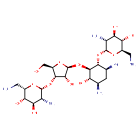
Structure for Framycetin (DB00452)
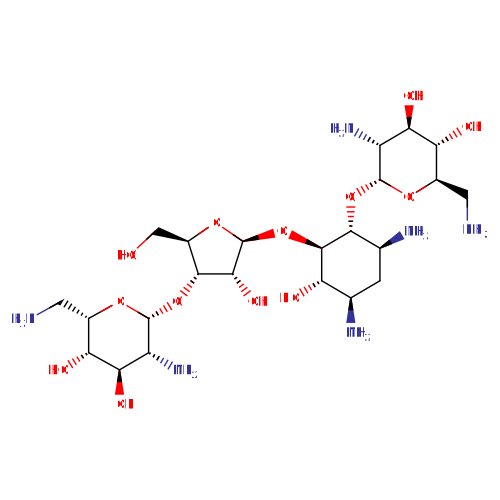
- Weight
- Average: 614.6437
Monoisotopic: 614.312285588 - Chemical Formula
- C23H46N6O13
- Synonyms
- Fradiomycin B
- Framicetina
- Framycetin
- Framycétine
- Framycetinum
- Neomycin B
- External IDs
- ANTIBIOTIQUE EF 185

Pharmacology
- Indication
For the treatment of bacterial blepharitis, bacterial bonjunctivitis, corneal injuries, corneal ulcers and meibomianitis. For the prophylaxis of ocular infections following foreign body removal
 Reduce drug development failure ratesBuild, train, & validate machine-learning modelswith evidence-based and structured datasets.Build, train, & validate predictive machine-learning models with structured datasets.
- Associated Conditions
Indication Type Indication Combined Product Details Approval Level Age Group Patient Characteristics Dose Form Treatment of Acute crusting rhinitis •••••••••••• ••••• Treatment of Conjunctivitis •••••••••••• •••••••••• Treatment of Corneal abrasion •••••••••••• •••••••••• Treatment of Corneal ulcer •••••••••••• •••••••••• Prophylaxis of Infection •••••••••••• ••••• - Contraindications & Blackbox Warnings
 Prevent Adverse Drug Events TodayTap into our Clinical API for life-saving information on contraindications & blackbox warnings, population restrictions, harmful risks, & more.Avoid life-threatening adverse drug events with our Clinical API
- Pharmacodynamics
Framycetin is used for the treatment of bacterial eye infections such as conjunctivitis. Framycetin is an antibiotic. It is not active against fungi, viruses and most kinds of anaerobic bacteria. Framycetin works by binding to the bacterial 30S ribosomal subunit, causing misreading of t-RNA, leaving the bacterium unable to synthesize proteins vital to its growth. Framycetin is useful primarily in infections involving aerobic bacteria bacteria.
- Mechanism of action
Framycetin binds to specific 30S-subunit proteins and 16S rRNA, four nucleotides of 16S rRNA and a single amino acid of protein S12. This interferes with decoding site in the vicinity of nucleotide 1400 in 16S rRNA of 30S subunit. This region interacts with the wobble base in the anticodon of tRNA. This leads to interference with the initiation complex, misreading of mRNA so incorrect amino acids are inserted into the polypeptide leading to nonfunctional or toxic peptides and the breakup of polysomes into nonfunctional monosomes.
Target Actions Organism A16S ribosomal RNA inhibitorEnteric bacteria and other eubacteria A30S ribosomal protein S12 inhibitorEscherichia coli (strain K12) UC-X-C chemokine receptor type 4 antagonistHumans - Absorption
Not Available
- Volume of distribution
Not Available
- Protein binding
Not Available
- Metabolism
- Not Available
- Route of elimination
Not Available
- Half-life
Not Available
- Clearance
Not Available
- Adverse Effects
 Improve decision support & research outcomesWith structured adverse effects data, including: blackbox warnings, adverse reactions, warning & precautions, & incidence rates. View sample adverse effects data in our new Data Library!Improve decision support & research outcomes with our structured adverse effects data.
- Toxicity
Not Available
- Pathways
Pathway Category Neomycin Action Pathway Drug action - Pharmacogenomic Effects/ADRs
- Not Available
Interactions
- Drug Interactions
- This information should not be interpreted without the help of a healthcare provider. If you believe you are experiencing an interaction, contact a healthcare provider immediately. The absence of an interaction does not necessarily mean no interactions exist.
Drug Interaction Integrate drug-drug
interactions in your softwareAbacavir Framycetin may decrease the excretion rate of Abacavir which could result in a higher serum level. Aceclofenac The risk or severity of nephrotoxicity can be increased when Framycetin is combined with Aceclofenac. Acemetacin The risk or severity of nephrotoxicity can be increased when Framycetin is combined with Acemetacin. Acenocoumarol The risk or severity of bleeding can be increased when Framycetin is combined with Acenocoumarol. Acetaminophen Framycetin may decrease the excretion rate of Acetaminophen which could result in a higher serum level. - Food Interactions
- No interactions found.
Products
 Drug product information from 10+ global regionsOur datasets provide approved product information including:dosage, form, labeller, route of administration, and marketing period.Access drug product information from over 10 global regions.
- Product Ingredients
Ingredient UNII CAS InChI Key Framycetin sulfate Y3720KZ4TQ 4146-30-9 KWBUARAINLGYMG-JGMIRXPNSA-N - International/Other Brands
- Isofra (Bouchara) / Izofra (Bouchara) / Leukase N (Dermapharm) / Pola (Royal) / Sofra-Tulle (sanofi-aventis) / Soframycin (sanofi-aventis) / Soframycine (Melisana)
- Brand Name Prescription Products
Name Dosage Strength Route Labeller Marketing Start Marketing End Region Image Sofra Tulle 10 X 10cm Dressing 1 % Topical Roussel Canada Inc. 1966-12-31 1996-09-09 Canada 
Sofra Tulle Strip (10 X 30cm) Dressing 1 % Topical Roussel Canada Inc. 1974-12-31 1997-08-05 Canada Sofra-tulle Dressing 1 % Topical Searchlight Pharma Inc 1995-12-31 Not applicable Canada Sofra-tulle Dressing 1 % Topical Searchlight Pharma Inc 1994-12-31 Not applicable Canada Soframycin Eye Drops Solution / drops 5 mg / mL Ophthalmic Searchlight Pharma Inc 2001-08-03 Not applicable Canada - Mixture Products
Name Ingredients Dosage Route Labeller Marketing Start Marketing End Region Image Odan Proctomyxin HC Framycetin sulfate (1 %) + Cinchocaine hydrochloride (0.5 %) + Esculin (1 %) + Hydrocortisone (0.5 %) Ointment Rectal Odan Laboratories Ltd 2001-03-09 2021-08-11 Canada Odan Proctomyxin HC Suppositories Framycetin sulfate (10 mg) + Cinchocaine hydrochloride (5 mg) + Esculin (10 mg) + Hydrocortisone (5 mg) Suppository Rectal Odan Laboratories Ltd 2001-01-05 2021-10-07 Canada Proctol Ointment Framycetin sulfate (1 %) + Cinchocaine hydrochloride (0.5 %) + Esculin (1 %) + Hydrocortisone (0.5 %) Ointment Rectal Odan Laboratories Ltd 2003-08-06 Not applicable Canada Proctol Suppositories Framycetin sulfate (10 mg) + Cinchocaine hydrochloride (5 mg) + Esculin (10 mg) + Hydrocortisone (5 mg) Suppository Rectal Odan Laboratories Ltd 2004-03-15 Not applicable Canada Proctosedyl Framycetin sulfate (10 mg) + Cinchocaine hydrochloride (5 mg) + Esculin (10 mg) + Hydrocortisone (5 mg) Suppository Rectal Aptalis Pharma Canada Ulc 1997-01-23 2020-05-27 Canada
Categories
- ATC Codes
- D09AA01 — Framycetin
- D09AA — Medicated dressings with antiinfectives
- D09A — MEDICATED DRESSINGS
- D09 — MEDICATED DRESSINGS
- D — DERMATOLOGICALS
- R01AX — Other nasal preparations
- R01A — DECONGESTANTS AND OTHER NASAL PREPARATIONS FOR TOPICAL USE
- R01 — NASAL PREPARATIONS
- R — RESPIRATORY SYSTEM
- Drug Categories
- Chemical TaxonomyProvided by Classyfire
- Description
- This compound belongs to the class of organic compounds known as 4,5-disubstituted 2-deoxystreptamines. These are 2-deoxystreptamine aminoglycosides that a glycosidically linked to a pyranose of furanose unit at the C4- and C5-positions.
- Kingdom
- Organic compounds
- Super Class
- Organic oxygen compounds
- Class
- Organooxygen compounds
- Sub Class
- Carbohydrates and carbohydrate conjugates
- Direct Parent
- 4,5-disubstituted 2-deoxystreptamines
- Alternative Parents
- O-glycosyl compounds / Disaccharides / Aminocyclitols and derivatives / Cyclohexylamines / Cyclohexanols / Oxanes / Tetrahydrofurans / 1,2-aminoalcohols / Oxacyclic compounds / Acetals show 4 more
- Substituents
- 1,2-aminoalcohol / 4,5-disubstituted 2-deoxystreptamine / Acetal / Alcohol / Aliphatic heteromonocyclic compound / Amine / Aminocyclitol or derivatives / Cyclic alcohol / Cyclitol or derivatives / Cyclohexanol show 16 more
- Molecular Framework
- Aliphatic heteromonocyclic compounds
- External Descriptors
- aminoglycoside (CHEBI:7508) / 2-Deoxystreptamines (C01737)
- Affected organisms
- Enteric bacteria and other eubacteria
Chemical Identifiers
- UNII
- 4BOC774388
- CAS number
- 119-04-0
- InChI Key
- PGBHMTALBVVCIT-VCIWKGPPSA-N
- InChI
- InChI=1S/C23H46N6O13/c24-2-7-13(32)15(34)10(28)21(37-7)40-18-6(27)1-5(26)12(31)20(18)42-23-17(36)19(9(4-30)39-23)41-22-11(29)16(35)14(33)8(3-25)38-22/h5-23,30-36H,1-4,24-29H2/t5-,6+,7-,8+,9-,10-,11-,12+,13-,14-,15-,16-,17-,18-,19-,20-,21-,22-,23+/m1/s1
- IUPAC Name
- (2R,3S,4R,5R,6R)-5-amino-2-(aminomethyl)-6-{[(1R,2R,3S,4R,6S)-4,6-diamino-2-{[(2S,3R,4S,5R)-4-{[(2R,3R,4R,5S,6S)-3-amino-6-(aminomethyl)-4,5-dihydroxyoxan-2-yl]oxy}-3-hydroxy-5-(hydroxymethyl)oxolan-2-yl]oxy}-3-hydroxycyclohexyl]oxy}oxane-3,4-diol
- SMILES
- NC[C@@H]1O[C@H](O[C@@H]2[C@@H](CO)O[C@@H](O[C@@H]3[C@@H](O)[C@H](N)C[C@H](N)[C@H]3O[C@H]3O[C@H](CN)[C@@H](O)[C@H](O)[C@H]3N)[C@@H]2O)[C@H](N)[C@@H](O)[C@@H]1O
References
- Synthesis Reference
Vanangamudi Subramaniam Sulur, Madhavan Srinivasan, Neelakandan Narayanan Chulliel, Haridas Sankar, Kuppusamy Senthilkumar, "Medicinal Cream Made Using Framycetin Sulphate and Chitosan and a Process to Make the Same." U.S. Patent US20120101056, issued April 26, 2012.
US20120101056- General References
- Not Available
- External Links
- Human Metabolome Database
- HMDB0015129
- KEGG Drug
- D05140
- KEGG Compound
- C01737
- PubChem Compound
- 8378
- PubChem Substance
- 46508892
- ChemSpider
- 8075
- BindingDB
- 19
- 4556
- ChEBI
- 7508
- ChEMBL
- CHEMBL184618
- ZINC
- ZINC000071928291
- Therapeutic Targets Database
- DNC001005
- PharmGKB
- PA450608
- PDBe Ligand
- NMY
- Wikipedia
- Neomycin
- PDB Entries
- 1ei2 / 1i9v / 2a04 / 2b0q / 2et4 / 2fcy / 3c7r / 4lf6 / 4lfb / 4v52 … show 20 more
Clinical Trials
- Clinical Trials
Phase Status Purpose Conditions Count 3 Recruiting Treatment Diffuse Large B-Cell Lymphoma (DLBCL) 1 2 Not Yet Recruiting Treatment Recurrent Diffuse Large B-Cell Lymphoma / Refractory Diffuse Large B Cell Lymphoma (DLBCL) 1 Not Available Unknown Status Not Available Diffuse Large B-Cell Lymphoma (DLBCL) 1
Pharmacoeconomics
- Manufacturers
- Not Available
- Packagers
- Amend
- Teva Pharmaceutical Industries Ltd.
- Dosage Forms
Form Route Strength Ointment Rectal Ointment Rectal; Topical Solution Auricular (otic); Ophthalmic Dressing Topical 1 % Dressing Topical Solution / drops Auricular (otic); Ophthalmic Solution / drops Topical Ointment Auricular (otic); Ophthalmic Solution / drops Ophthalmic 5 mg / mL Spray Nasal Ointment Ophthalmic 5 mg / g Suppository Rectal Ointment Topical - Prices
Unit description Cost Unit Neomycin Sulfate 500 mg tablet 1.39USD tablet Neomycin 500 mg tablet 1.25USD tablet Neomycin sulfate powder 0.84USD g DrugBank does not sell nor buy drugs. Pricing information is supplied for informational purposes only.- Patents
- Not Available
Properties
- State
- Solid
- Experimental Properties
Property Value Source logP -7.8 Not Available - Predicted Properties
Property Value Source Water Solubility 64.7 mg/mL ALOGPS logP -2.8 ALOGPS logP -8.4 Chemaxon logS -0.98 ALOGPS pKa (Strongest Acidic) 12.29 Chemaxon pKa (Strongest Basic) 9.73 Chemaxon Physiological Charge 6 Chemaxon Hydrogen Acceptor Count 19 Chemaxon Hydrogen Donor Count 13 Chemaxon Polar Surface Area 353.11 Å2 Chemaxon Rotatable Bond Count 9 Chemaxon Refractivity 135.9 m3·mol-1 Chemaxon Polarizability 59.47 Å3 Chemaxon Number of Rings 4 Chemaxon Bioavailability 0 Chemaxon Rule of Five No Chemaxon Ghose Filter No Chemaxon Veber's Rule No Chemaxon MDDR-like Rule Yes Chemaxon - Predicted ADMET Features
- Not Available
Spectra
- Mass Spec (NIST)
- Not Available
- Spectra
- Chromatographic Properties
Collision Cross Sections (CCS)
Adduct CCS Value (Å2) Source type Source [M-H]- 241.3378594 predictedDarkChem Lite v0.1.0 [M-H]- 241.3354594 predictedDarkChem Lite v0.1.0 [M-H]- 231.4723594 predictedDarkChem Lite v0.1.0 [M-H]- 235.23814 predictedDeepCCS 1.0 (2019) [M+H]+ 241.2678594 predictedDarkChem Lite v0.1.0 [M+H]+ 240.3204594 predictedDarkChem Lite v0.1.0 [M+H]+ 230.7331594 predictedDarkChem Lite v0.1.0 [M+H]+ 236.99402 predictedDeepCCS 1.0 (2019) [M+Na]+ 241.9307594 predictedDarkChem Lite v0.1.0 [M+Na]+ 241.8574594 predictedDarkChem Lite v0.1.0 [M+Na]+ 230.1869594 predictedDarkChem Lite v0.1.0 [M+Na]+ 243.20485 predictedDeepCCS 1.0 (2019)
Targets

References
- Overington JP, Al-Lazikani B, Hopkins AL: How many drug targets are there? Nat Rev Drug Discov. 2006 Dec;5(12):993-6. [Article]
- Imming P, Sinning C, Meyer A: Drugs, their targets and the nature and number of drug targets. Nat Rev Drug Discov. 2006 Oct;5(10):821-34. [Article]
- Chao PW, Chow CS: Monitoring aminoglycoside-induced conformational changes in 16S rRNA through acrylamide quenching. Bioorg Med Chem. 2007 Jun 1;15(11):3825-31. Epub 2007 Mar 13. [Article]
- Kind
- Protein
- Organism
- Escherichia coli (strain K12)
- Pharmacological action
- Yes
- Actions
- Inhibitor
- General Function
- Trna binding
- Specific Function
- With S4 and S5 plays an important role in translational accuracy.Interacts with and stabilizes bases of the 16S rRNA that are involved in tRNA selection in the A site and with the mRNA backbone. Lo...
- Gene Name
- rpsL
- Uniprot ID
- P0A7S3
- Uniprot Name
- 30S ribosomal protein S12
- Molecular Weight
- 13736.995 Da
References
- Overington JP, Al-Lazikani B, Hopkins AL: How many drug targets are there? Nat Rev Drug Discov. 2006 Dec;5(12):993-6. [Article]
- Imming P, Sinning C, Meyer A: Drugs, their targets and the nature and number of drug targets. Nat Rev Drug Discov. 2006 Oct;5(10):821-34. [Article]
- Famulok M, Huttenhofer A: In vitro selection analysis of neomycin binding RNAs with a mutagenized pool of variants of the 16S rRNA decoding region. Biochemistry. 1996 Apr 9;35(14):4265-70. [Article]
- Kind
- Protein
- Organism
- Humans
- Pharmacological action
- Unknown
- Actions
- Antagonist
- General Function
- Virus receptor activity
- Specific Function
- Receptor for the C-X-C chemokine CXCL12/SDF-1 that transduces a signal by increasing intracellular calcium ion levels and enhancing MAPK1/MAPK3 activation. Acts as a receptor for extracellular ubiq...
- Gene Name
- CXCR4
- Uniprot ID
- P61073
- Uniprot Name
- C-X-C chemokine receptor type 4
- Molecular Weight
- 39745.055 Da
References
- Litovchick A, Lapidot A, Eisenstein M, Kalinkovich A, Borkow G: Neomycin B-arginine conjugate, a novel HIV-1 Tat antagonist: synthesis and anti-HIV activities. Biochemistry. 2001 Dec 25;40(51):15612-23. [Article]
- Borkow G, Vijayabaskar V, Lara HH, Kalinkovich A, Lapidot A: Structure-activity relationship of neomycin, paromomycin, and neamine-arginine conjugates, targeting HIV-1 gp120-CXCR4 binding step. Antiviral Res. 2003 Nov;60(3):181-92. [Article]

Drug created at June 13, 2005 13:24 / Updated at April 27, 2024 09:44