Identification
- Summary
Aminocaproic acid is an antifibrinolytic agent used to induce clotting postoperatively.
- Brand Names
- Amicar
- Generic Name
- Aminocaproic acid
- DrugBank Accession Number
- DB00513
- Background
An antifibrinolytic agent that acts by inhibiting plasminogen activators which have fibrinolytic properties.
- Type
- Small Molecule
- Groups
- Approved, Investigational
- Structure

Structure for Aminocaproic acid (DB00513)
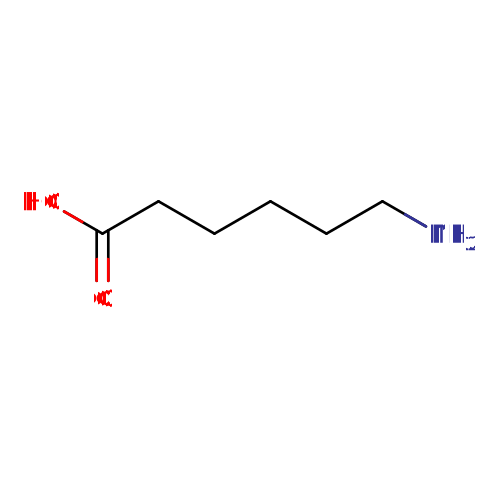
- Weight
- Average: 131.1729
Monoisotopic: 131.094628665 - Chemical Formula
- C6H13NO2
- Synonyms
- 6-Aminocaproic acid
- 6-aminohexanoic acid
- Acide aminocaproïque
- Ácido aminocapróico
- acidum aminocaproicum
- Aminocaproic acid
- Aminocapronsäure
- EACA
- EACS
- Epsilcapramine
- Epsilon Aminocaproic Acid
- Epsilon-Aminocaproic acid
- epsilon-Aminohexanoic acid
- omega-Aminocaproic acid
- omega-Aminohexanoic acid
- External IDs
- 177 J.D.
- CL 10304
- CL-10304
- CY 116
- CY-116
- JD 177
- NSC-26154
- NSC-400230

Pharmacology
- Indication
For use in the treatment of excessive postoperative bleeding.
 Reduce drug development failure ratesBuild, train, & validate machine-learning modelswith evidence-based and structured datasets.Build, train, & validate predictive machine-learning models with structured datasets.
- Associated Conditions
Indication Type Indication Combined Product Details Approval Level Age Group Patient Characteristics Dose Form Prevention of Hemorrhage •••••••••••• •••••••••• ••••••••• •••••• •••••• - Contraindications & Blackbox Warnings
 Prevent Adverse Drug Events TodayTap into our Clinical API for life-saving information on contraindications & blackbox warnings, population restrictions, harmful risks, & more.Avoid life-threatening adverse drug events with our Clinical API
- Pharmacodynamics
Aminocaproic acid works as an antifibrinolytic. It is a derivative of the amino acid lysine. The fibrinolysis-inhibitory effects of aminocaproic acid appear to be exerted principally via inhibition of plasminogen activators and to a lesser degree through antiplasmin activity. Aminocaproic acid may be a possible prophylactic for vascular disease, as it may prevent formation of lipoprotein (a), a risk factor for vascular disease.
- Mechanism of action
Aminocaproic acid binds reversibly to the kringle domain of plasminogen and blocks the binding of plasminogen to fibrin and its activation to plasmin. With NO activation of plasmin, there is a reduction in fibrinolysis. This consequently will reduce the amount of bleeding post surgery. Elevated plasma levels of lipoprotein(a) have been shown to increase the risk of vascular disease. Lipoprotein 9a)a has two components, apolipoprotein B-100, linked to apolipoprotein (a). Aminocaproic acid may change the conformation of apoliprotein (a), changing its binding properties and potentially preventing the formation of lipoprotein (a).
Target Actions Organism APlasminogen inhibitorHumans ATissue-type plasminogen activator antagonistHumans UApolipoprotein(a) otherHumans - Absorption
Absorbed rapidly following oral administration. In adults, oral absorption appears to be a zero-order process with an absorption rate of 5.2 g/hr. The mean lag time in absorption is 10 minutes. After a single oral dose of 5 g, absorption was complete (F=1).
- Volume of distribution
- 23.1 ± 6.6 L
- Protein binding
Not Available
- Metabolism
Sixty-five percent of the dose is recovered in the urine as unchanged drug and 11% of the dose appears as the metabolite adipic acid.
Hover over products below to view reaction partners
- Route of elimination
Renal excretion is the primary route of elimination, whether aminocaproic acid is administered orally or intravenously.
- Half-life
The terminal elimination half-life is approximately 2 hours.
- Clearance
- 169 mL/min
- Adverse Effects
 Improve decision support & research outcomesWith structured adverse effects data, including: blackbox warnings, adverse reactions, warning & precautions, & incidence rates. View sample adverse effects data in our new Data Library!Improve decision support & research outcomes with our structured adverse effects data.
- Toxicity
A few cases of acute overdosage with intravenous administration have been reported. The effects have ranged from no reaction to transient hypotension to severe acute renal failure leading to death. The intravenous and oral LD50 were 3.0 and 12.0 g/kg respectively in the mouse and 3.2 and 16.4 g/kg respectively in the rat. An intravenous infusion dose of 2.3 g/kg was lethal in the dog.
- Pathways
Pathway Category Aminocaproic Acid Action Pathway Drug action - Pharmacogenomic Effects/ADRs
- Not Available
Interactions
- Drug Interactions
- This information should not be interpreted without the help of a healthcare provider. If you believe you are experiencing an interaction, contact a healthcare provider immediately. The absence of an interaction does not necessarily mean no interactions exist.
Drug Interaction Integrate drug-drug
interactions in your softwareAlbutrepenonacog alfa The risk or severity of adverse effects can be increased when Aminocaproic acid is combined with Albutrepenonacog alfa. Alpha-1-proteinase inhibitor Alpha-1-proteinase inhibitor may increase the thrombogenic activities of Aminocaproic acid. Alteplase The therapeutic efficacy of Aminocaproic acid can be decreased when used in combination with Alteplase. Andexanet alfa The risk or severity of adverse effects can be increased when Aminocaproic acid is combined with Andexanet alfa. Anistreplase The therapeutic efficacy of Aminocaproic acid can be decreased when used in combination with Anistreplase. - Food Interactions
- Take with or without food. The absorption is unaffected by food.
Products
 Drug product information from 10+ global regionsOur datasets provide approved product information including:dosage, form, labeller, route of administration, and marketing period.Access drug product information from over 10 global regions.
- International/Other Brands
- Acepramin (Pannonpharma) / Amocap (Celon) / Caproamin (Rottapharm) / Caprocat (Catalysis) / Caprolisin (Menarini) / E-Capro (Edruc) / Epsicaprom / Hemocid (GlaxoSmithKline) / Inselon (Ying Yuan) / Ipron (Johnson) / Ipsilon (Nikkho) / Kai Nai Yin (Wuxi) / Minocap (ACI) / Plaslloid (CCPC) / Resplamin (Shinlin Sinseng)
- Brand Name Prescription Products
Name Dosage Strength Route Labeller Marketing Start Marketing End Region Image Amicar Solution 0.25 g/1mL Oral Akorn Operating Company LLC 2015-06-01 Not applicable US 
Amicar Solution 0.25 g/1mL Oral Xanodyne Pharmaceuticals 2008-09-30 2014-01-31 US Amicar Tablet 500 mg/1 Oral Physicians Total Care, Inc. 2006-05-16 2011-12-31 US Amicar Tablet 1000 mg/1 Oral Akorn Operating Company LLC 2015-06-01 Not applicable US Amicar Injection, solution 250 mg/1mL Intravenous XANODYNE PHARMACEUTICALS, INC. 2007-08-09 2007-08-09 US - Generic Prescription Products
Name Dosage Strength Route Labeller Marketing Start Marketing End Region Image Aminocaproic Acid Tablet 1000 mg/1 Oral Seton Pharmaceuticals, LLC 2021-05-11 Not applicable US Aminocaproic Acid Injection, solution 250 mg/1mL Intravenous Civica, Inc. 2020-10-29 Not applicable US Aminocaproic Acid Tablet 500 mg/1 Oral Akorn Operating Company LLC 2019-03-12 Not applicable US Aminocaproic Acid Tablet 1000 mg/1 Oral Biocon Pharma Inc. 2021-03-15 Not applicable US Aminocaproic Acid Solution 0.25 g/1mL Oral VistaPharm, LLC 2020-03-04 2024-03-31 US - Over the Counter Products
Name Dosage Strength Route Labeller Marketing Start Marketing End Region Image Solco Platino Iondenti Tooth Paste 0.02 g/100g Oral Solco Biomedical Co., Ltd. 2018-06-12 Not applicable US - Mixture Products
Name Ingredients Dosage Route Labeller Marketing Start Marketing End Region Image 28tak Gum Care Tooth Aminocaproic acid (0.12 g/120g) + Alcloxa (0.12 g/120g) + Calcium phosphate, dibasic (0.12 g/120g) + Calcium carbonate (36.0 g/120g) Paste, dentifrice Oral Elmeditec Co.,Ltd 2018-07-01 Not applicable US BAMBOO SALT Eunganggo Jook Yeom Aminocaproic acid (0.05 g/100g) + Curcuma xanthorrhiza oil (0.025 g/100g) + Glycyrrhizinate dipotassium (0.04 g/100g) + Sea salt (3 g/100g) + Silicon dioxide (20 g/100g) + Sodium fluoride (0.22 g/100g) + Ursodeoxycholic acid (0.02 g/100g) Paste Dental Lg Household & Health Care Ltd. 2011-03-15 Not applicable US BAMBOO SALT Eunganggo Jook Yeom Toothpaste Aminocaproic acid (0.05 g/100g) + Curcuma xanthorrhiza oil (0.025 g/100g) + Glycyrrhizinate dipotassium (0.04 g/100g) + Sea salt (3 g/100g) + Silicon dioxide (20 g/100g) + Sodium fluoride (0.22 g/100g) + Ursodeoxycholic acid (0.02 g/100g) Paste Dental Lg Household & Health Care Ltd. 2010-05-25 Not applicable US Clean Breath Tooth Aminocaproic acid (0.06 g/100g) + Alcloxa (0.06 g/100g) + Calcium phosphate, dibasic (0.07 g/100g) + Calcium carbonate (36 g/100g) Paste, dentifrice Dental K.Boeun Pharmaceutical Co.,Ltd. 2021-05-01 Not applicable US Clean Breath Tooth Aminocaproic acid (0.06 g/100g) + Alcloxa (0.06 g/100g) + Calcium phosphate, dibasic (0.07 g/100g) + Calcium carbonate (36 g/100g) Paste, dentifrice Dental K.Boeun Pharmaceutical Co.,Ltd. 2021-11-30 Not applicable US - Unapproved/Other Products
Name Ingredients Dosage Route Labeller Marketing Start Marketing End Region Image 28tak Gum Care Tooth Aminocaproic acid (0.12 g/120g) + Alcloxa (0.12 g/120g) + Calcium phosphate, dibasic (0.12 g/120g) + Calcium carbonate (36.0 g/120g) Paste, dentifrice Oral Elmeditec Co.,Ltd 2018-07-01 Not applicable US Clean Breath Tooth Aminocaproic acid (0.06 g/100g) + Alcloxa (0.06 g/100g) + Calcium phosphate, dibasic (0.07 g/100g) + Calcium carbonate (36 g/100g) Paste, dentifrice Dental K.Boeun Pharmaceutical Co.,Ltd. 2021-05-01 Not applicable US Clean Breath Tooth Aminocaproic acid (0.06 g/100g) + Alcloxa (0.06 g/100g) + Calcium phosphate, dibasic (0.07 g/100g) + Calcium carbonate (36 g/100g) Paste, dentifrice Dental K.Boeun Pharmaceutical Co.,Ltd. 2021-11-30 Not applicable US Clean Breath Tooth Aminocaproic acid (0.06 g/100g) + Alcloxa (0.06 g/100g) + Calcium phosphate, dibasic (0.07 g/100g) + Calcium carbonate (36 g/100g) Paste, dentifrice Dental K.Boeun Pharmaceutical Co.,Ltd. 2021-01-01 Not applicable US Dr.EL GUM CARE TOOTH Aminocaproic acid (0.1 g/100g) + Alcloxa (0.1 g/100g) + Calcium phosphate, dibasic (0.1 g/100g) + Calcium carbonate (30 g/100g) Paste, dentifrice Dental Dr. EL CO., LTD. 2019-08-01 Not applicable US
Categories
- ATC Codes
- B02AA01 — Aminocaproic acid
- Drug Categories
- Chemical TaxonomyProvided by Classyfire
- Description
- This compound belongs to the class of organic compounds known as medium-chain fatty acids. These are fatty acids with an aliphatic tail that contains between 4 and 12 carbon atoms.
- Kingdom
- Organic compounds
- Super Class
- Lipids and lipid-like molecules
- Class
- Fatty Acyls
- Sub Class
- Fatty acids and conjugates
- Direct Parent
- Medium-chain fatty acids
- Alternative Parents
- Amino fatty acids / Straight chain fatty acids / Amino acids / Monocarboxylic acids and derivatives / Carboxylic acids / Organopnictogen compounds / Organic oxides / Monoalkylamines / Hydrocarbon derivatives / Carbonyl compounds
- Substituents
- Aliphatic acyclic compound / Amine / Amino acid / Amino acid or derivatives / Amino fatty acid / Carbonyl group / Carboxylic acid / Carboxylic acid derivative / Hydrocarbon derivative / Medium-chain fatty acid
- Molecular Framework
- Aliphatic acyclic compounds
- External Descriptors
- omega-amino fatty acid, epsilon-amino acid (CHEBI:16586) / Amino fatty acids (C02378) / Amino fatty acids (LMFA01100035)
- Affected organisms
- Humans and other mammals
Chemical Identifiers
- UNII
- U6F3787206
- CAS number
- 60-32-2
- InChI Key
- SLXKOJJOQWFEFD-UHFFFAOYSA-N
- InChI
- InChI=1S/C6H13NO2/c7-5-3-1-2-4-6(8)9/h1-5,7H2,(H,8,9)
- IUPAC Name
- 6-aminohexanoic acid
- SMILES
- NCCCCCC(O)=O
References
- Synthesis Reference
Frantisek Mares, "Process for producing caprolactam from 6-aminocaproic acid." U.S. Patent US3988319, issued August, 1955.
US3988319- General References
- FDA Approved Drug Products: Amicar (aminocaproic acid) oral tablets/solution [Link]
- External Links
- Human Metabolome Database
- HMDB0001901
- KEGG Drug
- D00160
- KEGG Compound
- C02378
- PubChem Compound
- 564
- PubChem Substance
- 46506934
- ChemSpider
- 548
- BindingDB
- 50357211
- 99
- ChEBI
- 57826
- ChEMBL
- CHEMBL1046
- ZINC
- ZINC000001529425
- Therapeutic Targets Database
- DAP000200
- PharmGKB
- PA164774947
- PDBe Ligand
- ACA
- RxList
- RxList Drug Page
- Drugs.com
- Drugs.com Drug Page
- Wikipedia
- Aminocaproic_acid
- PDB Entries
- 1cea / 1hpk / 1ilp / 1ilq / 1kqs / 1m90 / 1pk2 / 1vq6 / 1vq8 / 1vq9 … show 42 more
- FDA label
- Download (152 KB)
- MSDS
- Download (73.6 KB)
Clinical Trials
- Clinical Trials
Phase Status Purpose Conditions Count 4 Completed Not Available Hemorrhage 1 4 Completed Other Complication of Extracorporeal Circulation / Pediatric Cardiac Surgery 1 4 Completed Prevention Pathologic Fibrinolysis 1 4 Completed Treatment Arthritis of the Hip / Arthritis of the Knee Joint / Bloodloss 1 4 Completed Treatment Bilateral Varus Rotational Osteotomy / E-Aminocaproic Acid 1
Pharmacoeconomics
- Manufacturers
- Xanodyne pharmaceutics inc
- Abraxis pharmaceutical products
- Baxter healthcare corp anesthesia and critical care
- Hospira inc
- Luitpold pharmaceuticals inc
- Mikart inc
- Packagers
- American Regent
- Atlantic Biologicals Corporation
- DispenseXpress Inc.
- Hospira Inc.
- Kaiser Foundation Hospital
- Luitpold Pharmaceuticals Inc.
- Mikart Inc.
- Murfreesboro Pharmaceutical Nursing Supply
- Physicians Total Care Inc.
- Versapharm Inc.
- Xanodyne Pharmaceuticals Inc.
- Dosage Forms
Form Route Strength Paste, dentifrice Oral Injection, solution Intravenous 250 mg/1mL Solution Oral 0.25 g/1mL Tablet Oral 1000 mg/1 Tablet Oral 500 mg/1 Syrup Oral 250 mg / mL Tablet Oral 500 mg Liquid Intravenous 250 mg / mL Tablet Oral 500 mg / tab Syrup Oral 0.25 g/1mL Paste Dental Solution Oral Paste Topical Paste Oral Gel, dentifrice Oral Paste Oral 0.02 g/100g Paste, dentifrice Dental Paste, dentifrice Topical - Prices
Unit description Cost Unit Amicar 1000 mg tablet 7.17USD tablet Amicar 500 mg tablet 3.67USD tablet Aminocaproic acid 500 mg tablet 2.28USD tablet Aminocaproic acid 250 mg/ml 0.06USD ml DrugBank does not sell nor buy drugs. Pricing information is supplied for informational purposes only.- Patents
- Not Available
Properties
- State
- Solid
- Experimental Properties
Property Value Source melting point (°C) 205 °C PhysProp water solubility 5.05E+005 mg/L (at 25 °C) YALKOWSKY,SH & DANNENFELSER,RM (1992) logP -2.95 HANSCH,C ET AL. (1995) pKa 4.43 (at 25 °C) KORTUM,G ET AL (1961) - Predicted Properties
Property Value Source Water Solubility 45.2 mg/mL ALOGPS logP -2.7 ALOGPS logP -2 Chemaxon logS -0.46 ALOGPS pKa (Strongest Acidic) 4.73 Chemaxon pKa (Strongest Basic) 10.21 Chemaxon Physiological Charge 0 Chemaxon Hydrogen Acceptor Count 3 Chemaxon Hydrogen Donor Count 2 Chemaxon Polar Surface Area 63.32 Å2 Chemaxon Rotatable Bond Count 5 Chemaxon Refractivity 34.66 m3·mol-1 Chemaxon Polarizability 14.71 Å3 Chemaxon Number of Rings 0 Chemaxon Bioavailability 1 Chemaxon Rule of Five Yes Chemaxon Ghose Filter No Chemaxon Veber's Rule No Chemaxon MDDR-like Rule No Chemaxon - Predicted ADMET Features
- Not Available
Spectra
- Mass Spec (NIST)
- Download (7.2 KB)
- Spectra
- Chromatographic Properties
Collision Cross Sections (CCS)
Adduct CCS Value (Å2) Source type Source [M-H]- 130.8063458 predictedDarkChem Lite v0.1.0 [M-H]- 130.9673458 predictedDarkChem Lite v0.1.0 [M-H]- 135.89687 predictedDeepCCS 1.0 (2019) [M+H]+ 131.4948458 predictedDarkChem Lite v0.1.0 [M+H]+ 131.5158458 predictedDarkChem Lite v0.1.0 [M+H]+ 138.65804 predictedDeepCCS 1.0 (2019) [M+Na]+ 130.8297458 predictedDarkChem Lite v0.1.0 [M+Na]+ 130.8252458 predictedDarkChem Lite v0.1.0 [M+Na]+ 147.09209 predictedDeepCCS 1.0 (2019)
Targets

- Kind
- Protein
- Organism
- Humans
- Pharmacological action
- Yes
- Actions
- Inhibitor
- General Function
- Serine-type peptidase activity
- Specific Function
- Plasmin dissolves the fibrin of blood clots and acts as a proteolytic factor in a variety of other processes including embryonic development, tissue remodeling, tumor invasion, and inflammation. In...
- Gene Name
- PLG
- Uniprot ID
- P00747
- Uniprot Name
- Plasminogen
- Molecular Weight
- 90568.415 Da
References
- Mochalkin I, Cheng B, Klezovitch O, Scanu AM, Tulinsky A: Recombinant kringle IV-10 modules of human apolipoprotein(a): structure, ligand binding modes, and biological relevance. Biochemistry. 1999 Feb 16;38(7):1990-8. [Article]
- Prandota J, Pankow-Prandota L, Kotecki L: Impaired activation of the fibrinolytic system in children with Henoch-Schonlein purpura: beneficial effect of hydrocortisone plus Sigma-aminocaproic acid therapy on disappearance rate of cutaneous vasculitis and fibrinolysis. Am J Ther. 2001 Jan-Feb;8(1):11-9. [Article]
- Lee KN, Jackson KW, McKee PA: Effect of a synthetic carboxy-terminal peptide of alpha(2)-antiplasmin on urokinase-induced fibrinolysis. Thromb Res. 2002 Feb 1;105(3):263-70. [Article]
- Sun Z, Chen YH, Wang P, Zhang J, Gurewich V, Zhang P, Liu JN: The blockage of the high-affinity lysine binding sites of plasminogen by EACA significantly inhibits prourokinase-induced plasminogen activation. Biochim Biophys Acta. 2002 Apr 29;1596(2):182-92. [Article]
- Kanalas JJ: Analysis of plasmin binding and urokinase activation of plasminogen bound to the Heymann nephritis autoantigen, gp330. Arch Biochem Biophys. 1992 Dec;299(2):255-60. [Article]
- Chen X, Ji ZL, Chen YZ: TTD: Therapeutic Target Database. Nucleic Acids Res. 2002 Jan 1;30(1):412-5. [Article]
- Kind
- Protein
- Organism
- Humans
- Pharmacological action
- Yes
- Actions
- Antagonist
- General Function
- Serine-type endopeptidase activity
- Specific Function
- Converts the abundant, but inactive, zymogen plasminogen to plasmin by hydrolyzing a single Arg-Val bond in plasminogen. By controlling plasmin-mediated proteolysis, it plays an important role in t...
- Gene Name
- PLAT
- Uniprot ID
- P00750
- Uniprot Name
- Tissue-type plasminogen activator
- Molecular Weight
- 62916.495 Da
References
- Husain SS, Hasan AA, Budzynski AZ: Differences between binding of one-chain and two-chain tissue plasminogen activators to non-cross-linked and cross-linked fibrin clots. Blood. 1989 Aug 15;74(3):999-1006. [Article]
- Urano T, Sator de Serrano V, Gaffney PJ, Castellino FJ: Effectors of the activation of human [Glu1]plasminogen by human tissue plasminogen activator. Biochemistry. 1988 Aug 23;27(17):6522-8. [Article]
- Tran-Thang C, Vouillamoz D, Kruithof EK, Sordat B: Human Co115 colon carcinoma cells potentiate the degradation of laminin mediated by tissue-type plasminogen activator. J Cell Physiol. 1994 Nov;161(2):285-92. [Article]
- Krishnamurti C, Vukelja SJ, Alving BM: Inhibitory effects of lysine analogues on t-PA induced whole blood clot lysis. Thromb Res. 1994 Mar 15;73(6):419-30. [Article]
- Kind
- Protein
- Organism
- Humans
- Pharmacological action
- Unknown
- Actions
- Other
- General Function
- Serine-type endopeptidase activity
- Specific Function
- Apo(a) is the main constituent of lipoprotein(a) (Lp(a)). It has serine proteinase activity and is able of autoproteolysis. Inhibits tissue-type plasminogen activator 1. Lp(a) may be a ligand for m...
- Gene Name
- LPA
- Uniprot ID
- P08519
- Uniprot Name
- Apolipoprotein(a)
- Molecular Weight
- 501316.005 Da
References
- Overington JP, Al-Lazikani B, Hopkins AL: How many drug targets are there? Nat Rev Drug Discov. 2006 Dec;5(12):993-6. [Article]
- Imming P, Sinning C, Meyer A: Drugs, their targets and the nature and number of drug targets. Nat Rev Drug Discov. 2006 Oct;5(10):821-34. [Article]
- Becker L, Cook PM, Koschinsky ML: Identification of sequences in apolipoprotein(a) that maintain its closed conformation: a novel role for apo(a) isoform size in determining the efficiency of covalent Lp(a) formation. Biochemistry. 2004 Aug 10;43(31):9978-88. [Article]
Enzymes
- Kind
- Protein
- Organism
- Humans
- Pharmacological action
- Unknown
- Actions
- Substrate
- General Function
- Xanthine dehydrogenase activity
- Specific Function
- Oxidase with broad substrate specificity, oxidizing aromatic azaheterocycles, such as N1-methylnicotinamide and N-methylphthalazinium, as well as aldehydes, such as benzaldehyde, retinal, pyridoxal...
- Gene Name
- AOX1
- Uniprot ID
- Q06278
- Uniprot Name
- Aldehyde oxidase
- Molecular Weight
- 147916.735 Da
References
- Subramanyam B, Callery PS, Geelhaar LA, Egorin MJ: A cyclic imine intermediate in the in vitro metabolic conversion of 1,6-diaminohexane to 6-aminohexanoic acid and caprolactam. Xenobiotica. 1989 Jan;19(1):33-42. [Article]


Drug created at June 13, 2005 13:24 / Updated at March 03, 2024 02:27