Identification
- Summary
Guanidine is a strong organic base used to treat muscle weakness and fatigue associated with the myasthenic complications of Eaton-Lambert syndrome.
- Generic Name
- Guanidine
- DrugBank Accession Number
- DB00536
- Background
A strong organic base existing primarily as guanidium ions at physiological pH. It is found in the urine as a normal product of protein metabolism. It is also used in laboratory research as a protein denaturant. (From Martindale, the Extra Pharmacopoeia, 30th ed and Merck Index, 12th ed) It is also used in the treatment of myasthenia and as a fluorescent probe in HPLC.
- Type
- Small Molecule
- Groups
- Approved
- Structure
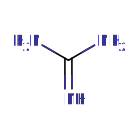
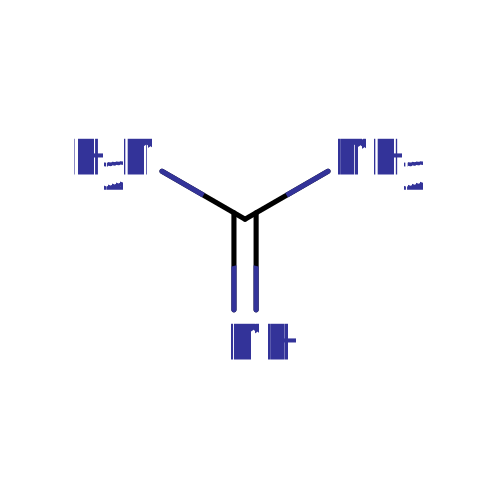
Structure for Guanidine (DB00536)
- Weight
- Average: 59.0705
Monoisotopic: 59.048347175 - Chemical Formula
- CH5N3
- Synonyms
- Aminomethanamidine
- Gu
- Guanidin
- Guanidine
- Imidourea
- Iminourea

Pharmacology
- Indication
For the reduction of the symptoms of muscle weakness and easy fatigability associated with the myasthenic syndrome of Eaton-Lambert. It is not indicated for treating myasthenia gravis.
 Reduce drug development failure ratesBuild, train, & validate machine-learning modelswith evidence-based and structured datasets.Build, train, & validate predictive machine-learning models with structured datasets.
- Associated Conditions
Indication Type Indication Combined Product Details Approval Level Age Group Patient Characteristics Dose Form Management of Fatigue •••••••••••• Management of Muscle weakness •••••••••••• - Contraindications & Blackbox Warnings
 Prevent Adverse Drug Events TodayTap into our Clinical API for life-saving information on contraindications & blackbox warnings, population restrictions, harmful risks, & more.Avoid life-threatening adverse drug events with our Clinical API
- Pharmacodynamics
Guanidine apparently acts by enhancing the release of acetylcholine following a nerve impulse. It also appears to slow the rates of depolarization and repolarization of muscle cell membranes.
- Mechanism of action
Target Actions Organism AAldehyde dehydrogenase, mitochondrial inhibitorHumans URibonuclease pancreatic Not Available Humans UDNA Not Available Humans UDisks large homolog 4 Not Available Humans ULysozyme Not Available Enterobacteria phage T4 UGuanidinoacetate N-methyltransferase Not Available Humans UArginase Not Available Bacillus caldovelox - Absorption
Rapidly absorbed and distributed
- Volume of distribution
Not Available
- Protein binding
Not Available
- Metabolism
Not metabolized.
- Route of elimination
Not Available
- Half-life
7-8 hours
- Clearance
Not Available
- Adverse Effects
 Improve decision support & research outcomesWith structured adverse effects data, including: blackbox warnings, adverse reactions, warning & precautions, & incidence rates. View sample adverse effects data in our new Data Library!Improve decision support & research outcomes with our structured adverse effects data.
- Toxicity
LD50 = 475 mg/kg (oral, rat). Can cause severe gastrointestinal symptoms (nausea, vomiting and diarrhea), bone marrow suppression, renal insufficiency and other hematologic abnormalities (anemia, leucopenia). Severe guanidine intoxication is characterized by nervous hyperirritability, fibrillary tremors and convulsive contractions of muscle, salivation, vomiting, diarrhea, hypoglycemia, and circulatory disturbances.
- Pathways
- Not Available
- Pharmacogenomic Effects/ADRs
- Not Available
Interactions
- Drug Interactions
- This information should not be interpreted without the help of a healthcare provider. If you believe you are experiencing an interaction, contact a healthcare provider immediately. The absence of an interaction does not necessarily mean no interactions exist.
Drug Interaction Integrate drug-drug
interactions in your softwareAbemaciclib The excretion of Abemaciclib can be decreased when combined with Guanidine. Acamprosate The excretion of Acamprosate can be decreased when combined with Guanidine. Acetylcholine The risk or severity of adverse effects can be increased when Guanidine is combined with Acetylcholine. Acyclovir The excretion of Acyclovir can be decreased when combined with Guanidine. Allopurinol The excretion of Allopurinol can be decreased when combined with Guanidine. - Food Interactions
- No interactions found.
Products
 Drug product information from 10+ global regionsOur datasets provide approved product information including:dosage, form, labeller, route of administration, and marketing period.Access drug product information from over 10 global regions.
- Product Ingredients
Ingredient UNII CAS InChI Key Guanidine hydrochloride 3YQC9ZY4YB 50-01-1 PJJJBBJSCAKJQF-UHFFFAOYSA-N - Brand Name Prescription Products
Name Dosage Strength Route Labeller Marketing Start Marketing End Region Image Guanidine hydrochloride Tablet 125 mg/1 Oral Merck Sharp & Dohme Corp. 1939-10-02 Not applicable US 
Categories
- Drug Categories
- Chemical TaxonomyProvided by Classyfire
- Description
- This compound belongs to the class of organic compounds known as guanidines. These are compounds containing a guanidine moiety, with the general structure (R1R2N)(R3R4N)C=N-R5.
- Kingdom
- Organic compounds
- Super Class
- Organic nitrogen compounds
- Class
- Organonitrogen compounds
- Sub Class
- Guanidines
- Direct Parent
- Guanidines
- Alternative Parents
- Carboximidamides / Organopnictogen compounds / Imines / Hydrocarbon derivatives
- Substituents
- Aliphatic acyclic compound / Carboximidamide / Guanidine / Hydrocarbon derivative / Imine / Organopnictogen compound
- Molecular Framework
- Aliphatic acyclic compounds
- External Descriptors
- one-carbon compound, guanidines, carboxamidine (CHEBI:42820) / a small molecule (CPD-13517)
- Affected organisms
- Humans and other mammals
Chemical Identifiers
- UNII
- JU58VJ6Y3B
- CAS number
- 113-00-8
- InChI Key
- ZRALSGWEFCBTJO-UHFFFAOYSA-N
- InChI
- InChI=1S/CH5N3/c2-1(3)4/h(H5,2,3,4)
- IUPAC Name
- guanidine
- SMILES
- NC(N)=N
References
- Synthesis Reference
Helmut Hoffmann, Carlhans Suling, "Process for the production of guanidine salts of aliphatic mercaptosulphonic acids." U.S. Patent US3956368, issued November, 1954.
US3956368- General References
- Not Available
- External Links
- Human Metabolome Database
- HMDB0001842
- PubChem Compound
- 3520
- PubChem Substance
- 46507543
- ChemSpider
- 3400
- BindingDB
- 50420178
- 50675
- ChEBI
- 42820
- ChEMBL
- CHEMBL821
- ZINC
- ZINC000008101126
- PharmGKB
- PA164781028
- PDBe Ligand
- GAI
- Drugs.com
- Drugs.com Drug Page
- Wikipedia
- Guanidine
- PDB Entries
- 1jxm / 1kp2 / 1kp3 / 1o01 / 1o02 / 1o04 / 1pxv / 1rbw / 1t8a / 1umj … show 91 more
- MSDS
- Download (72.9 KB)
Clinical Trials
Pharmacoeconomics
- Manufacturers
- Schering corp
- Packagers
- Schering Corp.
- Dosage Forms
Form Route Strength Tablet Oral 125 mg/1 - Prices
Unit description Cost Unit Guanidine hcl 125 mg tablet 0.25USD tablet DrugBank does not sell nor buy drugs. Pricing information is supplied for informational purposes only.- Patents
- Not Available
Properties
- State
- Solid
- Experimental Properties
Property Value Source melting point (°C) 50 °C PhysProp water solubility 1840 mg/L (at 20 °C) GREENWALD,I (1926) logP -0.6 Not Available pKa 12.5 Not Available - Predicted Properties
Property Value Source Water Solubility 11.5 mg/mL ALOGPS logP -1.9 ALOGPS logP -1.2 Chemaxon logS -0.71 ALOGPS pKa (Strongest Basic) 12.55 Chemaxon Physiological Charge 1 Chemaxon Hydrogen Acceptor Count 3 Chemaxon Hydrogen Donor Count 3 Chemaxon Polar Surface Area 75.89 Å2 Chemaxon Rotatable Bond Count 0 Chemaxon Refractivity 25.86 m3·mol-1 Chemaxon Polarizability 5.57 Å3 Chemaxon Number of Rings 0 Chemaxon Bioavailability 1 Chemaxon Rule of Five Yes Chemaxon Ghose Filter No Chemaxon Veber's Rule No Chemaxon MDDR-like Rule No Chemaxon - Predicted ADMET Features
Property Value Probability Human Intestinal Absorption + 0.9378 Blood Brain Barrier + 0.8502 Caco-2 permeable - 0.7527 P-glycoprotein substrate Non-substrate 0.8033 P-glycoprotein inhibitor I Non-inhibitor 0.977 P-glycoprotein inhibitor II Non-inhibitor 0.932 Renal organic cation transporter Non-inhibitor 0.7825 CYP450 2C9 substrate Non-substrate 0.8402 CYP450 2D6 substrate Non-substrate 0.6619 CYP450 3A4 substrate Non-substrate 0.8447 CYP450 1A2 substrate Non-inhibitor 0.9843 CYP450 2C9 inhibitor Non-inhibitor 0.9588 CYP450 2D6 inhibitor Non-inhibitor 0.9695 CYP450 2C19 inhibitor Non-inhibitor 0.9772 CYP450 3A4 inhibitor Non-inhibitor 0.9763 CYP450 inhibitory promiscuity Low CYP Inhibitory Promiscuity 0.9789 Ames test Non AMES toxic 0.9133 Carcinogenicity Non-carcinogens 0.7148 Biodegradation Not ready biodegradable 0.7652 Rat acute toxicity 1.9367 LD50, mol/kg Not applicable hERG inhibition (predictor I) Weak inhibitor 0.9733 hERG inhibition (predictor II) Non-inhibitor 0.9798
Spectra
- Mass Spec (NIST)
- Download (8.28 KB)
- Spectra
- Chromatographic Properties
Collision Cross Sections (CCS)
Adduct CCS Value (Å2) Source type Source [M-H]- 94.3984245 predictedDarkChem Lite v0.1.0 [M-H]- 94.4213245 predictedDarkChem Lite v0.1.0 [M-H]- 94.3340245 predictedDarkChem Lite v0.1.0 [M-H]- 114.839325 predictedDeepCCS 1.0 (2019) [M+H]+ 95.2227245 predictedDarkChem Lite v0.1.0 [M+H]+ 95.5827245 predictedDarkChem Lite v0.1.0 [M+H]+ 95.6810245 predictedDarkChem Lite v0.1.0 [M+H]+ 116.715576 predictedDeepCCS 1.0 (2019) [M+Na]+ 94.7697245 predictedDarkChem Lite v0.1.0 [M+Na]+ 94.8878245 predictedDarkChem Lite v0.1.0 [M+Na]+ 94.8329245 predictedDarkChem Lite v0.1.0 [M+Na]+ 124.07245 predictedDeepCCS 1.0 (2019)
Targets

- Kind
- Protein
- Organism
- Humans
- Pharmacological action
- Yes
- Actions
- Inhibitor
- Curator comments
- Literature at this time did not specifically point to the mitochondrial aldehyde dehydrogenase, but rather, is more directed to aldehyde dehydrogenase in general.
- General Function
- Electron carrier activity
- Specific Function
- Not Available
- Gene Name
- ALDH2
- Uniprot ID
- P05091
- Uniprot Name
- Aldehyde dehydrogenase, mitochondrial
- Molecular Weight
- 56380.93 Da
References
- Kikonyogo A, Pietruszko R: Cimetidine and other H2-receptor antagonists as inhibitors of human E3 aldehyde dehydrogenase. Mol Pharmacol. 1997 Aug;52(2):267-71. doi: 10.1124/mol.52.2.267. [Article]
- Kopczynski Z, Dryl T, Chmiel J: Studies on the effects of low-molecular uraemic toxins on the activity of 3-phospho-D-glycerol aldehyde dehydrogenase (E.C.1.2.1.12) in human erythrocytes. Acta Physiol Pol. 1984 Sep-Dec;35(5-6):539-45. [Article]
- Kind
- Protein
- Organism
- Humans
- Pharmacological action
- Unknown
- General Function
- Ribonuclease a activity
- Specific Function
- Endonuclease that catalyzes the cleavage of RNA on the 3' side of pyrimidine nucleotides. Acts on single-stranded and double-stranded RNA.
- Gene Name
- RNASE1
- Uniprot ID
- P07998
- Uniprot Name
- Ribonuclease pancreatic
- Molecular Weight
- 17644.125 Da
References
- Overington JP, Al-Lazikani B, Hopkins AL: How many drug targets are there? Nat Rev Drug Discov. 2006 Dec;5(12):993-6. [Article]
- Imming P, Sinning C, Meyer A: Drugs, their targets and the nature and number of drug targets. Nat Rev Drug Discov. 2006 Oct;5(10):821-34. [Article]
- Dodge RW, Laity JH, Rothwarf DM, Shimotakahara S, Scheraga HA: Folding pathway of guanidine-denatured disulfide-intact wild-type and mutant bovine pancreatic ribonuclease A. J Protein Chem. 1994 May;13(4):409-21. [Article]
- Nasiri H, Forouzandeh M, Rasaee MJ, Rahbarizadeh F: Modified salting-out method: high-yield, high-quality genomic DNA extraction from whole blood using laundry detergent. J Clin Lab Anal. 2005;19(6):229-32. [Article]
- Loh SN, Rohl CA, Kiefhaber T, Baldwin RL: A general two-process model describes the hydrogen exchange behavior of RNase A in unfolding conditions. Proc Natl Acad Sci U S A. 1996 Mar 5;93(5):1982-7. [Article]
- Berman HM, Westbrook J, Feng Z, Gilliland G, Bhat TN, Weissig H, Shindyalov IN, Bourne PE: The Protein Data Bank. Nucleic Acids Res. 2000 Jan 1;28(1):235-42. [Article]
References
- Matic J, Supljika F, Tandaric T, Duksi M, Piotrowski P, Vianello R, Brozovic A, Piantanida I, Schmuck C, Stojkovic MR: DNA/RNA recognition controlled by the glycine linker and the guanidine moiety of phenanthridine peptides. Int J Biol Macromol. 2019 Aug 1;134:422-434. doi: 10.1016/j.ijbiomac.2019.05.063. Epub 2019 May 10. [Article]
- Legin AA, Jakupec MA, Bokach NA, Tyan MR, Kukushkin VY, Keppler BK: Guanidine platinum(II) complexes: synthesis, in vitro antitumor activity, and DNA interactions. J Inorg Biochem. 2014 Apr;133:33-9. doi: 10.1016/j.jinorgbio.2013.12.007. Epub 2013 Dec 22. [Article]
- Shibata T, Murakami E, Nakatani K: 1,3-Di(quinolin-2-yl)guanidine binds to GGCCCC hexanucleotide repeat DNA in C9ORF72. Bioorg Med Chem Lett. 2018 Aug 1;28(14):2364-2368. doi: 10.1016/j.bmcl.2018.06.032. Epub 2018 Jun 18. [Article]
- Kind
- Protein
- Organism
- Humans
- Pharmacological action
- Unknown
- General Function
- Scaffold protein binding
- Specific Function
- Interacts with the cytoplasmic tail of NMDA receptor subunits and shaker-type potassium channels. Required for synaptic plasticity associated with NMDA receptor signaling. Overexpression or depleti...
- Gene Name
- DLG4
- Uniprot ID
- P78352
- Uniprot Name
- Disks large homolog 4
- Molecular Weight
- 80494.615 Da
References
- Overington JP, Al-Lazikani B, Hopkins AL: How many drug targets are there? Nat Rev Drug Discov. 2006 Dec;5(12):993-6. [Article]
- Imming P, Sinning C, Meyer A: Drugs, their targets and the nature and number of drug targets. Nat Rev Drug Discov. 2006 Oct;5(10):821-34. [Article]
- Berman HM, Westbrook J, Feng Z, Gilliland G, Bhat TN, Weissig H, Shindyalov IN, Bourne PE: The Protein Data Bank. Nucleic Acids Res. 2000 Jan 1;28(1):235-42. [Article]
- Kind
- Protein
- Organism
- Enterobacteria phage T4
- Pharmacological action
- Unknown
- General Function
- Lysozyme activity
- Specific Function
- Endolysin with lysozyme activity that degrades host peptidoglycans and participates with the holin and spanin proteins in the sequential events which lead to the programmed host cell lysis releasin...
- Gene Name
- E
- Uniprot ID
- P00720
- Uniprot Name
- Endolysin
- Molecular Weight
- 18691.385 Da
References
- Overington JP, Al-Lazikani B, Hopkins AL: How many drug targets are there? Nat Rev Drug Discov. 2006 Dec;5(12):993-6. [Article]
- Imming P, Sinning C, Meyer A: Drugs, their targets and the nature and number of drug targets. Nat Rev Drug Discov. 2006 Oct;5(10):821-34. [Article]
- Junn HJ, Youn J, Suh KH, Lee SS: Cloning and expression of Klebsiella phage K11 lysozyme gene. Protein Expr Purif. 2005 Jul;42(1):78-84. Epub 2005 Apr 19. [Article]
- Garcia-Orozco KD, Lopez-Zavala AA, Puentes-Camacho D, Calderon-de-la-Barca AM, Sotelo-Mundo RR: Recombinant bacterial expression of the lysozyme from the tobacco-hornworm Manduca sexta with activity at low temperatures. Biotechnol Lett. 2005 Aug;27(15):1075-80. [Article]
- Shiraki K, Kudou M, Sakamoto R, Yanagihara I, Takagi M: Amino Acid esters prevent thermal inactivation and aggregation of lysozyme. Biotechnol Prog. 2005 Mar-Apr;21(2):640-3. [Article]
- Kind
- Protein
- Organism
- Humans
- Pharmacological action
- Unknown
- General Function
- Methyltransferase activity
- Specific Function
- Not Available
- Gene Name
- GAMT
- Uniprot ID
- Q14353
- Uniprot Name
- Guanidinoacetate N-methyltransferase
- Molecular Weight
- 26317.925 Da
References
- Overington JP, Al-Lazikani B, Hopkins AL: How many drug targets are there? Nat Rev Drug Discov. 2006 Dec;5(12):993-6. [Article]
- Imming P, Sinning C, Meyer A: Drugs, their targets and the nature and number of drug targets. Nat Rev Drug Discov. 2006 Oct;5(10):821-34. [Article]
- Komoto J, Yamada T, Takata Y, Konishi K, Ogawa H, Gomi T, Fujioka M, Takusagawa F: Catalytic mechanism of guanidinoacetate methyltransferase: crystal structures of guanidinoacetate methyltransferase ternary complexes. Biochemistry. 2004 Nov 16;43(45):14385-94. [Article]
- Karelin AA, Mardashev SR: [The stimulating effect of cyclic AMP, glucagon and insulin on guanidine acetate-N-methyltransferase activity in rat liver and pancreas]. Biokhimiia. 1976 Feb;41(2):316-23. [Article]
- Berman HM, Westbrook J, Feng Z, Gilliland G, Bhat TN, Weissig H, Shindyalov IN, Bourne PE: The Protein Data Bank. Nucleic Acids Res. 2000 Jan 1;28(1):235-42. [Article]
Transporters
- Kind
- Protein
- Organism
- Humans
- Pharmacological action
- Unknown
- Actions
- Inhibitor
- General Function
- Quaternary ammonium group transmembrane transporter activity
- Specific Function
- Mediates tubular uptake of organic compounds from circulation. Mediates the influx of agmatine, dopamine, noradrenaline (norepinephrine), serotonin, choline, famotidine, ranitidine, histamin, creat...
- Gene Name
- SLC22A2
- Uniprot ID
- O15244
- Uniprot Name
- Solute carrier family 22 member 2
- Molecular Weight
- 62579.99 Da
References
- Urakami Y, Akazawa M, Saito H, Okuda M, Inui K: cDNA cloning, functional characterization, and tissue distribution of an alternatively spliced variant of organic cation transporter hOCT2 predominantly expressed in the human kidney. J Am Soc Nephrol. 2002 Jul;13(7):1703-10. [Article]
- Arndt P, Volk C, Gorboulev V, Budiman T, Popp C, Ulzheimer-Teuber I, Akhoundova A, Koppatz S, Bamberg E, Nagel G, Koepsell H: Interaction of cations, anions, and weak base quinine with rat renal cation transporter rOCT2 compared with rOCT1. Am J Physiol Renal Physiol. 2001 Sep;281(3):F454-68. [Article]
- Urakami Y, Okuda M, Masuda S, Saito H, Inui KI: Functional characteristics and membrane localization of rat multispecific organic cation transporters, OCT1 and OCT2, mediating tubular secretion of cationic drugs. J Pharmacol Exp Ther. 1998 Nov;287(2):800-5. [Article]
- Grundemann D, Liebich G, Kiefer N, Koster S, Schomig E: Selective substrates for non-neuronal monoamine transporters. Mol Pharmacol. 1999 Jul;56(1):1-10. [Article]
- Berman HM, Westbrook J, Feng Z, Gilliland G, Bhat TN, Weissig H, Shindyalov IN, Bourne PE: The Protein Data Bank. Nucleic Acids Res. 2000 Jan 1;28(1):235-42. [Article]
- Kind
- Protein
- Organism
- Humans
- Pharmacological action
- Unknown
- Actions
- Inhibitor
- General Function
- Secondary active organic cation transmembrane transporter activity
- Specific Function
- Translocates a broad array of organic cations with various structures and molecular weights including the model compounds 1-methyl-4-phenylpyridinium (MPP), tetraethylammonium (TEA), N-1-methylnico...
- Gene Name
- SLC22A1
- Uniprot ID
- O15245
- Uniprot Name
- Solute carrier family 22 member 1
- Molecular Weight
- 61153.345 Da
References
- Zhang L, Dresser MJ, Chun JK, Babbitt PC, Giacomini KM: Cloning and functional characterization of a rat renal organic cation transporter isoform (rOCT1A). J Biol Chem. 1997 Jun 27;272(26):16548-54. [Article]
- Arndt P, Volk C, Gorboulev V, Budiman T, Popp C, Ulzheimer-Teuber I, Akhoundova A, Koppatz S, Bamberg E, Nagel G, Koepsell H: Interaction of cations, anions, and weak base quinine with rat renal cation transporter rOCT2 compared with rOCT1. Am J Physiol Renal Physiol. 2001 Sep;281(3):F454-68. [Article]
- Urakami Y, Okuda M, Masuda S, Saito H, Inui KI: Functional characteristics and membrane localization of rat multispecific organic cation transporters, OCT1 and OCT2, mediating tubular secretion of cationic drugs. J Pharmacol Exp Ther. 1998 Nov;287(2):800-5. [Article]
- Kind
- Protein
- Organism
- Humans
- Pharmacological action
- Unknown
- Actions
- SubstrateInhibitor
- General Function
- Toxin transporter activity
- Specific Function
- Mediates potential-dependent transport of a variety of organic cations. May play a significant role in the disposition of cationic neurotoxins and neurotransmitters in the brain.
- Gene Name
- SLC22A3
- Uniprot ID
- O75751
- Uniprot Name
- Solute carrier family 22 member 3
- Molecular Weight
- 61279.485 Da
References
- Wu X, Huang W, Ganapathy ME, Wang H, Kekuda R, Conway SJ, Leibach FH, Ganapathy V: Structure, function, and regional distribution of the organic cation transporter OCT3 in the kidney. Am J Physiol Renal Physiol. 2000 Sep;279(3):F449-58. [Article]
- Kekuda R, Prasad PD, Wu X, Wang H, Fei YJ, Leibach FH, Ganapathy V: Cloning and functional characterization of a potential-sensitive, polyspecific organic cation transporter (OCT3) most abundantly expressed in placenta. J Biol Chem. 1998 Jun 26;273(26):15971-9. [Article]
- Kind
- Protein
- Organism
- Humans
- Pharmacological action
- Unknown
- Actions
- Inhibitor
- General Function
- Symporter activity
- Specific Function
- Sodium-ion dependent, high affinity carnitine transporter. Involved in the active cellular uptake of carnitine. Transports one sodium ion with one molecule of carnitine. Also transports organic cat...
- Gene Name
- SLC22A5
- Uniprot ID
- O76082
- Uniprot Name
- Solute carrier family 22 member 5
- Molecular Weight
- 62751.08 Da
References
- Wu X, Prasad PD, Leibach FH, Ganapathy V: cDNA sequence, transport function, and genomic organization of human OCTN2, a new member of the organic cation transporter family. Biochem Biophys Res Commun. 1998 May 29;246(3):589-95. [Article]
- Ohashi R, Tamai I, Yabuuchi H, Nezu JI, Oku A, Sai Y, Shimane M, Tsuji A: Na(+)-dependent carnitine transport by organic cation transporter (OCTN2): its pharmacological and toxicological relevance. J Pharmacol Exp Ther. 1999 Nov;291(2):778-84. [Article]
- Ohashi R, Tamai I, Nezu Ji J, Nikaido H, Hashimoto N, Oku A, Sai Y, Shimane M, Tsuji A: Molecular and physiological evidence for multifunctionality of carnitine/organic cation transporter OCTN2. Mol Pharmacol. 2001 Feb;59(2):358-66. [Article]
- Wu X, Huang W, Prasad PD, Seth P, Rajan DP, Leibach FH, Chen J, Conway SJ, Ganapathy V: Functional characteristics and tissue distribution pattern of organic cation transporter 2 (OCTN2), an organic cation/carnitine transporter. J Pharmacol Exp Ther. 1999 Sep;290(3):1482-92. [Article]
- Kind
- Protein
- Organism
- Humans
- Pharmacological action
- Unknown
- Actions
- Inhibitor
- General Function
- Sodium-independent organic anion transmembrane transporter activity
- Specific Function
- Plays an important role in the excretion/detoxification of endogenous and exogenous organic anions, especially from the brain and kidney. Involved in the transport basolateral of steviol, fexofenad...
- Gene Name
- SLC22A8
- Uniprot ID
- Q8TCC7
- Uniprot Name
- Solute carrier family 22 member 8
- Molecular Weight
- 59855.585 Da
References
- Cha SH, Sekine T, Fukushima JI, Kanai Y, Kobayashi Y, Goya T, Endou H: Identification and characterization of human organic anion transporter 3 expressing predominantly in the kidney. Mol Pharmacol. 2001 May;59(5):1277-86. [Article]
- Kind
- Protein
- Organism
- Humans
- Pharmacological action
- Unknown
- Actions
- Inhibitor
- General Function
- Symporter activity
- Specific Function
- Sodium-ion dependent, low affinity carnitine transporter. Probably transports one sodium ion with one molecule of carnitine. Also transports organic cations such as tetraethylammonium (TEA) without...
- Gene Name
- SLC22A4
- Uniprot ID
- Q9H015
- Uniprot Name
- Solute carrier family 22 member 4
- Molecular Weight
- 62154.48 Da
References
- Yabuuchi H, Tamai I, Nezu J, Sakamoto K, Oku A, Shimane M, Sai Y, Tsuji A: Novel membrane transporter OCTN1 mediates multispecific, bidirectional, and pH-dependent transport of organic cations. J Pharmacol Exp Ther. 1999 May;289(2):768-73. [Article]
- Kind
- Protein
- Organism
- Humans
- Pharmacological action
- Unknown
- Actions
- Substrate
- General Function
- Monovalent cation:proton antiporter activity
- Specific Function
- Solute transporter for tetraethylammonium (TEA), 1-methyl-4-phenylpyridinium (MPP), cimetidine, N-methylnicotinamide (NMN), metformin, creatinine, guanidine, procainamide, topotecan, estrone sulfat...
- Gene Name
- SLC47A1
- Uniprot ID
- Q96FL8
- Uniprot Name
- Multidrug and toxin extrusion protein 1
- Molecular Weight
- 61921.585 Da
References
- Tanihara Y, Masuda S, Sato T, Katsura T, Ogawa O, Inui K: Substrate specificity of MATE1 and MATE2-K, human multidrug and toxin extrusions/H(+)-organic cation antiporters. Biochem Pharmacol. 2007 Jul 15;74(2):359-71. doi: 10.1016/j.bcp.2007.04.010. Epub 2007 Apr 13. [Article]
- Winter TN, Elmquist WF, Fairbanks CA: OCT2 and MATE1 provide bidirectional agmatine transport. Mol Pharm. 2011 Feb 7;8(1):133-42. doi: 10.1021/mp100180a. Epub 2010 Dec 3. [Article]
- Kind
- Protein
- Organism
- Humans
- Pharmacological action
- Unknown
- General Function
- Drug transmembrane transporter activity
- Specific Function
- Solute transporter for tetraethylammonium (TEA), 1-methyl-4-phenylpyridinium (MPP), cimetidine, N-methylnicotinamide, metformin, creatinine, guanidine, procainamide, topotecan, estrone sulfate, acy...
- Gene Name
- SLC47A2
- Uniprot ID
- Q86VL8
- Uniprot Name
- Multidrug and toxin extrusion protein 2
- Molecular Weight
- 65083.915 Da
References
- Tanihara Y, Masuda S, Sato T, Katsura T, Ogawa O, Inui K: Substrate specificity of MATE1 and MATE2-K, human multidrug and toxin extrusions/H(+)-organic cation antiporters. Biochem Pharmacol. 2007 Jul 15;74(2):359-71. doi: 10.1016/j.bcp.2007.04.010. Epub 2007 Apr 13. [Article]
- Loncar J, Popovic M, Krznar P, Zaja R, Smital T: The first characterization of multidrug and toxin extrusion (MATE/SLC47) proteins in zebrafish (Danio rerio). Sci Rep. 2016 Jun 30;6:28937. doi: 10.1038/srep28937. [Article]
- Yonezawa A, Inui K: Importance of the multidrug and toxin extrusion MATE/SLC47A family to pharmacokinetics, pharmacodynamics/toxicodynamics and pharmacogenomics. Br J Pharmacol. 2011 Dec;164(7):1817-25. doi: 10.1111/j.1476-5381.2011.01394.x. [Article]


Drug created at June 13, 2005 13:24 / Updated at March 03, 2024 02:33