Identification
- Summary
Benazepril is an ACE inhibitor prodrug used to treat hypertension.
- Brand Names
- Amlobenz, Lotensin, Lotensin Hct, Lotrel
- Generic Name
- Benazepril
- DrugBank Accession Number
- DB00542
- Background
Benazepril, brand name Lotensin, is a medication used to treat high blood pressure (hypertension), congestive heart failure, and chronic renal failure3,2. Upon cleavage of its ester group by the liver, benazepril is converted into its active form benazeprilat, a non-sulfhydryl angiotensin-converting enzyme (ACE) inhibitor1.
- Type
- Small Molecule
- Groups
- Approved, Investigational
- Structure
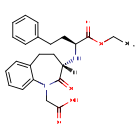
Structure for Benazepril (DB00542)

- Weight
- Average: 424.4895
Monoisotopic: 424.199822016 - Chemical Formula
- C24H28N2O5
- Synonyms
- Bénazépril
- Benazepril
- Benazeprilum
- External IDs
- CGS-14824A

Pharmacology
- Indication
Benazepril is indicated for the treatment of hypertension5. It may be used alone or in combination with thiazide diureticsLabel.
 Reduce drug development failure ratesBuild, train, & validate machine-learning modelswith evidence-based and structured datasets.Build, train, & validate predictive machine-learning models with structured datasets.
- Associated Conditions
Indication Type Indication Combined Product Details Approval Level Age Group Patient Characteristics Dose Form Management of Diabetic nephropathy ••• ••••• Management of Heart failure ••• ••••• Used in combination to manage High blood pressure (hypertension) Combination Product in combination with: Hydrochlorothiazide (DB00999) •••••••••••• •••••••••• ••••••• Used in combination to manage Hypertension Combination Product in combination with: Amlodipine (DB00381) •••••••••••• Management of Hypertension •••••••••••• - Contraindications & Blackbox Warnings
 Prevent Adverse Drug Events TodayTap into our Clinical API for life-saving information on contraindications & blackbox warnings, population restrictions, harmful risks, & more.Avoid life-threatening adverse drug events with our Clinical API
- Pharmacodynamics
Benazepril, an angiotensin-converting enzyme (ACE) inhibitor, is a prodrug which, when hydrolyzed by esterases to its active Benazeprilat1, is used to treat hypertension and heart failure, to reduce proteinuria and renal disease in patients with nephropathies, and to prevent stroke, myocardial infarction, and cardiac death in high-risk patients5,3,2. Benazepril and Benazeprilat inhibit angiotensin-converting enzyme (ACE) in human subjects and animals5,1. ACE is a peptidyl dipeptidase that catalyzes the conversion of angiotensin I to the vasoconstrictor substance, angiotensin IILabel. Angiotensin II also stimulates aldosterone secretion by the adrenal cortexLabel.
- Mechanism of action
Benazeprilat, the active metabolite of Benazepril, competes with angiotensin I for binding at the angiotensin-converting enzyme, blocking the conversion of angiotensin I to angiotensin IILabel. Inhibition of ACE results in decreased plasma angiotensin IILabel. As angiotensin II is a vasoconstrictor and a negative-feedback mediator for renin activity, lower concentrations result in a decrease in blood pressure and stimulation of baroreceptor reflex mechanisms, which leads to decreased vasopressor activity and to decreased aldosterone secretionLabel.
Target Actions Organism AAngiotensin-converting enzyme inhibitorHumans - Absorption
Bioavailability of oral dosing is 3% to 4% in horses6. In humans at least 37% of oral benazepril is absorbed and reaches peak plasma concentration in 0.5 hours to 1 hour7. Other studies have shown a peak plasma concentration at a median of 1.5 hours1.
- Volume of distribution
The final population pharmacokinetic model in one study estimated the volume of distribution to be 203±69.9L11.
- Protein binding
Benazepril is 96.7% protein bound while benazeprilat is 95.3% protein boundLabel.
- Metabolism
Cleavage of the ester group (primarily in the liver) converts benazepril to its active metabolite, benazeprilatLabel. Benazepril and benazeprilat are conjugated to glucuronic acid prior to urinary excretionLabel.
Hover over products below to view reaction partners
- Route of elimination
Benazepril and benazeprilat are cleared predominantly by renal excretion in healthy subjects with normal renal functionLabel. Nonrenal (i.e., biliary) excretion accounts for approximately 11%-12% of benazeprilat excretion in healthy subjectsLabel.
- Half-life
The half life of the prodrug benazepril is 2.7±8.5h1. The half life of the active metabolite benazeprilat is 22.3±9.2h1 The accumulation half life of benazepril is 10 to 11 hoursLabel1.
- Clearance
The final population pharmacokinetic model of one study estimates the clearance to be 129±30.0L11.
- Adverse Effects
 Improve decision support & research outcomesWith structured adverse effects data, including: blackbox warnings, adverse reactions, warning & precautions, & incidence rates. View sample adverse effects data in our new Data Library!Improve decision support & research outcomes with our structured adverse effects data.
- Toxicity
The most common adverse effects include headache, dizziness, fatigue, somnolence, postural dizziness, nausea, and coughLabel,4.
The most likely symptom of overdosage is severe hypotensionLabel.
- Pathways
Pathway Category Benazepril Action Pathway Drug action Benazepril Metabolism Pathway Drug metabolism - Pharmacogenomic Effects/ADRs
- Not Available
Interactions
- Drug Interactions
- This information should not be interpreted without the help of a healthcare provider. If you believe you are experiencing an interaction, contact a healthcare provider immediately. The absence of an interaction does not necessarily mean no interactions exist.
Drug Interaction Integrate drug-drug
interactions in your softwareAbaloparatide The risk or severity of adverse effects can be increased when Benazepril is combined with Abaloparatide. Acarbose The risk or severity of hypoglycemia can be increased when Benazepril is combined with Acarbose. Acebutolol Benazepril may increase the hypotensive activities of Acebutolol. Aceclofenac The risk or severity of renal failure, hyperkalemia, and hypertension can be increased when Aceclofenac is combined with Benazepril. Acemetacin The risk or severity of renal failure, hyperkalemia, and hypertension can be increased when Acemetacin is combined with Benazepril. - Food Interactions
- Avoid potassium-containing products. Potassium products increase the risk of hyperkalemia.
- Take with or without food. Food slows the rate of absorption but not the extent.
Products
 Drug product information from 10+ global regionsOur datasets provide approved product information including:dosage, form, labeller, route of administration, and marketing period.Access drug product information from over 10 global regions.
- Product Ingredients
Ingredient UNII CAS InChI Key Benazepril hydrochloride N1SN99T69T 86541-74-4 VPSRQEHTHIMDQM-FKLPMGAJSA-N - Active Moieties
Name Kind UNII CAS InChI Key Benazeprilat prodrug JRM708L703 86541-78-8 MADRIHWFJGRSBP-ROUUACIJSA-N - Product Images
- International/Other Brands
- Briem (Pierre Fabre (France)) / Cibacen (Novartis (Belgium, Philippines, Switzerland, Turkey), Meda (Denmark, Germany, Greece, Ireland, Italy, Netherlands, Spain)) / Cibacen WS / Cibacene (Meda (France))
- Brand Name Prescription Products
Name Dosage Strength Route Labeller Marketing Start Marketing End Region Image Benazepril Tablet 20 mg Oral Aa Pharma Inc 2006-03-24 Not applicable Canada 
Benazepril Tablet 10 mg Oral Aa Pharma Inc 2007-05-15 Not applicable Canada Benazepril Tablet 5 mg Oral Aa Pharma Inc 2007-05-15 Not applicable Canada Benazepril Hydrochloride Tablet, film coated 40 mg/1 Oral ETHEX 2007-03-28 Not applicable US 
Benazepril Hydrochloride Tablet, film coated 20 mg/1 Oral ETHEX 2007-03-28 Not applicable US - Generic Prescription Products
Name Dosage Strength Route Labeller Marketing Start Marketing End Region Image Benazepril Tablet 20 mg/1 Oral Stat Rx USA 2010-02-02 Not applicable US 
Benazepril Tablet, coated 40 mg/1 Oral International Laboratories, Llc 2013-09-19 2018-05-31 US 
Benazepril Tablet, coated 20 mg/1 Oral Direct_Rx 2019-01-15 Not applicable US Benazepril Hydrochloride Tablet, film coated 40 mg/1 Oral Mylan Pharmaceuticals Inc. 2004-02-11 2020-07-31 US Benazepril Hydrochloride Tablet, coated 40 mg/1 Oral bryant ranch prepack 2014-01-01 Not applicable US - Mixture Products
Name Ingredients Dosage Route Labeller Marketing Start Marketing End Region Image Amlobenz Benazepril hydrochloride (10 mg/1) + Amlodipine besylate (5 mg/1) Capsule Oral Rebel Distributors 2010-04-19 Not applicable US 
Amlobenz Benazepril hydrochloride (20 mg/1) + Amlodipine besylate (10 mg/1) Capsule Oral Rebel Distributors 2010-04-19 Not applicable US 
Amlodipine and Benazepril Hydrochloride Benazepril hydrochloride (40 mg/1) + Amlodipine besylate (5 mg/1) Capsule Oral Actavis Pharma, Inc. 2011-07-05 2019-08-31 US Amlodipine and Benazepril Hydrochloride Benazepril hydrochloride (40 mg/1) + Amlodipine besylate (5 mg/1) Capsule Oral A-S Medication Solutions 2012-09-05 Not applicable US Amlodipine and Benazepril Hydrochloride Benazepril hydrochloride (20 mg/1) + Amlodipine besylate (5 mg/1) Capsule Oral Nucare Pharmaceuticals,inc. 2012-09-05 Not applicable US


Categories
- ATC Codes
- C09BB13 — Benazepril and amlodipine
- C09BB — ACE inhibitors and calcium channel blockers
- C09B — ACE INHIBITORS, COMBINATIONS
- C09 — AGENTS ACTING ON THE RENIN-ANGIOTENSIN SYSTEM
- C — CARDIOVASCULAR SYSTEM
- C09BA — ACE inhibitors and diuretics
- C09B — ACE INHIBITORS, COMBINATIONS
- C09 — AGENTS ACTING ON THE RENIN-ANGIOTENSIN SYSTEM
- C — CARDIOVASCULAR SYSTEM
- Drug Categories
- ACE Inhibitors and Calcium Channel Blockers
- ACE Inhibitors and Diuretics
- Agents Acting on the Renin-Angiotensin System
- Agents causing angioedema
- Agents causing hyperkalemia
- Angiotensin-Converting Enzyme Inhibitors
- Antihypertensive Agents
- Antihypertensive Agents Indicated for Hypertension
- Cardiovascular Agents
- Decreased Blood Pressure
- Drugs causing inadvertant photosensitivity
- Enzyme Inhibitors
- Heterocyclic Compounds, Fused-Ring
- Hypotensive Agents
- Photosensitizing Agents
- Protease Inhibitors
- Chemical TaxonomyProvided by Classyfire
- Description
- This compound belongs to the class of organic compounds known as dipeptides. These are organic compounds containing a sequence of exactly two alpha-amino acids joined by a peptide bond.
- Kingdom
- Organic compounds
- Super Class
- Organic acids and derivatives
- Class
- Carboxylic acids and derivatives
- Sub Class
- Amino acids, peptides, and analogues
- Direct Parent
- Dipeptides
- Alternative Parents
- Alpha amino acid esters / Benzazepines / Aralkylamines / Fatty acid esters / Azepines / Dicarboxylic acids and derivatives / Benzene and substituted derivatives / Tertiary carboxylic acid amides / Amino acids / Lactams show 8 more
- Substituents
- Alpha-amino acid ester / Alpha-amino acid or derivatives / Alpha-dipeptide / Amine / Amino acid / Amino acid or derivatives / Aralkylamine / Aromatic heteropolycyclic compound / Azacycle / Azepine show 22 more
- Molecular Framework
- Aromatic heteropolycyclic compounds
- External Descriptors
- dicarboxylic acid monoester, ethyl ester, benzazepine (CHEBI:3011)
- Affected organisms
- Humans and other mammals
Chemical Identifiers
- UNII
- UDM7Q7QWP8
- CAS number
- 86541-75-5
- InChI Key
- XPCFTKFZXHTYIP-PMACEKPBSA-N
- InChI
- InChI=1S/C24H28N2O5/c1-2-31-24(30)20(14-12-17-8-4-3-5-9-17)25-19-15-13-18-10-6-7-11-21(18)26(23(19)29)16-22(27)28/h3-11,19-20,25H,2,12-16H2,1H3,(H,27,28)/t19-,20-/m0/s1
- IUPAC Name
- 2-[(3S)-3-{[(2S)-1-ethoxy-1-oxo-4-phenylbutan-2-yl]amino}-2-oxo-2,3,4,5-tetrahydro-1H-1-benzazepin-1-yl]acetic acid
- SMILES
- [H][C@@]1(CCC2=CC=CC=C2N(CC(O)=O)C1=O)N[C@@H](CCC1=CC=CC=C1)C(=O)OCC
References
- Synthesis Reference
Wei-Hong Tseng, "ASYMMETRIC SYNTHESIS OF A KEY INTERMEDIATE FOR MAKING BENAZEPRIL AND ANALOGUES THEREOF." U.S. Patent US20020183515, issued December 05, 2002.
US20020183515- General References
- Gengo FM, Brady E: The pharmacokinetics of benazepril relative to other ACE inhibitors. Clin Cardiol. 1991 Aug;14(8 Suppl 4):IV44-50; discussion IV51-5. [Article]
- Hou FF, Zhang X, Zhang GH, Xie D, Chen PY, Zhang WR, Jiang JP, Liang M, Wang GB, Liu ZR, Geng RW: Efficacy and safety of benazepril for advanced chronic renal insufficiency. N Engl J Med. 2006 Jan 12;354(2):131-40. [Article]
- Ishimitsu T, Akashiba A, Kameda T, Takahashi T, Ohta S, Yoshii M, Minami J, Ono H, Numabe A, Matsuoka H: Benazepril slows progression of renal dysfunction in patients with non-diabetic renal disease. Nephrology (Carlton). 2007 Jun;12(3):294-8. [Article]
- MacNab M, Mallows S: Safety profile of benazepril in essential hypertension. Clin Cardiol. 1991 Aug;14(8 Suppl 4):IV33-7; discussion IV51-5. [Article]
- Szekacs B, Vajo Z, Dachman W: Effect of ACE inhibition by benazepril, enalapril and captopril on chronic and post exercise proteinuria. Acta Physiol Hung. 1996;84(4):361-7. [Article]
- Serrano-Rodriguez JM, Gomez-Diez M, Esgueva M, Castejon-Riber C, Mena-Bravo A, Priego-Capote F, Ayala N, Caballero JMS, Munoz A: Pharmacokinetic/pharmacodynamic modeling of benazepril and benazeprilat after administration of intravenous and oral doses of benazepril in healthy horses. Res Vet Sci. 2017 Oct;114:117-122. doi: 10.1016/j.rvsc.2017.03.016. Epub 2017 Mar 28. [Article]
- Balfour JA, Goa KL: Benazepril. A review of its pharmacodynamic and pharmacokinetic properties, and therapeutic efficacy in hypertension and congestive heart failure. Drugs. 1991 Sep;42(3):511-39. doi: 10.2165/00003495-199142030-00008. [Article]
- FDA Approved Drug Products: Lotensin Benazepril Oral Tablets [Link]
- FDA Approved Drug Products: Lotensin HCT (lotensin hydrochloride/hydrochlorothiazide) tablets for oral use [Link]
- FDA Approved Drug Products: LOTREL (amlodipine and benazepril hydrochloride) capsules [Link]
- FDA Clinical Pharmacology and Biopharmaceutics Review: Lotensin [File]
- External Links
- Human Metabolome Database
- HMDB0014682
- KEGG Drug
- D07499
- KEGG Compound
- C06843
- PubChem Compound
- 5362124
- PubChem Substance
- 46507884
- ChemSpider
- 4514935
- BindingDB
- 50021153
- 18867
- ChEBI
- 3011
- ChEMBL
- CHEMBL838
- ZINC
- ZINC000003781943
- Therapeutic Targets Database
- DAP000584
- PharmGKB
- PA448561
- RxList
- RxList Drug Page
- Drugs.com
- Drugs.com Drug Page
- PDRhealth
- PDRhealth Drug Page
- Wikipedia
- Benazepril
- FDA label
- Download (323 KB)
- MSDS
- Download (350 KB)
Clinical Trials
- Clinical Trials
Phase Status Purpose Conditions Count 4 Completed Treatment Albuminuria 1 4 Completed Treatment Albuminuria / Hypertension / Type 2 Diabetes Mellitus 1 4 Completed Treatment Diabetes Mellitus / Hypertension 1 4 Completed Treatment Diabetes / Hypertension / Proteinuria 1 4 Completed Treatment Dilated Cardiomyopathy (DCM) 1
Pharmacoeconomics
- Manufacturers
- Apotex inc etobicoke site
- Aurobindo pharma ltd
- Biokey inc
- Genpharm inc
- Huahai us inc
- Ivax pharmaceuticals inc sub teva pharmaceuticals usa
- Mylan pharmaceuticals inc
- Ranbaxy laboratories ltd
- Sandoz inc
- Teva pharmaceuticals usa inc
- Watson laboratories inc florida
- Zydus pharmaceuticals usa inc
- Novartis pharmaceuticals corp
- Packagers
- Advanced Pharmaceutical Services Inc.
- Amneal Pharmaceuticals
- Apotex Inc.
- Apotheca Inc.
- A-S Medication Solutions LLC
- Atlantic Biologicals Corporation
- Aurobindo Pharma Ltd.
- Bryant Ranch Prepack
- Cardinal Health
- Caremark LLC
- Corepharma LLC
- Direct Dispensing Inc.
- Direct Pharmaceuticals Inc.
- Dispensing Solutions
- Diversified Healthcare Services Inc.
- Doctor Reddys Laboratories Ltd.
- Eon Labs
- Ethex Corp.
- Greenstone LLC
- H.J. Harkins Co. Inc.
- Heartland Repack Services LLC
- International Laboratories Inc.
- Ivax Pharmaceuticals
- KV Pharmaceutical Co.
- Lake Erie Medical and Surgical Supply
- Liberty Pharmaceuticals
- Lupin Pharmaceuticals Inc.
- Murfreesboro Pharmaceutical Nursing Supply
- Mylan
- Novartis AG
- Nucare Pharmaceuticals Inc.
- Ohm Laboratories Inc.
- Palmetto Pharmaceuticals Inc.
- PCA LLC
- PD-Rx Pharmaceuticals Inc.
- Pharmaceutical Utilization Management Program VA Inc.
- Physicians Total Care Inc.
- Preferred Pharmaceuticals Inc.
- Prepak Systems Inc.
- Ranbaxy Laboratories
- Rebel Distributors Corp.
- Resource Optimization and Innovation LLC
- Sandoz
- Southwood Pharmaceuticals
- Stat Rx Usa
- Teva Pharmaceutical Industries Ltd.
- UDL Laboratories
- Dosage Forms
Form Route Strength Capsule Oral Tablet Tablet Oral 10 mg Tablet Oral 20 mg/1 Tablet Oral 20 mg Tablet Oral 5 mg Tablet, film coated Oral 20 MG Tablet, film coated Oral Tablet Oral 10 mg/1 Tablet Oral 40 mg/1 Tablet Oral 5 mg/1 Tablet, coated Oral 10 mg/1 Tablet, coated Oral 20 mg/1 Tablet, coated Oral 40 mg/1 Tablet, coated Oral 5 mg/1 Tablet, film coated Oral 10 mg/1 Tablet, film coated Oral 20 mg/1 Tablet, film coated Oral 40 mg/1 Tablet, film coated Oral 5 mg/1 Tablet, film coated Oral 5.00 mg/1 Tablet, coated Oral Tablet, film coated Oral Tablet, coated Oral 10 mg Tablet, coated Oral 500 mg Tablet Oral Tablet Oral Tablet, film coated Oral 250 mg Solution Ophthalmic 3 mg Tablet, film coated Oral 10 MG Tablet, film coated Oral 5 MG Solution Conjunctival; Ophthalmic 3 mg - Prices
Unit description Cost Unit Lotensin 20 mg tablet 2.08USD tablet Lotensin 10 mg tablet 2.0USD tablet Lotensin 40 mg tablet 2.0USD tablet Lotensin 5 mg tablet 2.0USD tablet Lotensin HCT 20-12.5 mg tablet 1.97USD tablet Lotensin HCT 10-12.5 mg tablet 1.95USD tablet Lotensin HCT 20-25 mg tablet 1.94USD tablet Lotensin hct 10-12.5 tablet 1.9USD tablet Lotensin hct 20-12.5 tablet 1.9USD tablet Lotensin hct 20-25 tablet 1.9USD tablet Lotensin hct 5-6.25 tablet 1.9USD tablet Lotensin HCT 5-6.25 mg tablet 1.31USD tablet Lotensin 20 mg Tablet 1.14USD tablet Benazepril hcl 10 mg tablet 1.07USD tablet Benazepril hcl 20 mg tablet 1.07USD tablet Benazepril hcl 40 mg tablet 1.07USD tablet Benazepril hcl 5 mg tablet 1.07USD tablet Lotensin 10 mg Tablet 0.99USD tablet Lotensin 5 mg Tablet 0.84USD tablet Apo-Benazepril 20 mg Tablet 0.79USD tablet Apo-Benazepril 10 mg Tablet 0.69USD tablet Apo-Benazepril 5 mg Tablet 0.58USD tablet DrugBank does not sell nor buy drugs. Pricing information is supplied for informational purposes only.- Patents
Patent Number Pediatric Extension Approved Expires (estimated) Region US6162802 No 2000-12-19 2017-12-19 US
Properties
- State
- Solid
- Experimental Properties
Property Value Source melting point (°C) 148.5 http://www.chemspider.com/Chemical-Structure.4514935.html boiling point (°C) 691.2 http://www.chemspider.com/Chemical-Structure.4514935.html water solubility 19mg/mL http://www.chemspider.com/Chemical-Structure.4514935.html - Predicted Properties
Property Value Source Water Solubility 0.0105 mg/mL ALOGPS logP 1.14 ALOGPS logP 1.54 Chemaxon logS -4.6 ALOGPS pKa (Strongest Acidic) 3.53 Chemaxon pKa (Strongest Basic) 5.36 Chemaxon Physiological Charge -1 Chemaxon Hydrogen Acceptor Count 5 Chemaxon Hydrogen Donor Count 2 Chemaxon Polar Surface Area 95.94 Å2 Chemaxon Rotatable Bond Count 10 Chemaxon Refractivity 115.23 m3·mol-1 Chemaxon Polarizability 44.98 Å3 Chemaxon Number of Rings 3 Chemaxon Bioavailability 1 Chemaxon Rule of Five Yes Chemaxon Ghose Filter Yes Chemaxon Veber's Rule No Chemaxon MDDR-like Rule Yes Chemaxon - Predicted ADMET Features
Property Value Probability Human Intestinal Absorption + 0.5732 Blood Brain Barrier - 0.7082 Caco-2 permeable - 0.7279 P-glycoprotein substrate Substrate 0.8466 P-glycoprotein inhibitor I Inhibitor 0.7426 P-glycoprotein inhibitor II Non-inhibitor 0.7565 Renal organic cation transporter Non-inhibitor 0.8239 CYP450 2C9 substrate Non-substrate 0.7518 CYP450 2D6 substrate Non-substrate 0.8563 CYP450 3A4 substrate Substrate 0.5632 CYP450 1A2 substrate Non-inhibitor 0.8232 CYP450 2C9 inhibitor Non-inhibitor 0.6875 CYP450 2D6 inhibitor Non-inhibitor 0.8266 CYP450 2C19 inhibitor Inhibitor 0.5461 CYP450 3A4 inhibitor Inhibitor 0.5425 CYP450 inhibitory promiscuity Low CYP Inhibitory Promiscuity 0.6038 Ames test Non AMES toxic 0.8377 Carcinogenicity Non-carcinogens 0.9435 Biodegradation Not ready biodegradable 0.9713 Rat acute toxicity 2.2082 LD50, mol/kg Not applicable hERG inhibition (predictor I) Weak inhibitor 0.9787 hERG inhibition (predictor II) Inhibitor 0.6696
Spectra
- Mass Spec (NIST)
- Not Available
- Spectra
- Chromatographic Properties
Collision Cross Sections (CCS)
Adduct CCS Value (Å2) Source type Source [M-H]- 211.9324766 predictedDarkChem Lite v0.1.0 [M-H]- 211.0194766 predictedDarkChem Lite v0.1.0 [M-H]- 192.42891 predictedDeepCCS 1.0 (2019) [M+H]+ 211.0566766 predictedDarkChem Lite v0.1.0 [M+H]+ 211.8793766 predictedDarkChem Lite v0.1.0 [M+H]+ 194.82446 predictedDeepCCS 1.0 (2019) [M+Na]+ 212.2122766 predictedDarkChem Lite v0.1.0 [M+Na]+ 211.3577766 predictedDarkChem Lite v0.1.0 [M+Na]+ 200.73698 predictedDeepCCS 1.0 (2019)
Targets

- Kind
- Protein
- Organism
- Humans
- Pharmacological action
- Yes
- Actions
- Inhibitor
- General Function
- Zinc ion binding
- Specific Function
- Converts angiotensin I to angiotensin II by release of the terminal His-Leu, this results in an increase of the vasoconstrictor activity of angiotensin. Also able to inactivate bradykinin, a potent...
- Gene Name
- ACE
- Uniprot ID
- P12821
- Uniprot Name
- Angiotensin-converting enzyme
- Molecular Weight
- 149713.675 Da
References
Enzymes
- Kind
- Protein
- Organism
- Humans
- Pharmacological action
- Unknown
- Actions
- Substrate
- General Function
- Protein complex binding
- Specific Function
- Catalyzes the conversion of 5,10-methylenetetrahydrofolate to 5-methyltetrahydrofolate, a co-substrate for homocysteine remethylation to methionine.
- Gene Name
- MTHFR
- Uniprot ID
- P42898
- Uniprot Name
- Methylenetetrahydrofolate reductase
- Molecular Weight
- 74595.895 Da
References
- Jiang S, Yu Y, Venners SA, Zhang Y, Xing H, Wang X, Xu X: Effects of MTHFR and MS gene polymorphisms on baseline blood pressure and Benazepril effectiveness in Chinese hypertensive patients. J Hum Hypertens. 2011 Mar;25(3):172-7. doi: 10.1038/jhh.2010.50. Epub 2010 May 6. [Article]
- Jiang S, Hsu YH, Niu T, Xu X, Xing H, Chen C, Wang X, Zhang Y, Peng S, Xu X: A common haplotype on methylenetetrahydrofolate reductase gene modifies the effect of angiotensin-converting enzyme inhibitor on blood pressure in essential hypertension patients--a family-based association study. Clin Exp Hypertens. 2005 Aug;27(6):509-21. [Article]
- Jiang S, Hsu YH, Xu X, Xing H, Chen C, Niu T, Zhang Y, Peng S, Xu X: The C677T polymorphism of the methylenetetrahydrofolate reductase gene is associated with the level of decrease on diastolic blood pressure in essential hypertension patients treated by angiotensin-converting enzyme inhibitor. Thromb Res. 2004;113(6):361-9. [Article]
Transporters
- Kind
- Protein
- Organism
- Humans
- Pharmacological action
- Unknown
- Actions
- Substrate
- General Function
- Proton-dependent oligopeptide secondary active transmembrane transporter activity
- Specific Function
- Proton-coupled intake of oligopeptides of 2 to 4 amino acids with a preference for dipeptides. May constitute a major route for the absorption of protein digestion end-products.
- Gene Name
- SLC15A1
- Uniprot ID
- P46059
- Uniprot Name
- Solute carrier family 15 member 1
- Molecular Weight
- 78805.265 Da
References
- Knutter I, Wollesky C, Kottra G, Hahn MG, Fischer W, Zebisch K, Neubert RH, Daniel H, Brandsch M: Transport of angiotensin-converting enzyme inhibitors by H+/peptide transporters revisited. J Pharmacol Exp Ther. 2008 Nov;327(2):432-41. doi: 10.1124/jpet.108.143339. Epub 2008 Aug 19. [Article]
- Kitagawa S, Takeda J, Sato S: pH-dependent inhibitory effects of angiotensin-converting enzyme inhibitors on cefroxadine uptake by rabbit small intestinal brush-border membrane vesicles and their relationship with hydrophobicity and the ratio of zwitterionic species. Biol Pharm Bull. 1999 Jul;22(7):721-4. [Article]
- Wang CY, Liu S, Xie XN, Tan ZR: Regulation profile of the intestinal peptide transporter 1 (PepT1). Drug Des Devel Ther. 2017 Dec 8;11:3511-3517. doi: 10.2147/DDDT.S151725. eCollection 2017. [Article]
- Kind
- Protein
- Organism
- Humans
- Pharmacological action
- Unknown
- Actions
- Substrate
- General Function
- Peptide:proton symporter activity
- Specific Function
- Proton-coupled intake of oligopeptides of 2 to 4 amino acids with a preference for dipeptides.
- Gene Name
- SLC15A2
- Uniprot ID
- Q16348
- Uniprot Name
- Solute carrier family 15 member 2
- Molecular Weight
- 81782.77 Da
References
- Knutter I, Wollesky C, Kottra G, Hahn MG, Fischer W, Zebisch K, Neubert RH, Daniel H, Brandsch M: Transport of angiotensin-converting enzyme inhibitors by H+/peptide transporters revisited. J Pharmacol Exp Ther. 2008 Nov;327(2):432-41. doi: 10.1124/jpet.108.143339. Epub 2008 Aug 19. [Article]
- Kitagawa S, Takeda J, Sato S: pH-dependent inhibitory effects of angiotensin-converting enzyme inhibitors on cefroxadine uptake by rabbit small intestinal brush-border membrane vesicles and their relationship with hydrophobicity and the ratio of zwitterionic species. Biol Pharm Bull. 1999 Jul;22(7):721-4. [Article]

Drug created at June 13, 2005 13:24 / Updated at April 27, 2024 09:44