Identification
- Generic Name
- Carbenicillin
- DrugBank Accession Number
- DB00578
- Background
Broad-spectrum semisynthetic penicillin derivative used parenterally. It is susceptible to gastric juice and penicillinase and may damage platelet function.
- Type
- Small Molecule
- Groups
- Approved, Investigational
- Structure
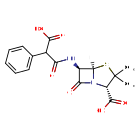
Structure for Carbenicillin (DB00578)
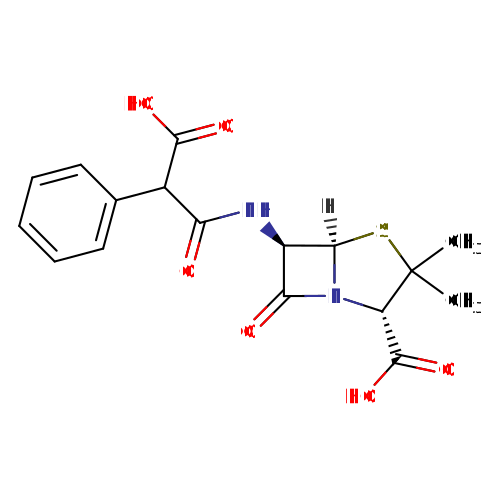
- Weight
- Average: 378.4
Monoisotopic: 378.088557008 - Chemical Formula
- C17H18N2O6S
- Synonyms
- (2S,5R,6R)-6-{[carboxy(phenyl)acetyl]amino}-3,3-dimethyl-7-oxo-4-thia-1-azabicyclo[3.2.0]heptane-2-carboxylic acid
- Carbenicilina
- Carbenicillin
- Carbenicilline
- Carbenicillinum
- Carboxybenzylpenicillin
- CBPC
- N-(2-carboxy-3,3-dimethyl-7-oxo-4-thia-1-azabicyclo(3.2.0)hept-6-yl)-2-phenylmalonamic acid
- α-carboxybenzylpencillin
- α-phenyl(carboxymethylpenicillin)
- External IDs
- BRL 2064
- CP 15639-2
- NSC 111071

Pharmacology
- Indication
For the treatment of acute and chronic infections of the upper and lower urinary tract and in asymptomatic bacteriuria due to susceptible strains of bacteria.
 Reduce drug development failure ratesBuild, train, & validate machine-learning modelswith evidence-based and structured datasets.Build, train, & validate predictive machine-learning models with structured datasets.
- Contraindications & Blackbox Warnings
 Prevent Adverse Drug Events TodayTap into our Clinical API for life-saving information on contraindications & blackbox warnings, population restrictions, harmful risks, & more.Avoid life-threatening adverse drug events with our Clinical API
- Pharmacodynamics
Carbenicillin is a semisynthetic penicillin. Though carbenicillin provides substantial in vitro activity against a variety of both gram-positive and gram-negative microorganisms, the most important aspect of its profile is in its antipseudomonal and antiproteal activity. Because of the high urine levels obtained following administration, carbenicillin has demonstrated clinical efficacy in urinary infections due to susceptible strains of: Escherichia coli, Proteus mirabilis, Proteus vulgaris, Morganella morganii, Pseudomonas species, Providencia rettgeri, Enterobacter species, and Enterococci (S. faecalis).
- Mechanism of action
Free carbenicillin is the predominant pharmacologically active fraction of the salt. Carbenicillin exerts its antibacterial activity by interference with final cell wall synthesis of susceptible bacteria. Penicillins acylate the penicillin-sensitive transpeptidase C-terminal domain by opening the lactam ring. This inactivation of the enzyme prevents the formation of a cross-link of two linear peptidoglycan strands, inhibiting the third and last stage of bacterial cell wall synthesis. Cell lysis is then mediated by bacterial cell wall autolytic enzymes such as autolysins; it is possible that carbenicillin interferes with an autolysin inhibitor.
Target Actions Organism APenicillin-binding protein inhibitorGram positive and gram negative bacteria UBeta-lactamase Toho-1 substrateEscherichia coli - Absorption
Rapidly absorbed from the small intestine following oral administration. Oral bioavailability is 30 to 40%.
- Volume of distribution
Not Available
- Protein binding
30 to 60%
- Metabolism
Minimal.
- Route of elimination
Not Available
- Half-life
1 hour
- Clearance
Not Available
- Adverse Effects
 Improve decision support & research outcomesWith structured adverse effects data, including: blackbox warnings, adverse reactions, warning & precautions, & incidence rates. View sample adverse effects data in our new Data Library!Improve decision support & research outcomes with our structured adverse effects data.
- Toxicity
Carbenicillin blood levels achievable are very low, and toxic reactions as a function of overdosage should not occur systematically. The oral LD50 in mice is 3,600 mg/kg, in rats 2,000 mg/kg, and in dogs is in excess of 500 mg/kg. The lethal human dose is not known. Symptoms of overdose include diarrhea, nausea, stomach upset, and vomiting.
- Pathways
- Not Available
- Pharmacogenomic Effects/ADRs
- Not Available
Interactions
- Drug Interactions
- This information should not be interpreted without the help of a healthcare provider. If you believe you are experiencing an interaction, contact a healthcare provider immediately. The absence of an interaction does not necessarily mean no interactions exist.
Drug Interaction Integrate drug-drug
interactions in your softwareAcemetacin Acemetacin may decrease the excretion rate of Carbenicillin which could result in a higher serum level. Acenocoumarol Carbenicillin may increase the anticoagulant activities of Acenocoumarol. Acyclovir The excretion of Acyclovir can be decreased when combined with Carbenicillin. Adefovir dipivoxil The excretion of Adefovir dipivoxil can be decreased when combined with Carbenicillin. Ambroxol The risk or severity of methemoglobinemia can be increased when Carbenicillin is combined with Ambroxol. - Food Interactions
- Take on an empty stomach.
Products
 Drug product information from 10+ global regionsOur datasets provide approved product information including:dosage, form, labeller, route of administration, and marketing period.Access drug product information from over 10 global regions.
- Product Ingredients
Ingredient UNII CAS InChI Key Carbenicillin disodium 9TS4B3H261 4800-94-6 RTYJTGSCYUUYAL-YCAHSCEMSA-L - International/Other Brands
- Carbenicillin (Polfa Tarchomin) / Pyopen (GlaxoSmithKline)
Categories
- ATC Codes
- J01CR50 — Combinations of penicillins
- J01CR — Combinations of penicillins, incl. beta-lactamase inhibitors
- J01C — BETA-LACTAM ANTIBACTERIALS, PENICILLINS
- J01 — ANTIBACTERIALS FOR SYSTEMIC USE
- J — ANTIINFECTIVES FOR SYSTEMIC USE
- Drug Categories
- Chemical TaxonomyProvided by Classyfire
- Description
- This compound belongs to the class of organic compounds known as dipeptides. These are organic compounds containing a sequence of exactly two alpha-amino acids joined by a peptide bond.
- Kingdom
- Organic compounds
- Super Class
- Organic acids and derivatives
- Class
- Carboxylic acids and derivatives
- Sub Class
- Amino acids, peptides, and analogues
- Direct Parent
- Dipeptides
- Alternative Parents
- Penicillins / N-acyl-alpha amino acids and derivatives / Phenylacetamides / 1,3-dicarbonyl compounds / Dicarboxylic acids and derivatives / Thiazolidines / Tertiary carboxylic acid amides / Secondary carboxylic acid amides / Azetidines / Thiohemiaminal derivatives show 7 more
- Substituents
- 1,3-dicarbonyl compound / Alpha-amino acid or derivatives / Alpha-dipeptide / Aromatic heteropolycyclic compound / Azacycle / Azetidine / Benzenoid / Beta-lactam / Carbonyl group / Carboxamide group show 22 more
- Molecular Framework
- Aromatic heteropolycyclic compounds
- External Descriptors
- penicillin (CHEBI:3393)
- Affected organisms
- Enteric bacteria and other eubacteria
- Gram-negative Bacteria
- Pseudomonas aeruginosa
- Escherichia coli
- Proteus mirabilis
Chemical Identifiers
- UNII
- G42ZU72N5G
- CAS number
- 4697-36-3
- InChI Key
- FPPNZSSZRUTDAP-UWFZAAFLSA-N
- InChI
- InChI=1S/C17H18N2O6S/c1-17(2)11(16(24)25)19-13(21)10(14(19)26-17)18-12(20)9(15(22)23)8-6-4-3-5-7-8/h3-7,9-11,14H,1-2H3,(H,18,20)(H,22,23)(H,24,25)/t9?,10-,11+,14-/m1/s1
- IUPAC Name
- (2S,5R,6R)-6-(2-carboxy-2-phenylacetamido)-3,3-dimethyl-7-oxo-4-thia-1-azabicyclo[3.2.0]heptane-2-carboxylic acid
- SMILES
- [H][C@]12SC(C)(C)[C@@H](N1C(=O)[C@H]2NC(=O)C(C(O)=O)C1=CC=CC=C1)C(O)=O
References
- Synthesis Reference
Brain, E.G. and Nayler, J.H.C.; US. Patents 3,282,926; November 1,1966 and 3,492,291; January 27,1970; both assigned to Beecham Group Limited, England.
- General References
- Not Available
- External Links
- Human Metabolome Database
- HMDB0014717
- KEGG Drug
- D07614
- KEGG Compound
- C06869
- PubChem Compound
- 20824
- PubChem Substance
- 46505653
- ChemSpider
- 19599
- 2015
- ChEBI
- 3393
- ChEMBL
- CHEMBL1214
- Therapeutic Targets Database
- DAP000438
- PharmGKB
- PA448788
- RxList
- RxList Drug Page
- Drugs.com
- Drugs.com Drug Page
- Wikipedia
- Carbenicillin
- MSDS
- Download (72 KB)
Clinical Trials
- Clinical Trials
Phase Status Purpose Conditions Count 0 Terminated Treatment Osteomyelitis 1
Pharmacoeconomics
- Manufacturers
- Roerig div pfizer inc
- Glaxosmithkline
- Packagers
- Pfizer Inc.
- Pharmaceutical Utilization Management Program VA Inc.
- Dosage Forms
- Not Available
- Prices
- Not Available
- Patents
- Not Available
Properties
- State
- Solid
- Experimental Properties
Property Value Source water solubility 451 mg/L Not Available logP 1.13 HANSCH,C ET AL. (1995) - Predicted Properties
Property Value Source Water Solubility 0.39 mg/mL ALOGPS logP 1.13 ALOGPS logP 0.82 Chemaxon logS -3 ALOGPS pKa (Strongest Acidic) 3.11 Chemaxon pKa (Strongest Basic) -6.3 Chemaxon Physiological Charge -2 Chemaxon Hydrogen Acceptor Count 6 Chemaxon Hydrogen Donor Count 3 Chemaxon Polar Surface Area 124.01 Å2 Chemaxon Rotatable Bond Count 5 Chemaxon Refractivity 90.82 m3·mol-1 Chemaxon Polarizability 36.39 Å3 Chemaxon Number of Rings 3 Chemaxon Bioavailability 1 Chemaxon Rule of Five Yes Chemaxon Ghose Filter Yes Chemaxon Veber's Rule No Chemaxon MDDR-like Rule No Chemaxon - Predicted ADMET Features
Property Value Probability Human Intestinal Absorption - 0.9112 Blood Brain Barrier - 0.9954 Caco-2 permeable - 0.7812 P-glycoprotein substrate Substrate 0.5274 P-glycoprotein inhibitor I Non-inhibitor 0.9447 P-glycoprotein inhibitor II Non-inhibitor 0.9872 Renal organic cation transporter Non-inhibitor 0.962 CYP450 2C9 substrate Non-substrate 0.7684 CYP450 2D6 substrate Non-substrate 0.8611 CYP450 3A4 substrate Non-substrate 0.5946 CYP450 1A2 substrate Non-inhibitor 0.8778 CYP450 2C9 inhibitor Non-inhibitor 0.9259 CYP450 2D6 inhibitor Non-inhibitor 0.935 CYP450 2C19 inhibitor Non-inhibitor 0.9206 CYP450 3A4 inhibitor Non-inhibitor 0.8921 CYP450 inhibitory promiscuity Low CYP Inhibitory Promiscuity 0.9761 Ames test Non AMES toxic 0.8884 Carcinogenicity Non-carcinogens 0.6178 Biodegradation Not ready biodegradable 0.976 Rat acute toxicity 1.4599 LD50, mol/kg Not applicable hERG inhibition (predictor I) Weak inhibitor 0.9997 hERG inhibition (predictor II) Non-inhibitor 0.9091
Spectra
- Mass Spec (NIST)
- Not Available
- Spectra
Spectrum Spectrum Type Splash Key Predicted GC-MS Spectrum - GC-MS Predicted GC-MS splash10-000f-9648000000-75c4ae9c8d8548759c79 Predicted MS/MS Spectrum - 10V, Positive (Annotated) Predicted LC-MS/MS splash10-08ml-0941000000-dd04761aba676e737365 Predicted MS/MS Spectrum - 10V, Negative (Annotated) Predicted LC-MS/MS splash10-000i-0093000000-2481d8576e383313ecfa Predicted MS/MS Spectrum - 20V, Positive (Annotated) Predicted LC-MS/MS splash10-0006-0910000000-5e16937a715baee100d2 Predicted MS/MS Spectrum - 20V, Negative (Annotated) Predicted LC-MS/MS splash10-0016-9774000000-fce5db20fc35ce747364 Predicted MS/MS Spectrum - 40V, Positive (Annotated) Predicted LC-MS/MS splash10-014l-1900000000-9fcde5d9a40519e2fca4 Predicted MS/MS Spectrum - 40V, Negative (Annotated) Predicted LC-MS/MS splash10-0006-9626000000-3b8a7fd71c7606208706 Predicted 1H NMR Spectrum 1D NMR Not Applicable Predicted 13C NMR Spectrum 1D NMR Not Applicable - Chromatographic Properties
Collision Cross Sections (CCS)
Adduct CCS Value (Å2) Source type Source [M-H]- 190.0361556 predictedDarkChem Lite v0.1.0 [M-H]- 182.77989 predictedDeepCCS 1.0 (2019) [M+H]+ 191.4709556 predictedDarkChem Lite v0.1.0 [M+H]+ 185.17546 predictedDeepCCS 1.0 (2019) [M+Na]+ 190.5526556 predictedDarkChem Lite v0.1.0 [M+Na]+ 191.08798 predictedDeepCCS 1.0 (2019)
Targets

- Kind
- Protein group
- Organism
- Gram positive and gram negative bacteria
- Pharmacological action
- Yes
- Actions
- Inhibitor
- General Function
- Serine-type d-ala-d-ala carboxypeptidase activity
- Specific Function
- Removes C-terminal D-alanyl residues from sugar-peptide cell wall precursors.
Components:
References
- Sainsbury S, Bird L, Rao V, Shepherd SM, Stuart DI, Hunter WN, Owens RJ, Ren J: Crystal structures of penicillin-binding protein 3 from Pseudomonas aeruginosa: comparison of native and antibiotic-bound forms. J Mol Biol. 2011 Jan 7;405(1):173-84. doi: 10.1016/j.jmb.2010.10.024. Epub 2010 Oct 23. [Article]
- Kind
- Protein
- Organism
- Escherichia coli
- Pharmacological action
- Unknown
- Actions
- Substrate
- General Function
- Beta-lactamase activity
- Specific Function
- Has strong cefotaxime-hydrolyzing activity.
- Gene Name
- bla
- Uniprot ID
- Q47066
- Uniprot Name
- Beta-lactamase Toho-1
- Molecular Weight
- 31446.6 Da
References
- Ishii Y, Ohno A, Taguchi H, Imajo S, Ishiguro M, Matsuzawa H: Cloning and sequence of the gene encoding a cefotaxime-hydrolyzing class A beta-lactamase isolated from Escherichia coli. Antimicrob Agents Chemother. 1995 Oct;39(10):2269-75. [Article]
Enzymes
- Kind
- Protein
- Organism
- Humans
- Pharmacological action
- Unknown
- Actions
- Inhibitor
- General Function
- Phospholipase a2 activity
- Specific Function
- Selectively hydrolyzes arachidonyl phospholipids in the sn-2 position releasing arachidonic acid. Together with its lysophospholipid activity, it is implicated in the initiation of the inflammatory...
- Gene Name
- PLA2G4A
- Uniprot ID
- P47712
- Uniprot Name
- Cytosolic phospholipase A2
- Molecular Weight
- 85238.2 Da
References
- Sugatani J, Saito K, Honjo I: In vitro actions of some antibiotics on phospholipases. J Antibiot (Tokyo). 1979 Jul;32(7):734-9. [Article]
Transporters
- Kind
- Protein
- Organism
- Humans
- Pharmacological action
- Unknown
- Actions
- Inhibitor
- General Function
- Sodium-independent organic anion transmembrane transporter activity
- Specific Function
- Involved in the renal elimination of endogenous and exogenous organic anions. Functions as organic anion exchanger when the uptake of one molecule of organic anion is coupled with an efflux of one ...
- Gene Name
- SLC22A6
- Uniprot ID
- Q4U2R8
- Uniprot Name
- Solute carrier family 22 member 6
- Molecular Weight
- 61815.78 Da
References
- Jariyawat S, Sekine T, Takeda M, Apiwattanakul N, Kanai Y, Sophasan S, Endou H: The interaction and transport of beta-lactam antibiotics with the cloned rat renal organic anion transporter 1. J Pharmacol Exp Ther. 1999 Aug;290(2):672-7. [Article]

Drug created at June 13, 2005 13:24 / Updated at February 02, 2024 22:53