Identification
- Generic Name
- Cyclothiazide
- DrugBank Accession Number
- DB00606
- Background
As a diuretic, cyclothiazide inhibits active chloride reabsorption at the early distal tubule via the Na-Cl cotransporter, resulting in an increase in the excretion of sodium, chloride, and water. Thiazides like cyclothiazide also inhibit sodium ion transport across the renal tubular epithelium through binding to the thiazide sensitive sodium-chloride transporter. This results in an increase in potassium excretion via the sodium-potassium exchange mechanism. The antihypertensive mechanism of cyclothiazide is less well understood although it may be mediated through its action on carbonic anhydrases in the smooth muscle or through its action on the large-conductance calcium-activated potassium (KCa) channel, also found in the smooth muscle. Cyclothiazide is indicated as adjunctive therapy in edema associated with congestive heart failure, hepatic cirrhosis, and corticosteroid and estrogen therapy. It is also indicated in the management of hypertension either as the sole therapeutic agent or to enhance the effectiveness of other antihypertensive drugs in the more severe forms of hypertension.
- Type
- Small Molecule
- Groups
- Approved
- Structure
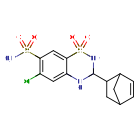
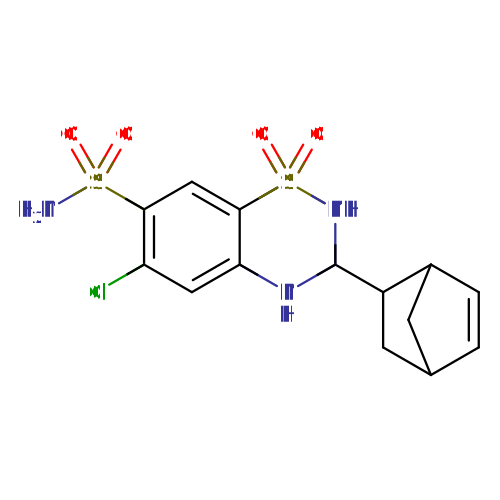
Structure for Cyclothiazide (DB00606)
- Weight
- Average: 389.878
Monoisotopic: 389.027075102 - Chemical Formula
- C14H16ClN3O4S2
- Synonyms
- 6-chloro-3-(2-norbornen-5-yl)-7-sulfamyl-3,4-dihydro-1,2,4-benzothiadiazine 1,1-dioxide
- 6-chloro-3,4-dihydro-3-(2-norbornen-5-yl)-2H-1,2,4-benzothiadiazine-7-sulfonamide 1,1-dioxide
- 6-chloro-3,4-dihydro-3-(2-norbornen-5-yl)-7-sulfamoyl-1,2,4-benzothiadiazine 1,1-dioxide
- 6-chloro-3,4-dihydro-3-(5-norbornen-2-yl)-2H-1,2,4-benzothiadiazine-7-sulfonamide 1,1-dioxide
- Ciclotiazida
- Ciclotiazide
- Cyclothiazide
- Cyclothiazidum
- External IDs
- Lilly 35,483

Pharmacology
- Indication
Cyclothiazide is indicated as adjunctive therapy in edema associated with congestive heart failure, hepatic cirrhosis, and corticosteroid and estrogen therapy. It is also indicated in the management of hypertension either as the sole therapeutic agent or to enhance the effectiveness of other antihypertensive drugs in the more severe forms of hypertension.
 Reduce drug development failure ratesBuild, train, & validate machine-learning modelswith evidence-based and structured datasets.Build, train, & validate predictive machine-learning models with structured datasets.
- Contraindications & Blackbox Warnings
 Prevent Adverse Drug Events TodayTap into our Clinical API for life-saving information on contraindications & blackbox warnings, population restrictions, harmful risks, & more.Avoid life-threatening adverse drug events with our Clinical API
- Pharmacodynamics
Like other thiazides, cyclothiazide promotes water loss from the body (diuretics). It inhibits Na+/Cl- reabsorption from the distal convoluted tubules in the kidneys. Thiazides also cause loss of potassium and an increase in serum uric acid. Thiazides are often used to treat hypertension, but their hypotensive effects are not necessarily due to their diuretic activity. Thiazides have been shown to prevent hypertension-related morbidity and mortality although the mechanism is not fully understood. Thiazides cause vasodilation by activating calcium-activated potassium channels (large conductance) in vascular smooth muscles and inhibiting various carbonic anhydrases in vascular tissue. Cyclothiazide affects the distal renal tubular mechanism of electrolyte reabsorption. At maximal therapeutic dosages, all thiazides are approximately equal in their diuretic efficacy. Cyclothiazide increases excretion of sodium and chloride in approximately equivalent amounts. Natriuresis may be accompanied by some loss of potassium and bicarbonate.
- Mechanism of action
Hydrochlorothiazide, a thiazide diuretic, inhibits water reabsorption in the nephron by inhibiting the sodium-chloride symporter (SLC12A3) in the distal convoluted tubule, which is responsible for 5% of total sodium reabsorption. Normally, the sodium-chloride symporter transports sodium and chloride from the lumen into the epithelial cell lining the distal convoluted tubule. The energy for this is provided by a sodium gradient established by sodium-potassium ATPases on the basolateral membrane. Once sodium has entered the cell, it is transported out into the basolateral interstitium via the sodium-potassium ATPase, causing an increase in the osmolarity of the interstitium, thereby establishing an osmotic gradient for water reabsorption. By blocking the sodium-chloride symporter, hydrochlorothiazide effectively reduces the osmotic gradient and water reabsorption throughout the nephron.Hydrochlorothiazide, a thiazide diuretic, inhibits water reabsorption in the nephron by inhibiting the sodium-chloride symporter (SLC12A3) in the distal convoluted tubule, which is responsible for 5% of total sodium reabsorption. Normally, the sodium-chloride symporter transports sodium and chloride from the lumen into the epithelial cell lining the distal convoluted tubule. The energy for this is provided by a sodium gradient established by sodium-potassium ATPases on the basolateral membrane. Once sodium has entered the cell, it is transported out into the basolateral interstitium via the sodium-potassium ATPase, causing an increase in the osmolarity of the interstitium, thereby establishing an osmotic gradient for water reabsorption. By blocking the sodium-chloride symporter, hydrochlorothiazide effectively reduces the osmotic gradient and water reabsorption throughout the nephron.
Target Actions Organism ASodium/potassium-transporting ATPase subunit gamma inhibitorHumans ACarbonic anhydrase inhibitorHumans UCarbonic anhydrase 1 inhibitorHumans UCarbonic anhydrase 2 inhibitorHumans USecreted frizzled-related protein 4 inhibitorHumans - Absorption
Not Available
- Volume of distribution
Not Available
- Protein binding
Not Available
- Metabolism
- Not Available
- Route of elimination
Not Available
- Half-life
Not Available
- Clearance
Not Available
- Adverse Effects
 Improve decision support & research outcomesWith structured adverse effects data, including: blackbox warnings, adverse reactions, warning & precautions, & incidence rates. View sample adverse effects data in our new Data Library!Improve decision support & research outcomes with our structured adverse effects data.
- Toxicity
Oral LD50 in mouse is > 10000 mg/kg, and > 4000 mg/kg in rat. Signs of overdose include those caused by electrolyte depletion (hypokalemia, hypochloremia, hyponatremia) and dehydration resulting from excessive diuresis. If digitalis has also been administered hypokalemia may accentuate cardiac arrhythmias.
- Pathways
Pathway Category Cyclothiazide Action Pathway Drug action - Pharmacogenomic Effects/ADRs
- Not Available
Interactions
- Drug Interactions
- This information should not be interpreted without the help of a healthcare provider. If you believe you are experiencing an interaction, contact a healthcare provider immediately. The absence of an interaction does not necessarily mean no interactions exist.
Drug Interaction Integrate drug-drug
interactions in your softwareAbacavir Cyclothiazide may increase the excretion rate of Abacavir which could result in a lower serum level and potentially a reduction in efficacy. Abaloparatide Abaloparatide may increase the hypotensive activities of Cyclothiazide. Abciximab The therapeutic efficacy of Abciximab can be decreased when used in combination with Cyclothiazide. Acarbose The therapeutic efficacy of Acarbose can be decreased when used in combination with Cyclothiazide. Acebutolol The therapeutic efficacy of Acebutolol can be increased when used in combination with Cyclothiazide. - Food Interactions
- Not Available
Products
 Drug product information from 10+ global regionsOur datasets provide approved product information including:dosage, form, labeller, route of administration, and marketing period.Access drug product information from over 10 global regions.
- International/Other Brands
- Acquirel / Anhydron (Lilly) / Doburil (Boehringer Ingelheim) / Fluidil / Renazide / Tensodiural / Valmiran (Boehringer Ingelheim)
Categories
- ATC Codes
- G01AE10 — Combinations of sulfonamides
- G01AE — Sulfonamides
- G01A — ANTIINFECTIVES AND ANTISEPTICS, EXCL. COMBINATIONS WITH CORTICOSTEROIDS
- G01 — GYNECOLOGICAL ANTIINFECTIVES AND ANTISEPTICS
- G — GENITO URINARY SYSTEM AND SEX HORMONES
- C03AB — Thiazides and potassium in combination
- C03A — LOW-CEILING DIURETICS, THIAZIDES
- C03 — DIURETICS
- C — CARDIOVASCULAR SYSTEM
- Drug Categories
- Antihypertensive Agents
- Cardiovascular Agents
- Diuretics
- Genito Urinary System and Sex Hormones
- Gynecological Antiinfectives and Antiseptics
- Heterocyclic Compounds, Fused-Ring
- Hyperglycemia-Associated Agents
- Natriuretic Agents
- OAT1/SLC22A6 inhibitors
- Receptors, AMPA
- Sulfonamides
- Sulfones
- Sulfur Compounds
- Thiazides
- Chemical TaxonomyProvided by Classyfire
- Description
- This compound belongs to the class of organic compounds known as 1,2,4-benzothiadiazine-1,1-dioxides. These are aromatic heterocyclic compounds containing a 1,2,4-benzothiadiazine ring system with two S=O bonds at the 1-position.
- Kingdom
- Organic compounds
- Super Class
- Organoheterocyclic compounds
- Class
- Thiadiazines
- Sub Class
- Benzothiadiazines
- Direct Parent
- 1,2,4-benzothiadiazine-1,1-dioxides
- Alternative Parents
- Secondary alkylarylamines / Organosulfonamides / Benzenoids / Aryl chlorides / Aminosulfonyl compounds / Azacyclic compounds / Organopnictogen compounds / Organochlorides / Organic oxides / Hydrocarbon derivatives
- Substituents
- 1,2,4-benzothiadiazine-1,1-dioxide / Amine / Aminosulfonyl compound / Aromatic heteropolycyclic compound / Aryl chloride / Aryl halide / Azacycle / Benzenoid / Hydrocarbon derivative / Organic nitrogen compound
- Molecular Framework
- Aromatic heteropolycyclic compounds
- External Descriptors
- benzothiadiazine (CHEBI:31448)
- Affected organisms
- Humans and other mammals
Chemical Identifiers
- UNII
- P71U09G5BW
- CAS number
- 2259-96-3
- InChI Key
- BOCUKUHCLICSIY-UHFFFAOYSA-N
- InChI
- InChI=1S/C14H16ClN3O4S2/c15-10-5-11-13(6-12(10)23(16,19)20)24(21,22)18-14(17-11)9-4-7-1-2-8(9)3-7/h1-2,5-9,14,17-18H,3-4H2,(H2,16,19,20)
- IUPAC Name
- 3-{bicyclo[2.2.1]hept-5-en-2-yl}-6-chloro-1,1-dioxo-3,4-dihydro-2H-1lambda6,2,4-benzothiadiazine-7-sulfonamide
- SMILES
- NS(=O)(=O)C1=C(Cl)C=C2NC(NS(=O)(=O)C2=C1)C1CC2CC1C=C2
References
- Synthesis Reference
Muller, E. and Hasspacher, K.; US. Patent 3,275,625; September 27,1966; assigned to Boehringer lngelheim GmbH, Germany.
- General References
- Not Available
- External Links
- Human Metabolome Database
- HMDB0014744
- KEGG Drug
- D01256
- KEGG Compound
- C12685
- PubChem Compound
- 2910
- PubChem Substance
- 46508269
- ChemSpider
- 2807
- BindingDB
- 50192229
- 22033
- ChEBI
- 31448
- ChEMBL
- CHEMBL61593
- Therapeutic Targets Database
- DAP000604
- PharmGKB
- PA449168
- PDBe Ligand
- CYZ
- Wikipedia
- Cyclothiazide
- MSDS
- Download (74.8 KB)
Clinical Trials
Pharmacoeconomics
- Manufacturers
- Eli lilly and co
- Pharmacia and upjohn co
- Packagers
- Not Available
- Dosage Forms
- Not Available
- Prices
- Not Available
- Patents
- Not Available
Properties
- State
- Solid
- Experimental Properties
Property Value Source melting point (°C) 229-230 Muller, E. and Hasspacher, K.; US. Patent 3,275,625; September 27,1966; assigned to Boehringer lngelheim GmbH, Germany. logP 1.95 YAMAZAKI,M ET AL. (1984) - Predicted Properties
Property Value Source Water Solubility 0.279 mg/mL ALOGPS logP 1.32 ALOGPS logP 0.94 Chemaxon logS -3.2 ALOGPS pKa (Strongest Acidic) 9.06 Chemaxon pKa (Strongest Basic) -2.5 Chemaxon Physiological Charge 0 Chemaxon Hydrogen Acceptor Count 5 Chemaxon Hydrogen Donor Count 3 Chemaxon Polar Surface Area 118.36 Å2 Chemaxon Rotatable Bond Count 2 Chemaxon Refractivity 92.65 m3·mol-1 Chemaxon Polarizability 37.1 Å3 Chemaxon Number of Rings 4 Chemaxon Bioavailability 1 Chemaxon Rule of Five Yes Chemaxon Ghose Filter Yes Chemaxon Veber's Rule No Chemaxon MDDR-like Rule No Chemaxon - Predicted ADMET Features
Property Value Probability Human Intestinal Absorption + 0.9936 Blood Brain Barrier - 0.8102 Caco-2 permeable - 0.7087 P-glycoprotein substrate Non-substrate 0.6003 P-glycoprotein inhibitor I Non-inhibitor 0.8315 P-glycoprotein inhibitor II Non-inhibitor 0.9504 Renal organic cation transporter Non-inhibitor 0.894 CYP450 2C9 substrate Non-substrate 0.6644 CYP450 2D6 substrate Non-substrate 0.8212 CYP450 3A4 substrate Non-substrate 0.6385 CYP450 1A2 substrate Non-inhibitor 0.9045 CYP450 2C9 inhibitor Non-inhibitor 0.9071 CYP450 2D6 inhibitor Non-inhibitor 0.9231 CYP450 2C19 inhibitor Non-inhibitor 0.9026 CYP450 3A4 inhibitor Inhibitor 0.7478 CYP450 inhibitory promiscuity Low CYP Inhibitory Promiscuity 0.8682 Ames test Non AMES toxic 0.8015 Carcinogenicity Non-carcinogens 0.813 Biodegradation Not ready biodegradable 1.0 Rat acute toxicity 1.9232 LD50, mol/kg Not applicable hERG inhibition (predictor I) Weak inhibitor 0.9813 hERG inhibition (predictor II) Non-inhibitor 0.8693
Spectra
- Mass Spec (NIST)
- Download (9.61 KB)
- Spectra
Spectrum Spectrum Type Splash Key Predicted GC-MS Spectrum - GC-MS Predicted GC-MS splash10-016u-9133000000-93e2b7d86e56b630140d Predicted MS/MS Spectrum - 10V, Positive (Annotated) Predicted LC-MS/MS splash10-0006-0009000000-8e16b627cbde0bec8349 Predicted MS/MS Spectrum - 20V, Positive (Annotated) Predicted LC-MS/MS splash10-0006-1009000000-d7cc6509b2f994f0a3db Predicted MS/MS Spectrum - 10V, Negative (Annotated) Predicted LC-MS/MS splash10-000i-0009000000-5be909a63d3f3b761056 Predicted MS/MS Spectrum - 40V, Positive (Annotated) Predicted LC-MS/MS splash10-0a4i-2469000000-3b2761f454964c5a3580 Predicted MS/MS Spectrum - 20V, Negative (Annotated) Predicted LC-MS/MS splash10-000i-2009000000-bbd595db44c1cd6f967f Predicted MS/MS Spectrum - 40V, Negative (Annotated) Predicted LC-MS/MS splash10-004i-9031000000-94b10379503b79bc5895 Predicted 1H NMR Spectrum 1D NMR Not Applicable Predicted 13C NMR Spectrum 1D NMR Not Applicable - Chromatographic Properties
Collision Cross Sections (CCS)
Adduct CCS Value (Å2) Source type Source [M-H]- 192.3008796 predictedDarkChem Lite v0.1.0 [M-H]- 171.04872 predictedDeepCCS 1.0 (2019) [M+H]+ 192.8624796 predictedDarkChem Lite v0.1.0 [M+H]+ 173.40672 predictedDeepCCS 1.0 (2019) [M+Na]+ 191.8772796 predictedDarkChem Lite v0.1.0 [M+Na]+ 180.06145 predictedDeepCCS 1.0 (2019)
Targets

- Kind
- Protein
- Organism
- Humans
- Pharmacological action
- Yes
- Actions
- Inhibitor
- General Function
- Transporter activity
- Specific Function
- May be involved in forming the receptor site for cardiac glycoside binding or may modulate the transport function of the sodium ATPase.
- Gene Name
- FXYD2
- Uniprot ID
- P54710
- Uniprot Name
- Sodium/potassium-transporting ATPase subunit gamma
- Molecular Weight
- 7283.265 Da
References
- Yu Cao (2018). 1. In Advances in Membrane Proteins - Part I: Mass Processing and Transportation (pp. 11). Springer. [ISBN:9789811305320]
- Kind
- Protein group
- Organism
- Humans
- Pharmacological action
- Yes
- Actions
- Inhibitor
- Curator comments
- Literature states that the protein class is targeted by the family that the drug comes from -- thiazide diuretics.
- General Function
- Zinc ion binding
- Specific Function
- Reversible hydration of carbon dioxide. Can hydrates cyanamide to urea.
Components:
References
- Temperini C, Cecchi A, Scozzafava A, Supuran CT: Carbonic anhydrase inhibitors. Comparison of chlorthalidone, indapamide, trichloromethiazide, and furosemide X-ray crystal structures in adducts with isozyme II, when several water molecules make the difference. Bioorg Med Chem. 2009 Feb 1;17(3):1214-21. doi: 10.1016/j.bmc.2008.12.023. Epub 2008 Dec 24. [Article]
- Temperini C, Cecchi A, Scozzafava A, Supuran CT: Carbonic anhydrase inhibitors. Comparison of chlorthalidone and indapamide X-ray crystal structures in adducts with isozyme II: when three water molecules and the keto-enol tautomerism make the difference. J Med Chem. 2009 Jan 22;52(2):322-8. doi: 10.1021/jm801386n. [Article]
- Kind
- Protein
- Organism
- Humans
- Pharmacological action
- Unknown
- Actions
- Inhibitor
- General Function
- Zinc ion binding
- Specific Function
- Reversible hydration of carbon dioxide. Can hydrates cyanamide to urea.
- Gene Name
- CA1
- Uniprot ID
- P00915
- Uniprot Name
- Carbonic anhydrase 1
- Molecular Weight
- 28870.0 Da
References
- Rammes G, Zeilhofer HU, Collingridge GL, Parsons CG, Swandulla D: Expression of early hippocampal CA1 LTP does not lead to changes in AMPA-EPSC kinetics or sensitivity to cyclothiazide. Pflugers Arch. 1999 Jan;437(2):191-6. [Article]
- Rammes G, Swandulla D, Collingridge GL, Hartmann S, Parsons CG: Interactions of 2,3-benzodiazepines and cyclothiazide at AMPA receptors: patch clamp recordings in cultured neurones and area CA1 in hippocampal slices. Br J Pharmacol. 1996 Mar;117(6):1209-21. [Article]
- Fleck MW, Bahring R, Patneau DK, Mayer ML: AMPA receptor heterogeneity in rat hippocampal neurons revealed by differential sensitivity to cyclothiazide. J Neurophysiol. 1996 Jun;75(6):2322-33. [Article]
- Pirotte B, Podona T, Diouf O, de Tullio P, Lebrun P, Dupont L, Somers F, Delarge J, Morain P, Lestage P, Lepagnol J, Spedding M: 4H-1,2,4-Pyridothiadiazine 1,1-dioxides and 2,3-dihydro-4H-1,2, 4-pyridothiadiazine 1,1-dioxides chemically related to diazoxide and cyclothiazide as powerful positive allosteric modulators of (R/S)-2-amino-3-(3-hydroxy-5-methylisoxazol-4-yl)propionic acid receptors: design, synthesis, pharmacology, and structure-activity relationships. J Med Chem. 1998 Jul 30;41(16):2946-59. [Article]
- Larson J, Le TT, Hall RA, Lynch G: Effects of cyclothiazide on synaptic responses in slices of adult and neonatal rat hippocampus. Neuroreport. 1994 Jan 12;5(4):389-92. [Article]
- Kind
- Protein
- Organism
- Humans
- Pharmacological action
- Unknown
- Actions
- Inhibitor
- General Function
- Zinc ion binding
- Specific Function
- Essential for bone resorption and osteoclast differentiation (By similarity). Reversible hydration of carbon dioxide. Can hydrate cyanamide to urea. Involved in the regulation of fluid secretion in...
- Gene Name
- CA2
- Uniprot ID
- P00918
- Uniprot Name
- Carbonic anhydrase 2
- Molecular Weight
- 29245.895 Da
References
- Liljequist S, Cebers G, Kalda A: Effects of decahydroisoquinoline-3-carboxylic acid monohydrate, a novel AMPA receptor antagonist, on glutamate-induced CA2+ responses and neurotoxicity in rat cortical and cerebellar granule neurons. Biochem Pharmacol. 1995 Nov 27;50(11):1761-74. [Article]
- Chen X, Ji ZL, Chen YZ: TTD: Therapeutic Target Database. Nucleic Acids Res. 2002 Jan 1;30(1):412-5. [Article]
- Kind
- Protein
- Organism
- Humans
- Pharmacological action
- Unknown
- Actions
- Inhibitor
- General Function
- Soluble frizzled-related proteins (sFRPS) function as modulators of Wnt signaling through direct interaction with Wnts. They have a role in regulating cell growth and differentiation in specific cell types (By similarity). SFRP4 plays a role in bone morphogenesis. May also act as a regulator of adult uterine morphology and function. May also increase apoptosis during ovulation possibly through modulation of FZ1/FZ4/WNT4 signaling (By similarity). Has phosphaturic effects by specifically inhibiting sodium-dependent phosphate uptake (PubMed:12952927).
- Specific Function
- Wnt-protein binding
- Gene Name
- SFRP4
- Uniprot ID
- Q6FHJ7
- Uniprot Name
- Secreted frizzled-related protein 4
- Molecular Weight
- 39826.305 Da
References
- Bukhari SA, Shamshari WA, Ur-Rahman M, Zia-Ul-Haq M, Jaafar HZ: Computer aided screening of secreted frizzled-related protein 4 (SFRP4): a potential control for diabetes mellitus. Molecules. 2014 Jul 11;19(7):10129-36. doi: 10.3390/molecules190710129. [Article]
Transporters
- Kind
- Protein
- Organism
- Humans
- Pharmacological action
- Unknown
- Actions
- Inhibitor
- General Function
- Sodium-independent organic anion transmembrane transporter activity
- Specific Function
- Involved in the renal elimination of endogenous and exogenous organic anions. Functions as organic anion exchanger when the uptake of one molecule of organic anion is coupled with an efflux of one ...
- Gene Name
- SLC22A6
- Uniprot ID
- Q4U2R8
- Uniprot Name
- Solute carrier family 22 member 6
- Molecular Weight
- 61815.78 Da
References
- Uwai Y, Saito H, Hashimoto Y, Inui KI: Interaction and transport of thiazide diuretics, loop diuretics, and acetazolamide via rat renal organic anion transporter rOAT1. J Pharmacol Exp Ther. 2000 Oct;295(1):261-5. [Article]


Drug created at June 13, 2005 13:24 / Updated at December 02, 2023 06:53