Identification
- Summary
Demeclocycline is a tetracycline antibiotic used to treat a wide variety of susceptible bacterial infections.
- Generic Name
- Demeclocycline
- DrugBank Accession Number
- DB00618
- Background
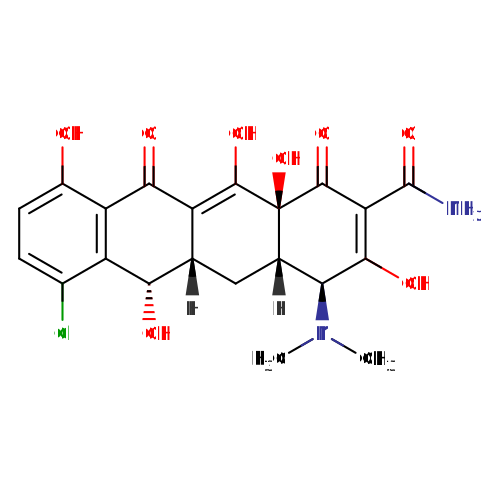
A tetracycline analog having a 7-chloro and a 6-methyl. Because it is excreted more slowly than tetracycline, it maintains effective blood levels for longer periods of time.
- Type
- Small Molecule
- Groups
- Approved
- Structure
Structure for Demeclocycline (DB00618)
- Weight
- Average: 464.853
Monoisotopic: 464.098643365 - Chemical Formula
- C21H21ClN2O8
- Synonyms
- [4S-(4α,4aα,5aα,6β,12aα)]-7-chloro-4-(dimethylamino)1,4,4a,5,5a,6,11,12a-octahydro-3,6,10,12,12a-pentahydroxy-1,11-dioxo-2-naphthacenecarboxamide
- 6-demethyl-7-chlorotetracycline
- 7-chloro-6-demethyltetracycline
- Demeclociclina
- Demeclocycline
- Demeclocyclinum
- Demethylchlortetracyclin
- Demethylchlortetracycline
- DMCT
- DMCTC

Pharmacology
- Indication
Used primarily to treat Lyme disease, acne, and bronchitis. Also indicated (but rarely used) to treat urinary tract infections, gum disease, malaria, and other bacterial infections such as gonorrhea and chlamydia. One of its other registered uses is the treatment of hyponatremia (low blood sodium concentration) due to the syndrome of inappropriate antidiuretic hormone (SIADH) where fluid restriction alone has been ineffective.
 Reduce drug development failure ratesBuild, train, & validate machine-learning modelswith evidence-based and structured datasets.Build, train, & validate predictive machine-learning models with structured datasets.
- Associated Conditions
Indication Type Indication Combined Product Details Approval Level Age Group Patient Characteristics Dose Form Treatment of Actinomycosis •••••••••••• Treatment of Anthrax •••••••••••• Treatment of Bartonellosis •••••••••••• Used in combination to treat Brucellosis Regimen in combination with: Streptomycin (DB01082) •••••••••••• Treatment of Chlamydia •••••••••••• - Contraindications & Blackbox Warnings
 Prevent Adverse Drug Events TodayTap into our Clinical API for life-saving information on contraindications & blackbox warnings, population restrictions, harmful risks, & more.Avoid life-threatening adverse drug events with our Clinical API
- Pharmacodynamics
Demeclocycline is a tetracycline antibiotic active against the following microorganisms: Rickettsiae (Rocky Mountain spotted fever, typhus fever and the typhus group, Q fever, rickettsial pox, tick fevers), Mycoplasma pneumoniae (PPLO, Eaton agent), agents of psittacosis and ornithosis, agents of lymphogranulomavenereum and granuloma inguinale, the spirochetal agent of relapsing fever (Borrelia recurrentis), Haemophilus ducreyi (chancroid), Yersinia pestis, Pasteurella pestis and Pasteurella tularensis, Bartonella bacilliformis, Bacteroides species, Vibrio comma and Vibrio fetus, and Brucella species (in conjunction with streptomycin). Demeclocycline inhibits cell growth by inhibiting translation. Demeclocycline is lipophilic and can easily pass through the cell membrane or passively diffuses through porin channels in the bacterial membrane. Demeclocycline is not a direct bactericidal agent; rather, it is a bacteriostatic drug that impairs bacterial growth. Because it is excreted more slowly than tetracycline, it maintains effective blood levels for longer periods of time.
- Mechanism of action
Demeclocycline inhibits cell growth by inhibiting translation. It binds (reversibly) to the 30S and 50S ribosomal subunit and prevents the amino-acyl tRNA from binding to the A site of the ribosome, which impairs protein synthesis by bacteria. The binding is reversible in nature. The use in SIADH actually relies on a side-effect of tetracycline antibiotics; many may cause diabetes insipidus (dehydration due to the inability to concentrate urine). It is not completely understood why demeclocycline impairs the action of antidiuretic hormone, but it is thought that it blocks the binding of the hormone to its receptor.
Target Actions Organism A30S ribosomal protein inhibitorUVasopressin V2 receptor inhibitorHumans - Absorption
Tetracyclines are readily absorbed.
- Volume of distribution
Not Available
- Protein binding
41-50%
- Metabolism
Hepatic
- Route of elimination
Demeclocycline hydrochloride, like other tetracyclines, is concentrated in the liver and excreted into the bile where it is found in much higher concentrations than in the blood. Following a single 150 mg dose of demeclocycline hydrochloride in normal volunteers, 44% (n = 8) was excreted in urine and 13% and 46%, respectively, were excreted in feces in two patients within 96 hours as active drug.
- Half-life
10-17 hours
- Clearance
- Renal cl=35 mL/min/1.73 m2
- Adverse Effects
 Improve decision support & research outcomesWith structured adverse effects data, including: blackbox warnings, adverse reactions, warning & precautions, & incidence rates. View sample adverse effects data in our new Data Library!Improve decision support & research outcomes with our structured adverse effects data.
- Toxicity
Oral, rat: LD50 = 2372 mg/kg
- Pathways
Pathway Category Demeclocycline Action Pathway Drug action - Pharmacogenomic Effects/ADRs
- Not Available
Interactions
- Drug Interactions
- This information should not be interpreted without the help of a healthcare provider. If you believe you are experiencing an interaction, contact a healthcare provider immediately. The absence of an interaction does not necessarily mean no interactions exist.
Drug Interaction Integrate drug-drug
interactions in your softwareAcenocoumarol Demeclocycline may increase the anticoagulant activities of Acenocoumarol. Acitretin The risk or severity of pseudotumor cerebri can be increased when Acitretin is combined with Demeclocycline. Alitretinoin The risk or severity of pseudotumor cerebri can be increased when Alitretinoin is combined with Demeclocycline. Almasilate Almasilate can cause a decrease in the absorption of Demeclocycline resulting in a reduced serum concentration and potentially a decrease in efficacy. Aluminium Aluminium can cause a decrease in the absorption of Demeclocycline resulting in a reduced serum concentration and potentially a decrease in efficacy. - Food Interactions
- Avoid milk and dairy products.
- Avoid multivalent ions.
- Take on an empty stomach.
Products
 Drug product information from 10+ global regionsOur datasets provide approved product information including:dosage, form, labeller, route of administration, and marketing period.Access drug product information from over 10 global regions.
- Product Ingredients
Ingredient UNII CAS InChI Key Demeclocycline calcium SD6S4YY5HP 17146-81-5 UXOZEKMTWNWUFI-IQDXIELBSA-L Demeclocycline hydrochloride 29O079NTYT 64-73-3 GVSJQNRGSCOSNJ-KBHRXELFSA-N - Product Images


- International/Other Brands
- Declostatin / Ledermycin (Takeda)
- Brand Name Prescription Products
Name Dosage Strength Route Labeller Marketing Start Marketing End Region Image Declomycin Tablet 150 mg Oral Wyeth Ltd. 1996-10-25 2007-08-13 Canada 
Declomycin - Tab 300mg Tablet 300 mg Oral Wyeth Ayerst Canada Inc. 1997-10-15 2002-07-31 Canada Declomycin Tab 150mg Tablet 150 mg / tab Oral Lederle Cyanamid Canada Inc. 1977-12-31 1997-08-14 Canada Declomycin Tab 300mg Tablet 300 mg / tab Oral Lederle Cyanamid Canada Inc. 1966-12-31 1999-04-12 Canada Demeclocycline Hydrochloride Tablet 300 mg/1 Oral Core Pharma, Llc 2012-08-28 2012-08-28 US 
- Generic Prescription Products
Name Dosage Strength Route Labeller Marketing Start Marketing End Region Image Demeclocycline Hydrochloride Tablet 300 mg/1 Oral American Health Packaging 2010-12-09 2023-10-31 US Demeclocycline Hydrochloride Tablet 150 mg/1 Oral Amneal Pharmaceuticals LLC 2008-02-27 Not applicable US Demeclocycline Hydrochloride Tablet 300 mg/1 Oral American Health Packaging 2023-01-19 Not applicable US Demeclocycline Hydrochloride Tablet, film coated 300 mg/1 Oral PuraCap Laboratories LLC 2017-10-07 Not applicable US Demeclocycline Hydrochloride Tablet 150 mg/1 Oral Amneal Pharmaceuticals of New York Llc 2022-05-25 Not applicable US - Mixture Products
Name Ingredients Dosage Route Labeller Marketing Start Marketing End Region Image Ledermix Paste Demeclocycline hydrochloride (30 mg/g) + Triamcinolone acetonide (10 mg/g) Paste Dental Esteve Pharmaceuticals Gmb H 1963-08-14 Not applicable Austria 


Categories
- ATC Codes
- J01AA01 — Demeclocycline
- J01AA — Tetracyclines
- J01A — TETRACYCLINES
- J01 — ANTIBACTERIALS FOR SYSTEMIC USE
- J — ANTIINFECTIVES FOR SYSTEMIC USE
- D06AA — Tetracycline and derivatives
- D06A — ANTIBIOTICS FOR TOPICAL USE
- D06 — ANTIBIOTICS AND CHEMOTHERAPEUTICS FOR DERMATOLOGICAL USE
- D — DERMATOLOGICALS
- Drug Categories
- Chemical TaxonomyProvided by Classyfire
- Description
- This compound belongs to the class of organic compounds known as tetracyclines. These are polyketides having an octahydrotetracene-2-carboxamide skeleton, substituted with many hydroxy and other groups.
- Kingdom
- Organic compounds
- Super Class
- Phenylpropanoids and polyketides
- Class
- Tetracyclines
- Sub Class
- Not Available
- Direct Parent
- Tetracyclines
- Alternative Parents
- Naphthacenes / Anthracenecarboxylic acids and derivatives / Tetralins / Aryl ketones / 1-hydroxy-2-unsubstituted benzenoids / Aralkylamines / Cyclohexenones / Aryl chlorides / Vinylogous acids / Tertiary alcohols show 10 more
- Substituents
- 1-hydroxy-2-unsubstituted benzenoid / Alcohol / Amine / Amino acid or derivatives / Anthracene carboxylic acid or derivatives / Aralkylamine / Aromatic homopolycyclic compound / Aryl chloride / Aryl halide / Aryl ketone show 27 more
- Molecular Framework
- Aromatic homopolycyclic compounds
- External Descriptors
- tetracyclines (CHEBI:4392)
- Affected organisms
- Enteric bacteria and other eubacteria
Chemical Identifiers
- UNII
- 5R5W9ICI6O
- CAS number
- 127-33-3
- InChI Key
- FMTDIUIBLCQGJB-SEYHBJAFSA-N
- InChI
- InChI=1S/C21H21ClN2O8/c1-24(2)14-7-5-6-10(16(27)12-9(25)4-3-8(22)11(12)15(6)26)18(29)21(7,32)19(30)13(17(14)28)20(23)31/h3-4,6-7,14-15,25-26,28-29,32H,5H2,1-2H3,(H2,23,31)/t6-,7-,14-,15-,21-/m0/s1
- IUPAC Name
- (4S,4aS,5aS,6S,12aS)-7-chloro-4-(dimethylamino)-3,6,10,12,12a-pentahydroxy-1,11-dioxo-1,4,4a,5,5a,6,11,12a-octahydrotetracene-2-carboxamide
- SMILES
- [H][C@]12C[C@@]3([H])[C@H](N(C)C)C(O)=C(C(N)=O)C(=O)[C@@]3(O)C(O)=C1C(=O)C1=C([C@H]2O)C(Cl)=CC=C1O
References
- Synthesis Reference
McCormick, J.R.D., Hirsch, U., Jensen, E.R. and Sjolander, N.O.; U.S. Patent 2,878,289; March 17, 1959; assigned to American Cyanamid Company. Szumski, S.A.; U.S. Patent 3,012,946; December 12,1961; assigned to American Cyanamid Company. Goodman, J.J. and Matrishin, M.; U.S. Patent 3,019,172; assigned to American Cyanamid Company. Goodman, J.J.; U.S. Patent 3,050,446; August 21, 1962; assigned to American Cyanamid Company. Neidleman, S. L.; US. Patent 3,154,476; October 27,1964; assigned to Olin Mathieson Chemical Corporation.
- General References
- De Troyer A, Demanet JC: Correction of antidiuresis by demeclocycline. N Engl J Med. 1975 Oct 30;293(18):915-8. [Article]
- External Links
- Human Metabolome Database
- HMDB0014756
- KEGG Drug
- D00290
- PubChem Compound
- 54680690
- PubChem Substance
- 46506314
- ChemSpider
- 10482117
- 3154
- ChEBI
- 4392
- ChEMBL
- CHEMBL1591
- ZINC
- ZINC000100036924
- Therapeutic Targets Database
- DAP000402
- PharmGKB
- PA164745513
- RxList
- RxList Drug Page
- Drugs.com
- Drugs.com Drug Page
- Wikipedia
- Demeclocycline
- MSDS
- Download (51.5 KB)
Clinical Trials
- Clinical Trials
Phase Status Purpose Conditions Count 4 Completed Treatment Endodontic Disease / Postoperative pain / Root canal infection 1 4 Completed Treatment Osteoporosis 1 1 Unknown Status Diagnostic Brain Neoplasm 1 0 Terminated Treatment Osteomyelitis 1 Not Available Withdrawn Not Available Breast Cancer 1
Pharmacoeconomics
- Manufacturers
- Lederle laboratories div american cyanamid co
- Stiefel laboratories inc
- Amneal pharmaceutical
- Barr laboratories inc
- Convenant pharma inc
- Impax laboratories inc
- Abbott laboratories pharmaceutical products div
- Elkins sinn div ah robins co inc
- John j ferrante
- Heather drug co inc
- Ivax pharmaceuticals inc sub teva pharmaceuticals usa
- Laboratorios atral sarl
- Mm mast and co
- Mutual pharmaceutical co inc
- Mylan pharmaceuticals inc
- Purepac pharmaceutical co
- Private formulations inc
- Roxane laboratories inc
- Sandoz inc
- Superpharm corp
- Valeant pharmaceuticals international
- Warner chilcott inc
- Watson laboratories inc
- West ward pharmaceutical corp
- Wyeth ayerst laboratories
- Alpharma us pharmaceuticals division
- Proter laboratory spa
- Packagers
- Amerisource Health Services Corp.
- Amneal Pharmaceuticals
- Barr Pharmaceuticals
- Global Pharmaceuticals
- Impax Laboratories Inc.
- Murfreesboro Pharmaceutical Nursing Supply
- Patheon Inc.
- Pharmaceutical Utilization Management Program VA Inc.
- Resource Optimization and Innovation LLC
- Stonebridge Pharmaceuticals
- Versapharm Inc.
- Dosage Forms
Form Route Strength Tablet Oral 150 mg Tablet Oral 300 mg Tablet Oral 150 mg / tab Tablet Oral 300 mg / tab Tablet Oral 150 mg/1 Tablet Oral 300 mg/1 Tablet, film coated Oral 150 mg/1 Tablet, film coated Oral 300 mg/1 Capsule Tablet Oral Paste Dental - Prices
Unit description Cost Unit Declomycin 300 mg tablet 22.29USD tablet Demeclocycline 300 mg tablet 17.06USD tablet Declomycin 150 mg tablet 12.31USD tablet Demeclocycline 150 mg tablet 9.42USD tablet DrugBank does not sell nor buy drugs. Pricing information is supplied for informational purposes only.- Patents
- Not Available
Properties
- State
- Solid
- Experimental Properties
Property Value Source melting point (°C) 220-223 °C Not Available water solubility 1520 mg/L (at 21 °C) YALKOWSKY,SH & DANNENFELSER,RM (1992) logP 0.2 Not Available logS -2.52 ADME Research, USCD - Predicted Properties
Property Value Source Water Solubility 0.53 mg/mL ALOGPS logP -0.4 ALOGPS logP -3.2 Chemaxon logS -2.9 ALOGPS pKa (Strongest Acidic) 2.94 Chemaxon pKa (Strongest Basic) 9.04 Chemaxon Physiological Charge -1 Chemaxon Hydrogen Acceptor Count 9 Chemaxon Hydrogen Donor Count 6 Chemaxon Polar Surface Area 181.62 Å2 Chemaxon Rotatable Bond Count 2 Chemaxon Refractivity 114.35 m3·mol-1 Chemaxon Polarizability 44.33 Å3 Chemaxon Number of Rings 4 Chemaxon Bioavailability 1 Chemaxon Rule of Five No Chemaxon Ghose Filter No Chemaxon Veber's Rule No Chemaxon MDDR-like Rule No Chemaxon - Predicted ADMET Features
Property Value Probability Human Intestinal Absorption + 0.8161 Blood Brain Barrier - 0.9659 Caco-2 permeable + 0.5 P-glycoprotein substrate Substrate 0.7387 P-glycoprotein inhibitor I Non-inhibitor 0.8835 P-glycoprotein inhibitor II Non-inhibitor 0.8615 Renal organic cation transporter Non-inhibitor 0.9375 CYP450 2C9 substrate Non-substrate 0.8197 CYP450 2D6 substrate Non-substrate 0.8739 CYP450 3A4 substrate Substrate 0.6802 CYP450 1A2 substrate Non-inhibitor 0.9045 CYP450 2C9 inhibitor Non-inhibitor 0.8995 CYP450 2D6 inhibitor Non-inhibitor 0.9231 CYP450 2C19 inhibitor Non-inhibitor 0.9025 CYP450 3A4 inhibitor Non-inhibitor 0.8851 CYP450 inhibitory promiscuity Low CYP Inhibitory Promiscuity 0.5128 Ames test Non AMES toxic 0.8478 Carcinogenicity Non-carcinogens 0.9182 Biodegradation Not ready biodegradable 1.0 Rat acute toxicity 1.8691 LD50, mol/kg Not applicable hERG inhibition (predictor I) Weak inhibitor 0.9949 hERG inhibition (predictor II) Non-inhibitor 0.5633
Spectra
- Mass Spec (NIST)
- Not Available
- Spectra
Spectrum Spectrum Type Splash Key Predicted GC-MS Spectrum - GC-MS Predicted GC-MS splash10-0a4i-9378400000-329aa1208117aab0f5e4 Predicted MS/MS Spectrum - 10V, Positive (Annotated) Predicted LC-MS/MS splash10-014j-0000900000-94a55c1ef9f82a4eee99 Predicted MS/MS Spectrum - 20V, Positive (Annotated) Predicted LC-MS/MS splash10-003s-0000900000-6a086b276ffba46cc377 Predicted MS/MS Spectrum - 10V, Negative (Annotated) Predicted LC-MS/MS splash10-01t9-0009600000-4a7251b9434c00d0c962 Predicted MS/MS Spectrum - 40V, Positive (Annotated) Predicted LC-MS/MS splash10-11or-3988500000-001334289ab953e6bfbc Predicted MS/MS Spectrum - 20V, Negative (Annotated) Predicted LC-MS/MS splash10-004i-1009200000-c3bacd55455b65faf6ef Predicted MS/MS Spectrum - 40V, Negative (Annotated) Predicted LC-MS/MS splash10-0f7o-2096700000-805f07e8af1bc0830b2f Predicted 1H NMR Spectrum 1D NMR Not Applicable Predicted 13C NMR Spectrum 1D NMR Not Applicable - Chromatographic Properties
Collision Cross Sections (CCS)
Adduct CCS Value (Å2) Source type Source [M-H]- 206.9240119 predictedDarkChem Lite v0.1.0 [M-H]- 206.5577119 predictedDarkChem Lite v0.1.0 [M-H]- 197.7843 predictedDeepCCS 1.0 (2019) [M+H]+ 204.2978119 predictedDarkChem Lite v0.1.0 [M+H]+ 207.7447119 predictedDarkChem Lite v0.1.0 [M+H]+ 199.8194 predictedDeepCCS 1.0 (2019) [M+Na]+ 204.1542119 predictedDarkChem Lite v0.1.0 [M+Na]+ 206.9747119 predictedDarkChem Lite v0.1.0 [M+Na]+ 205.73192 predictedDeepCCS 1.0 (2019)
Targets

References
- Griffin MO, Fricovsky E, Ceballos G, Villarreal F: Tetracyclines: a pleitropic family of compounds with promising therapeutic properties. Review of the literature. Am J Physiol Cell Physiol. 2010 Sep;299(3):C539-48. doi: 10.1152/ajpcell.00047.2010. Epub 2010 Jun 30. [Article]
- Chopra I, Roberts M: Tetracycline antibiotics: mode of action, applications, molecular biology, and epidemiology of bacterial resistance. Microbiol Mol Biol Rev. 2001 Jun;65(2):232-60 ; second page, table of contents. [Article]
- Kind
- Protein
- Organism
- Humans
- Pharmacological action
- Unknown
- Actions
- Inhibitor
- General Function
- Vasopressin receptor activity
- Specific Function
- Receptor for arginine vasopressin. The activity of this receptor is mediated by G proteins which activate adenylate cyclase. Involved in renal water reabsorption.
- Gene Name
- AVPR2
- Uniprot ID
- P30518
- Uniprot Name
- Vasopressin V2 receptor
- Molecular Weight
- 40278.57 Da
References
- Narayen G, Mandal SN: Vasopressin receptor antagonists and their role in clinical medicine. Indian J Endocrinol Metab. 2012 Mar;16(2):183-91. doi: 10.4103/2230-8210.93734. [Article]
- Kortenoeven ML, Sinke AP, Hadrup N, Trimpert C, Wetzels JF, Fenton RA, Deen PM: Demeclocycline attenuates hyponatremia by reducing aquaporin-2 expression in the renal inner medulla. Am J Physiol Renal Physiol. 2013 Dec 15;305(12):F1705-18. doi: 10.1152/ajprenal.00723.2012. Epub 2013 Oct 23. [Article]
- Eric Fliers, Marta Korbonits , J.A. Romijn (2014). Clinical Neuroendocrinology, Volume 124 (1st ed.). Elsevier.

Drug created at June 13, 2005 13:24 / Updated at April 09, 2024 18:19