Identification
- Summary
Flumethasone is a corticosteroid used to treat contact dermatitis, atopic dermatitis, eczema, psoriasis, diaper rash, and other skin conditions.
- Brand Names
- Locacorten Vioform
- Generic Name
- Flumethasone
- DrugBank Accession Number
- DB00663
- Background
Flumethasone is a moderately potent difluorinated corticosteroid ester with anti-inflammatory, antipruritic and vasoconstrictive properties. As it is a privalate salt, its anti-inflammatory action is concentrated at the site of application. This local effect on diseased areas results in a prompt decrease in inflammation, exudation and itching.
- Type
- Small Molecule
- Groups
- Approved, Vet approved
- Structure
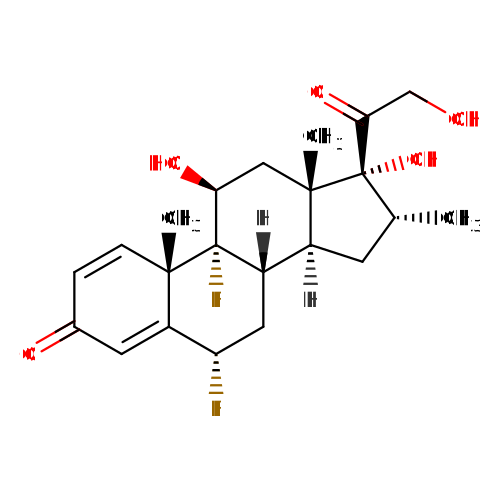
Structure for Flumethasone (DB00663)
- Weight
- Average: 410.458
Monoisotopic: 410.190480328 - Chemical Formula
- C22H28F2O5
- Synonyms
- 6alpha,9-Difluoro-11beta,17,21-trihydroxy-16alpha-methylpregna-1,4-diene-3,20-dione
- Flumetasona
- Flumétasone
- Flumetasone
- Flumetasonum
- Flumethasone
- External IDs
- NSC-54702
- RS 2177
- U 10974
- U-10,974
- U-10974

Pharmacology
- Indication
For the treatment of contact dermatitis, atopic dermatitis, exczema, psoriasis, diaper rash and other skin conditions
 Reduce drug development failure ratesBuild, train, & validate machine-learning modelswith evidence-based and structured datasets.Build, train, & validate predictive machine-learning models with structured datasets.
- Associated Conditions
Indication Type Indication Combined Product Details Approval Level Age Group Patient Characteristics Dose Form Used in combination to treat Atopic dermatitis (ad) Combination Product in combination with: Neomycin (DB00994) •••••••••••• ••••• Used in combination to treat Atopic dermatitis (ad) of the external ear canal Combination Product in combination with: Neomycin (DB00994) •••••••••••• ••••• Used in combination to treat Cradle cap Combination Product in combination with: Neomycin (DB00994) •••••••••••• ••••• Used in combination to treat Dermatosis Combination Product in combination with: Clioquinol (DB04815) •••••••••••• Used in combination to treat Discoid lupus erythematosus (dle) Combination Product in combination with: Neomycin (DB00994) •••••••••••• ••••• - Contraindications & Blackbox Warnings
 Prevent Adverse Drug Events TodayTap into our Clinical API for life-saving information on contraindications & blackbox warnings, population restrictions, harmful risks, & more.Avoid life-threatening adverse drug events with our Clinical API
- Pharmacodynamics
Flumethasone pivalate is a moderately potent difluorinated corticosteroid ester with anti-inflammatory, antipruritic and vasoconstrictive properties. As it is a privalate salt, its anti-inflammatory action is concentrated at the site of application. This local effect on diseased areas results in a prompt decrease in inflammation, exudation and itching.
- Mechanism of action
Flumethasone is a glucocorticoid receptor agonist. This complex binds to the nucleus causing a variety of genetic activation and repressions. The antiinflammatory actions of corticosteroids are thought to involve lipocortins, phospholipase A2 inhibitory proteins which, through inhibition arachidonic acid, control the biosynthesis of prostaglandins and leukotrienes. The immune system is suppressed by corticosteroids due to a decrease in the function of the lymphatic system, a reduction in immunoglobulin and complement concentrations, the precipitation of lymphocytopenia, and interference with antigen-antibody binding. Flumethasone binds to plasma transcortin, and it becomes active when it is not bound to transcortin.
Target Actions Organism AGlucocorticoid receptor agonistHumans - Absorption
Minimal if applied topically
- Volume of distribution
Not Available
- Protein binding
Not Available
- Metabolism
Primarily hepatic
- Route of elimination
Not Available
- Half-life
Not Available
- Clearance
Not Available
- Adverse Effects
 Improve decision support & research outcomesWith structured adverse effects data, including: blackbox warnings, adverse reactions, warning & precautions, & incidence rates. View sample adverse effects data in our new Data Library!Improve decision support & research outcomes with our structured adverse effects data.
- Toxicity
Can lead to signs of irritation such as burning sensation, itching or skin rash at the site of application; hypersensitivity reactions.
- Pathways
- Not Available
- Pharmacogenomic Effects/ADRs
- Not Available
Interactions
- Drug Interactions
- This information should not be interpreted without the help of a healthcare provider. If you believe you are experiencing an interaction, contact a healthcare provider immediately. The absence of an interaction does not necessarily mean no interactions exist.
Drug Interaction Integrate drug-drug
interactions in your softwareAbametapir The serum concentration of Flumethasone can be increased when it is combined with Abametapir. Acarbose The risk or severity of hyperglycemia can be increased when Flumethasone is combined with Acarbose. Aceclofenac The risk or severity of gastrointestinal irritation can be increased when Flumethasone is combined with Aceclofenac. Acemetacin The risk or severity of gastrointestinal irritation can be increased when Flumethasone is combined with Acemetacin. Acenocoumarol Flumethasone may increase the anticoagulant activities of Acenocoumarol. - Food Interactions
- No interactions found.
Products
 Drug product information from 10+ global regionsOur datasets provide approved product information including:dosage, form, labeller, route of administration, and marketing period.Access drug product information from over 10 global regions.
- Product Ingredients
Ingredient UNII CAS InChI Key Flumethasone acetate HB84ATQ00X 2823-42-9 ISSQQUKLQJHHOR-OSNGSNEUSA-N Flumethasone pivalate 0DV09X6F21 2002-29-1 JWRMHDSINXPDHB-OJAGFMMFSA-N - International/Other Brands
- Cerson (Riemser) / Locacorten (Novartis) / Locorten (Novartis) / Testohgen (Maeda Yakuhin)
- Brand Name Prescription Products
Name Dosage Strength Route Labeller Marketing Start Marketing End Region Image Locacorten .03% Cream .03 % Topical Novartis 1966-12-31 1999-05-19 Canada 
- Mixture Products
Name Ingredients Dosage Route Labeller Marketing Start Marketing End Region Image Locacorten Vioform Flumethasone pivalate (.02 %) + Clioquinol (3 %) Ointment Topical Novartis 1968-12-31 1998-05-08 Canada Locacorten Vioform Flumethasone pivalate (0.02 %) + Clioquinol (3 %) Cream Topical Paladin Labs Inc 1968-12-31 Not applicable Canada Locacorten Vioform Eardrops Flumethasone pivalate (0.02 %) + Clioquinol (1 %) Solution / drops Auricular (otic) Paladin Labs Inc 1969-12-31 Not applicable Canada LOCACORTENE VİOFORME 0,2 MG/G+30 MG/G KREM, 15 G Flumethasone pivalate (0.2 mg/g) + Clioquinol (30 mg/g) Cream Topical AVİXA İLAÇ SAN. VE TİC. LTD. ŞTİ. 2020-05-27 Not applicable Turkey 
LOCACORTENE VİOFORME 0,2 MG/G+30 MG/G KREM, 30 G Flumethasone pivalate (0.2 mg/g) + Clioquinol (30 mg/g) Cream Topical AVİXA İLAÇ SAN. VE TİC. LTD. ŞTİ. 2020-05-27 Not applicable Turkey
Categories
- ATC Codes
- D07AB03 — Flumetasone
- D07AB — Corticosteroids, moderately potent (group II)
- D07A — CORTICOSTEROIDS, PLAIN
- D07 — CORTICOSTEROIDS, DERMATOLOGICAL PREPARATIONS
- D — DERMATOLOGICALS
- D07BB — Corticosteroids, moderately potent, combinations with antiseptics
- D07B — CORTICOSTEROIDS, COMBINATIONS WITH ANTISEPTICS
- D07 — CORTICOSTEROIDS, DERMATOLOGICAL PREPARATIONS
- D — DERMATOLOGICALS
- S02CA — Corticosteroids and antiinfectives in combination
- S02C — CORTICOSTEROIDS AND ANTIINFECTIVES IN COMBINATION
- S02 — OTOLOGICALS
- S — SENSORY ORGANS
- D07CB — Corticosteroids, moderately potent, combinations with antibiotics
- D07C — CORTICOSTEROIDS, COMBINATIONS WITH ANTIBIOTICS
- D07 — CORTICOSTEROIDS, DERMATOLOGICAL PREPARATIONS
- D — DERMATOLOGICALS
- Drug Categories
- Adrenal Cortex Hormones
- Anti-Inflammatory Agents
- Corticosteroids
- Corticosteroids, Dermatological Preparations
- Corticosteroids, Moderately Potent (Group II)
- Cytochrome P-450 CYP3A Substrates
- Cytochrome P-450 CYP3A4 Substrates
- Cytochrome P-450 Substrates
- Dermatologicals
- Fused-Ring Compounds
- Hormones
- Hormones, Hormone Substitutes, and Hormone Antagonists
- Immunosuppressive Agents
- Otologicals
- Pregnadienes
- Pregnadienetriols
- Pregnanes
- Sensory Organs
- Steroids
- Steroids, Fluorinated
- Chemical TaxonomyProvided by Classyfire
- Description
- This compound belongs to the class of organic compounds known as 21-hydroxysteroids. These are steroids carrying a hydroxyl group at the 21-position of the steroid backbone.
- Kingdom
- Organic compounds
- Super Class
- Lipids and lipid-like molecules
- Class
- Steroids and steroid derivatives
- Sub Class
- Hydroxysteroids
- Direct Parent
- 21-hydroxysteroids
- Alternative Parents
- Gluco/mineralocorticoids, progestogins and derivatives / 20-oxosteroids / 11-beta-hydroxysteroids / 17-hydroxysteroids / 3-oxo delta-1,4-steroids / Halogenated steroids / Delta-1,4-steroids / Tertiary alcohols / Alpha-hydroxy ketones / Secondary alcohols show 8 more
- Substituents
- 11-beta-hydroxysteroid / 11-hydroxysteroid / 17-hydroxysteroid / 20-oxosteroid / 21-hydroxysteroid / 3-oxo-delta-1,4-steroid / 3-oxosteroid / 6-halo-steroid / 9-halo-steroid / Alcohol show 24 more
- Molecular Framework
- Aliphatic homopolycyclic compounds
- External Descriptors
- 11beta-hydroxy steroid, 17alpha-hydroxy steroid, glucocorticoid, 20-oxo steroid, fluorinated steroid, 3-oxo-Delta(1),Delta(4)-steroid, 21-hydroxy steroid (CHEBI:34764)
- Affected organisms
- Humans and other mammals
Chemical Identifiers
- UNII
- LR3CD8SX89
- CAS number
- 2135-17-3
- InChI Key
- WXURHACBFYSXBI-GQKYHHCASA-N
- InChI
- InChI=1S/C22H28F2O5/c1-11-6-13-14-8-16(23)15-7-12(26)4-5-19(15,2)21(14,24)17(27)9-20(13,3)22(11,29)18(28)10-25/h4-5,7,11,13-14,16-17,25,27,29H,6,8-10H2,1-3H3/t11-,13+,14+,16+,17+,19+,20+,21+,22+/m1/s1
- IUPAC Name
- (1R,2S,8S,10S,11S,13R,14R,15S,17S)-1,8-difluoro-14,17-dihydroxy-14-(2-hydroxyacetyl)-2,13,15-trimethyltetracyclo[8.7.0.0²,⁷.0¹¹,¹⁵]heptadeca-3,6-dien-5-one
- SMILES
- [H][C@@]12C[C@@H](C)[C@](O)(C(=O)CO)[C@@]1(C)C[C@H](O)[C@@]1(F)[C@@]2([H])C[C@H](F)C2=CC(=O)C=C[C@]12C
References
- Synthesis Reference
Lincoln, F.H., Schneider, W.P. and Spero, G.B.; U.S. Patent 3,557,158; January 19, 1971; assigned to The Upjohn Co.
- General References
- Not Available
- External Links
- KEGG Drug
- D04208
- KEGG Compound
- C14479
- PubChem Compound
- 16490
- PubChem Substance
- 46505121
- ChemSpider
- 15632
- BindingDB
- 50240002
- 4458
- ChEBI
- 34764
- ChEMBL
- CHEMBL1201392
- ZINC
- ZINC000003983936
- Therapeutic Targets Database
- DAP000814
- PharmGKB
- PA164749388
- Wikipedia
- Flumetasone
Clinical Trials
Pharmacoeconomics
- Manufacturers
- Novartis pharmaceuticals corp
- Packagers
- Not Available
- Dosage Forms
Form Route Strength Cream Topical 0.2 mg/g Solution Oral 0.2 mg/g Cream Topical 0.02 % Cream Topical .03 % Cream Topical Solution / drops Auricular (otic) Ointment Topical Ointment Cutaneous Ointment Emulsion Topical Paste Topical Solution / drops Transmucosal Solution Topical Ointment - Prices
- Not Available
- Patents
- Not Available
Properties
- State
- Solid
- Experimental Properties
Property Value Source melting point (°C) 219 °C (base only) Not Available water solubility 0.392 mg/L Not Available logP 3.86 HANSCH,C ET AL. (1995) - Predicted Properties
Property Value Source Water Solubility 0.0853 mg/mL ALOGPS logP 1.91 ALOGPS logP 1.34 Chemaxon logS -3.7 ALOGPS pKa (Strongest Acidic) 12.42 Chemaxon pKa (Strongest Basic) -3.3 Chemaxon Physiological Charge 0 Chemaxon Hydrogen Acceptor Count 5 Chemaxon Hydrogen Donor Count 3 Chemaxon Polar Surface Area 94.83 Å2 Chemaxon Rotatable Bond Count 2 Chemaxon Refractivity 102.32 m3·mol-1 Chemaxon Polarizability 41.25 Å3 Chemaxon Number of Rings 4 Chemaxon Bioavailability 1 Chemaxon Rule of Five Yes Chemaxon Ghose Filter Yes Chemaxon Veber's Rule No Chemaxon MDDR-like Rule No Chemaxon - Predicted ADMET Features
Property Value Probability Human Intestinal Absorption + 0.9877 Blood Brain Barrier + 0.9664 Caco-2 permeable + 0.5146 P-glycoprotein substrate Substrate 0.8083 P-glycoprotein inhibitor I Inhibitor 0.5199 P-glycoprotein inhibitor II Non-inhibitor 0.7781 Renal organic cation transporter Non-inhibitor 0.8453 CYP450 2C9 substrate Non-substrate 0.9008 CYP450 2D6 substrate Non-substrate 0.908 CYP450 3A4 substrate Substrate 0.7477 CYP450 1A2 substrate Non-inhibitor 0.9087 CYP450 2C9 inhibitor Non-inhibitor 0.9052 CYP450 2D6 inhibitor Non-inhibitor 0.9591 CYP450 2C19 inhibitor Non-inhibitor 0.9337 CYP450 3A4 inhibitor Non-inhibitor 0.7935 CYP450 inhibitory promiscuity Low CYP Inhibitory Promiscuity 0.9005 Ames test Non AMES toxic 0.8008 Carcinogenicity Non-carcinogens 0.9259 Biodegradation Not ready biodegradable 1.0 Rat acute toxicity 2.4249 LD50, mol/kg Not applicable hERG inhibition (predictor I) Weak inhibitor 0.9912 hERG inhibition (predictor II) Non-inhibitor 0.6792
Spectra
- Mass Spec (NIST)
- Not Available
- Spectra
- Chromatographic Properties
Collision Cross Sections (CCS)
Adduct CCS Value (Å2) Source type Source [M-H]- 192.86536 predictedDeepCCS 1.0 (2019) [M+H]+ 194.76077 predictedDeepCCS 1.0 (2019) [M+Na]+ 200.58122 predictedDeepCCS 1.0 (2019)
Targets

- Kind
- Protein
- Organism
- Humans
- Pharmacological action
- Yes
- Actions
- Agonist
- General Function
- Zinc ion binding
- Specific Function
- Receptor for glucocorticoids (GC). Has a dual mode of action: as a transcription factor that binds to glucocorticoid response elements (GRE), both for nuclear and mitochondrial DNA, and as a modula...
- Gene Name
- NR3C1
- Uniprot ID
- P04150
- Uniprot Name
- Glucocorticoid receptor
- Molecular Weight
- 85658.57 Da
References
- Overington JP, Al-Lazikani B, Hopkins AL: How many drug targets are there? Nat Rev Drug Discov. 2006 Dec;5(12):993-6. [Article]
- Imming P, Sinning C, Meyer A: Drugs, their targets and the nature and number of drug targets. Nat Rev Drug Discov. 2006 Oct;5(10):821-34. [Article]
- Maier C, Runzler D, Schindelar J, Grabner G, Waldhausl W, Kohler G, Luger A: G-protein-coupled glucocorticoid receptors on the pituitary cell membrane. J Cell Sci. 2005 Aug 1;118(Pt 15):3353-61. [Article]
- Labeur M, Holsboer F: Molecular mechanisms of glucocorticoid receptor signaling. Medicina (B Aires). 2010;70(5):457-62. [Article]
Enzymes
- Kind
- Protein
- Organism
- Humans
- Pharmacological action
- No
- Actions
- Substrate
- General Function
- Vitamin d3 25-hydroxylase activity
- Specific Function
- Cytochromes P450 are a group of heme-thiolate monooxygenases. In liver microsomes, this enzyme is involved in an NADPH-dependent electron transport pathway. It performs a variety of oxidation react...
- Gene Name
- CYP3A4
- Uniprot ID
- P08684
- Uniprot Name
- Cytochrome P450 3A4
- Molecular Weight
- 57342.67 Da
References
- CRDD [Link]
Carriers
- Kind
- Protein
- Organism
- Humans
- Pharmacological action
- Unknown
- Actions
- Binder
- General Function
- Steroid binding
- Specific Function
- Major transport protein for glucocorticoids and progestins in the blood of almost all vertebrate species.
- Gene Name
- SERPINA6
- Uniprot ID
- P08185
- Uniprot Name
- Corticosteroid-binding globulin
- Molecular Weight
- 45140.49 Da
References
- Overington JP, Al-Lazikani B, Hopkins AL: How many drug targets are there? Nat Rev Drug Discov. 2006 Dec;5(12):993-6. [Article]
- Imming P, Sinning C, Meyer A: Drugs, their targets and the nature and number of drug targets. Nat Rev Drug Discov. 2006 Oct;5(10):821-34. [Article]
- Chen X, Ji ZL, Chen YZ: TTD: Therapeutic Target Database. Nucleic Acids Res. 2002 Jan 1;30(1):412-5. [Article]

Drug created at June 13, 2005 13:24 / Updated at April 27, 2024 09:44