Identification
- Summary
Pirenzepine is an antimuscarinic agent used to treat peptic ulcers, gastric ulcers, and duodenal ulcers.
- Generic Name
- Pirenzepine
- DrugBank Accession Number
- DB00670
- Background
An antimuscarinic agent that inhibits gastric secretion at lower doses than are required to affect gastrointestinal motility, salivary, central nervous system, cardiovascular, ocular, and urinary function. It promotes the healing of duodenal ulcers and due to its cytoprotective action is beneficial in the prevention of duodenal ulcer recurrence. It also potentiates the effect of other antiulcer agents such as cimetidine and ranitidine. It is generally well tolerated by patients.
- Type
- Small Molecule
- Groups
- Approved
- Structure
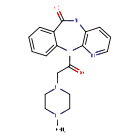
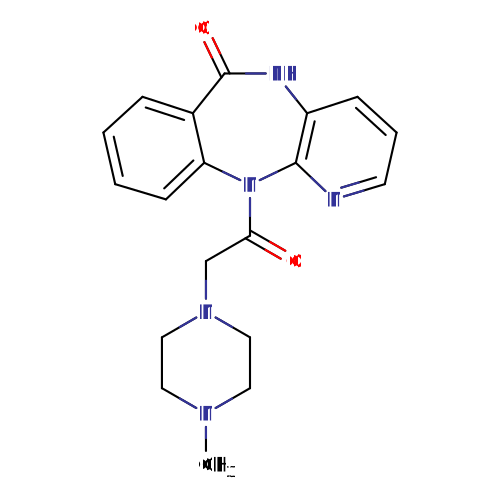
Structure for Pirenzepine (DB00670)
- Weight
- Average: 351.4023
Monoisotopic: 351.169524941 - Chemical Formula
- C19H21N5O2
- Synonyms
- 11-((4-Methyl-1-piperazinyl)acetyl)-5,11-dihydro-6H-pyrido(2,3-b)(1,4)benzodiazepin-6-one
- Pirenzepin
- Pirenzepina
- Pirenzépine
- Pirenzepine
- Pirenzepinum
- External IDs
- ACI-91
- L-S519

Pharmacology
- Indication
For the treatment of peptic ulcer, gastric ulcer, and duodenal ulcer.
 Reduce drug development failure ratesBuild, train, & validate machine-learning modelswith evidence-based and structured datasets.Build, train, & validate predictive machine-learning models with structured datasets.
- Associated Conditions
Indication Type Indication Combined Product Details Approval Level Age Group Patient Characteristics Dose Form Treatment of Gastric ulcer •••••••••••• •••••• Treatment of Small intestine ulcer •••••••••••• •••••• - Contraindications & Blackbox Warnings
 Prevent Adverse Drug Events TodayTap into our Clinical API for life-saving information on contraindications & blackbox warnings, population restrictions, harmful risks, & more.Avoid life-threatening adverse drug events with our Clinical API
- Pharmacodynamics
Pirenzepine belongs to a group of medications called antispasmodics/anticholinergics. These medications are used to relieve cramps or spasms of the stomach, intestines, and bladder. Pirenzepine is used to treat duodenal or stomach ulcers or intestine problems. It can be used together with antacids or other medicine in the treatment of peptic ulcer. It may also be used to prevent nausea, vomiting, and motion sickness.
- Mechanism of action
Pirenzepine is a muscarinic receptor antagonist and binds to the muscarinic acetylcholine receptor. The muscarinic acetylcholine receptor mediates various cellular responses, including inhibition of adenylate cyclase, breakdown of phosphoinositides and modulation of potassium channels through the action of G proteins.
Target Actions Organism AMuscarinic acetylcholine receptor M1 antagonistHumans - Absorption
Not Available
- Volume of distribution
Not Available
- Protein binding
Not Available
- Metabolism
- Not Available
- Route of elimination
Not Available
- Half-life
Not Available
- Clearance
Not Available
- Adverse Effects
 Improve decision support & research outcomesWith structured adverse effects data, including: blackbox warnings, adverse reactions, warning & precautions, & incidence rates. View sample adverse effects data in our new Data Library!Improve decision support & research outcomes with our structured adverse effects data.
- Toxicity
Not Available
- Pathways
Pathway Category Pirenzepine Action Pathway Drug action - Pharmacogenomic Effects/ADRs
- Not Available
Interactions
- Drug Interactions
- This information should not be interpreted without the help of a healthcare provider. If you believe you are experiencing an interaction, contact a healthcare provider immediately. The absence of an interaction does not necessarily mean no interactions exist.
Drug Interaction Integrate drug-drug
interactions in your softwareAclidinium The risk or severity of adverse effects can be increased when Pirenzepine is combined with Aclidinium. Adenosine The risk or severity of Tachycardia can be increased when Adenosine is combined with Pirenzepine. Albuterol The risk or severity of Tachycardia can be increased when Pirenzepine is combined with Salbutamol. Alfentanil The risk or severity of adverse effects can be increased when Pirenzepine is combined with Alfentanil. Alloin The therapeutic efficacy of Alloin can be decreased when used in combination with Pirenzepine. - Food Interactions
- Take on an empty stomach. Take pirenzepine at least 30 minutes before meals.
Products
 Drug product information from 10+ global regionsOur datasets provide approved product information including:dosage, form, labeller, route of administration, and marketing period.Access drug product information from over 10 global regions.
- Product Ingredients
Ingredient UNII CAS InChI Key Pirenzepine hydrochloride 10YM403FLS 29868-97-1 FFNMBRCFFADNAO-UHFFFAOYSA-N - International/Other Brands
- Anquwei (Panion & BF) / Folinzepin (Tsuruhara Seiyaku) / Garendopine (Choseido Pharmaceutical) / Gaspin (Gentle) / Gastrozepin (Boehringer Ingelheim) / Gastsion (Shiono Kemikaru) / Gaszepin (Swiss Pharm) / Karoderin (Nippon Chemiphar) / Kawaipin (Siu Guan) / Kiccalzin (Takata Seiyaku) / Lizepine (Health Chemical) / Lonzepin (Li Ta) / Muszepin (Royal) / Pilenzel (Taiyo Pharmaceutical) / Pin (Tatsumi Kagaku) / Pirepine (Yu Sheng) / Pirodeine (Medisa Shinyaku) / Pizepine (Yuan Chou) / Ranclic (Towa Yakuhin) / Regastric (Jinup) / Stomazepin (Taisho Yakuhin) / Ulopine (Panbiotic)
- Brand Name Prescription Products
Name Dosage Strength Route Labeller Marketing Start Marketing End Region Image Gastrozepin Tab 50mg Tablet 50 mg / tab Oral Boehringer Ingelheim (Canada) Ltd Ltee 1984-12-31 1996-09-09 Canada 
Categories
- ATC Codes
- A02BX03 — Pirenzepine
- Drug Categories
- Agents producing tachycardia
- Alimentary Tract and Metabolism
- Anti-Ulcer Agents
- Anticholinergic Agents
- Benzazepines
- Benzodiazepinones
- Cholinergic Agents
- Drugs for Acid Related Disorders
- Drugs for Peptic Ulcer and Gastro-Oesophageal Reflux Disease (Gord)
- Gastrointestinal Agents
- Heterocyclic Compounds, Fused-Ring
- Muscarinic Antagonists
- Neurotransmitter Agents
- Chemical TaxonomyProvided by Classyfire
- Description
- This compound belongs to the class of organic compounds known as 1,4-benzodiazepines. These are organic compounds containing a benzene ring fused to a 1,4-azepine.
- Kingdom
- Organic compounds
- Super Class
- Organoheterocyclic compounds
- Class
- Benzodiazepines
- Sub Class
- 1,4-benzodiazepines
- Direct Parent
- 1,4-benzodiazepines
- Alternative Parents
- Pyridodiazepines / Alpha amino acids and derivatives / N-piperazineacetamides / N-methylpiperazines / Benzenoids / Pyridines and derivatives / Imidolactams / Tertiary carboxylic acid amides / Cyclic carboximidic acids / Heteroaromatic compounds show 7 more
- Substituents
- 1,4-benzodiazepine / 1,4-diazinane / Alpha-amino acid or derivatives / Amine / Amino acid or derivatives / Aromatic heteropolycyclic compound / Azacycle / Benzenoid / Carbonyl group / Carboxamide group show 22 more
- Molecular Framework
- Aromatic heteropolycyclic compounds
- External Descriptors
- pyridobenzodiazepine (CHEBI:8247)
- Affected organisms
- Humans and other mammals
Chemical Identifiers
- UNII
- 3G0285N20N
- CAS number
- 28797-61-7
- InChI Key
- RMHMFHUVIITRHF-UHFFFAOYSA-N
- InChI
- InChI=1S/C19H21N5O2/c1-22-9-11-23(12-10-22)13-17(25)24-16-7-3-2-5-14(16)19(26)21-15-6-4-8-20-18(15)24/h2-8H,9-13H2,1H3,(H,21,26)
- IUPAC Name
- 2-[2-(4-methylpiperazin-1-yl)acetyl]-2,4,9-triazatricyclo[9.4.0.0^{3,8}]pentadeca-1(15),3(8),4,6,11,13-hexaen-10-one
- SMILES
- CN1CCN(CC(=O)N2C3=CC=CC=C3C(=O)NC3=C2N=CC=C3)CC1
References
- General References
- Czepita D: [Fundamentals of modern treatment of myopia]. Ann Acad Med Stetin. 2005;51(2):5-9. [Article]
- External Links
- Human Metabolome Database
- HMDB0014808
- KEGG Drug
- D08389
- KEGG Compound
- C07508
- PubChem Compound
- 4848
- PubChem Substance
- 46509029
- ChemSpider
- 4682
- BindingDB
- 39341
- 8352
- ChEBI
- 8247
- ChEMBL
- CHEMBL9967
- ZINC
- ZINC000019632927
- Therapeutic Targets Database
- DAP000492
- PharmGKB
- PA10159
- Wikipedia
- Pirenzepine
- MSDS
- Download (36.5 KB)
Clinical Trials
- Clinical Trials
Phase Status Purpose Conditions Count 2 Completed Treatment Diabetes Mellitus / Painful Diabetic Neuropathy (PDN) 1 2 Completed Treatment Painful Diabetic Neuropathy (PDN) / Peripheral neuropathy 1
Pharmacoeconomics
- Manufacturers
- Not Available
- Packagers
- Not Available
- Dosage Forms
Form Route Strength Tablet Oral 50 MG Tablet Oral 50 mg / tab Tablet Oral Capsule Tablet Oral 25 mg - Prices
- Not Available
- Patents
- Not Available
Properties
- State
- Solid
- Experimental Properties
Property Value Source logP 0.6 Not Available Caco2 permeability -6.36 ADME Research, USCD - Predicted Properties
Property Value Source Water Solubility 0.682 mg/mL ALOGPS logP 1.26 ALOGPS logP 0.97 Chemaxon logS -2.7 ALOGPS pKa (Strongest Acidic) 14.78 Chemaxon pKa (Strongest Basic) 7.2 Chemaxon Physiological Charge 1 Chemaxon Hydrogen Acceptor Count 5 Chemaxon Hydrogen Donor Count 1 Chemaxon Polar Surface Area 68.78 Å2 Chemaxon Rotatable Bond Count 2 Chemaxon Refractivity 100.93 m3·mol-1 Chemaxon Polarizability 37.11 Å3 Chemaxon Number of Rings 4 Chemaxon Bioavailability 1 Chemaxon Rule of Five Yes Chemaxon Ghose Filter Yes Chemaxon Veber's Rule No Chemaxon MDDR-like Rule No Chemaxon - Predicted ADMET Features
Property Value Probability Human Intestinal Absorption + 0.9917 Blood Brain Barrier + 0.9737 Caco-2 permeable - 0.8957 P-glycoprotein substrate Substrate 0.8101 P-glycoprotein inhibitor I Inhibitor 0.5362 P-glycoprotein inhibitor II Non-inhibitor 0.8383 Renal organic cation transporter Inhibitor 0.5983 CYP450 2C9 substrate Non-substrate 0.7426 CYP450 2D6 substrate Non-substrate 0.5571 CYP450 3A4 substrate Substrate 0.6503 CYP450 1A2 substrate Inhibitor 0.5788 CYP450 2C9 inhibitor Non-inhibitor 0.9071 CYP450 2D6 inhibitor Non-inhibitor 0.9231 CYP450 2C19 inhibitor Non-inhibitor 0.8814 CYP450 3A4 inhibitor Non-inhibitor 0.8958 CYP450 inhibitory promiscuity Low CYP Inhibitory Promiscuity 0.8682 Ames test Non AMES toxic 0.5 Carcinogenicity Non-carcinogens 0.946 Biodegradation Not ready biodegradable 0.9839 Rat acute toxicity 1.8779 LD50, mol/kg Not applicable hERG inhibition (predictor I) Weak inhibitor 0.6797 hERG inhibition (predictor II) Non-inhibitor 0.5475
Spectra
- Mass Spec (NIST)
- Not Available
- Spectra
Spectrum Spectrum Type Splash Key Predicted GC-MS Spectrum - GC-MS Predicted GC-MS splash10-03di-9274000000-86b6dd314412cb49103e Predicted MS/MS Spectrum - 10V, Positive (Annotated) Predicted LC-MS/MS splash10-0udi-0109000000-5af04abd6e884ecec77a Predicted MS/MS Spectrum - 10V, Negative (Annotated) Predicted LC-MS/MS splash10-0udi-0129000000-64151795ad36d84f357c Predicted MS/MS Spectrum - 20V, Positive (Annotated) Predicted LC-MS/MS splash10-0w29-0719000000-c28dcb1c2e013a70837b Predicted MS/MS Spectrum - 20V, Negative (Annotated) Predicted LC-MS/MS splash10-0w29-0489000000-48d254f52927f5ddd17a Predicted MS/MS Spectrum - 40V, Positive (Annotated) Predicted LC-MS/MS splash10-01q9-9444000000-9260b4ae9b1a952be315 Predicted MS/MS Spectrum - 40V, Negative (Annotated) Predicted LC-MS/MS splash10-03di-1690000000-75cbfc34e557a8d53bd0 Predicted 1H NMR Spectrum 1D NMR Not Applicable Predicted 13C NMR Spectrum 1D NMR Not Applicable - Chromatographic Properties
Collision Cross Sections (CCS)
Adduct CCS Value (Å2) Source type Source [M-H]- 194.2724498 predictedDarkChem Lite v0.1.0 [M-H]- 194.0423498 predictedDarkChem Lite v0.1.0 [M-H]- 184.12595 predictedDeepCCS 1.0 (2019) [M+H]+ 194.9931498 predictedDarkChem Lite v0.1.0 [M+H]+ 194.4382498 predictedDarkChem Lite v0.1.0 [M+H]+ 186.48395 predictedDeepCCS 1.0 (2019) [M+Na]+ 194.3747498 predictedDarkChem Lite v0.1.0 [M+Na]+ 193.78146 predictedDeepCCS 1.0 (2019)
Targets

- Kind
- Protein
- Organism
- Humans
- Pharmacological action
- Yes
- Actions
- Antagonist
- General Function
- Phosphatidylinositol phospholipase c activity
- Specific Function
- The muscarinic acetylcholine receptor mediates various cellular responses, including inhibition of adenylate cyclase, breakdown of phosphoinositides and modulation of potassium channels through the...
- Gene Name
- CHRM1
- Uniprot ID
- P11229
- Uniprot Name
- Muscarinic acetylcholine receptor M1
- Molecular Weight
- 51420.375 Da
References
- Chen X, Ji ZL, Chen YZ: TTD: Therapeutic Target Database. Nucleic Acids Res. 2002 Jan 1;30(1):412-5. [Article]
- Pedretti RF, Prete G, Foreman RD, Adamson PB, Vanoli E: Autonomic modulation during acute myocardial ischemia by low-dose pirenzepine in conscious dogs with a healed myocardial infarction: a comparison with beta-adrenergic blockade. J Cardiovasc Pharmacol. 2003 May;41(5):671-7. [Article]

Drug created at June 13, 2005 13:24 / Updated at December 02, 2023 07:00