Identification
- Generic Name
- Isoflurophate
- DrugBank Accession Number
- DB00677
- Background
An irreversible cholinesterase inhibitor with actions similar to those of echothiophate. It is a powerful miotic used mainly in the treatment of glaucoma. Its vapor is highly toxic and it is recommended that only solutions in arachis oil be used therapeutically. (From Martindale, The Extra Pharmacopoeia, 29th ed, p1330)
- Type
- Small Molecule
- Groups
- Approved, Investigational, Withdrawn
- Structure
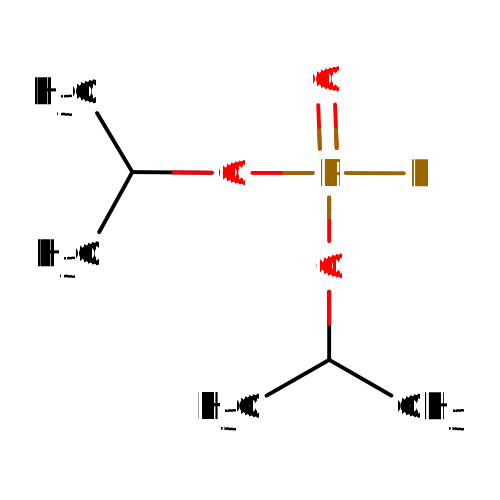
Structure for Isoflurophate (DB00677)
- Weight
- Average: 184.1457
Monoisotopic: 184.066459031 - Chemical Formula
- C6H14FO3P
- Synonyms
- DFP
- Diisopropoxyphosphoryl fluoride
- Diisopropyl fluorophosphate
- Diisopropyl fluorophosphonate
- Diisopropyl phosphofluoridate
- Diisopropyl phosphorofluoridate
- Diisopropylfluorophosphate
- Diisopropylfluorophosphoric acid ester
- Diisopropylphosphofluoridate
- Diisopropylphosphorofluoridate
- Fluorodiisopropyl phosphate
- Fluorostigmine
- Isofluorphate
- Isoflurophate
- Isoflurophosphate
- Isopropyl fluophosphate
- Isopropyl phosphorofluoridate
- O,O'-diisopropyl phosphoryl fluoride
- External IDs
- T-1703
- TL 466

Pharmacology
- Indication
For use in the eye to treat certain types of glaucoma and other eye conditions, such as accommodative esotropia.
 Reduce drug development failure ratesBuild, train, & validate machine-learning modelswith evidence-based and structured datasets.Build, train, & validate predictive machine-learning models with structured datasets.
- Contraindications & Blackbox Warnings
 Prevent Adverse Drug Events TodayTap into our Clinical API for life-saving information on contraindications & blackbox warnings, population restrictions, harmful risks, & more.Avoid life-threatening adverse drug events with our Clinical API
- Pharmacodynamics
Isoflurophate is used as ocular drops in the treatment of chronic glaucoma. Isoflurophate is an organophosphorus compound that acts as an irreversible cholinesterase inhibitor. As such, it displays parasympathomimetic effects. Isoflurophate is used in the eye to treat certain types of glaucoma and other eye conditions, such as accommodative esotropia. They may also be used in the diagnosis of certain eye conditions, such as accommodative esotropia. Isoflurophate damages the acetylcholinesterase enzyme and is therefore irreversible, however, pralidoxime can displace organophosphates such as isoflurophate from acetylcholinesterase, but only if administered before isoflurophate damages (alkylates) the enzyme.
- Mechanism of action
The mechanism of isoflurophate's action involves the irreversible inhibition of cholinesterase.
Target Actions Organism AAcetylcholinesterase inhibitorHumans ACholinesterase inhibitorHumans USerotransferrin Not Available Humans - Absorption
Not Available
- Volume of distribution
Not Available
- Protein binding
Not Available
- Metabolism
- Not Available
- Route of elimination
Not Available
- Half-life
Not Available
- Clearance
Not Available
- Adverse Effects
 Improve decision support & research outcomesWith structured adverse effects data, including: blackbox warnings, adverse reactions, warning & precautions, & incidence rates. View sample adverse effects data in our new Data Library!Improve decision support & research outcomes with our structured adverse effects data.
- Toxicity
Signs of overdose include increased sweating, loss of bladder control, muscle weakness, nausea, vomiting, diarrhea, or stomach cramps or pain, shortness of breath, tightness in chest, or wheezing, slow or irregular heartbeat, unusual tiredness or weakness, watering of mouth.
- Pathways
- Not Available
- Pharmacogenomic Effects/ADRs
- Not Available
Interactions
- Drug Interactions
- This information should not be interpreted without the help of a healthcare provider. If you believe you are experiencing an interaction, contact a healthcare provider immediately. The absence of an interaction does not necessarily mean no interactions exist.
Drug Interaction Integrate drug-drug
interactions in your softwareAcebutolol Isoflurophate may increase the bradycardic activities of Acebutolol. Acetylcholine The risk or severity of adverse effects can be increased when Isoflurophate is combined with Acetylcholine. Aclidinium Isoflurophate may increase the neuromuscular blocking activities of Aclidinium. Amantadine The therapeutic efficacy of Amantadine can be decreased when used in combination with Isoflurophate. Amifampridine The risk or severity of adverse effects can be increased when Isoflurophate is combined with Amifampridine. - Food Interactions
- Not Available
Products
 Drug product information from 10+ global regionsOur datasets provide approved product information including:dosage, form, labeller, route of administration, and marketing period.Access drug product information from over 10 global regions.
- International/Other Brands
- Diflupyl / Floropryl (Merck) / Fluopryl (Merck) / Neoglaucit
Categories
- Drug Categories
- Chemical TaxonomyProvided by Classyfire
- Description
- This compound belongs to the class of organic compounds known as phosphate esters. These are organic compounds containing phosphoric acid ester functional group, with the general structure R1P(=O)(R2)OR3. R1,R2 = O,N, or halogen atom; R3 = organyl group.
- Kingdom
- Organic compounds
- Super Class
- Organic acids and derivatives
- Class
- Organic phosphoric acids and derivatives
- Sub Class
- Phosphate esters
- Direct Parent
- Phosphate esters
- Alternative Parents
- Organooxygen compounds / Organic oxides / Hydrocarbon derivatives
- Substituents
- Aliphatic acyclic compound / Hydrocarbon derivative / Organic oxide / Organic oxygen compound / Organooxygen compound / Phosphoric acid ester
- Molecular Framework
- Aliphatic acyclic compounds
- External Descriptors
- dialkyl phosphate (CHEBI:17941) / a small molecule (DIISOPROPYL-FLUOROPHOSPHATE)
- Affected organisms
- Humans and other mammals
Chemical Identifiers
- UNII
- 12UHW9R67N
- CAS number
- 55-91-4
- InChI Key
- MUCZHBLJLSDCSD-UHFFFAOYSA-N
- InChI
- InChI=1S/C6H14FO3P/c1-5(2)9-11(7,8)10-6(3)4/h5-6H,1-4H3
- IUPAC Name
- bis(propan-2-yl) phosphorofluoridate
- SMILES
- CC(C)OP(F)(=O)OC(C)C
References
- Synthesis Reference
U.S. Patent 2,409,039.
- General References
- Not Available
- External Links
- Human Metabolome Database
- HMDB0014815
- KEGG Drug
- D00043
- KEGG Compound
- C00202
- PubChem Compound
- 5936
- PubChem Substance
- 46504499
- ChemSpider
- 5723
- BindingDB
- 50022772
- 6027
- ChEBI
- 17941
- ChEMBL
- CHEMBL1025
- ZINC
- ZINC000008214587
- Therapeutic Targets Database
- DAP000896
- PharmGKB
- PA164748933
- Wikipedia
- Diisopropyl_fluorophosphate
- MSDS
- Download (57.7 KB)
Clinical Trials
Pharmacoeconomics
- Manufacturers
- Merck and co inc
- Packagers
- Not Available
- Dosage Forms
- Not Available
- Prices
- Not Available
- Patents
- Not Available
Properties
- State
- Liquid
- Experimental Properties
Property Value Source boiling point (°C) 62 @ 9mm, 46 @ 5mm U.S. Patent 2,409,039. water solubility 1.54E+004 mg/L (at 25 °C) MERCK INDEX (1996) logP 1.17 CZERWINSKI,SE ET AL. (1998) - Predicted Properties
Property Value Source Water Solubility 6.78 mg/mL ALOGPS logP 1.1 ALOGPS logP 1.76 Chemaxon logS -1.4 ALOGPS pKa (Strongest Basic) -9.6 Chemaxon Physiological Charge 0 Chemaxon Hydrogen Acceptor Count 1 Chemaxon Hydrogen Donor Count 0 Chemaxon Polar Surface Area 35.53 Å2 Chemaxon Rotatable Bond Count 4 Chemaxon Refractivity 40.89 m3·mol-1 Chemaxon Polarizability 16.82 Å3 Chemaxon Number of Rings 0 Chemaxon Bioavailability 1 Chemaxon Rule of Five Yes Chemaxon Ghose Filter Yes Chemaxon Veber's Rule Yes Chemaxon MDDR-like Rule No Chemaxon - Predicted ADMET Features
Property Value Probability Human Intestinal Absorption + 0.9971 Blood Brain Barrier + 0.9803 Caco-2 permeable - 0.5386 P-glycoprotein substrate Non-substrate 0.8483 P-glycoprotein inhibitor I Non-inhibitor 0.7683 P-glycoprotein inhibitor II Non-inhibitor 0.9518 Renal organic cation transporter Non-inhibitor 0.9541 CYP450 2C9 substrate Non-substrate 0.8393 CYP450 2D6 substrate Non-substrate 0.8447 CYP450 3A4 substrate Non-substrate 0.5232 CYP450 1A2 substrate Non-inhibitor 0.8174 CYP450 2C9 inhibitor Non-inhibitor 0.8396 CYP450 2D6 inhibitor Non-inhibitor 0.9132 CYP450 2C19 inhibitor Non-inhibitor 0.7248 CYP450 3A4 inhibitor Non-inhibitor 0.8834 CYP450 inhibitory promiscuity Low CYP Inhibitory Promiscuity 0.9185 Ames test Non AMES toxic 0.8082 Carcinogenicity Carcinogens 0.8124 Biodegradation Not ready biodegradable 0.8938 Rat acute toxicity 4.5346 LD50, mol/kg Not applicable hERG inhibition (predictor I) Weak inhibitor 0.9572 hERG inhibition (predictor II) Non-inhibitor 0.8508
Spectra
- Mass Spec (NIST)
- Not Available
- Spectra
Spectrum Spectrum Type Splash Key Predicted GC-MS Spectrum - GC-MS Predicted GC-MS splash10-0006-5900000000-a89a631cb99168cf7ba0 Predicted MS/MS Spectrum - 10V, Positive (Annotated) Predicted LC-MS/MS splash10-0f6x-0900000000-55eed0a4bf9c2d651444 Predicted MS/MS Spectrum - 10V, Negative (Annotated) Predicted LC-MS/MS splash10-053r-0900000000-310f5ad7a0ef91df0817 Predicted MS/MS Spectrum - 20V, Positive (Annotated) Predicted LC-MS/MS splash10-0006-9400000000-af0cee11dc6bc972618e Predicted MS/MS Spectrum - 20V, Negative (Annotated) Predicted LC-MS/MS splash10-00dj-3900000000-5f24887e71172f607846 Predicted MS/MS Spectrum - 40V, Positive (Annotated) Predicted LC-MS/MS splash10-0006-9100000000-f2311e70466a213000a2 Predicted MS/MS Spectrum - 40V, Negative (Annotated) Predicted LC-MS/MS splash10-00di-2900000000-b6c6d8f419d5ec1938f8 Predicted 1H NMR Spectrum 1D NMR Not Applicable Predicted 13C NMR Spectrum 1D NMR Not Applicable - Chromatographic Properties
Collision Cross Sections (CCS)
Adduct CCS Value (Å2) Source type Source [M-H]- 138.1339453 predictedDarkChem Lite v0.1.0 [M-H]- 137.71777 predictedDeepCCS 1.0 (2019) [M+H]+ 139.9814453 predictedDarkChem Lite v0.1.0 [M+H]+ 140.15903 predictedDeepCCS 1.0 (2019) [M+Na]+ 137.9479453 predictedDarkChem Lite v0.1.0 [M+Na]+ 148.4438 predictedDeepCCS 1.0 (2019)
Targets

- Kind
- Protein
- Organism
- Humans
- Pharmacological action
- Yes
- Actions
- Inhibitor
- General Function
- Serine hydrolase activity
- Specific Function
- Terminates signal transduction at the neuromuscular junction by rapid hydrolysis of the acetylcholine released into the synaptic cleft. Role in neuronal apoptosis.
- Gene Name
- ACHE
- Uniprot ID
- P22303
- Uniprot Name
- Acetylcholinesterase
- Molecular Weight
- 67795.525 Da
References
- Malatova Z, Gottlieb M, Marsala J: Depression of acetylcholinesterase synthesis following transient cerebral ischemia in rat: pharmacohistochemical and biochemical investigation. Gen Physiol Biophys. 1999 Mar;18(1):57-71. [Article]
- Quistad GB, Zhang N, Sparks SE, Casida JE: Phosphoacetylcholinesterase: toxicity of phosphorus oxychloride to mammals and insects that can be attributed to selective phosphorylation of acetylcholinesterase by phosphorodichloridic acid. Chem Res Toxicol. 2000 Jul;13(7):652-7. [Article]
- da Costa VL Jr, Lapa AJ, Godinho RO: Short- and long-term influences of calcitonin gene-related peptide on the synthesis of acetylcholinesterase in mammalian myotubes. Br J Pharmacol. 2001 May;133(2):229-36. [Article]
- Pang YP, Kollmeyer TM, Hong F, Lee JC, Hammond PI, Haugabouk SP, Brimijoin S: Rational design of alkylene-linked bis-pyridiniumaldoximes as improved acetylcholinesterase reactivators. Chem Biol. 2003 Jun;10(6):491-502. [Article]
- Ashani Y, Gentry MK, Doctor BP: Differences in conformational stability between native and phosphorylated acetylcholinesterase as evidenced by a monoclonal antibody. Biochemistry. 1990 Mar 13;29(10):2456-63. [Article]
- Chen X, Ji ZL, Chen YZ: TTD: Therapeutic Target Database. Nucleic Acids Res. 2002 Jan 1;30(1):412-5. [Article]
- Kind
- Protein
- Organism
- Humans
- Pharmacological action
- Yes
- Actions
- Inhibitor
- General Function
- Identical protein binding
- Specific Function
- Esterase with broad substrate specificity. Contributes to the inactivation of the neurotransmitter acetylcholine. Can degrade neurotoxic organophosphate esters.
- Gene Name
- BCHE
- Uniprot ID
- P06276
- Uniprot Name
- Cholinesterase
- Molecular Weight
- 68417.575 Da
References
- Kamata R, Saito S, Suzuki T, Takewaki T, Kobayashi H: Correlation of binding sites for diisopropyl phosphorofluoridate with cholinesterase and neuropathy target esterase in membrane and cytosol preparations from hen. Neurotoxicology. 2001 Apr;22(2):203-14. [Article]
- Acey RA, Bailey S, Healy P, Jo C, Unger TF, Hudson RA: A butyrylcholinesterase in the early development of the brine shrimp (Artemia salina) larvae: a target for phthalate ester embryotoxicity? Biochem Biophys Res Commun. 2002 Dec 13;299(4):659-62. [Article]
- Pittel Z, Cohen S, Fisher A, Heldman E: Differential long-term effect of AF64A on [3H]ACh synthesis and release in rat hippocampal synaptosomes. Brain Res. 1992 Jul 17;586(1):148-51. [Article]
- Miller RB, Blank CL: Determination of serum cholinesterase activity by liquid chromatography with electrochemical detection. Anal Biochem. 1991 Aug 1;196(2):377-84. [Article]
- Kelly SS, Ferry CB, Bamforth JP: The effects of anticholinesterases on the latencies of action potentials in mouse skeletal muscles. Br J Pharmacol. 1990 Apr;99(4):721-6. [Article]
- Kind
- Protein
- Organism
- Humans
- Pharmacological action
- Unknown
- General Function
- Transferrin receptor binding
- Specific Function
- Transferrins are iron binding transport proteins which can bind two Fe(3+) ions in association with the binding of an anion, usually bicarbonate. It is responsible for the transport of iron from si...
- Gene Name
- TF
- Uniprot ID
- P02787
- Uniprot Name
- Serotransferrin
- Molecular Weight
- 77063.195 Da
References
- Li B, Schopfer LM, Grigoryan H, Thompson CM, Hinrichs SH, Masson P, Lockridge O: Tyrosines of human and mouse transferrin covalently labeled by organophosphorus agents: a new motif for binding to proteins that have no active site serine. Toxicol Sci. 2009 Jan;107(1):144-55. doi: 10.1093/toxsci/kfn211. Epub 2008 Oct 16. [Article]
Enzymes
- Kind
- Protein
- Organism
- Humans
- Pharmacological action
- Unknown
- Actions
- Inhibitor
- General Function
- Identical protein binding
- Specific Function
- Esterase with broad substrate specificity. Contributes to the inactivation of the neurotransmitter acetylcholine. Can degrade neurotoxic organophosphate esters.
- Gene Name
- BCHE
- Uniprot ID
- P06276
- Uniprot Name
- Cholinesterase
- Molecular Weight
- 68417.575 Da
References
- Kamata R, Saito S, Suzuki T, Takewaki T, Kobayashi H: Correlation of binding sites for diisopropyl phosphorofluoridate with cholinesterase and neuropathy target esterase in membrane and cytosol preparations from hen. Neurotoxicology. 2001 Apr;22(2):203-14. [Article]
- Acey RA, Bailey S, Healy P, Jo C, Unger TF, Hudson RA: A butyrylcholinesterase in the early development of the brine shrimp (Artemia salina) larvae: a target for phthalate ester embryotoxicity? Biochem Biophys Res Commun. 2002 Dec 13;299(4):659-62. [Article]
- Pittel Z, Cohen S, Fisher A, Heldman E: Differential long-term effect of AF64A on [3H]ACh synthesis and release in rat hippocampal synaptosomes. Brain Res. 1992 Jul 17;586(1):148-51. [Article]
- Miller RB, Blank CL: Determination of serum cholinesterase activity by liquid chromatography with electrochemical detection. Anal Biochem. 1991 Aug 1;196(2):377-84. [Article]
- Kelly SS, Ferry CB, Bamforth JP: The effects of anticholinesterases on the latencies of action potentials in mouse skeletal muscles. Br J Pharmacol. 1990 Apr;99(4):721-6. [Article]
- Masson P, Fortier PL, Albaret C, Froment MT, Bartels CF, Lockridge O: Aging of di-isopropyl-phosphorylated human butyrylcholinesterase. Biochem J. 1997 Oct 15;327 ( Pt 2):601-7. [Article]
Carriers
- Kind
- Protein
- Organism
- Humans
- Pharmacological action
- Unknown
- General Function
- Toxic substance binding
- Specific Function
- Serum albumin, the main protein of plasma, has a good binding capacity for water, Ca(2+), Na(+), K(+), fatty acids, hormones, bilirubin and drugs. Its main function is the regulation of the colloid...
- Gene Name
- ALB
- Uniprot ID
- P02768
- Uniprot Name
- Serum albumin
- Molecular Weight
- 69365.94 Da
References
- Peeples ES, Schopfer LM, Duysen EG, Spaulding R, Voelker T, Thompson CM, Lockridge O: Albumin, a new biomarker of organophosphorus toxicant exposure, identified by mass spectrometry. Toxicol Sci. 2005 Feb;83(2):303-12. Epub 2004 Nov 3. [Article]
- Li B, Schopfer LM, Hinrichs SH, Masson P, Lockridge O: Matrix-assisted laser desorption/ionization time-of-flight mass spectrometry assay for organophosphorus toxicants bound to human albumin at Tyr411. Anal Biochem. 2007 Feb 15;361(2):263-72. Epub 2006 Dec 4. [Article]

Drug created at June 13, 2005 13:24 / Updated at December 02, 2023 06:54