Identification
- Summary
Tirofiban is a platelet aggregation inhibitor used to prevent thrombotic events in non-ST elevated acute coronary syndrome.
- Brand Names
- Aggrastat
- Generic Name
- Tirofiban
- DrugBank Accession Number
- DB00775
- Background
Tirofiban prevents the blood from clotting during episodes of chest pain or a heart attack, or while the patient is undergoing a procedure to treat a blocked coronary artery. It is a non-peptide reversible antagonist of the platelet glycoprotein (GP) IIb/IIIa receptor, and inhibits platelet aggregation.
- Type
- Small Molecule
- Groups
- Approved
- Structure
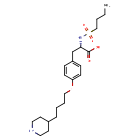
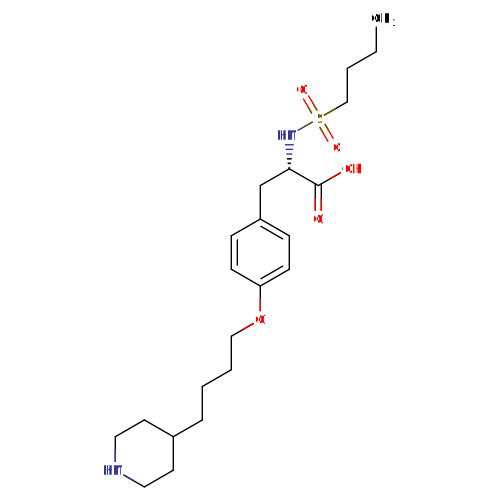
Structure for Tirofiban (DB00775)
- Weight
- Average: 440.597
Monoisotopic: 440.234492962 - Chemical Formula
- C22H36N2O5S
- Synonyms
- (2S)-2-(butylsulfonylamino)-3-[4-(4-piperidin-4-ylbutoxy)phenyl]propanoic acid
- N-(Butylsulfonyl)-O-(4-(4-piperidyl)butyl)-L-tyrosine
- Tirofiban
- Tirofibán
- Tirofibanum
- External IDs
- MK 383

Pharmacology
- Indication
For treatment, in combination with heparin, of acute coronary syndrome, including patients who are to be managed medically and those undergoing PTCA or atherectomy.
 Reduce drug development failure ratesBuild, train, & validate machine-learning modelswith evidence-based and structured datasets.Build, train, & validate predictive machine-learning models with structured datasets.
- Associated Conditions
Indication Type Indication Combined Product Details Approval Level Age Group Patient Characteristics Dose Form Prevention of Cardiovascular event •••••••••••• Prevention of Cardiovascular event •••••••••••• - Contraindications & Blackbox Warnings
 Prevent Adverse Drug Events TodayTap into our Clinical API for life-saving information on contraindications & blackbox warnings, population restrictions, harmful risks, & more.Avoid life-threatening adverse drug events with our Clinical API
- Pharmacodynamics
Tirofiban prevents the blood from clotting during episodes of chest pain or a heart attack, or while the patient is undergoing a procedure to treat a blocked coronary artery. It is a non-peptide antagonist of the platelet glycoprotein (GP) IIb/IIIa receptor, and inhibits platelet aggregation. When administered intravenously, tirofiban inhibits ex vivo platelet aggregation in a dose- and concentration-dependent manner. When given according to the recommended regimen, >90% inhibition is attained by the end of the 30-minute infusion. Tirofiban has been recently shown in patients with unstable angina to reduce ischemic events at 48 hours following infusion when compared to standard heparin therapy.
- Mechanism of action
Tirofiban is a reversible antagonist of fibrinogen binding to the GP IIb/IIIa receptor, the major platelet surface receptor involved in platelet aggregation. Platelet aggregation inhibition is reversible following cessation of the infusion of tirofiban.
Target Actions Organism AIntegrin alpha-IIb antagonistHumans AIntegrin beta-3 antagonistHumans - Absorption
Not Available
- Volume of distribution
- 22 to 42 L
- Protein binding
65%
- Metabolism
Metabolism appears to be limited.
- Route of elimination
It is cleared from the plasma largely by renal excretion, with about 65% of an administered dose appearing in urine and about 25% in feces, both largely as unchanged tirofiban.
- Half-life
2 hours
- Clearance
- 213 - 314 mL/min [Healthy subjects]
- 152 - 267 mL/min [patients with coronary artery disease]
- Adverse Effects
 Improve decision support & research outcomesWith structured adverse effects data, including: blackbox warnings, adverse reactions, warning & precautions, & incidence rates. View sample adverse effects data in our new Data Library!Improve decision support & research outcomes with our structured adverse effects data.
- Toxicity
Not Available
- Pathways
Pathway Category Tirofiban Action Pathway Drug action - Pharmacogenomic Effects/ADRs
- Not Available
Interactions
- Drug Interactions
- This information should not be interpreted without the help of a healthcare provider. If you believe you are experiencing an interaction, contact a healthcare provider immediately. The absence of an interaction does not necessarily mean no interactions exist.
Drug Interaction Integrate drug-drug
interactions in your softwareAbacavir Tirofiban may decrease the excretion rate of Abacavir which could result in a higher serum level. Abciximab The risk or severity of bleeding can be increased when Tirofiban is combined with Abciximab. Abrocitinib The risk or severity of bleeding and thrombocytopenia can be increased when Tirofiban is combined with Abrocitinib. Aceclofenac The risk or severity of bleeding can be increased when Aceclofenac is combined with Tirofiban. Acemetacin The risk or severity of bleeding can be increased when Acemetacin is combined with Tirofiban. - Food Interactions
- No interactions found.
Products
 Drug product information from 10+ global regionsOur datasets provide approved product information including:dosage, form, labeller, route of administration, and marketing period.Access drug product information from over 10 global regions.
- Product Ingredients
Ingredient UNII CAS InChI Key Tirofiban hydrochloride 6H925F8O5J 150915-40-5 HWAAPJPFZPHHBC-FGJQBABTSA-N - International/Other Brands
- Aggribloc (Abbott) / Agrastat (Merck Sharp & Dohme)
- Brand Name Prescription Products
Name Dosage Strength Route Labeller Marketing Start Marketing End Region Image Aggrastat Liquid 0.25 mg / mL Intravenous Correvio (Uk) Ltd 1999-09-16 2013-02-06 Canada 
Aggrastat Injection, solution 5 mg/100mL Intravenous Medicure International Inc 1998-05-14 Not applicable US 
Aggrastat Injection, solution 3.75 mg/15mL Intravenous Medicure International Inc 2016-10-15 Not applicable US Aggrastat Solution 12.5 mg / 250 mL Intravenous Cipher Pharmaceuticals Inc. 2002-05-01 Not applicable Canada Aggrastat Injection, solution 5 mg/100mL Intravenous Medicure International Inc 1998-05-14 Not applicable US - Generic Prescription Products
Name Dosage Strength Route Labeller Marketing Start Marketing End Region Image Tirofiban Injection, solution 12.5 mg/250mL Intravenous Eugia US LLC 2023-05-01 Not applicable US Tirofiban Injection, solution 5 mg/100mL Intravenous Eugia US LLC 2023-05-01 Not applicable US Tirofiban Hydrochloride Injection 50 ug/1mL Intravenous Nexus Pharmaceuticals LLC 2023-09-25 Not applicable US Tirofiban hydrochloride Injection, solution 12.5 mg/250mL Intravenous Gland Pharma Limited 2021-04-15 Not applicable US Tirofiban Hydrochloride Injection 50 ug/1mL Intravenous Nexus Pharmaceuticals LLC 2023-09-25 Not applicable US
Categories
- ATC Codes
- B01AC17 — Tirofiban
- Drug Categories
- Amino Acids
- Amino Acids, Aromatic
- Amino Acids, Cyclic
- Amino Acids, Peptides, and Proteins
- Antiplatelet agents
- Blood and Blood Forming Organs
- Cardiovascular Agents
- Decreased Platelet Aggregation
- Drugs that are Mainly Renally Excreted
- Fibrin Modulating Agents
- Hematologic Agents
- Platelet Aggregation Inhibitors Excl. Heparin
- Chemical TaxonomyProvided by Classyfire
- Description
- This compound belongs to the class of organic compounds known as phenylalanine and derivatives. These are compounds containing phenylalanine or a derivative thereof resulting from reaction of phenylalanine at the amino group or the carboxy group, or from the replacement of any hydrogen of glycine by a heteroatom.
- Kingdom
- Organic compounds
- Super Class
- Organic acids and derivatives
- Class
- Carboxylic acids and derivatives
- Sub Class
- Amino acids, peptides, and analogues
- Direct Parent
- Phenylalanine and derivatives
- Alternative Parents
- Phenylpropanoic acids / Amphetamines and derivatives / Phenoxy compounds / Phenol ethers / Alkyl aryl ethers / Piperidines / Organosulfonamides / Organic sulfonamides / Aminosulfonyl compounds / Amino acids show 8 more
- Substituents
- 3-phenylpropanoic-acid / Alkyl aryl ether / Amine / Amino acid / Aminosulfonyl compound / Amphetamine or derivatives / Aromatic heteromonocyclic compound / Azacycle / Benzenoid / Carbonyl group show 24 more
- Molecular Framework
- Aromatic heteromonocyclic compounds
- External Descriptors
- piperidines, sulfonamide, L-tyrosine derivative (CHEBI:9605)
- Affected organisms
- Humans and other mammals
Chemical Identifiers
- UNII
- GGX234SI5H
- CAS number
- 144494-65-5
- InChI Key
- COKMIXFXJJXBQG-NRFANRHFSA-N
- InChI
- InChI=1S/C22H36N2O5S/c1-2-3-16-30(27,28)24-21(22(25)26)17-19-7-9-20(10-8-19)29-15-5-4-6-18-11-13-23-14-12-18/h7-10,18,21,23-24H,2-6,11-17H2,1H3,(H,25,26)/t21-/m0/s1
- IUPAC Name
- (2S)-2-(butane-1-sulfonamido)-3-{4-[4-(piperidin-4-yl)butoxy]phenyl}propanoic acid
- SMILES
- CCCCS(=O)(=O)N[C@@H](CC1=CC=C(OCCCCC2CCNCC2)C=C1)C(O)=O
References
- Synthesis Reference
George Roby Thomas, Dawson James Reimer, Albert D. Friesen, "TRANSDERMAL PHARMACEUTICAL PREPARATION AND ADMINISTRATION OF TIROFIBAN." U.S. Patent US20120029447, issued February 02, 2012.
US20120029447- General References
- Not Available
- External Links
- Human Metabolome Database
- HMDB0014913
- KEGG Compound
- C07965
- PubChem Compound
- 60947
- PubChem Substance
- 46504678
- ChemSpider
- 54912
- BindingDB
- 50004058
- 73137
- ChEBI
- 9605
- ChEMBL
- CHEMBL916
- ZINC
- ZINC000003806104
- Therapeutic Targets Database
- DAP000696
- PharmGKB
- PA451698
- PDBe Ligand
- AGG
- RxList
- RxList Drug Page
- Drugs.com
- Drugs.com Drug Page
- Wikipedia
- Tirofiban
- PDB Entries
- 2vdm / 7td8
- FDA label
- Download (59.1 KB)
Clinical Trials
- Clinical Trials
Phase Status Purpose Conditions Count 4 Completed Treatment Acute Coronary Syndrome (ACS) 1 4 Completed Treatment Acute Myocardial Infarction (AMI) 3 4 Completed Treatment Acute Myocardial Infarction (AMI) / Percutaneous Coronary Intervention (PCI) 1 4 Completed Treatment Angioplasty, Transluminal, Percutaneous Coronary 1 4 Completed Treatment Coronary Artery Disease (CAD) 2
Pharmacoeconomics
- Manufacturers
- Medicure international inc
- Packagers
- Baxter International Inc.
- Ben Venue Laboratories Inc.
- Guilford Pharmaceuticals
- Iroko Pharmaceuticals
- Medicure International Inc.
- Merck & Co.
- Dosage Forms
Form Route Strength Injection, solution Intravenous 0.05 MG/ML Injection, solution Intravenous 3.75 mg/15mL Injection, solution Intravenous 5 mg/100mL Injection, solution, concentrate Intravenous; Parenteral 250 MICROGRAMMI/ML Liquid Intravenous 0.25 mg / mL Solution Intravenous 12.5 mg / 250 mL Injection, solution, concentrate Intravenous 0.25 mg/mL Injection, solution, concentrate Parenteral 250 Mikrogramm/ml Solution Parenteral 50 Mikrogramm/ml Injection Intravenous 0.281 mg/mL Injection, solution, concentrate Intravenous 12.5 mg/50ml Injection, solution, concentrate Intravenous Solution Intravenous 14.045 mg Injection, solution Intravenous Solution Intravenous 12.500 mg Solution Intravenous 50 mcg/ml Solution, concentrate Intravenous 0.25 mg Injection Intravenous 50 ug/1mL Injection Not applicable 0.25 mg/1mL Injection, solution Intravenous 12.5 mg/250mL Injection, solution Parenteral 50 MICROGRAMMI/ML Solution Intravenous 12.5 mg Injection Intravenous 12.5 mg/50ml - Prices
Unit description Cost Unit Aggrastat 250 mcg/ml vial 10.62USD ml DrugBank does not sell nor buy drugs. Pricing information is supplied for informational purposes only.- Patents
Patent Number Pediatric Extension Approved Expires (estimated) Region US5658929 No 1997-08-19 2010-09-27 US CA2234364 No 2000-02-08 2016-10-23 Canada CA2052073 No 1998-05-26 2011-09-23 Canada US6770660 No 2004-08-03 2023-05-01 US US5965581 No 1999-10-12 2016-10-23 US US5978698 No 1999-11-02 2017-10-08 US US5733919 No 1998-03-31 2016-10-23 US US5972967 No 1999-10-26 2016-10-23 US US6136794 No 2000-10-24 2019-01-29 US
Properties
- State
- Solid
- Experimental Properties
Property Value Source water solubility Very slightly soluble Not Available logP 1.4 Not Available - Predicted Properties
Property Value Source Water Solubility 0.00317 mg/mL ALOGPS logP 1.78 ALOGPS logP 0.6 Chemaxon logS -5.1 ALOGPS pKa (Strongest Acidic) 3.17 Chemaxon pKa (Strongest Basic) 10.21 Chemaxon Physiological Charge 0 Chemaxon Hydrogen Acceptor Count 6 Chemaxon Hydrogen Donor Count 3 Chemaxon Polar Surface Area 104.73 Å2 Chemaxon Rotatable Bond Count 13 Chemaxon Refractivity 117.48 m3·mol-1 Chemaxon Polarizability 49.27 Å3 Chemaxon Number of Rings 2 Chemaxon Bioavailability 1 Chemaxon Rule of Five Yes Chemaxon Ghose Filter Yes Chemaxon Veber's Rule No Chemaxon MDDR-like Rule No Chemaxon - Predicted ADMET Features
Property Value Probability Human Intestinal Absorption + 0.9934 Blood Brain Barrier + 0.5951 Caco-2 permeable - 0.6716 P-glycoprotein substrate Substrate 0.8571 P-glycoprotein inhibitor I Non-inhibitor 0.5443 P-glycoprotein inhibitor II Non-inhibitor 0.9898 Renal organic cation transporter Non-inhibitor 0.8435 CYP450 2C9 substrate Non-substrate 0.7483 CYP450 2D6 substrate Non-substrate 0.7803 CYP450 3A4 substrate Substrate 0.5096 CYP450 1A2 substrate Non-inhibitor 0.8569 CYP450 2C9 inhibitor Non-inhibitor 0.8219 CYP450 2D6 inhibitor Non-inhibitor 0.8967 CYP450 2C19 inhibitor Non-inhibitor 0.7916 CYP450 3A4 inhibitor Non-inhibitor 0.9023 CYP450 inhibitory promiscuity Low CYP Inhibitory Promiscuity 0.9498 Ames test Non AMES toxic 0.7023 Carcinogenicity Non-carcinogens 0.8449 Biodegradation Not ready biodegradable 0.9525 Rat acute toxicity 2.3684 LD50, mol/kg Not applicable hERG inhibition (predictor I) Weak inhibitor 0.5278 hERG inhibition (predictor II) Inhibitor 0.7024
Spectra
- Mass Spec (NIST)
- Not Available
- Spectra
Spectrum Spectrum Type Splash Key Predicted GC-MS Spectrum - GC-MS Predicted GC-MS splash10-0a4i-9233000000-449c9f26afd8b05e7422 Predicted MS/MS Spectrum - 10V, Positive (Annotated) Predicted LC-MS/MS splash10-000x-0119800000-6c962f7ed5b4baeaf6e3 Predicted MS/MS Spectrum - 10V, Negative (Annotated) Predicted LC-MS/MS splash10-000i-2201900000-47118e4d816f3a137e0a Predicted MS/MS Spectrum - 20V, Positive (Annotated) Predicted LC-MS/MS splash10-0uml-3469200000-7127488c54966085a8ff Predicted MS/MS Spectrum - 20V, Negative (Annotated) Predicted LC-MS/MS splash10-00di-9020000000-865b1743d92c05f533f2 Predicted MS/MS Spectrum - 40V, Negative (Annotated) Predicted LC-MS/MS splash10-0wvj-9531200000-b287e432f7623093ef9a Predicted MS/MS Spectrum - 40V, Positive (Annotated) Predicted LC-MS/MS splash10-0006-7921100000-0512b7527e70419d1756 Predicted 1H NMR Spectrum 1D NMR Not Applicable Predicted 13C NMR Spectrum 1D NMR Not Applicable - Chromatographic Properties
Collision Cross Sections (CCS)
Adduct CCS Value (Å2) Source type Source [M-H]- 223.3032209 predictedDarkChem Lite v0.1.0 [M-H]- 228.2209209 predictedDarkChem Lite v0.1.0 [M-H]- 206.46861 predictedDeepCCS 1.0 (2019) [M+H]+ 223.7370209 predictedDarkChem Lite v0.1.0 [M+H]+ 228.6238209 predictedDarkChem Lite v0.1.0 [M+H]+ 208.82661 predictedDeepCCS 1.0 (2019) [M+Na]+ 223.9126209 predictedDarkChem Lite v0.1.0 [M+Na]+ 228.2066209 predictedDarkChem Lite v0.1.0 [M+Na]+ 215.95685 predictedDeepCCS 1.0 (2019)
Targets

- Kind
- Protein
- Organism
- Humans
- Pharmacological action
- Yes
- Actions
- Antagonist
- General Function
- Metal ion binding
- Specific Function
- Integrin alpha-IIb/beta-3 is a receptor for fibronectin, fibrinogen, plasminogen, prothrombin, thrombospondin and vitronectin. It recognizes the sequence R-G-D in a wide array of ligands. It recogn...
- Gene Name
- ITGA2B
- Uniprot ID
- P08514
- Uniprot Name
- Integrin alpha-IIb
- Molecular Weight
- 113375.96 Da
References
- Theroux P, Alexander J Jr, Pharand C, Barr E, Snapinn S, Ghannam AF, Sax FL: Glycoprotein IIb/IIIa receptor blockade improves outcomes in diabetic patients presenting with unstable angina/non-ST-elevation myocardial infarction: results from the Platelet Receptor Inhibition in Ischemic Syndrome Management in Patients Limited by Unstable Signs and Symptoms (PRISM-PLUS) study. Circulation. 2000 Nov 14;102(20):2466-72. [Article]
- Dickfeld T, Ruf A, Pogatsa-Murray G, Muller I, Engelmann B, Taubitz W, Fischer J, Meier O, Gawaz M: Differential antiplatelet effects of various glycoprotein IIb-IIIa antagonists. Thromb Res. 2001 Jan 15;101(2):53-64. [Article]
- von Segesser LK, Mueller X, Marty B, Horisberger J, Corno A: Alternatives to unfractionated heparin for anticoagulation in cardiopulmonary bypass. Perfusion. 2001 Sep;16(5):411-6. [Article]
- Kondo K, Umemura K: Clinical pharmacokinetics of tirofiban, a nonpeptide glycoprotein IIb/IIIa receptor antagonist: comparison with the monoclonal antibody abciximab. Clin Pharmacokinet. 2002;41(3):187-95. [Article]
- Roffi M, Moliterno DJ, Meier B, Powers ER, Grines CL, DiBattiste PM, Herrmann HC, Bertrand M, Harris KE, Demopoulos LA, Topol EJ: Impact of different platelet glycoprotein IIb/IIIa receptor inhibitors among diabetic patients undergoing percutaneous coronary intervention: : Do Tirofiban and ReoPro Give Similar Efficacy Outcomes Trial (TARGET) 1-year follow-up. Circulation. 2002 Jun 11;105(23):2730-6. [Article]
- Juwana YB, Suryapranata H, Ottervanger JP, van 't Hof AW: Tirofiban for myocardial infarction. Expert Opin Pharmacother. 2010 Apr;11(5):861-6. doi: 10.1517/14656561003690005. [Article]
- Kind
- Protein
- Organism
- Humans
- Pharmacological action
- Yes
- Actions
- Antagonist
- General Function
- Virus receptor activity
- Specific Function
- Integrin alpha-V/beta-3 (ITGAV:ITGB3) is a receptor for cytotactin, fibronectin, laminin, matrix metalloproteinase-2, osteopontin, osteomodulin, prothrombin, thrombospondin, vitronectin and von Wil...
- Gene Name
- ITGB3
- Uniprot ID
- P05106
- Uniprot Name
- Integrin beta-3
- Molecular Weight
- 87056.975 Da
References
- Chen X, Ji ZL, Chen YZ: TTD: Therapeutic Target Database. Nucleic Acids Res. 2002 Jan 1;30(1):412-5. [Article]
- Berman HM, Westbrook J, Feng Z, Gilliland G, Bhat TN, Weissig H, Shindyalov IN, Bourne PE: The Protein Data Bank. Nucleic Acids Res. 2000 Jan 1;28(1):235-42. [Article]
- Juwana YB, Suryapranata H, Ottervanger JP, van 't Hof AW: Tirofiban for myocardial infarction. Expert Opin Pharmacother. 2010 Apr;11(5):861-6. doi: 10.1517/14656561003690005. [Article]

Drug created at June 13, 2005 13:24 / Updated at April 26, 2024 00:45