Identification
- Generic Name
- Carprofen
- DrugBank Accession Number
- DB00821
- Background
Carprofen is a non-steroidal anti-inflammatory drug (NSAID) that is used by veterinarians as a supportive treatment for the relief of arthritic symptoms in geriatric dogs. Carprofen was previously used in human medicine for over 10 years (1985-1995). It was generally well tolerated, with the majority of adverse effects being mild, such as gastro-intestinal pain and nausea, similar to those recorded with aspirin and other non-steroidal anti-inflammatory drugs. It is no longer marketed for human usage, after being withdrawn on commercial grounds.
- Type
- Small Molecule
- Groups
- Approved, Vet approved, Withdrawn
- Structure
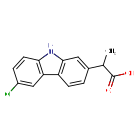
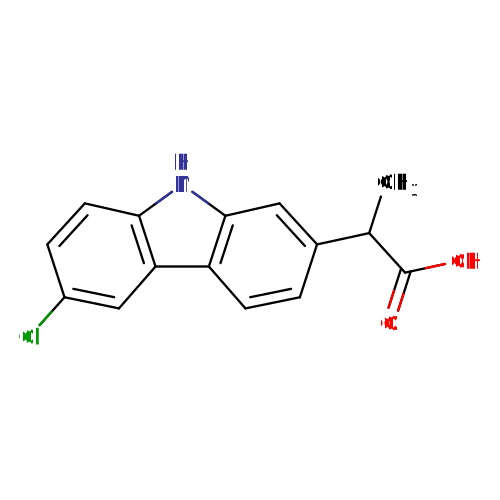
Structure for Carprofen (DB00821)
- Weight
- Average: 273.714
Monoisotopic: 273.05565634 - Chemical Formula
- C15H12ClNO2
- Synonyms
- (+/-)-2-(3-chloro-9H-carbazol-7-yl)propanoic acid
- (±)-6-chloro-α-methylcarbazole-2-acetic acid
- 2-(6-Chloro-9H-carbazol-2-yl)-propionic acid
- 6-chloro-α-methyl-9H-carbazole-2-acetic acid
- Carprofen
- Carprofène
- Carprofeno
- Carprofenum
- External IDs
- C 5720
- C 8012
- Ro 20-5720/000

Pharmacology
- Indication
For use as a pain reliever in the treatment of joint pain and post-surgical pain.
 Reduce drug development failure ratesBuild, train, & validate machine-learning modelswith evidence-based and structured datasets.Build, train, & validate predictive machine-learning models with structured datasets.
- Contraindications & Blackbox Warnings
 Prevent Adverse Drug Events TodayTap into our Clinical API for life-saving information on contraindications & blackbox warnings, population restrictions, harmful risks, & more.Avoid life-threatening adverse drug events with our Clinical API
- Pharmacodynamics
Carprofen is a non-steroidal anti-inflammatory drug (NSAID) of the propionic acid class that includes ibuprofen, naproxen, and ketoprofen. It is no longer used in the clinical setting, but is approved for use in dogs. Carprofen is non-narcotic and has characteristic analgesic and antipyretic activity approximately equipotent to indomethacin in animal models.
- Mechanism of action
The mechanism of action of carprofen, like that of other NSAIDs, is believed to be associated with the inhibition of cyclooxygenase activity. Two unique cyclooxygenases have been described in mammals. The constitutive cyclooxygenase, COX-1, synthesizes prostaglandins necessary for normal gastrointestinal and renal function. The inducible cyclooxygenase, COX-2, generates prostaglandins involved in inflammation. Inhibition of COX-1 is thought to be associated with gastrointestinal and renal toxicity while inhibition of COX-2 provides anti-inflammatory activity. In an in vitro study using canine cell cultures, carprofen demonstrated selective inhibition of COX-2 versus COX-1.
Target Actions Organism AProstaglandin G/H synthase 2 inhibitorHumans UProstaglandin G/H synthase 1 inhibitorHumans - Absorption
Rapidly and nearly completely absorbed (more than 90% bioavailable) when administered orally.
- Volume of distribution
Not Available
- Protein binding
High (99%)
- Metabolism
Hepatic.
- Route of elimination
Not Available
- Half-life
Approximately 8 hours (range 4.5–9.8 hours) in dogs.
- Clearance
Not Available
- Adverse Effects
 Improve decision support & research outcomesWith structured adverse effects data, including: blackbox warnings, adverse reactions, warning & precautions, & incidence rates. View sample adverse effects data in our new Data Library!Improve decision support & research outcomes with our structured adverse effects data.
- Toxicity
Symptoms of NSAID overdose include dizziness and nystagmus. Oral LD50 in mouse and rat is 282 mg/kg and 149 mg/kg, respectively.
- Pathways
Pathway Category Carprofen Action Pathway Drug action - Pharmacogenomic Effects/ADRs
- Not Available
Interactions
- Drug Interactions
- This information should not be interpreted without the help of a healthcare provider. If you believe you are experiencing an interaction, contact a healthcare provider immediately. The absence of an interaction does not necessarily mean no interactions exist.
Drug Interaction Integrate drug-drug
interactions in your softwareAbacavir Carprofen may decrease the excretion rate of Abacavir which could result in a higher serum level. Abciximab The risk or severity of bleeding and hemorrhage can be increased when Carprofen is combined with Abciximab. Acebutolol Carprofen may decrease the antihypertensive activities of Acebutolol. Aceclofenac The risk or severity of adverse effects can be increased when Carprofen is combined with Aceclofenac. Acemetacin The risk or severity of adverse effects can be increased when Carprofen is combined with Acemetacin. - Food Interactions
- Not Available
Products
 Drug product information from 10+ global regionsOur datasets provide approved product information including:dosage, form, labeller, route of administration, and marketing period.Access drug product information from over 10 global regions.
- International/Other Brands
- lmadyl (Roche) / lmafen (Roche) / Rimadyt (Roche)
Categories
- Drug Categories
- Agents causing hyperkalemia
- Agents that produce hypertension
- Analgesics
- Analgesics, Non-Narcotic
- Anti-Inflammatory Agents
- Anti-Inflammatory Agents, Non-Steroidal
- Anti-Inflammatory Agents, Non-Steroidal (Non-Selective)
- Antirheumatic Agents
- Dermatologicals
- Heterocyclic Compounds, Fused-Ring
- Indoles
- Nephrotoxic agents
- OAT1/SLC22A6 inhibitors
- Peripheral Nervous System Agents
- Photosensitizing Agents
- Radiation-Sensitizing Agents
- Selective Cyclooxygenase 2 Inhibitors (NSAIDs)
- Sensory System Agents
- Chemical TaxonomyProvided by Classyfire
- Description
- This compound belongs to the class of organic compounds known as carbazoles. These are compounds containing a three ring system containing a pyrrole ring fused on either side to a benzene ring.
- Kingdom
- Organic compounds
- Super Class
- Organoheterocyclic compounds
- Class
- Indoles and derivatives
- Sub Class
- Carbazoles
- Direct Parent
- Carbazoles
- Alternative Parents
- Indoles / Benzenoids / Aryl chlorides / Pyrroles / Heteroaromatic compounds / Monocarboxylic acids and derivatives / Carboxylic acids / Azacyclic compounds / Organopnictogen compounds / Organonitrogen compounds show 4 more
- Substituents
- Aromatic heteropolycyclic compound / Aryl chloride / Aryl halide / Azacycle / Benzenoid / Carbazole / Carbonyl group / Carboxylic acid / Carboxylic acid derivative / Heteroaromatic compound show 12 more
- Molecular Framework
- Aromatic heteropolycyclic compounds
- External Descriptors
- organochlorine compound, carbazoles (CHEBI:364453)
- Affected organisms
- Humans and other mammals
Chemical Identifiers
- UNII
- FFL0D546HO
- CAS number
- 53716-49-7
- InChI Key
- PUXBGTOOZJQSKH-UHFFFAOYSA-N
- InChI
- InChI=1S/C15H12ClNO2/c1-8(15(18)19)9-2-4-11-12-7-10(16)3-5-13(12)17-14(11)6-9/h2-8,17H,1H3,(H,18,19)
- IUPAC Name
- 2-(6-chloro-9H-carbazol-2-yl)propanoic acid
- SMILES
- CC(C(O)=O)C1=CC2=C(C=C1)C1=C(N2)C=CC(Cl)=C1
References
- Synthesis Reference
Berger, L. and Corraz, A.J.; US. Patent 3,896,145; July 22,1975; assigned to Hoffmann- LaRoche, Inc.
- General References
- Not Available
- External Links
- Human Metabolome Database
- HMDB0014959
- KEGG Compound
- C18364
- PubChem Compound
- 2581
- PubChem Substance
- 46505357
- ChemSpider
- 2483
- BindingDB
- 50097346
- 20343
- ChEBI
- 364453
- ChEMBL
- CHEMBL1316
- Therapeutic Targets Database
- DAP000975
- PharmGKB
- PA164781361
- Wikipedia
- Carprofen
- MSDS
- Download (24.5 KB)
Clinical Trials
Pharmacoeconomics
- Manufacturers
- Hoffmann la roche inc
- Packagers
- Emcure Pharmaceuticals Ltd.
- Norbrook Laboratories Ltd.
- Vericore Ltd.
- Dosage Forms
- Not Available
- Prices
- Not Available
- Patents
- Not Available
Properties
- State
- Solid
- Experimental Properties
Property Value Source melting point (°C) 195-199 Berger, L. and Corraz, A.J.; US. Patent 3,896,145; July 22,1975; assigned to Hoffmann- LaRoche, Inc. water solubility Practically insoluble at 25 °C Not Available logP 3.8 Not Available - Predicted Properties
Property Value Source Water Solubility 0.00379 mg/mL ALOGPS logP 4.09 ALOGPS logP 3.88 Chemaxon logS -4.9 ALOGPS pKa (Strongest Acidic) 4.42 Chemaxon Physiological Charge -1 Chemaxon Hydrogen Acceptor Count 2 Chemaxon Hydrogen Donor Count 2 Chemaxon Polar Surface Area 53.09 Å2 Chemaxon Rotatable Bond Count 2 Chemaxon Refractivity 74.16 m3·mol-1 Chemaxon Polarizability 28.56 Å3 Chemaxon Number of Rings 3 Chemaxon Bioavailability 1 Chemaxon Rule of Five Yes Chemaxon Ghose Filter Yes Chemaxon Veber's Rule No Chemaxon MDDR-like Rule No Chemaxon - Predicted ADMET Features
Property Value Probability Human Intestinal Absorption + 1.0 Blood Brain Barrier + 0.9742 Caco-2 permeable + 0.5595 P-glycoprotein substrate Non-substrate 0.7062 P-glycoprotein inhibitor I Non-inhibitor 0.985 P-glycoprotein inhibitor II Non-inhibitor 0.9319 Renal organic cation transporter Non-inhibitor 0.8485 CYP450 2C9 substrate Non-substrate 0.7405 CYP450 2D6 substrate Non-substrate 0.8318 CYP450 3A4 substrate Non-substrate 0.6389 CYP450 1A2 substrate Inhibitor 0.6573 CYP450 2C9 inhibitor Non-inhibitor 0.7193 CYP450 2D6 inhibitor Non-inhibitor 0.9481 CYP450 2C19 inhibitor Non-inhibitor 0.7037 CYP450 3A4 inhibitor Non-inhibitor 0.8308 CYP450 inhibitory promiscuity Low CYP Inhibitory Promiscuity 0.794 Ames test Non AMES toxic 0.9133 Carcinogenicity Non-carcinogens 0.8521 Biodegradation Not ready biodegradable 0.9874 Rat acute toxicity 3.4155 LD50, mol/kg Not applicable hERG inhibition (predictor I) Weak inhibitor 0.9725 hERG inhibition (predictor II) Non-inhibitor 0.8697
Spectra
- Mass Spec (NIST)
- Not Available
- Spectra
- Chromatographic Properties
Collision Cross Sections (CCS)
Adduct CCS Value (Å2) Source type Source [M-H]- 166.1240471 predictedDarkChem Lite v0.1.0 [M-H]- 163.54425 predictedDeepCCS 1.0 (2019) [M+H]+ 165.9027 predictedDeepCCS 1.0 (2019) [M+Na]+ 171.99585 predictedDeepCCS 1.0 (2019)
Targets

- Kind
- Protein
- Organism
- Humans
- Pharmacological action
- Yes
- Actions
- Inhibitor
- General Function
- Prostaglandin-endoperoxide synthase activity
- Specific Function
- Converts arachidonate to prostaglandin H2 (PGH2), a committed step in prostanoid synthesis. Constitutively expressed in some tissues in physiological conditions, such as the endothelium, kidney and...
- Gene Name
- PTGS2
- Uniprot ID
- P35354
- Uniprot Name
- Prostaglandin G/H synthase 2
- Molecular Weight
- 68995.625 Da
References
- Kay-Mugford P, Benn SJ, LaMarre J, Conlon P: In vitro effects of nonsteroidal anti-inflammatory drugs on cyclooxygenase activity in dogs. Am J Vet Res. 2000 Jul;61(7):802-10. [Article]
- Brideau C, Van Staden C, Chan CC: In vitro effects of cyclooxygenase inhibitors in whole blood of horses, dogs, and cats. Am J Vet Res. 2001 Nov;62(11):1755-60. [Article]
- Wilson JE, Chandrasekharan NV, Westover KD, Eager KB, Simmons DL: Determination of expression of cyclooxygenase-1 and -2 isozymes in canine tissues and their differential sensitivity to nonsteroidal anti-inflammatory drugs. Am J Vet Res. 2004 Jun;65(6):810-8. [Article]
- Beretta C, Garavaglia G, Cavalli M: COX-1 and COX-2 inhibition in horse blood by phenylbutazone, flunixin, carprofen and meloxicam: an in vitro analysis. Pharmacol Res. 2005 Oct;52(4):302-6. [Article]
- Narlawar R, Perez Revuelta BI, Haass C, Steiner H, Schmidt B, Baumann K: Scaffold of the cyclooxygenase-2 (COX-2) inhibitor carprofen provides Alzheimer gamma-secretase modulators. J Med Chem. 2006 Dec 28;49(26):7588-91. [Article]
- Chen X, Ji ZL, Chen YZ: TTD: Therapeutic Target Database. Nucleic Acids Res. 2002 Jan 1;30(1):412-5. [Article]
- Kind
- Protein
- Organism
- Humans
- Pharmacological action
- Unknown
- Actions
- Inhibitor
- General Function
- Prostaglandin-endoperoxide synthase activity
- Specific Function
- Converts arachidonate to prostaglandin H2 (PGH2), a committed step in prostanoid synthesis. Involved in the constitutive production of prostanoids in particular in the stomach and platelets. In gas...
- Gene Name
- PTGS1
- Uniprot ID
- P23219
- Uniprot Name
- Prostaglandin G/H synthase 1
- Molecular Weight
- 68685.82 Da
References
- Beretta C, Garavaglia G, Cavalli M: COX-1 and COX-2 inhibition in horse blood by phenylbutazone, flunixin, carprofen and meloxicam: an in vitro analysis. Pharmacol Res. 2005 Oct;52(4):302-6. [Article]
Transporters
- Kind
- Protein
- Organism
- Humans
- Pharmacological action
- Unknown
- Actions
- Inhibitor
- General Function
- Sodium-independent organic anion transmembrane transporter activity
- Specific Function
- Involved in the renal elimination of endogenous and exogenous organic anions. Functions as organic anion exchanger when the uptake of one molecule of organic anion is coupled with an efflux of one ...
- Gene Name
- SLC22A6
- Uniprot ID
- Q4U2R8
- Uniprot Name
- Solute carrier family 22 member 6
- Molecular Weight
- 61815.78 Da
References
- Kuze K, Graves P, Leahy A, Wilson P, Stuhlmann H, You G: Heterologous expression and functional characterization of a mouse renal organic anion transporter in mammalian cells. J Biol Chem. 1999 Jan 15;274(3):1519-24. [Article]

Drug created at June 13, 2005 13:24 / Updated at February 02, 2024 22:44