Identification
- Summary
Ethynodiol diacetate is an oral contraceptive used to prevent pregnancy.
- Brand Names
- Kelnor 1/35 28 Day, Kelnor 1/50 28 Day, Zovia 1/35e 28 Day, Zovia 1/50e 28 Day
- Generic Name
- Ethynodiol diacetate
- DrugBank Accession Number
- DB00823
- Background
A synthetic progestational hormone used alone or in combination with estrogens as an oral contraceptive. Although etynodiol or ethynodiol are sometimes used as a synonym for ethynodiol diacetate, what is usually being referred to is actually ethynodiol diacetate and not ethynodiol (which is a separate drug that has never been marketed, see Etynodiol).
- Type
- Small Molecule
- Groups
- Approved
- Structure
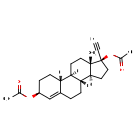
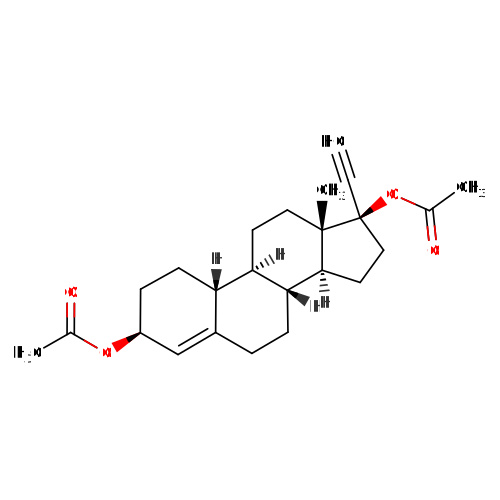
Structure for Ethynodiol diacetate (DB00823)
- Weight
- Average: 384.5085
Monoisotopic: 384.230059512 - Chemical Formula
- C24H32O4
- Synonyms
- 17α-Ethynyl-19-norandrost-4-ene-3β,17-beta-diol diacetate
- 17α-Ethynyl-3,17-dihydroxy-4-estrene diacetate
- 17α-Ethynyl-4-estrene-3β,17β-diol diacetate
- 17α-Ethynylestr-4-ene-3β,17β-diol acetate
- 19-Nor-17α-pregn-4-en-20-yne-3β,17-diol diacetate
- 3β, 17β-Diacetoxy-17α-ethynyl-4-oestrene
- 3β,17β-Diacetoxy-19-nor-17α-pregn-4-en-20-yne
- Ethynodiol diacetate
- Etynodiol acetate
- Etynodiol diacetate
- External IDs
- CB 8080
- SC 11800
- SC-11800

Pharmacology
- Indication
For the prevention of pregnancy in women who elect to use this product as a method of contraception.
 Reduce drug development failure ratesBuild, train, & validate machine-learning modelswith evidence-based and structured datasets.Build, train, & validate predictive machine-learning models with structured datasets.
- Associated Conditions
Indication Type Indication Combined Product Details Approval Level Age Group Patient Characteristics Dose Form Used in combination to manage Abnormal uterine bleeding Combination Product in combination with: Ethinylestradiol (DB00977) ••• ••••• Used in combination to manage Dysmenorrhea Combination Product in combination with: Ethinylestradiol (DB00977) ••• ••••• Used in combination to manage Menorrhagia Combination Product in combination with: Ethinylestradiol (DB00977) ••• ••••• Used in combination to manage Pain Combination Product in combination with: Ethinylestradiol (DB00977) ••• ••••• Used in combination to manage Polycystic ovarian syndrome Combination Product in combination with: Ethinylestradiol (DB00977) ••• ••••• - Associated Therapies
- Contraindications & Blackbox Warnings
 Prevent Adverse Drug Events TodayTap into our Clinical API for life-saving information on contraindications & blackbox warnings, population restrictions, harmful risks, & more.Avoid life-threatening adverse drug events with our Clinical API
- Pharmacodynamics
Ethynodiol Diacetate is used as a female contraceptive. Ethynodiol Diacetate is a progestin or a synthetic form of the naturally occurring female sex hormone, progesterone. In a woman's normal menstrual cycle, an egg matures and is released from the ovaries (ovulation). The ovary then produces progesterone, preventing the release of further eggs and priming the lining of the womb for a possible pregnancy. If pregnancy occurs, progesterone levels in the body remain high, maintaining the womb lining. If pregnancy does not occur, progesterone levels in the body fall, resulting in a menstrual period. Ethynodiol Diacetate tricks the body processes into thinking that ovulation has already occurred, by maintaining high levels of the synthetic progesterone. This prevents the release of eggs from the ovaries.
- Mechanism of action
Binds to the progesterone and estrogen receptors. Target cells include the female reproductive tract, the mammary gland, the hypothalamus, and the pituitary. Once bound to the receptor, progestins like Ethynodiol Diacetate will slow the frequency of release of gonadotropin releasing hormone (GnRH) from the hypothalamus and blunt the pre-ovulatory LH (luteinizing hormone) surge.
Target Actions Organism AProgesterone receptor agonistHumans AEstrogen receptor alpha agonistHumans - Absorption
Not Available
- Volume of distribution
Not Available
- Protein binding
50-85%
- Metabolism
- Not Available
- Route of elimination
Not Available
- Half-life
Not Available
- Clearance
Not Available
- Adverse Effects
 Improve decision support & research outcomesWith structured adverse effects data, including: blackbox warnings, adverse reactions, warning & precautions, & incidence rates. View sample adverse effects data in our new Data Library!Improve decision support & research outcomes with our structured adverse effects data.
- Toxicity
Not Available
- Pathways
- Not Available
- Pharmacogenomic Effects/ADRs
- Not Available
Interactions
- Drug Interactions
- This information should not be interpreted without the help of a healthcare provider. If you believe you are experiencing an interaction, contact a healthcare provider immediately. The absence of an interaction does not necessarily mean no interactions exist.
Drug Interaction Integrate drug-drug
interactions in your softwareAbametapir The serum concentration of Ethynodiol diacetate can be increased when it is combined with Abametapir. Abciximab The risk or severity of adverse effects can be increased when Ethynodiol diacetate is combined with Abciximab. Acarbose The therapeutic efficacy of Acarbose can be decreased when used in combination with Ethynodiol diacetate. Acenocoumarol The risk or severity of adverse effects can be increased when Ethynodiol diacetate is combined with Acenocoumarol. Acetaminophen The metabolism of Ethynodiol diacetate can be increased when combined with Acetaminophen. - Food Interactions
- No interactions found.
Products
 Drug product information from 10+ global regionsOur datasets provide approved product information including:dosage, form, labeller, route of administration, and marketing period.Access drug product information from over 10 global regions.
- Active Moieties
Name Kind UNII CAS InChI Key Etynodiol prodrug 9E01C36A9S 1231-93-2 JYILPERKVHXLNF-QMNUTNMBSA-N - Product Images


- International/Other Brands
- Conova (Searle) / Continuin / Dernulen (Searle) / Femulen (Pfizer ) / Luteonorm / Luto-Metrodiol / Metrodiol
- Mixture Products
Name Ingredients Dosage Route Labeller Marketing Start Marketing End Region Image Demulen 30 (21 Day Pack) Ethynodiol diacetate (2 mg) + Ethinylestradiol (30 mcg) Tablet Oral Pfizer Canada Ulc 1979-12-31 2019-07-04 Canada 
Demulen 30 (28 Day Pack) Ethynodiol diacetate (2 mg) + Ethinylestradiol (30 mcg) Tablet Oral Pfizer Canada Ulc 1979-12-31 2019-07-04 Canada Demulen 50 (21 Day Pack) Ethynodiol diacetate (1 mg) + Ethinylestradiol (50 mcg) Tablet Oral Pfizer Canada Ulc 1970-12-31 2005-04-01 Canada Demulen 50 (28 Day Pack) Ethynodiol diacetate (1 mg) + Ethinylestradiol (50 mcg) Tablet Oral Pfizer Canada Ulc 1970-12-31 2005-04-01 Canada Ethynodiol Diacetate and Ethinyl Estradiol Ethynodiol diacetate (1 mg/1) + Ethinylestradiol (35 ug/1) Kit Oral Mylan Pharmaceuticals Inc. 2017-09-19 Not applicable US 


Categories
- Drug Categories
- Adrenal Cortex Hormones
- Combination Contraceptives (with Estrogen and derivatives)
- Contraceptive Agents, Female
- Contraceptive Agents, Hormonal
- Contraceptives, Oral
- Contraceptives, Oral, Hormonal
- Contraceptives, Oral, Synthetic
- Cytochrome P-450 CYP3A Substrates
- Cytochrome P-450 CYP3A4 Substrates
- Cytochrome P-450 Substrates
- Fused-Ring Compounds
- Genito Urinary System and Sex Hormones
- Hormonal Contraceptives for Systemic Use
- Hyperglycemia-Associated Agents
- Norpregnanes
- Norpregnenes
- Norsteroids
- Progestin Contraceptives
- Progestins
- Reproductive Control Agents
- Sex Hormones and Modulators of the Genital System
- Steroids
- Chemical TaxonomyProvided by Classyfire
- Description
- This compound belongs to the class of organic compounds known as steroid esters. These are compounds containing a steroid moiety which bears a carboxylic acid ester group.
- Kingdom
- Organic compounds
- Super Class
- Lipids and lipid-like molecules
- Class
- Steroids and steroid derivatives
- Sub Class
- Steroid esters
- Direct Parent
- Steroid esters
- Alternative Parents
- Estrane steroids / Delta-4-steroids / Ynones / Dicarboxylic acids and derivatives / Carboxylic acid esters / Acetylides / Organic oxides / Hydrocarbon derivatives
- Substituents
- Acetylide / Aliphatic homopolycyclic compound / Carbonyl group / Carboxylic acid derivative / Carboxylic acid ester / Delta-4-steroid / Dicarboxylic acid or derivatives / Estrane-skeleton / Hydrocarbon derivative / Organic oxide
- Molecular Framework
- Aliphatic homopolycyclic compounds
- External Descriptors
- terminal acetylenic compound, steroid ester (CHEBI:31580) / C21 steroids (gluco/mineralocorticoids, progestogens) and derivatives (C12724) / C21 steroids (gluco/mineralocorticoids, progestogins) and derivatives (LMST02030124)
- Affected organisms
- Humans and other mammals
Chemical Identifiers
- UNII
- 62H10A1236
- CAS number
- 297-76-7
- InChI Key
- ONKUMRGIYFNPJW-KIEAKMPYSA-N
- InChI
- InChI=1S/C24H32O4/c1-5-24(28-16(3)26)13-11-22-21-8-6-17-14-18(27-15(2)25)7-9-19(17)20(21)10-12-23(22,24)4/h1,14,18-22H,6-13H2,2-4H3/t18-,19-,20+,21+,22-,23-,24-/m0/s1
- IUPAC Name
- (1R,3aS,3bR,7S,9aR,9bS,11aS)-7-(acetyloxy)-1-ethynyl-11a-methyl-1H,2H,3H,3aH,3bH,4H,5H,7H,8H,9H,9aH,9bH,10H,11H,11aH-cyclopenta[a]phenanthren-1-yl acetate
- SMILES
- [H][C@@]12CC[C@@](OC(C)=O)(C#C)[C@@]1(C)CC[C@]1([H])[C@@]3([H])CC[C@H](OC(C)=O)C=C3CC[C@@]21[H]
References
- Synthesis Reference
Klimstra, P.D.; U.S. Patent 3,176,013; March 30, 1965; assigned to G.D. Searle & Co.
- General References
- Not Available
- External Links
- Human Metabolome Database
- HMDB0014961
- KEGG Drug
- D01294
- KEGG Compound
- C12724
- PubChem Compound
- 9270
- PubChem Substance
- 46506993
- ChemSpider
- 8913
- BindingDB
- 50237627
- 4170
- ChEBI
- 31580
- ChEMBL
- CHEMBL1200624
- ZINC
- ZINC000003876023
- Therapeutic Targets Database
- DAP000856
- PharmGKB
- PA164749157
- RxList
- RxList Drug Page
- Wikipedia
- Etynodiol_diacetate
Clinical Trials
- Clinical Trials
Phase Status Purpose Conditions Count 1 Completed Basic Science Therapeutic Equivalency 1
Pharmacoeconomics
- Manufacturers
- Not Available
- Packagers
- Barr Pharmaceuticals
- Cardinal Health
- GD Searle LLC
- Innovative Manufacturing and Distribution Services Inc.
- Mckesson Corp.
- Pfizer Inc.
- Pharmaceutical Utilization Management Program VA Inc.
- Physicians Total Care Inc.
- Watson Pharmaceuticals
- Dosage Forms
Form Route Strength Tablet Oral Tablet Oral 0.5 mg Kit Oral Kit; tablet Oral Tablet - Prices
- Not Available
- Patents
- Not Available
Properties
- State
- Solid
- Experimental Properties
Property Value Source melting point (°C) 126-127 Klimstra, P.D.; U.S. Patent 3,176,013; March 30, 1965; assigned to G.D. Searle & Co. logP 5 Not Available - Predicted Properties
Property Value Source Water Solubility 0.00397 mg/mL ALOGPS logP 3.99 ALOGPS logP 3.69 Chemaxon logS -5 ALOGPS pKa (Strongest Basic) -6.7 Chemaxon Physiological Charge 0 Chemaxon Hydrogen Acceptor Count 2 Chemaxon Hydrogen Donor Count 0 Chemaxon Polar Surface Area 52.6 Å2 Chemaxon Rotatable Bond Count 4 Chemaxon Refractivity 106.62 m3·mol-1 Chemaxon Polarizability 44.13 Å3 Chemaxon Number of Rings 4 Chemaxon Bioavailability 1 Chemaxon Rule of Five Yes Chemaxon Ghose Filter Yes Chemaxon Veber's Rule No Chemaxon MDDR-like Rule No Chemaxon - Predicted ADMET Features
Property Value Probability Human Intestinal Absorption + 0.9907 Blood Brain Barrier + 0.9399 Caco-2 permeable + 0.6125 P-glycoprotein substrate Substrate 0.5754 P-glycoprotein inhibitor I Inhibitor 0.8432 P-glycoprotein inhibitor II Inhibitor 0.619 Renal organic cation transporter Non-inhibitor 0.8131 CYP450 2C9 substrate Non-substrate 0.8497 CYP450 2D6 substrate Non-substrate 0.9139 CYP450 3A4 substrate Substrate 0.7647 CYP450 1A2 substrate Non-inhibitor 0.9045 CYP450 2C9 inhibitor Non-inhibitor 0.6524 CYP450 2D6 inhibitor Non-inhibitor 0.9519 CYP450 2C19 inhibitor Non-inhibitor 0.7671 CYP450 3A4 inhibitor Non-inhibitor 0.6564 CYP450 inhibitory promiscuity Low CYP Inhibitory Promiscuity 0.8322 Ames test Non AMES toxic 0.9651 Carcinogenicity Non-carcinogens 0.9119 Biodegradation Not ready biodegradable 0.963 Rat acute toxicity 2.1783 LD50, mol/kg Not applicable hERG inhibition (predictor I) Weak inhibitor 0.9037 hERG inhibition (predictor II) Non-inhibitor 0.8353
Spectra
- Mass Spec (NIST)
- Not Available
- Spectra
Spectrum Spectrum Type Splash Key Predicted GC-MS Spectrum - GC-MS Predicted GC-MS splash10-0100-1194000000-36378317102183460fae Predicted MS/MS Spectrum - 10V, Positive (Annotated) Predicted LC-MS/MS splash10-024l-0039000000-35be505ff53b8230d2d3 Predicted MS/MS Spectrum - 10V, Negative (Annotated) Predicted LC-MS/MS splash10-0089-3019000000-bf25499019cf9315ad71 Predicted MS/MS Spectrum - 20V, Negative (Annotated) Predicted LC-MS/MS splash10-053s-3090000000-36e86216c366cf0c9aec Predicted MS/MS Spectrum - 20V, Positive (Annotated) Predicted LC-MS/MS splash10-0296-6096000000-a35e8a4b5db064f0b493 Predicted MS/MS Spectrum - 40V, Negative (Annotated) Predicted LC-MS/MS splash10-0536-9013000000-5ee6167597f12a295d9a Predicted MS/MS Spectrum - 40V, Positive (Annotated) Predicted LC-MS/MS splash10-0a4u-2954000000-a966d1c9bd183728a4f0 Predicted 1H NMR Spectrum 1D NMR Not Applicable Predicted 13C NMR Spectrum 1D NMR Not Applicable - Chromatographic Properties
Collision Cross Sections (CCS)
Adduct CCS Value (Å2) Source type Source [M-H]- 214.7681871 predictedDarkChem Lite v0.1.0 [M-H]- 214.0796871 predictedDarkChem Lite v0.1.0 [M-H]- 213.5543871 predictedDarkChem Lite v0.1.0 [M-H]- 188.20244 predictedDeepCCS 1.0 (2019) [M+H]+ 215.9969871 predictedDarkChem Lite v0.1.0 [M+H]+ 214.2975871 predictedDarkChem Lite v0.1.0 [M+H]+ 214.7773871 predictedDarkChem Lite v0.1.0 [M+H]+ 190.09787 predictedDeepCCS 1.0 (2019) [M+Na]+ 214.7356871 predictedDarkChem Lite v0.1.0 [M+Na]+ 215.4069871 predictedDarkChem Lite v0.1.0 [M+Na]+ 214.5491871 predictedDarkChem Lite v0.1.0 [M+Na]+ 195.82228 predictedDeepCCS 1.0 (2019)
Targets

- Kind
- Protein
- Organism
- Humans
- Pharmacological action
- Yes
- Actions
- Agonist
- General Function
- Zinc ion binding
- Specific Function
- The steroid hormones and their receptors are involved in the regulation of eukaryotic gene expression and affect cellular proliferation and differentiation in target tissues. Progesterone receptor ...
- Gene Name
- PGR
- Uniprot ID
- P06401
- Uniprot Name
- Progesterone receptor
- Molecular Weight
- 98979.96 Da
References
- Tamaya T, Nioka S, Furuta N, Shimura T, Takano N: Contribution of functional groups of 19-nor-progestogens to binding to progesterone and estradiol-17beta receptors in rabbit uterus. Endocrinology. 1977 Jun;100(6):1579-84. [Article]
- Briggs MH: Contraceptive steroid binding to the human uterine progesterone-receptor. Curr Med Res Opin. 1975;3(2):95-8. [Article]
- Chen X, Ji ZL, Chen YZ: TTD: Therapeutic Target Database. Nucleic Acids Res. 2002 Jan 1;30(1):412-5. [Article]
- Kind
- Protein
- Organism
- Humans
- Pharmacological action
- Yes
- Actions
- Agonist
- General Function
- Zinc ion binding
- Specific Function
- Nuclear hormone receptor. The steroid hormones and their receptors are involved in the regulation of eukaryotic gene expression and affect cellular proliferation and differentiation in target tissu...
- Gene Name
- ESR1
- Uniprot ID
- P03372
- Uniprot Name
- Estrogen receptor
- Molecular Weight
- 66215.45 Da
References
- Overington JP, Al-Lazikani B, Hopkins AL: How many drug targets are there? Nat Rev Drug Discov. 2006 Dec;5(12):993-6. [Article]
- Imming P, Sinning C, Meyer A: Drugs, their targets and the nature and number of drug targets. Nat Rev Drug Discov. 2006 Oct;5(10):821-34. [Article]
- Kappus H, Bolt HM, Remmer H: Affinity of ethynyl-estradiol and mestranol for the uterine estrogen receptor and for the microsomal mixed function oxidase of the liver. J Steroid Biochem. 1973 Mar;4(2):121-8. [Article]
Enzymes
- Kind
- Protein
- Organism
- Humans
- Pharmacological action
- No
- Actions
- Substrate
- General Function
- Vitamin d3 25-hydroxylase activity
- Specific Function
- Cytochromes P450 are a group of heme-thiolate monooxygenases. In liver microsomes, this enzyme is involved in an NADPH-dependent electron transport pathway. It performs a variety of oxidation react...
- Gene Name
- CYP3A4
- Uniprot ID
- P08684
- Uniprot Name
- Cytochrome P450 3A4
- Molecular Weight
- 57342.67 Da
References
- Gene labs [Link]

Drug created at June 13, 2005 13:24 / Updated at February 02, 2024 22:44