Identification
- Summary
Brompheniramine is a histamine H1 antagonist used to treat coughs, upper respiratory symptoms, and nasal congestion associated with allergies and the common cold.
- Brand Names
- Bromfed DM, Lodrane D, M-end PE, Mar-cof BP
- Generic Name
- Brompheniramine
- DrugBank Accession Number
- DB00835
- Background
Histamine H1 antagonist used in treatment of allergies, rhinitis, and urticaria.
- Type
- Small Molecule
- Groups
- Approved
- Structure
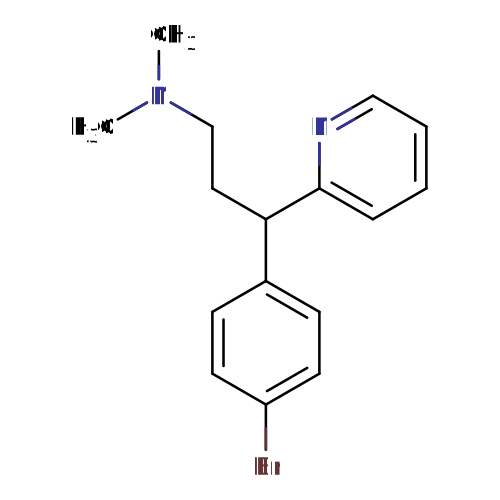
Structure for Brompheniramine (DB00835)
- Weight
- Average: 319.239
Monoisotopic: 318.073161265 - Chemical Formula
- C16H19BrN2
- Synonyms
- [3-(4-Bromo-phenyl)-3-pyridin-2-yl-propyl]-dimethyl-amine
- 1-(p-bromophenyl)-1-(2-pyridyl)-3-dimethylaminopropane
- 2-(p-bromo-α-(2-dimethylaminoethyl)benzyl)pyridine
- 3-(4-bromophenyl)-N,N-dimethyl-3-(2-pyridinyl)-1-propanamine
- 3-(p-bromophenyl)-3-(2-pyridyl)-N,N-dimethylpropylamine
- BPN
- Bromfeniramina
- Brompheniramin
- Bromphéniramine
- Brompheniramine
- Brompheniraminum
- External IDs
- AHR 1843
- D 721

Pharmacology
- Indication
For the treatment of the symptoms of the common cold and allergic rhinitis, such as runny nose, itchy eyes, watery eyes, and sneezing.
 Reduce drug development failure ratesBuild, train, & validate machine-learning modelswith evidence-based and structured datasets.Build, train, & validate predictive machine-learning models with structured datasets.
- Associated Conditions
Indication Type Indication Combined Product Details Approval Level Age Group Patient Characteristics Dose Form Used in combination to treat Acute nasopharyngitis Combination Product in combination with: Phenylephrine (DB00388) •••••••••••• Used in combination for symptomatic treatment of Allergic rhinitis Mixture Product in combination with: Pseudoephedrine (DB00852), Dextromethorphan (DB00514) •••••••••••• Symptomatic treatment of Allergic rhinitis ••• ••• Used in combination to treat Allergic rhinitis Combination Product in combination with: Phenylephrine (DB00388) •••••••••••• Used in combination for symptomatic treatment of Allergies Combination Product in combination with: Acetaminophen (DB00316), Phenylephrine (DB00388) •••••••••••• - Associated Therapies
- Contraindications & Blackbox Warnings
 Prevent Adverse Drug Events TodayTap into our Clinical API for life-saving information on contraindications & blackbox warnings, population restrictions, harmful risks, & more.Avoid life-threatening adverse drug events with our Clinical API
- Pharmacodynamics
Brompheniramine is an antihistaminergic medication of the propylamine class. It is a first-generation antihistamine. In allergic reactions an allergen interacts with and cross-links surface IgE antibodies on mast cells and basophils. Once the mast cell-antibody-antigen complex is formed, a complex series of events occurs that eventually leads to cell-degranulation and the release of histamine (and other chemical mediators) from the mast cell or basophil. Once released, histamine can react with local or widespread tissues through histamine receptors. Histamine, acting on H1-receptors, produces pruritis, vasodilatation, hypotension, flushing, headache, tachycardia, and bronchoconstriction. Histamine also increases vascular permeability and potentiates pain. Brompheniramine is a histamine H1 antagonist (or more correctly, an inverse histamine agonist) of the alkylamine class. It provides effective, temporary relief of sneezing, watery and itchy eyes, and runny nose due to hay fever and other upper respiratory allergies.
- Mechanism of action
Brompheniramine is an antagonist of the H1 histamine receptors with moderate antimuscarinic actions, as with other common antihistamines such as diphenhydramine. Due to its anticholindergic effects, brompheniramine may cause drowsiness, sedation, dry mouth, dry throat, blurred vision, and increased heart rate.
Target Actions Organism AHistamine H1 receptor antagonistHumans UMuscarinic acetylcholine receptor M1 antagonistHumans UMuscarinic acetylcholine receptor M2 antagonistHumans UMuscarinic acetylcholine receptor M3 antagonistHumans UMuscarinic acetylcholine receptor M4 antagonistHumans UMuscarinic acetylcholine receptor M5 antagonistHumans - Absorption
Antihistamines are well absorbed from the gastrointestinal tract after oral administration.
- Volume of distribution
Not Available
- Protein binding
Not Available
- Metabolism
Hepatic (cytochrome P-450 system), some renal.
- Route of elimination
Not Available
- Half-life
Not Available
- Clearance
Not Available
- Adverse Effects
 Improve decision support & research outcomesWith structured adverse effects data, including: blackbox warnings, adverse reactions, warning & precautions, & incidence rates. View sample adverse effects data in our new Data Library!Improve decision support & research outcomes with our structured adverse effects data.
- Toxicity
Oral, rat: LD50 = 318 mg/kg. Signs of overdose include fast or irregular heartbeat, mental or mood changes, tightness in the chest, and unusual tiredness or weakness.
- Pathways
Pathway Category Brompheniramine H1-Antihistamine Action Drug action - Pharmacogenomic Effects/ADRs
- Not Available
Interactions
- Drug Interactions
- This information should not be interpreted without the help of a healthcare provider. If you believe you are experiencing an interaction, contact a healthcare provider immediately. The absence of an interaction does not necessarily mean no interactions exist.
Drug Interaction Integrate drug-drug
interactions in your software1,2-Benzodiazepine The risk or severity of CNS depression can be increased when Brompheniramine is combined with 1,2-Benzodiazepine. Abametapir The serum concentration of Brompheniramine can be increased when it is combined with Abametapir. Abatacept The metabolism of Brompheniramine can be increased when combined with Abatacept. Acetazolamide The risk or severity of CNS depression can be increased when Acetazolamide is combined with Brompheniramine. Acetophenazine The risk or severity of CNS depression can be increased when Brompheniramine is combined with Acetophenazine. - Food Interactions
- Avoid alcohol.
- Take with food.
Products
 Drug product information from 10+ global regionsOur datasets provide approved product information including:dosage, form, labeller, route of administration, and marketing period.Access drug product information from over 10 global regions.
- Product Ingredients
Ingredient UNII CAS InChI Key Brompheniramine maleate IXA7C9ZN03 980-71-2 SRGKFVAASLQVBO-BTJKTKAUSA-N - Product Images

- International/Other Brands
- Bromfed (Wockhardt USA, LLC) / Bromfenex (Ethex Corporation) / Brotane / Dimetane (Wyeth) / Lodrane (ECR Pharmaceuticals)
- Brand Name Prescription Products
Name Dosage Strength Route Labeller Marketing Start Marketing End Region Image Bromax Tablet, extended release 11 mg/1 Oral Poly Pharmaceuticals 2009-12-01 2011-11-30 US 
Brompheniramine Maleate Liquid 1 mg/1mL Oral River's Edge Pharmaceuticals, LLC 2008-06-01 2010-10-31 US - Over the Counter Products
Name Dosage Strength Route Labeller Marketing Start Marketing End Region Image BOMEX TABLET 4 mg Tablet 4.0 mg Oral YUNG SHIN PHARMACEUTICAL (SINGAPORE) PTE LTD 1998-08-12 Not applicable Singapore 
Dimegan Inj 10mg/ml Liquid 10 mg / mL Intramuscular; Subcutaneous Dexo Sa Labs Pharms 1988-12-31 1997-05-30 Canada 
Dimetane Elixir 2mg/5ml Elixir 2 mg / 5 mL Oral Whitehall Robins Inc. 1993-12-31 1997-08-07 Canada Dimetane Tab 4mg Tablet 4 mg / tab Oral Whitehall Robins Inc. 1957-12-31 2000-07-26 Canada J-tan Pd Liquid 1 mg/1mL Oral Jaymac Pharmaceuticals Llc 2007-05-29 2016-08-01 US - Mixture Products
Name Ingredients Dosage Route Labeller Marketing Start Marketing End Region Image 7 Select Cold and Allergy Childrens Brompheniramine maleate (1 mg/5mL) + Phenylephrine hydrochloride (2.5 mg/5mL) Liquid Oral 7 Eleven 2014-08-05 2016-02-19 US Alahist DM Brompheniramine maleate (4 mg/5mL) + Dextromethorphan hydrobromide monohydrate (15 mg/5mL) + Phenylephrine hydrochloride (7.5 mg/5mL) Liquid Oral Poly Pharmaceuticals 2007-12-27 2018-02-01 US Altidec A Brompheniramine maleate (2 mg/5mL) + Phenylephrine hydrochloride (5 mg/5mL) Liquid Oral Alternative Pharmacal Corporation 2015-03-01 2017-01-01 US Altipres-B Brompheniramine maleate (4 mg/5mL) + Dextromethorphan hydrobromide monohydrate (20 mg/5mL) + Phenylephrine hydrochloride (10 mg/5mL) Liquid Oral Alternative Pharmacal Corporation 2012-11-01 Not applicable US AP-Hist DM Brompheniramine maleate (4 mg/1mL) + Dextromethorphan hydrobromide monohydrate (15 mg/1mL) + Phenylephrine hydrochloride (7.5 mg/1mL) Liquid Oral Allegis Pharmaceuticals, LLC 2013-04-15 2018-12-01 US - Unapproved/Other Products
Name Ingredients Dosage Route Labeller Marketing Start Marketing End Region Image BPM Mal Phenyleph HCl DM HBr Brompheniramine maleate (4 mg/5mL) + Dextromethorphan hydrobromide monohydrate (20 mg/5mL) + Phenylephrine hydrochloride (10 mg/5mL) Liquid Oral River's Edge Pharmaceuticals, LLC 2010-01-18 2012-01-31 US Brom Mal Phenyl HCl Dex HBr Brompheniramine maleate (4 mg/5mL) + Dextromethorphan hydrobromide monohydrate (15 mg/5mL) + Phenylephrine hydrochloride (7.5 mg/5mL) Liquid Oral River's Edge Pharmaceuticals, LLC 2010-02-10 2012-02-29 US Bromax Brompheniramine maleate (11 mg/1) Tablet, extended release Oral Poly Pharmaceuticals 2009-12-01 2011-11-30 US Bromdex D Brompheniramine maleate (3 mg/5mL) + Dextromethorphan hydrobromide monohydrate (30 mg/5mL) + Pseudoephedrine hydrochloride (50 mg/5mL) Syrup Oral Breckenridge Pharmaceutical, Inc. 2009-07-21 2011-05-31 US Bromhist PDX Brompheniramine maleate (2 mg/5mL) + Dextromethorphan hydrobromide monohydrate (5 mg/5mL) + Guaifenesin (50 mg/5mL) + Phenylephrine hydrochloride (5 mg/5mL) Syrup Oral Cypress Pharmaceutical, Inc 2006-04-28 2011-08-26 US

Categories
- ATC Codes
- R06AB51 — Brompheniramine, combinations
- R06AB — Substituted alkylamines
- R06A — ANTIHISTAMINES FOR SYSTEMIC USE
- R06 — ANTIHISTAMINES FOR SYSTEMIC USE
- R — RESPIRATORY SYSTEM
- Drug Categories
- Agents producing tachycardia
- Anti-Allergic Agents
- Anticholinergic Agents
- Antihistamines for Systemic Use
- Central Nervous System Depressants
- Cytochrome P-450 CYP2B6 Substrates
- Cytochrome P-450 Substrates
- Histamine Agents
- Histamine Antagonists
- Histamine H1 Antagonists
- Muscarinic Antagonists
- Neurotransmitter Agents
- Potential QTc-Prolonging Agents
- Propylamine Derivatives
- Pyridines
- QTc Prolonging Agents
- Substituted Alkylamines
- Chemical TaxonomyProvided by Classyfire
- Description
- This compound belongs to the class of organic compounds known as pheniramines. These are compounds containing a pheniramine moiety, which is structurally characterized by the presence of a 2-benzylpyridine linked to an dimethyl(propyl)amine to form a dimethyl[3-phenyl-3-(pyridin-2-yl)propyl]amine skeleton.
- Kingdom
- Organic compounds
- Super Class
- Organoheterocyclic compounds
- Class
- Pyridines and derivatives
- Sub Class
- Pheniramines
- Direct Parent
- Pheniramines
- Alternative Parents
- Bromobenzenes / Aralkylamines / Aryl bromides / Heteroaromatic compounds / Trialkylamines / Azacyclic compounds / Organopnictogen compounds / Organobromides / Hydrocarbon derivatives
- Substituents
- Amine / Aralkylamine / Aromatic heteromonocyclic compound / Aryl bromide / Aryl halide / Azacycle / Benzenoid / Bromobenzene / Halobenzene / Heteroaromatic compound
- Molecular Framework
- Aromatic heteromonocyclic compounds
- External Descriptors
- organobromine compound, pyridines (CHEBI:3183)
- Affected organisms
- Humans and other mammals
Chemical Identifiers
- UNII
- H57G17P2FN
- CAS number
- 86-22-6
- InChI Key
- ZDIGNSYAACHWNL-UHFFFAOYSA-N
- InChI
- InChI=1S/C16H19BrN2/c1-19(2)12-10-15(16-5-3-4-11-18-16)13-6-8-14(17)9-7-13/h3-9,11,15H,10,12H2,1-2H3
- IUPAC Name
- [3-(4-bromophenyl)-3-(pyridin-2-yl)propyl]dimethylamine
- SMILES
- CN(C)CCC(C1=CC=C(Br)C=C1)C1=CC=CC=N1
References
- Synthesis Reference
Sperber, N., Papa, D. and Schwenk, E.; US. Patent 2,567,245; September 11, 1951; assigned to Schering Corporation. Sperber, N., Papa, D. and Schwenk, E.; U.S. Patent 2,676,964: April 27,1954; assigned to Schering Corporation.
- General References
- Not Available
- External Links
- Human Metabolome Database
- HMDB0001941
- KEGG Drug
- D07543
- KEGG Compound
- C06857
- PubChem Compound
- 6834
- PubChem Substance
- 46508137
- ChemSpider
- 6573
- BindingDB
- 50017666
- 1767
- ChEBI
- 3183
- ChEMBL
- CHEMBL811
- Therapeutic Targets Database
- DAP001066
- PharmGKB
- PA448675
- Drugs.com
- Drugs.com Drug Page
- Wikipedia
- Brompheniramine
- MSDS
- Download (73.1 KB)
Clinical Trials
- Clinical Trials
Phase Status Purpose Conditions Count 3 Completed Treatment Nasal Congestion and Inflammations / Rhinitis 1 3 Withdrawn Treatment Cough / Inflammation / Rhinitis 1 1 Completed Treatment Allergic Reaction 1
Pharmacoeconomics
- Manufacturers
- Alpharma us pharmaceuticals division
- Kv pharmaceutical co
- Pharmaceutical assoc inc div beach products
- Usl pharma inc
- Watson laboratories inc
- Wyeth ayerst laboratories
- Wyeth consumer healthcare
- Barr laboratories inc
- Ivax pharmaceuticals inc sub teva pharmaceuticals usa
- Newtron pharmaceuticals inc
- Nexgen pharma inc
- Par pharmaceutical inc
- Pioneer pharmaceuticals inc
- Sandoz inc
- Vitarine pharmaceuticals inc
- Packagers
- Anip Acquisition Co.
- Athlon Pharmaceuticals Inc.
- Boca Pharmacal
- Brighton Pharmaceuticals
- C.O. Truxton Inc.
- Clint Pharmaceutical Inc.
- Corvit Pharmaceuticals
- Cypress Pharmaceutical Inc.
- ECR Pharmaceuticals
- Elite Laboratories Inc.
- Great Southern Laboratories
- Irisys Inc.
- Jaymac Pharmaceuticals LLC
- Larken Laboratories Inc.
- Llorens Pharmaceutical
- Lunsco Inc.
- Martica Enterprises Inc.
- Martin Surgical Supply
- MCR American Pharmaceuticals Inc.
- Merit Pharmaceuticals
- Midlothian Labs
- Nexgen Pharma Inc.
- Physicians Total Care Inc.
- Poly Pharmaceuticals Inc.
- Provident Pharmaceuticals LLC
- Quality Care
- Respa Pharmaceuticals Inc.
- River's Edge Pharmaceuticals
- Sovereign Pharmaceuticals Ltd.
- Spectrum Pharmaceuticals
- Vision Pharma LLC
- Wockhardt Ltd.
- Dosage Forms
Form Route Strength Tablet Oral Solution Oral Tablet Oral 4.0 mg Tablet, extended release Oral 11 mg/1 Liquid Oral 1 mg/1mL Liquid Oral Capsule Oral 250.0000 mg Tablet, chewable Oral Kit; liquid Oral Liquid Intramuscular; Subcutaneous 10 mg / mL Elixir Oral 2 mg / 5 mL Tablet Oral 4 mg / tab Elixir; kit; solution Oral Tablet, extended release Oral Gel Pill Capsule Oral Solution / drops Oral Elixir Oral Tablet, coated Oral Syrup Oral Tablet Oral Suspension Oral Capsule Capsule 4 mg Elixir Oral 2 mg/5ml Syrup 2 mg/5mL Tablet, coated Oral 4 mg Syrup Capsule Nasal Syrup Nasal Tablet Oral 2 mg Tablet, sugar coated Oral 4 mg Tablet Tablet Oral 4 mg Tablet, film coated Nasal Tablet, film coated - Prices
Unit description Cost Unit Brompheniramine maleate powder 9.83USD g Brovex ct 12 mg tablet chew 1.58USD tablet Brompheniramine 12 mg tablet chew 1.42USD tablet Bromfenex-pd capsule sa 0.56USD capsule Bromfed-dm cough syrup 0.21USD ml Brom-pseud-dm syrup 0.14USD ml DrugBank does not sell nor buy drugs. Pricing information is supplied for informational purposes only.- Patents
- Not Available
Properties
- State
- Liquid
- Experimental Properties
Property Value Source melting point (°C) < 25 °C PhysProp boiling point (°C) 149.5 °C at 5.00E-01 mm Hg PhysProp water solubility Freely soluble (maleate salt) Not Available logP 3.4 Not Available - Predicted Properties
Property Value Source Water Solubility 0.0127 mg/mL ALOGPS logP 3.63 ALOGPS logP 3.75 Chemaxon logS -4.4 ALOGPS pKa (Strongest Basic) 9.48 Chemaxon Physiological Charge 1 Chemaxon Hydrogen Acceptor Count 2 Chemaxon Hydrogen Donor Count 0 Chemaxon Polar Surface Area 16.13 Å2 Chemaxon Rotatable Bond Count 5 Chemaxon Refractivity 83.67 m3·mol-1 Chemaxon Polarizability 32.08 Å3 Chemaxon Number of Rings 2 Chemaxon Bioavailability 1 Chemaxon Rule of Five Yes Chemaxon Ghose Filter Yes Chemaxon Veber's Rule Yes Chemaxon MDDR-like Rule No Chemaxon - Predicted ADMET Features
Property Value Probability Human Intestinal Absorption + 0.9648 Blood Brain Barrier + 0.9576 Caco-2 permeable + 0.8867 P-glycoprotein substrate Substrate 0.6242 P-glycoprotein inhibitor I Non-inhibitor 0.8782 P-glycoprotein inhibitor II Non-inhibitor 0.93 Renal organic cation transporter Inhibitor 0.7955 CYP450 2C9 substrate Non-substrate 0.8345 CYP450 2D6 substrate Substrate 0.8346 CYP450 3A4 substrate Substrate 0.5898 CYP450 1A2 substrate Non-inhibitor 0.9045 CYP450 2C9 inhibitor Non-inhibitor 0.9071 CYP450 2D6 inhibitor Inhibitor 0.8932 CYP450 2C19 inhibitor Non-inhibitor 0.9025 CYP450 3A4 inhibitor Non-inhibitor 0.8398 CYP450 inhibitory promiscuity Low CYP Inhibitory Promiscuity 0.7748 Ames test Non AMES toxic 0.9351 Carcinogenicity Non-carcinogens 0.9349 Biodegradation Not ready biodegradable 1.0 Rat acute toxicity 3.0758 LD50, mol/kg Not applicable hERG inhibition (predictor I) Weak inhibitor 0.9121 hERG inhibition (predictor II) Inhibitor 0.7207
Spectra
- Mass Spec (NIST)
- Not Available
- Spectra
- Chromatographic Properties
Collision Cross Sections (CCS)
Adduct CCS Value (Å2) Source type Source [M-H]- 170.9806217 predictedDarkChem Lite v0.1.0 [M-H]- 158.57423 predictedDeepCCS 1.0 (2019) [M+H]+ 171.4766217 predictedDarkChem Lite v0.1.0 [M+H]+ 160.93224 predictedDeepCCS 1.0 (2019) [M+Na]+ 171.3445217 predictedDarkChem Lite v0.1.0 [M+Na]+ 167.02538 predictedDeepCCS 1.0 (2019)
Targets

- Kind
- Protein
- Organism
- Humans
- Pharmacological action
- Yes
- Actions
- Antagonist
- General Function
- Histamine receptor activity
- Specific Function
- In peripheral tissues, the H1 subclass of histamine receptors mediates the contraction of smooth muscles, increase in capillary permeability due to contraction of terminal venules, and catecholamin...
- Gene Name
- HRH1
- Uniprot ID
- P35367
- Uniprot Name
- Histamine H1 receptor
- Molecular Weight
- 55783.61 Da
References
- Bokesoy TA, Onaran HO: Atypical Schild plots with histamine H1 receptor agonists and antagonists in the rabbit aorta. Eur J Pharmacol. 1991 May 2;197(1):49-56. [Article]
- Onaran HO, Bokesoy TA: Kinetics of antagonism at histamine-H1 receptors in isolated rabbit arteries. Naunyn Schmiedebergs Arch Pharmacol. 1990 Apr;341(4):316-23. [Article]
- Yanni JM, Stephens DJ, Parnell DW, Spellman JM: Preclinical efficacy of emedastine, a potent, selective histamine H1 antagonist for topical ocular use. J Ocul Pharmacol. 1994 Winter;10(4):665-75. [Article]
- Cusack B, Nelson A, Richelson E: Binding of antidepressants to human brain receptors: focus on newer generation compounds. Psychopharmacology (Berl). 1994 May;114(4):559-65. [Article]
- Yasuda SU, Yasuda RP: Affinities of brompheniramine, chlorpheniramine, and terfenadine at the five human muscarinic cholinergic receptor subtypes. Pharmacotherapy. 1999 Apr;19(4):447-51. [Article]
- Chen X, Ji ZL, Chen YZ: TTD: Therapeutic Target Database. Nucleic Acids Res. 2002 Jan 1;30(1):412-5. [Article]
- Kind
- Protein
- Organism
- Humans
- Pharmacological action
- Unknown
- Actions
- Antagonist
- General Function
- Phosphatidylinositol phospholipase c activity
- Specific Function
- The muscarinic acetylcholine receptor mediates various cellular responses, including inhibition of adenylate cyclase, breakdown of phosphoinositides and modulation of potassium channels through the...
- Gene Name
- CHRM1
- Uniprot ID
- P11229
- Uniprot Name
- Muscarinic acetylcholine receptor M1
- Molecular Weight
- 51420.375 Da
References
- Yasuda SU, Yasuda RP: Affinities of brompheniramine, chlorpheniramine, and terfenadine at the five human muscarinic cholinergic receptor subtypes. Pharmacotherapy. 1999 Apr;19(4):447-51. [Article]
- Kind
- Protein
- Organism
- Humans
- Pharmacological action
- Unknown
- Actions
- Antagonist
- General Function
- G-protein coupled acetylcholine receptor activity
- Specific Function
- The muscarinic acetylcholine receptor mediates various cellular responses, including inhibition of adenylate cyclase, breakdown of phosphoinositides and modulation of potassium channels through the...
- Gene Name
- CHRM2
- Uniprot ID
- P08172
- Uniprot Name
- Muscarinic acetylcholine receptor M2
- Molecular Weight
- 51714.605 Da
References
- Yasuda SU, Yasuda RP: Affinities of brompheniramine, chlorpheniramine, and terfenadine at the five human muscarinic cholinergic receptor subtypes. Pharmacotherapy. 1999 Apr;19(4):447-51. [Article]
- Kind
- Protein
- Organism
- Humans
- Pharmacological action
- Unknown
- Actions
- Antagonist
- General Function
- Receptor activity
- Specific Function
- The muscarinic acetylcholine receptor mediates various cellular responses, including inhibition of adenylate cyclase, breakdown of phosphoinositides and modulation of potassium channels through the...
- Gene Name
- CHRM3
- Uniprot ID
- P20309
- Uniprot Name
- Muscarinic acetylcholine receptor M3
- Molecular Weight
- 66127.445 Da
References
- Yasuda SU, Yasuda RP: Affinities of brompheniramine, chlorpheniramine, and terfenadine at the five human muscarinic cholinergic receptor subtypes. Pharmacotherapy. 1999 Apr;19(4):447-51. [Article]
- Kind
- Protein
- Organism
- Humans
- Pharmacological action
- Unknown
- Actions
- Antagonist
- General Function
- Guanyl-nucleotide exchange factor activity
- Specific Function
- The muscarinic acetylcholine receptor mediates various cellular responses, including inhibition of adenylate cyclase, breakdown of phosphoinositides and modulation of potassium channels through the...
- Gene Name
- CHRM4
- Uniprot ID
- P08173
- Uniprot Name
- Muscarinic acetylcholine receptor M4
- Molecular Weight
- 53048.65 Da
References
- Yasuda SU, Yasuda RP: Affinities of brompheniramine, chlorpheniramine, and terfenadine at the five human muscarinic cholinergic receptor subtypes. Pharmacotherapy. 1999 Apr;19(4):447-51. [Article]
- Kind
- Protein
- Organism
- Humans
- Pharmacological action
- Unknown
- Actions
- Antagonist
- General Function
- Phosphatidylinositol phospholipase c activity
- Specific Function
- The muscarinic acetylcholine receptor mediates various cellular responses, including inhibition of adenylate cyclase, breakdown of phosphoinositides and modulation of potassium channels through the...
- Gene Name
- CHRM5
- Uniprot ID
- P08912
- Uniprot Name
- Muscarinic acetylcholine receptor M5
- Molecular Weight
- 60073.205 Da
References
- Yasuda SU, Yasuda RP: Affinities of brompheniramine, chlorpheniramine, and terfenadine at the five human muscarinic cholinergic receptor subtypes. Pharmacotherapy. 1999 Apr;19(4):447-51. [Article]

Drug created at June 13, 2005 13:24 / Updated at April 26, 2024 00:45